6.7 Power Stroke Oil Type & Capacity: Specs by Year 2011-2026

The 6.7L Powerstroke takes 13 quarts of oil with the filter on 2011 to 2022 F-250, F-350, F-450, and F-550 Super Duty trucks. Starting with the 2023 model year, that jumps to 15 quarts.
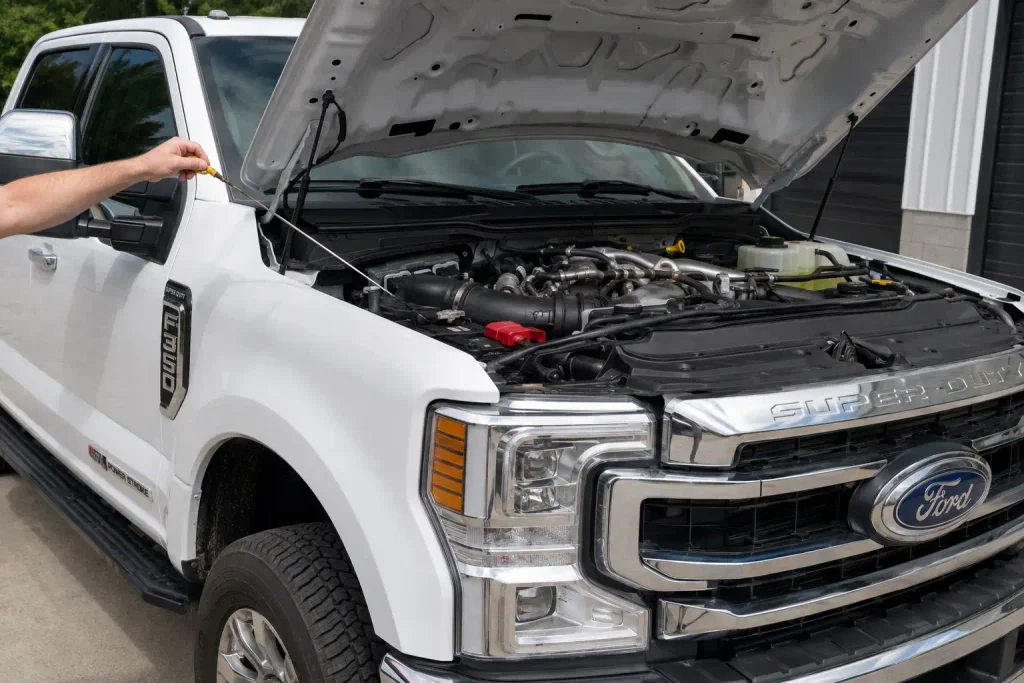
Ford requires oil that meets its WSS-M2C171-F1 specification, with 10W-30 as the default viscosity and 5W-40 or 15W-40 recommended for severe duty and cold climates. Below is the full breakdown by year, chassis class, and filter part number.

Prime for Young Adults — 6 Months Free
Students and 18–24s get six months of Prime free, then half price.
Start 6 Months Free6.7 Powerstroke Oil Capacity and Type at a Glance
2011 to 2026 Ford F-250, F-350, F-450, F-550, F-650, and F-750
Oil Spec By Model Year
Capacity and Filter By Chassis Class
| Years | Chassis Class | Capacity With Filter | Motorcraft Filter |
|---|---|---|---|
| 2011 to 2022 | F-250 to F-550 pickup and chassis cab | 13.0 qt (12.3 L) | FL-2051-S |
| 2023 to 2026 | F-250 to F-550 pickup and chassis cab | 15.0 qt (14.2 L) | FL-2124-S |
| 2015 to 2026 | F-650, F-750 medium duty | ~15 to 17 qt, confirm by VIN | Confirm by VIN |
| Any year | All classes, after full rebuild | 14 to 15 qt dry fill | Match year above |
Recommended Oil By Use Case
Figures include the oil filter. Confirm exact capacity and spec against your VIN and model year owner’s manual before purchasing oil in bulk.
6.7 Powerstroke Oil Capacity By Model Year
Recommended Best Deal Products


Oil capacity for the 6.7L Powerstroke changed once during its production run, tied to a redesigned oil pan Ford introduced for the 2023 model year. Every figure below already includes the oil filter, so do not add extra quarts on top of these numbers.
| Model Year | Chassis Class | Oil Capacity With Filter | Oil Filter Part Number |
|---|---|---|---|
| 2011 to 2022 | F-250, F-350, F-450, F-550 pickup and chassis cab | 13.0 quarts (12.3 liters) | Motorcraft FL-2051-S |
| 2023 to 2026 | F-250, F-350, F-450, F-550 pickup and chassis cab | 15.0 quarts (14.2 liters) | Motorcraft FL-2124-S |
| 2015 to 2022 | F-650, F-750 medium duty | ~15 quarts, confirm by VIN | Confirm by VIN and build sheet |
| 2023 to 2026 | F-650, F-750 medium duty | ~15 to 17 quarts, confirm by VIN | Confirm by VIN and build sheet |
| Any year, after a full rebuild | All chassis classes | 14 to 15 quarts for the initial dry fill | Match filter to model year above |
Medium duty F-650 and F-750 trucks share the 6.7L Powerstroke block with the pickup line, but they run different oil pans and cooling packages depending on the build sheet. If you own an F-650 or F-750, confirm your exact capacity against the specification sheet for your VIN before buying oil in bulk.
The figures above for medium duty trucks are the range reported across current documentation and should be treated as a starting point, not a final number.
Some 2017 model year owner’s manuals shipped with a printing error that listed 15 quarts for a 6.7L engine that actually takes 13 quarts. Ford issued correction inserts for affected manuals, and owners on Ford Truck Enthusiasts confirmed the correct figure and the correction process. If your manual says 15 quarts for a 2017 to 2022 truck, check for a correction sheet or confirm the figure with a dealer parts department before trusting the printed number over the chart above.

Audible — Listen Free for 30 Days
One free credit a month and thousands of titles included.
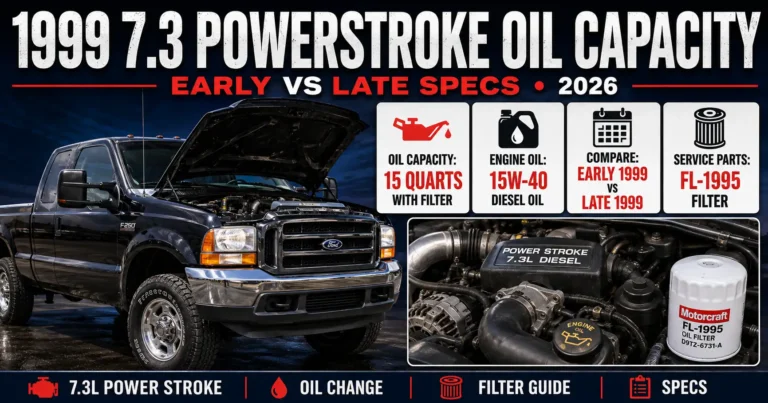
Listen Free for 30 DaysIf you are cross-shopping the older 7.3L Powerstroke against the 6.7L for towing and reliability, see how the two engines compare before deciding which platform fits your use case.
6.7 Powerstroke Oil Type And Specification By Year
Capacity is only half the answer. The engine also needs oil that meets the correct Ford material specification for its model year, and that specification changed twice during the platform’s life.
- 2011 model year: requires oil meeting WSS-M2C171-D
- 2012 to 2016 model years: requires oil meeting WSS-M2C171-E
- 2017 to 2026 model years: requires oil meeting WSS-M2C171-F1
Each generation builds on the API CJ-4 or CK-4 diesel oil baseline, but the Ford-specific spec is what actually matters for warranty compliance and compatibility with the truck’s emissions hardware.
That includes the Diesel Particulate Filter (DPF), which traps soot from the exhaust, the Diesel Oxidation Catalyst (DOC), which converts exhaust gases before they reach the DPF, and the Selective Catalytic Reduction (SCR) system,
which uses Diesel Exhaust Fluid to reduce nitrogen oxide emissions. Oil that does not meet the correct WSS-M2C171 generation can increase soot loading and shorten the service life of these components.
Do not assume a current WSS-M2C171-F1 oil is a safe substitute for an older truck’s original WSS-M2C171-D or WSS-M2C171-E requirement just because it is newer. Match the specification listed in your exact model year’s owner’s manual, or check Ford’s official Capacities and Specifications page for the 6.7L Diesel, since Ford’s own documentation is the authority here, not a generic chart pulled from a single model year.
Recommended Viscosity By Climate And Duty Cycle
Recommended Best Deal Products


Ford’s default recommendation for the 6.7L Powerstroke is Motorcraft SAE 10W-30 Super Duty Diesel Motor Oil, meeting WSS-M2C171-F1, for normal driving in typical conditions. Outside of normal use, Ford lists three specific alternatives:
- Extremely cold climates, at or below negative 22°F: SAE 0W-40, to improve cold start performance
- Biodiesel fuel blends up to B20: SAE 5W-40 full synthetic or SAE 15W-40, both still meeting WSS-M2C171-F1
- Severe duty service: SAE 5W-40 full synthetic
Severe duty covers sustained heavy towing, frequent idling, and stop-and-go driving that keeps the engine from reaching full operating temperature for extended periods. Full synthetic 5W-40 holds up better under that kind of sustained heat than the standard 10W-30, which is why Ford calls it out specifically for towing-heavy use rather than leaving owners to guess.
Audible Premium Plus — Annual Membership
12 audiobook credits up front, plus the full Audible catalogue.
See Annual PlansAlways confirm the exact oil against your specific model year’s owner’s manual before switching, since Ford has adjusted approved alternatives across the platform’s production run.
OEM Oil Filter Part Numbers By Year
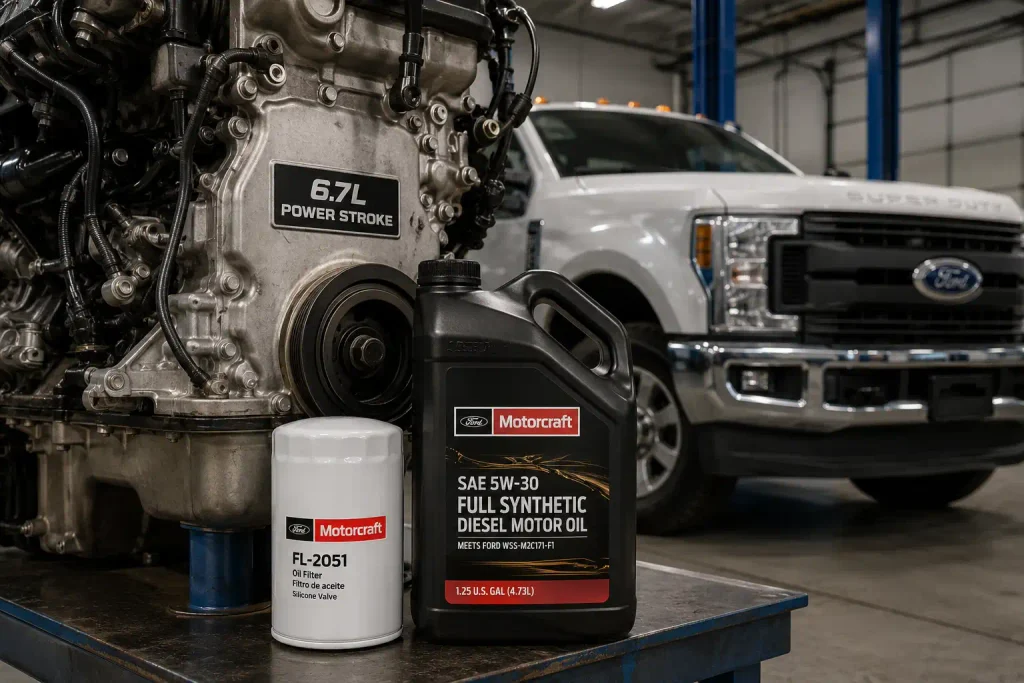
The filter part number changed alongside the 2023 capacity increase, and using the wrong one will not seal correctly against the updated housing on newer trucks.
- 2011 to 2022 pickups and chassis cab: Motorcraft FL-2051-S
- 2023 to 2026 pickups and chassis cab: Motorcraft FL-2124-S
- F-650 and F-750 medium duty: confirm against your build sheet, since medium duty filters can differ from the pickup line even within the same model year
Cross-reference your filter choice against your VIN at a Ford parts counter, or check the Motorcraft FL-2051-S listing on RockAuto to confirm fitment before ordering in bulk, particularly if you are stocking up on filters for multiple oil changes at once.
6.7 Powerstroke Oil Change Interval And Real Cost
Recommended Best Deal Products


Ford recommends changing the oil every 7,500 to 10,000 miles or every 6 to 12 months under normal driving conditions, whichever comes first. That interval shortens under severe duty,
which Ford defines as heavy towing, frequent idling, extreme heat or cold, or repeated short trips that never let the engine reach full operating temperature.
If you tow near your truck’s rated capacity on a regular basis, plan for the shorter end of that interval rather than the longer one. For reference on what your specific Super Duty is rated to tow, check the towing capacity chart for your model year before setting your maintenance schedule around a duty cycle that does not match how you actually drive the truck.
Real owner-reported costs vary by region and whether you supply your own oil:
- DIY oil change: roughly $60 to $180 in parts, depending on oil brand and whether you buy synthetic or a synthetic blend, plus a $10 to $50 filter
- Quick-lube or independent shop: owners report figures in the $100 to $200 range when supplying their own oil and letting the shop handle disposal
- Dealer service: commonly $200 to $400, which typically includes labor, Motorcraft-brand synthetic oil, and proper used oil disposal
Buying oil and filters in bulk when they go on sale, rather than one change at a time, is the most consistent way owners on the Powerstroke diesel forum report cutting their per-change cost over a full ownership cycle.
Which Chassis Class Are You Working On
Before you commit to a capacity and filter from the chart above, confirm which chassis class your truck actually falls into. Ford builds the 6.7L Powerstroke across pickup, chassis cab, and medium duty platforms, and payload, towing, and oil system specifications all shift by class even within the same model year.
Check your driver door jamb sticker or your VIN to confirm whether your truck is a standard pickup, a chassis cab, or a medium duty F-650 or F-750 before ordering parts. This distinction also affects your Gross Vehicle Weight Rating (GVWR),
the maximum total weight your truck can safely carry including passengers and cargo, and your Gross Combined Weight Rating (GCWR), the maximum combined weight of the truck and anything it is towing.
If you are also verifying how much your specific configuration can carry, see the payload capacity chart for the F-350 to confirm your truck’s exact rating before loading up for a trip.
Frequently Asked Questions
How many quarts of oil does a 6.7 Powerstroke take?
13 quarts with the filter on 2011 to 2022 F-250 through F-550 trucks, and 15 quarts with the filter on 2023 and newer trucks. Medium duty F-650 and F-750 trucks may require more, so confirm against your build sheet.
What oil does Ford recommend for the 6.7 Powerstroke?
Oil meeting Ford’s WSS-M2C171 specification, with the exact generation depending on your model year. Current trucks require WSS-M2C171-F1, while 2012 to 2016 trucks require WSS-M2C171-E and 2011 trucks require WSS-M2C171-D.
Can I use 15W-40 in my 6.7 Powerstroke?
Yes, if you run biodiesel blends up to B20. Ford lists SAE 15W-40 as an approved alternative for biodiesel use, while 10W-30 remains the default for normal driving and 5W-40 full synthetic is Ford’s pick for severe duty towing and extremely cold starts.
How often should I change 6.7 Powerstroke oil?
Every 7,500 to 10,000 miles or 6 to 12 months under normal conditions. Heavy towing, frequent idling, or extreme temperatures call for shorter intervals.