5.7 Hemi Engine Specs: The Definitive Guide (2003-2026)

The 5.7-liter V8, or 345 cubic-inch Hemi, is arguably the most important engine of the 21st century for Chrysler, Dodge, Ram, and Jeep. First introduced in the 2003 Dodge Ram 1500 , this engine resurrected the legendary “Hemi” name and became the brand’s workhorse. For over two decades, it has powered millions of vehicles, from heavy-duty Ram 2500 trucks and Dodge Durangos to iconic muscle cars like the Dodge Charger R/T and Challenger R/T.
The engine’s story is not just one of engineering, but of market emotion and brand identity. In 2024, Stellantis (Ram’s parent company) announced the 5.7L Hemi would be discontinued for the 2025 model year Ram 1500, replaced by the new, more powerful 3.0L twin-turbo “Hurricane” inline-six.
This decision highlights the Hemi’s true legacy. Despite the new Hurricane engine being objectively more powerful (540 hp vs. 395 hp) and more fuel-efficient , the market reaction against the loss of the V8 was so immediate and negative that it forced a corporate reversal. In a stunning admission, Ram CEO Tim Kuniskis stated, “Ram screwed up… we own it and we fixed it”. Citing “consumer sentiment” , Ram is bringing the 5.7L Hemi back for the 2026 model year.
The market had spoken: the Hemi’s value is more than its spec sheet. It’s about the proven 20-year reliability, the simple pushrod design, and the unmistakable V8 sound.
This guide serves as the definitive technical reference for the 5.7L Hemi. We will cover the detailed specifications of its two major generations, its critical service data, its infamous “Hemi tick,” and how it stacks up against the competition.
The 5.7L Hemi V8: A Deep Dive
An infographic on the specs, evolution, and performance of an American icon.
What is the 5.7L Hemi?
First introduced in 2003, the 5.7L Hemi V8 (also known as the 345 Hemi) is a legendary engine from Chrysler, now Stellantis. It marked the return of the “Hemi” hemispherical combustion chamber design, balancing iconic V8 power with modern technology. It has been the standard V8 in countless Dodge, Ram, and Chrysler vehicles, from muscle cars to heavy-duty trucks.
At a Glance
Core Architecture
The engine’s foundation consists of a 90-degree V8 design with a pushrod valvetrain (2 valves per cylinder).
| Bore | 3.92 in (99.5 mm) |
| Stroke | 3.58 in (90.9 mm) |
| Block Material | Cast Iron (Trucks) / Aluminum (Cars) |
| Head Material | Aluminum Alloy |
| Compression | 9.6:1 to 10.5:1 (Varies by year/model) |
The Evolution of Power in Ram Trucks
The 5.7L Hemi was not static; it evolved significantly. The most notable update came in 2009 with the “Eagle” revision, which introduced Variable Valve Timing (VVT) and an improved Multi-Displacement System (MDS). This, along with other tweaks, dramatically boosted output, especially in the flagship Ram trucks.
Ram 1500 Horsepower Trend
The introduction of VVT in 2009 provided a major jump in horsepower, with further refinements in 2013.
Ram 1500 Torque Trend
Torque saw a similar and significant increase, improving the truck’s towing and hauling capabilities.
Truck vs. Car: One Engine, Different Tunes
The same 5.7L Hemi is tuned differently depending on the vehicle. Truck applications (like the Ram 1500) are typically optimized for low-end torque for towing, while car applications (like the Dodge Challenger and Charger) are tuned for a balance of torque and high-RPM horsepower.
Key Technologies Explained
Two key pieces of technology define the modern 5.7L Hemi: The Multi-Displacement System (MDS) for fuel economy and Variable Valve Timing (VVT) for an optimized powerband.
Multi-Displacement System (MDS)
MDS improves fuel economy by deactivating four of the eight cylinders during light-load conditions, such as highway cruising.
Variable Valve Timing (VVT)
VVT (introduced in 2009) advances or retards the camshaft timing to optimize performance across the entire RPM range.
maximize low-end torque.
maximize high-end horsepower.
Real-World Performance & Ownership
Beyond the numbers, the 5.7L Hemi is known for its real-world capability and, like any complex engine, has common issues owners should be aware of.
Ram 1500 Towing
When properly equipped, the 5.7L Hemi gives the Ram 1500 formidable towing power.
Common Issues
While generally reliable, two of the most frequently discussed problems include:
- “Hemi Tick”: A ticking noise often traced to failed hydraulic lifters and/or worn camshaft lobes, especially on pre-Eagle engines or those with extended oil change intervals.
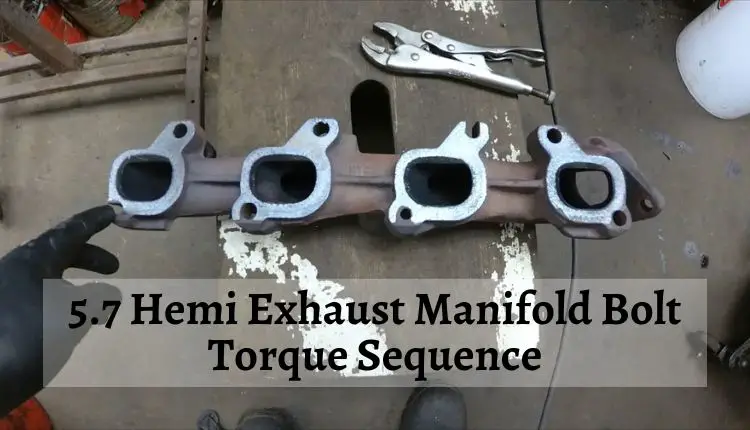
- Exhaust Manifold Bolts: The bolts securing the exhaust manifold to the block can break, causing an exhaust leak (which can also sound like a tick when cold).
Conclusion & Further Reading
The 5.7L Hemi remains a benchmark for American V8 performance, blending classic pushrod architecture with modern efficiency-improving tech. Its longevity and widespread use are a testament to its successful design.
5.7 Hemi Specs: A Tale of Two Engines (2003-2008 vs. 2009+ “Eagle”)
The Gen III 5.7L Hemi’s 20-year production is split into two distinct versions: the original 2003-2008 non-VVT engine and the updated 2009+ “Eagle” VVT engine.
The Original Workhorse: 2003-2008 5.7L Hemi (Non-VVT)
Launched in the 2003 Dodge Ram, this engine was a modern 2-valve-per-cylinder, pushrod V8 built on a deep-skirt cast-iron block with aluminum alloy heads. It brought the Hemi name back with 345 horsepower in Ram trucks. Passenger cars like the Chrysler 300C, Dodge Magnum R/T, and Dodge Charger R/T received this engine starting in 2005, which featured the Multi-Displacement System (MDS) to improve fuel economy.
2003-2008 5.7L Hemi Specifications (Non-VVT)
The “Eagle” Arrives: 2009-Present 5.7L Hemi (VVT)
In 2009, the 5.7L Hemi received a significant update, earning the “Eagle” designation. This was far more than a simple tune. The power jump to 395 horsepower in trucks was not the result of a displacement change—the bore and stroke remained identical —but from a series of sophisticated airflow and efficiency improvements.
The “biggest change” was the addition of Variable Cam Timing (VCT), also known as VVT. This technology allows the engine’s computer to advance or retard the camshaft timing while the engine is running. This change, combined with an increased 10.5:1 compression ratio and all-new “Eagle” cylinder heads with improved intake and exhaust port airflow, resulted in a “broad flat torque curve”. This new torque profile was ideal for truck applications while also providing a significant bump in peak horsepower. This new engine also featured an updated Multi-Displacement System (MDS).
2009+ 5.7L “Eagle” Hemi Specifications (VVT)
| Specification | Details |
| Displacement | 5,654 cc (345 cu in) |
| Bore | 3.92 in (99.5 mm) |
| Stroke | 3.58 in (90.9 mm) |
| Block Material | Cast Iron (Revised casting) |
| Head Material | Aluminum Alloy (Improved “Eagle” heads) |
| Compression Ratio | 10.5:1 |
| Horsepower (Trucks) | 395 hp @ 5600 rpm |
| Torque (Trucks) | 410 lb-ft @ 3950 rpm |
| Horsepower (Cars) | 375 hp @ 5150 rpm (e.g., Challenger R/T) |
| Torque (Cars) | 410 lb-ft @ 4300 rpm |
| Technology | Variable Cam Timing (VVT) + MDS |
| Fuel Requirement | 89 Octane Mid-Grade (Recommended) |
Core Engine Data & Service Specifications (For Owners)
This section provides the quick, essential data every 5.7 Hemi owner needs for service and diagnosis.
5.7 Hemi Firing Order & Cylinder Layout
A frequent point of confusion for DIY mechanics diagnosing a misfire, the cylinder layout is simple. The firing order is consistent across all Gen III Hemi engines, including the 5.7L, 6.1L, and 6.4L.
- Firing Order: 1-8-4-3-6-5-7-2
- Cylinder Layout:
- Left (Driver) Bank: 1, 3, 5, 7 (from front of engine to back)
- Right (Passenger) Bank: 2, 4, 6, 8 (from front of engine to back)
5.7 Hemi Oil Capacity & Type
This is the single most critical maintenance item for Hemi longevity.
- Oil Capacity: 7.0 quarts (6.6L) with oil filter change.
- Oil Type: SAE 5W-20 Full Synthetic Oil.
- Required Specification: Must meet the FCA MS-6395 specification.
Using the correct 5W-20 viscosity is non-negotiable. This is not just for fuel economy; the 5.7L Hemi uses engine oil as hydraulic fluid to operate two complex systems: the VVT phasers and the MDS lifters. Using a thicker oil (like 5W-30) can slow the response of these systems and impede oil flow into the lifters’ small passages, especially at idle. Sticking to a manufacturer-specified, MS-6395 certified 5W-20 synthetic, such as those from Pennzoil or Mopar, is the single best preventative measure against premature engine wear.
The 5.7 Hemi’s Biggest Problem: Understanding the “Hemi Tick”
No discussion of the 5.7 Hemi is complete without addressing its most notorious issue: the “Hemi tick.” This umbrella term covers several distinct noises, ranging from perfectly normal to catastrophic.
Benign Ticks (Normal Noises)
- Fuel Injector Tick: This is a light, fast, steady “click-click-click” that is audible at all temperatures, especially at idle. This is the normal sound of the fuel injectors’ electric solenoids firing. It is 100% normal.
- Cold-Start Rattle: This is a 2-3 second rattle or tick that occurs only on a cold start and goes away immediately. This is normal hydraulic lifter “bleed-down” as the oil pump fills the lifters with oil.
Serious Ticks (Causes for Concern)
- Exhaust Manifold Leak (The “Cold Tick”):
- Symptom: A loud, distinct ticking noise that is clearly audible when the engine is cold but fades away or disappears entirely as the engine warms up.
- Cause: This is almost always caused by broken or warped exhaust manifold bolts. The Hemi’s cast-iron exhaust manifold and aluminum cylinder head expand at different rates. Over many heat cycles, this snaps the bolts. The “tick” is the sound of exhaust gas escaping through the small gap, which seals itself once the metals expand from heat. This is a very common issue but is not catastrophic.
- Lifter/Camshaft Failure (The “Hot Tick”):
- Symptom: A persistent, often random “tick” or “ping” that is only present, or is worst, at idle after the engine is fully warmed up.
- Cause: This is the true “Hemi tick” and signals a catastrophic failure in progress. The noise is caused by a failing roller lifter. The needle bearings inside the lifter fail, causing the roller to seize and “skid” on the camshaft lobe, grinding it flat. This requires immediate attention.
Hemi Tick” Diagnostic Guide
| Noise | When It Happens | Seriousness |
| Light, fast clicking | All the time, steady rhythm | Normal (Fuel Injectors) |
| 2-3 second rattle | Cold start only | Normal (Lifter Bleed-down) |
| Loud tick | Loud when cold, fades when hot | Problem (Exhaust Manifold Leak) |
| Persistent tick/ping | Only at hot idle | Catastrophic (Lifter/Cam Failure) |
Deep Dive: 5.7 Hemi Lifter Failure & MDS Explained
The catastrophic “hot tick” is the 5.7L Hemi’s Achilles’ heel, primarily affecting the 2009+ “Eagle” engines. Understanding why it happens is key to prevention.
What is the 5.7 Hemi MDS System?
The Multi-Displacement System (MDS) is Chrysler’s cylinder deactivation technology, designed to improve fuel economy. Under light-load cruising, the engine’s computer deactivates four cylinders (typically 1, 4, 6, and 7) by sending an oil pressure signal to special hydraulic lifters. This signal causes the lifters to “collapse,” preventing them from opening the valves. This allows the engine to effectively run on four cylinders.
The Fatal Flaw: Oiling Path, Not MDS Itself
The internet is full of theories that incorrectly blame the act of MDS switching for lifter failure. The true culprit, however, is a design flaw in the engine’s oiling path, which starves the lifters of lubrication at idle—a time when MDS is not even active.
Here is the step-by-step failure process:
- The Flaw: The Gen III Hemi oils its lifters in a unique, “backwards” path. Crucially, the MDS lifters only receive pressurized oil flow to their internal bearings when the MDS solenoids open to deactivate the cylinder.
- The Problem: At idle, MDS is off. This means the solenoids are closed. This design stops all pressurized oil flow to the body of the lifters.
- The Result: The lifters are forced to survive on “splash” lubrication from the crankshaft, which is described as “very minimal” to “near zero”.
- The Failure: This prolonged oil starvation, especially during long idle times (when the oil gets hot and thin), causes the lifter’s internal needle bearings to fail. The roller seizes, stops spinning, and “skids” on the camshaft lobe, grinding it away.
Symptoms and Prevention
The “hot idle tick” is the first and only warning. If ignored, it will eventually lead to a misfire (especially on an MDS cylinder like 1, 4, 6, or 7) and throw a P0300 (Random Misfire) code or a cylinder-specific code. By the time a misfire code is present, the camshaft is almost certainly damaged.
Prevention:
- Oil is Everything: Strict adherence to 7,000-mile (or less) oil changes with the correct 5W-20 Full Synthetic (MS-6395) is critical.
- Avoid Excessive Idling: This is the #1 lifestyle change. Long periods of idling are the primary cause of the oil starvation that kills the lifters.
- The “Mechanic’s Fix”: Many independent shops recommend proactively installing a higher-volume oil pump, such as the one from the 6.2L Hellcat, to force more oil to the lifters at idle.
5.7 Hemi vs. The Competition (Comparative Analysis)
The 5.7L Hemi’s specs are best understood in context, both against its internal Mopar siblings and its “Big 3” truck rivals.
Internal Battle: 5.7L Hemi vs. 6.4L “392” Hemi
This is the common “R/T vs. Scat Pack” or “Ram 1500 vs. 2500” question. The 6.4L (392 cu in) Hemi is not just a bored-out 5.7L. It is a high-performance SRT engine introduced in 2011 to replace the 6.1L Hemi It has a different, larger bore and a longer stroke , and was designed for high-RPM horsepower, not low-end truck torque.
The 5.7L is a workhorse, built for towing and daily driving with a torque curve to match. The 6.4L is a racehorse. In fact, many in the aftermarket community find the 5.7L’s internals handle forced induction (superchargers) better on a stock block than the high-compression 6.4L.
Eagle” Hemi vs. 6.4L “392” Hemi (SRT Spec)
| Engine | 5.7L “Eagle” Hemi (Car) | 6.4L “392” Hemi (Car) |
| Displacement | 5.7L (345 cu in) | 6.4L (392 cu in) |
| Bore | 3.92 in | 4.09 in |
| Stroke | 3.58 in | 3.72 in |
| Compression | 10.5:1 | 10.9:1 (approx) |
| Horsepower | 375 hp @ 5150 rpm | 485 hp @ 6100 rpm |
| Torque | 410 lb-ft @ 4300 rpm | 475 lb-ft @ 4200 rpm |
| Key Feature | VVT, MDS (Excellent daily) | VVT, MDS (High-performance) |
| Fuel | 89 Octane | 91+ Octane (Required) |
Truck Engine Showdown: Ram 5.7L vs. Ford 5.0L vs. Chevy 5.3L
For a fair comparison, we’ll use 2021 model year specs for the “Big 3” V8 workhorses. The data reveals the 5.7 Hemi’s “sweet spot” in the market.
The Hemi is not the “best” in any single metric, but it hits a perfect balance. The Ford 5.0L “Coyote” V8 matches the Hemi on horsepower (400 hp) and torque (410 lb-ft). The Chevy 5.3L V8 lags significantly behind both (355 hp / 383 lb-ft).
However, Ford’s most popular EcoBoost 3.5L V6 beats all of them in torque (500 lb-ft) and towing (14,000 lbs). The Hemi’s true selling point is its “average” greatness: it delivers significantly more power than the Chevy 5.3L, boasts the proven V8 reliability and sound that the turbocharged V6 EcoBoost cannot claim, and has a lower cost and complexity than Ford’s DOHC 5.0L V8.
2021 V8 Truck Engine Comparison
| Engine | Ram 5.7L Hemi | Ford 5.0L “Coyote” V8 | Chevy 5.3L EcoTec3 V8 |
| Horsepower | 395 hp | 400 hp | 355 hp |
| Torque | 410 lb-ft | 410 lb-ft | 383 lb-ft |
| Max Towing | ~11,610 – 12,750 lbs (eTorque) | ~13,000 lbs | ~11,500 lbs |
| Technology | Pushrod (OHV), VVT, MDS | DOHC, Ti-VCT | Pushrod (OHV), DFM |
5.7 Hemi Towing Capacity by Year (Ram 1500)
It is critical to note that towing capacity is determined by the entire vehicle—including its frame, axles, gearing, and cooling—not just the engine. However, the 5.7L Hemi has consistently been the powertrain at the top of the Ram 1500’s towing charts.
Towing capacity saw a significant jump with the 5th-generation Ram 1500 (2019+). The introduction of the “eTorque” mild-hybrid system, which assists the engine at launch, allowed Ram 1500 models so equipped to achieve the maximum rating of 12,750 lbs.
Ram 1500 5.7L Hemi Max Towing Capacity by Year
| Model Year | 5.7L Hemi (Max Towing) | 5.7L Hemi eTorque (Max Towing) |
| 2017 | 10,650 lbs | N/A |
| 2018 | 10,620 lbs | N/A |
| 2019 | 11,610 lbs | 12,750 lbs |
| 2020-2021 | 11,610 lbs | 12,750 lbs |
Conclusion: The Hemi’s Enduring Legacy
The 5.7L Hemi’s 20-plus-year journey cements its status as a true American icon. It served as the perfect bridge between classic pushrod V8 simplicity and modern technologies like Variable Cam Timing and cylinder deactivation.
While it has well-documented and preventable flaws—namely the lifter/camshaft issue on 2009+ models—its overall longevity is proven. It is widely considered a reliable engine capable of lasting well over 200,000 miles when properly maintained. That maintenance is simple: strict adherence to 5W-20 (MS-6395) synthetic oil changes and avoiding excessive idle time.
Its announced return for 2026, after being replaced by a more advanced engine, is the ultimate testament to its legacy. The 5.7L Hemi is not just a piece of engineering; it is the engine the market demanded back.
Frequently Asked Questions (FAQ)
Q: What is the horsepower and torque of a 5.7 Hemi?
A: It varies by year and application. The original 2003-2008 truck engines make 345 hp and 375 lb-ft of torque. The updated 2009-present “Eagle” Hemi in a Ram 1500 is rated at 395 hp and 410 lb-ft of torque.
Q: What is the “Hemi tick” and should I be worried?
A: “Hemi tick” can be normal injector noise or a minor exhaust manifold leak (a tick that is loud when cold and goes away when hot). However, a persistent tick that only appears or gets worse at hot idle is a sign of serious lifter and camshaft failure, which requires immediate mechanical attention.
Q: What is the difference between the 5.7 Hemi and the 6.4 Hemi?
A: They are different engines. The 5.7L (345 cu in) is a workhorse engine designed for trucks and daily drivers (up to 395 hp). The 6.4L (392 cu in) is a high-performance SRT engine (485 hp) with a larger bore, longer stroke, and stronger internals, designed for high-RPM speed.
Q: What is the best oil for a 5.7 Hemi?
A: The manufacturer requires 7 quarts of SAE 5W-20 full synthetic oil that meets the FCA MS-6395 specification.18 Using this specific oil is critical for protecting the hydraulic VVT and MDS lifter systems.
Q: Is the 5.7 Hemi a reliable engine?
A: Yes, when properly maintained, the 5.7 Hemi is widely considered a reliable and durable engine capable of lasting over 200,000 miles.7 Its main weakness is the 2009+ lifter/camshaft issue, which can be largely prevented with regular, high-quality 5W-20 oil changes and avoiding long idle times.
Q: What is 5.7 Hemi MDS lifter failure?
A: This is a failure on 2009+ “Eagle” engines where the hydraulic roller lifters fail due to a design that starves them of pressurized oil at idle. This causes the lifter roller to seize and destroy the camshaft lobe, leading to a “hot idle tick” and eventually a P0300 misfire code.