5.7 HEMI Engine Specs Chart by Year: HP, Torque & Oil Capacity (2003–2026)

The 5.7 HEMI is a 5,654 cc (345-cu-in) naturally aspirated V8 that has powered Ram trucks, Dodge muscle cars, Chrysler sedans and Jeep SUVs since 2003. Depending on the model year and vehicle, factory output ranges from about 340 horsepower in early passenger-car applications to 395 horsepower in modern Ram 1500 trucks.
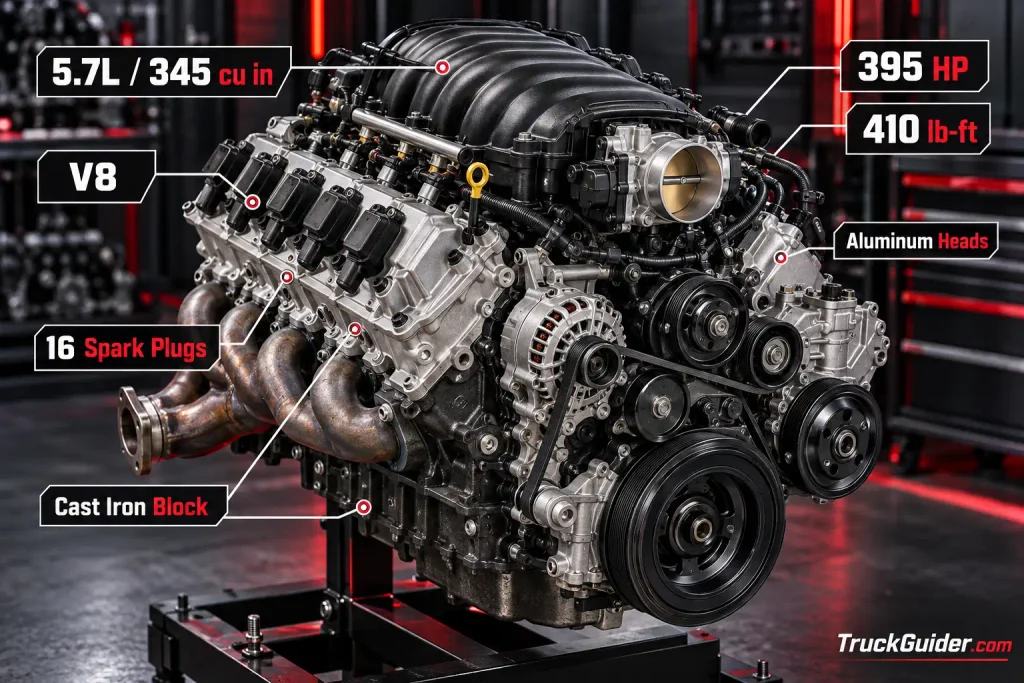
5.7 HEMI engine specs 345 cubic inch V8 395 hp 410 lb-ft.For the 2026 Ram 1500, the 5.7L HEMI V8 with eTorque produces 395 horsepower and 410 lb-ft of torque. Ram lists a maximum towing capacity of 11,320 pounds when properly configured.



The engine itself has kept the same basic 5.7-liter displacement throughout its production life, but major updates—including new cylinder heads, Variable Valve Timing (VVT), Multi-Displacement System (MDS) and eTorque—changed its performance and efficiency significantly.
5.7L HEMI Engine Specs
A quick visual guide to the 345-cu-in Gen III HEMI, including horsepower, torque, major generations, oil specifications, firing order and the returning 2026 Ram 1500 HEMI.
5.7 HEMI Core Specifications
Original vs. Eagle 5.7 HEMI
Original Gen III HEMI
Eagle 5.7 HEMI
5.7 HEMI Evolution
Introduced in Dodge Ram trucks with 345 hp and 375 lb-ft.
VVT, revised heads and higher compression increase output substantially.
The familiar 395-hp and 410-lb-ft Ram 1500 specification becomes established.
48-volt mild-hybrid assistance arrives in fifth-generation Ram 1500 applications.
The 5.7 HEMI is absent from the new Ram 1500 lineup.
The 5.7L HEMI eTorque returns to the Ram 1500.
Ram 1500 5.7 HEMI eTorque
5.7 HEMI Oil Quick Guide
5.7 HEMI Firing Order & Cylinder Layout
OF
ENGINE
Common 5.7 HEMI Issues to Watch
Exhaust Manifold Leaks
Broken bolts or manifold leaks can cause a ticking sound, especially during cold starts.
Lifter & Cam Wear
Persistent valvetrain noise, misfires or rough running can justify further mechanical inspection.
Oil Specification
VVT and MDS depend on proper lubrication, making the correct model-year oil specification important.
5.7 HEMI Specs at a Glance
| Specification | 5.7 HEMI |
|---|---|
| Engine Family | Chrysler Gen III HEMI |
| Configuration | 90-degree V8 |
| Displacement | 5,654 cc / 345 cu in |
| Bore | 3.917 in / 99.5 mm |
| Stroke | 3.578 in / 90.9 mm |
| Block Material | Cast iron |
| Cylinder Heads | Aluminum alloy |
| Valvetrain | OHV pushrod, 2 valves per cylinder |
| Total Valves | 16 |
| Spark Plugs | 16 — two per cylinder |
| Compression Ratio | Approx. 9.6:1 early / 10.5:1 Eagle |
| Fuel System | Sequential multi-port fuel injection |
| Firing Order | 1-8-4-3-6-5-7-2 |
| Ram 1500 Peak Output | Up to 395 hp |
| Ram 1500 Peak Torque | Up to 410 lb-ft |
| Ram 1500 Oil Capacity | 7 qt / 6.6 L with filter |
| Recommended Fuel, Recent Ram Applications | 89 octane recommended; 87 acceptable |
| VVT | 2009+ Eagle engines |
| Cylinder Deactivation | MDS on applicable versions |
| eTorque | Available on modern Ram 1500 applications |
Important: Exact horsepower, oil viscosity, transmission, MDS configuration and service specifications vary by model year and vehicle. Always verify the owner’s manual for the specific VIN or application before servicing the engine.
5.7 HEMI Horsepower and Torque by Year
There is no single horsepower figure that applies to every 5.7 HEMI. Chrysler used different calibrations in Ram trucks, Dodge performance cars and Jeep/Chrysler SUVs.
For truck owners, this is the most useful overview of the Ram 1500 5.7 HEMI horsepower by year.
| Model Years | Ram 1500 Horsepower | Torque | Major Change |
|---|---|---|---|
| 2003–2008 | 345 hp | 375 lb-ft | Original Gen III 5.7 HEMI |
| 2009–2012 | 390 hp | 407 lb-ft | Eagle update with VVT |
| 2013 | 395 hp | Approx. 407–410 lb-ft* | Revised output/calibration |
| 2014–2018 | 395 hp | 410 lb-ft | Mature Eagle configuration |
| 2019–2024 | 395 hp | 410 lb-ft | Fifth-gen Ram; eTorque available |
| 2025 | Not offered in new Ram 1500 | — | Hurricane I6 replaced HEMI |
| 2026 | 395 hp | 410 lb-ft | 5.7 HEMI eTorque returns |
*Published 2013 Ram literature contains both 407-lb-ft and 410-lb-ft figures depending on the publication/application. From 2014 onward, 395 hp and 410 lb-ft became the familiar Ram 1500 rating.
For a more detailed vehicle-by-vehicle breakdown, see our 5.7 HEMI Horsepower by Year guide.
2003–2008 5.7 HEMI: The Original Gen III Engine
The modern 5.7 HEMI debuted for the 2003 model year in Dodge Ram trucks.
This original version combined relatively simple pushrod architecture with modern electronic fuel injection, aluminum cylinder heads and two spark plugs per cylinder.
Important specifications include:
| Specification | 2003–2008 5.7 HEMI |
|---|---|
| Displacement | 5,654 cc / 345 cu in |
| Bore | 3.917 in |
| Stroke | 3.578 in |
| Compression Ratio | Approximately 9.6:1 |
| Block | Cast iron |
| Heads | Aluminum |
| Valvetrain | Pushrod OHV, 16 valves |
| Ram Truck Output | 345 hp |
| Ram Truck Torque | 375 lb-ft |
| VVT | No |
| MDS | Application-dependent |
The early engine established the architecture that would remain at the core of the 5.7 HEMI for more than two decades.
Passenger-car versions were calibrated differently. For example, early Chrysler 300C and Dodge Magnum R/T applications produced around 340 hp and 390 lb-ft, rather than the Ram truck’s 345 hp and 375 lb-ft.
2009+ 5.7 HEMI “Eagle”: The Major Update
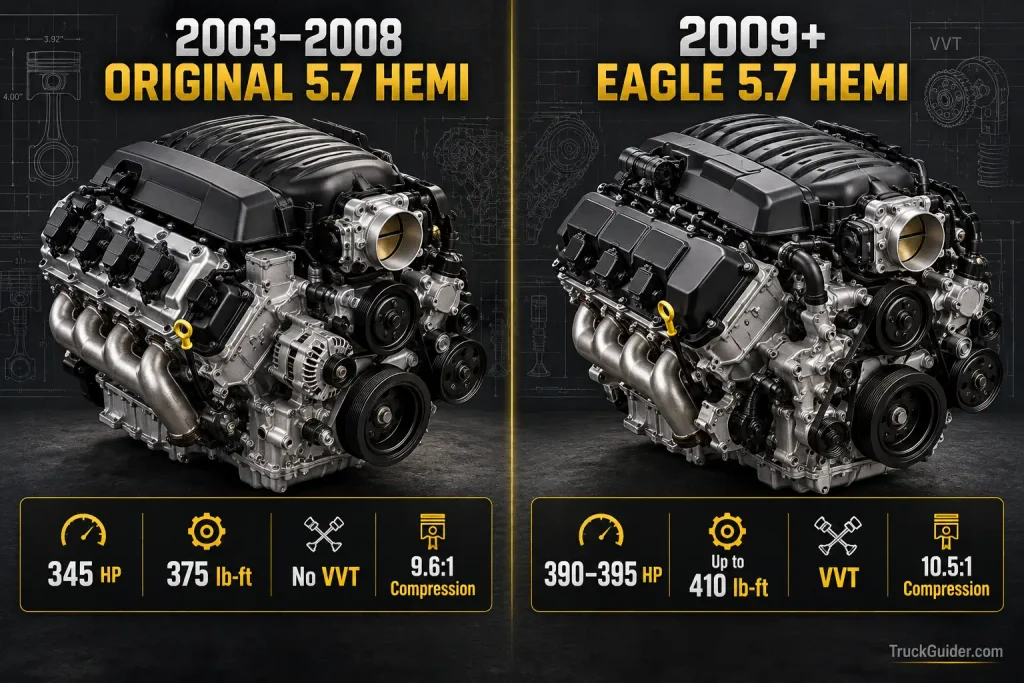
2003-2008 vs 2009+ 5.7 HEMI Eagle engine comparison.The most important update in the 5.7 HEMI’s history arrived for 2009.
Often called the Eagle HEMI, the revised engine retained the same 5,654 cc displacement and basic pushrod architecture but received substantial changes to airflow, cylinder heads, compression and valve timing.
Key Eagle HEMI Changes
The 2009 update introduced Variable Valve Timing, allowing the engine computer to change cam timing depending on engine speed and load.
The compression ratio increased to approximately 10.5:1, while revised cylinder heads improved airflow.
In the 2009 Ram 1500, output jumped from the earlier 345 hp to approximately 390 hp and 407 lb-ft of torque.
Further revisions brought the Ram 1500 to its familiar rating of 395 hp and 410 lb-ft.
2009+ Eagle HEMI Specifications
| Specification | 2009+ 5.7 HEMI Eagle |
|---|---|
| Displacement | 5,654 cc / 345 cu in |
| Bore | 3.917 in / 99.5 mm |
| Stroke | 3.578 in / 90.9 mm |
| Compression Ratio | Approx. 10.5:1 |
| Block | Deep-skirt cast iron |
| Cylinder Heads | Aluminum alloy |
| Valvetrain | OHV pushrod, 16 valves |
| Variable Valve Timing | Yes |
| MDS | Application-dependent |
| Ram Output | Up to 395 hp |
| Ram Torque | Up to 410 lb-ft |
Despite the power increase, Chrysler did not increase displacement. Much of the improvement came from better breathing, revised combustion characteristics and variable valve timing.
5.7 HEMI Truck vs. Car Horsepower
The same basic engine can have different horsepower ratings depending on the vehicle.
That is why searching for “5.7 HEMI horsepower” can return several apparently conflicting numbers.
Examples include:
| Application | Typical Factory Output |
|---|---|
| Early Ram truck | 345 hp / 375 lb-ft |
| 2009 Ram 1500 | 390 hp / 407 lb-ft |
| Modern Ram 1500 | 395 hp / 410 lb-ft |
| Chrysler 300C, early 5.7 | Around 340 hp / 390 lb-ft |
| Dodge Charger R/T | Around 370 hp / 395 lb-ft |
| Challenger R/T automatic | Around 372 hp / 400 lb-ft |
| Challenger R/T manual | Up to 375 hp / 410 lb-ft |
These differences come from intake and exhaust systems, engine calibration, transmission choice and the intended use of each vehicle.
A Ram 1500 calibration prioritizes usable truck torque and towing capability, while performance-car versions are optimized differently for acceleration and higher-rpm operation.
What Changed for the 2026 5.7 HEMI?
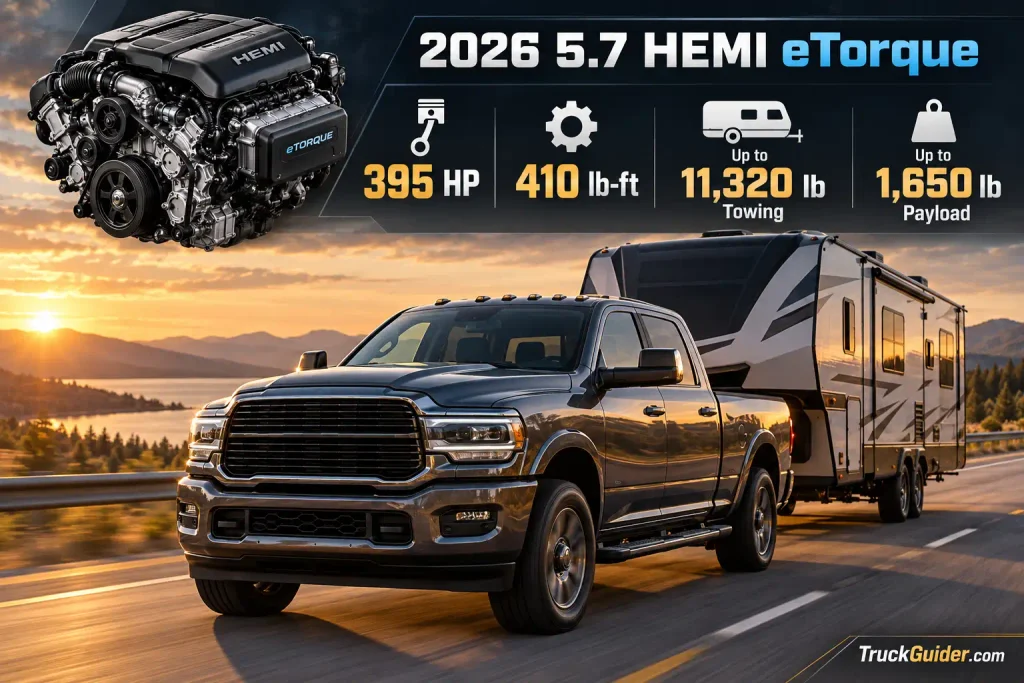
2026 Ram 1500 5.7 HEMI eTorque 395 hp 410 lb-ft towing capacity.The 2025 Ram 1500 launched without the 5.7 HEMI, relying instead on the 3.6L Pentastar and 3.0L Hurricane inline-six engine family.
For 2026, Ram brought the V8 back.
The returning engine is the 5.7L HEMI V8 with eTorque, rated at:


- 395 horsepower
- 410 lb-ft of engine torque
- Up to 11,320 lb maximum towing capacity
- Up to 1,650 lb maximum payload
- TorqueFlite 8-speed automatic transmission
The 2026 HEMI therefore retains the familiar 395-hp/410-lb-ft engine output rather than receiving a major horsepower increase.
Its importance is instead its return to the Ram 1500 powertrain lineup after the one-model-year absence.
2026 5.7 HEMI Towing Capacity
Ram’s current maximum published towing capacity for a 2026 5.7 HEMI 4×2 configuration is 11,320 pounds when properly equipped.
The maximum published figure for a HEMI-powered 4×4 is lower and depends on configuration.
This is important because older Ram 1500 HEMI/eTorque trucks reached towing ratings as high as approximately 12,750 pounds in certain configurations. That older figure should not be presented as the maximum towing capacity of the 2026 model.
Towing capacity is determined by much more than engine horsepower. Cab configuration, drivetrain, axle ratio, GCWR, bed length, vehicle equipment, passenger weight and cargo all affect the final rating.
For detailed historical data, see our Ram 1500 Towing Capacity Chart by Year.
What Is eTorque on the 5.7 HEMI?
Ram introduced eTorque to the fifth-generation Ram 1500.
Instead of relying only on a traditional alternator, eTorque uses a belt-driven motor-generator and a 48-volt battery system.
On the 5.7 HEMI, the system can provide supplemental torque during launch, support engine start/stop operation and recover energy during deceleration.
Ram advertised up to 130 lb-ft of supplemental launch torque from the eTorque system on the HEMI.
However, that figure should not simply be added to the engine’s 410 lb-ft rating.
The official engine rating remains:
395 hp and 410 lb-ft.
eTorque primarily changes how the truck delivers torque at low speed and how efficiently the powertrain operates rather than creating a new 540-lb-ft combined engine rating.
5.7 HEMI MDS Explained
The Multi-Displacement System, or MDS, is Chrysler’s cylinder-deactivation technology.
During light-load driving, applicable MDS-equipped engines can deactivate four cylinders. When the driver requests more power, all eight cylinders return to operation.
The goal is to reduce fuel consumption when full V8 output is unnecessary.
Not every 5.7 HEMI application uses MDS in exactly the same way. Transmission and vehicle configuration matter—for example, some manual-transmission performance applications differ from automatic versions.
For this reason, replacement engines, camshafts, lifters and control-system components should always be matched to the exact model year and engine configuration.
If you are planning an engine replacement, check our Truck Parts Interchange Database before buying a donor engine.
Variable Valve Timing on the 5.7 HEMI
VVT arrived with the 2009 Eagle update.
Instead of using one fixed camshaft timing position under every operating condition, the engine can advance or retard cam timing.
This helps broaden the usable torque curve while also supporting efficiency and emissions targets.
VVT is one of the major reasons a 2009+ Eagle HEMI should not be treated as identical to a 2003–2008 engine, even though both displace 5.7 liters.
5.7 HEMI Oil Capacity
For recent Ram 1500 applications, the 5.7 HEMI holds:
7 quarts (6.6 liters) of engine oil with the filter.
The 2026 Ram 1500 owner documentation continues to specify a 7-quart oil capacity for the 5.7L engine.
However, oil viscosity has changed over the life of the engine.
What Oil Does a 5.7 HEMI Use?
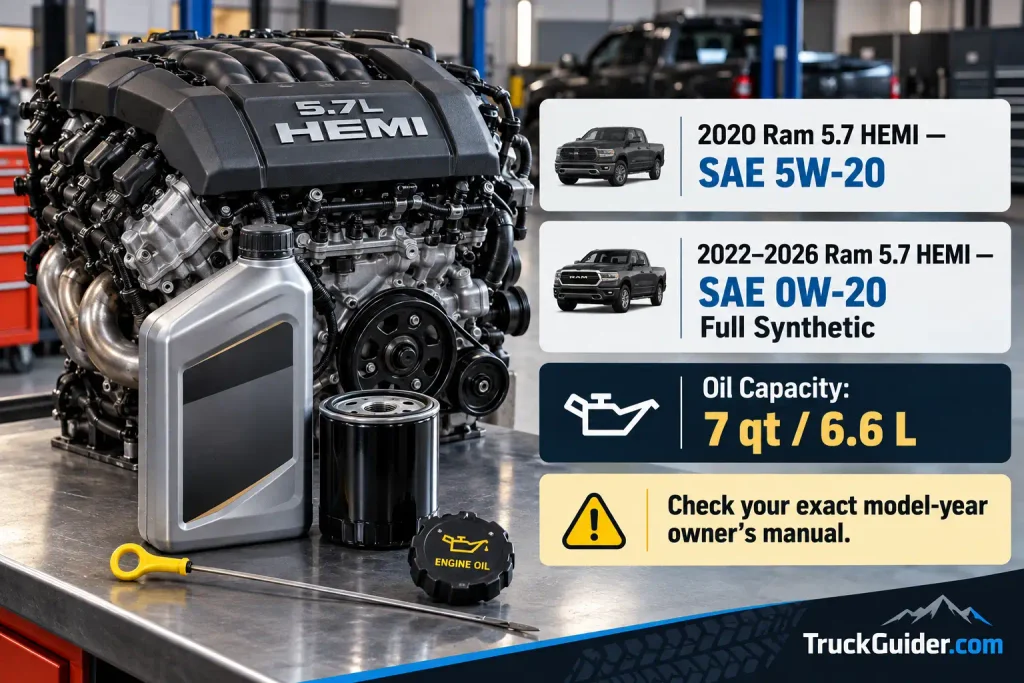
5.7 HEMI oil type and capacity 5W-20 0W-20 7 quartsDo not use one oil-viscosity recommendation for every 5.7 HEMI from 2003 through 2026.
For example:
| Example Model/Period | Manufacturer Specification |
|---|---|
| 2020 Ram 1500 5.7L | SAE 5W-20 meeting MS-6395 |
| 2022 Ram 1500 Classic 5.7L | SAE 0W-20 full synthetic, MS-6395 |
| 2023 Ram 1500 5.7L | SAE 0W-20 full synthetic, MS-6395 |
| 2024 Ram 1500 5.7L | SAE 0W-20 full synthetic, application-specific manual |
| 2026 Ram 1500 5.7L | SAE 0W-20 full synthetic, MS-6395 |
The correct recommendation therefore depends on the model year and vehicle.
Best practice: check the oil-fill cap and owner’s manual for your exact vehicle rather than assuming every 5.7 HEMI requires 5W-20.
For the complete model-by-model chart, see our Ram 1500 Oil Capacity Chart by Year.
5.7 HEMI Fuel Requirement
Recent Ram owner documentation recommends 89-octane gasoline for the 5.7 HEMI while allowing 87 octane.
Using the recommended octane can help the engine operate under its intended ignition strategy, especially under heavier loads.


Fuel requirements can vary by application, so performance-car and modified-engine owners should follow the specific vehicle or calibration requirements rather than applying a Ram specification universally.
5.7 HEMI Firing Order
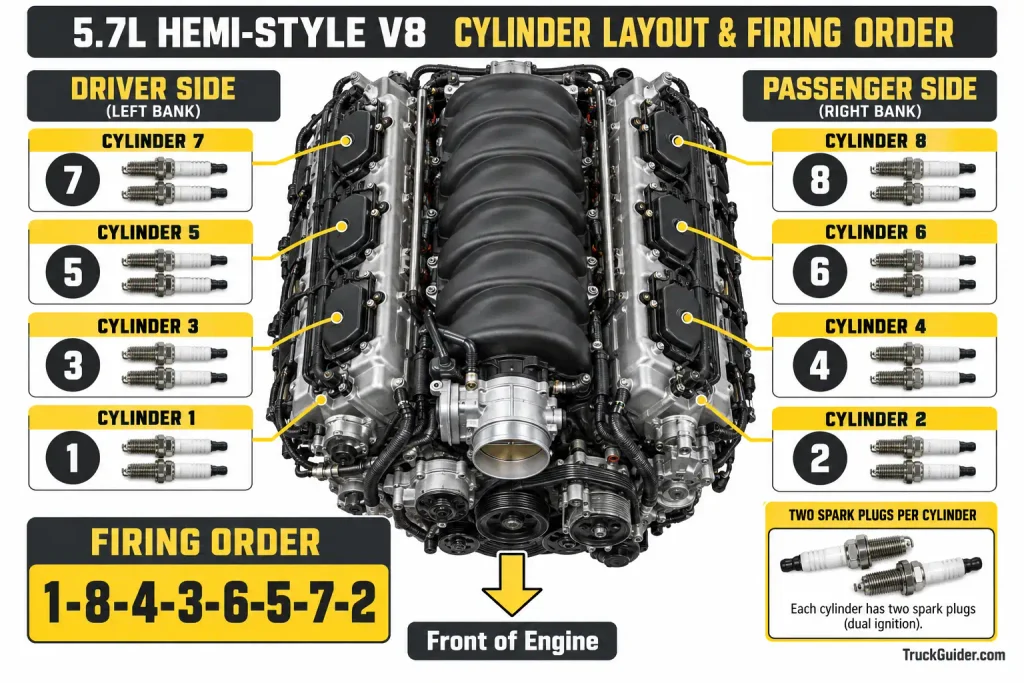
The Gen III 5.7 HEMI firing order is:
1-8-4-3-6-5-7-2
Cylinder numbering is:
- Driver/left bank: 1-3-5-7, front to rear
- Passenger/right bank: 2-4-6-8, front to rear
The engine uses two spark plugs per cylinder, for a total of 16 spark plugs.
Knowing the correct cylinder numbering is especially useful when diagnosing codes such as P0301, P0303 or other cylinder-specific misfires.
For a full diagram and ignition-system explanation, see our 5.7 HEMI Engine Diagram guide.
Vehicles That Used the 5.7 HEMI
The Gen III 5.7 HEMI has appeared across a wide range of Chrysler, Dodge, Jeep and Ram products.
Major applications have included:
- Ram 1500
- Ram 2500 and 3500 in earlier model years
- Dodge Durango
- Dodge Charger R/T
- Dodge Challenger R/T
- Dodge Magnum R/T
- Chrysler 300C and V8 300 models
- Jeep Grand Cherokee
- Jeep Commander
- Chrysler Aspen
- Jeep Wagoneer in selected model years
Not every model used the same engine calibration, accessories, MDS configuration, intake system or transmission.
That distinction becomes particularly important when buying a replacement engine or attempting an engine swap.
Is the 5.7 HEMI Reliable?
The 5.7 HEMI has been in production for more than two decades and is widely used in high-mileage trucks and SUVs.
Its basic cast-iron-block, pushrod V8 architecture is relatively straightforward, but that does not mean every 5.7 HEMI is trouble-free.
Maintenance history matters significantly.
Among the commonly discussed issues are exhaust manifold leaks and valvetrain wear.
1. Exhaust Manifold Bolts and Cold Ticking
Broken exhaust manifold bolts or a leaking manifold can produce a noticeable ticking sound, particularly when the engine is cold.
As the exhaust components warm and expand, the sound may become quieter.
This is different from automatically assuming every HEMI tick means internal engine failure.
2. Lifter and Camshaft Wear
Some 5.7 HEMI engines experience hydraulic roller lifter or camshaft wear.
Possible symptoms can include:
- Persistent valvetrain ticking
- Misfire codes
- Rough running
- Loss of performance
- Metal contamination in the oil in severe cases
A ticking engine should be diagnosed rather than classified by sound alone because fuel injectors, exhaust leaks and internal valvetrain problems can produce similar noises.
See our dedicated Ram 1500 Ticking Noise at Idle guide for more detailed troubleshooting.
3. MDS and VVT Depend on Correct Oil
MDS and VVT both rely on the engine’s lubrication and hydraulic-control systems.
Using the manufacturer-specified oil viscosity and specification for the exact model year is therefore more important than following a generic recommendation found online.
Check oil level regularly and follow the maintenance schedule for your specific vehicle.
2003–2008 vs. 2009+ 5.7 HEMI
The simplest way to understand the engine family is to divide it into pre-Eagle and Eagle generations.
| Feature | 2003–2008 | 2009+ Eagle |
|---|---|---|
| Displacement | 5.7L / 345 cu in | 5.7L / 345 cu in |
| Bore | 3.917 in | 3.917 in |
| Stroke | 3.578 in | 3.578 in |
| Block | Cast iron | Cast iron |
| Heads | Aluminum | Revised aluminum |
| Compression | Approx. 9.6:1 | Approx. 10.5:1 |
| VVT | No | Yes |
| Ram HP | 345 hp | 390–395 hp |
| Ram Torque | 375 lb-ft | Up to 410 lb-ft |
| MDS | Application-dependent | Application-dependent |
The 2009 update is the major dividing line for engine compatibility and parts selection.
Many internal and external components changed even though the displacement remained 345 cubic inches.
5.7 HEMI vs. 6.4 HEMI: Quick Difference
The 5.7 and 6.4 HEMI belong to the same modern Gen III engine family, but they should not be treated as the same engine.
The 5.7L has a displacement of 345 cubic inches, while the 6.4L is 392 cubic inches.
The 6.4 uses a larger bore and longer stroke and was designed for higher performance or heavier-duty applications depending on the specific version.
For someone choosing between them, the 5.7 HEMI is best understood as the long-running mainstream V8 used in everything from Ram trucks to R/T performance cars, while the 6.4 serves higher-output performance and heavy-duty roles.
Frequently Asked Questions
How much horsepower does a 5.7 HEMI have?
Horsepower depends on the year and vehicle. Early Ram 5.7 HEMI engines produced 345 hp, the 2009 Ram 1500 increased to 390 hp, and later Ram 1500 versions—including the returning 2026 HEMI—produce 395 hp.
Passenger-car versions have different ratings.
How much torque does the 5.7 HEMI make?
The original Ram version produced 375 lb-ft. Updated Eagle Ram engines increased output to approximately 407–410 lb-ft, while the 2026 Ram 1500 5.7 HEMI is officially rated at 410 lb-ft.
What is the displacement of a 5.7 HEMI?
The Gen III 5.7 HEMI displaces 5,654 cc, or approximately 345 cubic inches.


What are the bore and stroke of a 5.7 HEMI?
The bore is approximately 3.917 inches (99.5 mm) and the stroke is 3.578 inches (90.9 mm).
Is the 5.7 HEMI block aluminum?
No. Production Gen III 5.7 HEMI engines use a cast-iron engine block with aluminum cylinder heads.
What is the 5.7 HEMI firing order?
The firing order is:
1-8-4-3-6-5-7-2.
How many spark plugs does a 5.7 HEMI have?
The 5.7 HEMI uses 16 spark plugs—two plugs for each of its eight cylinders.
How much oil does a 5.7 HEMI take?
Recent Ram 1500 5.7 HEMI applications use 7 quarts (6.6 liters) with the oil filter. Verify capacity for your specific vehicle before filling.
Does a 5.7 HEMI use 5W-20 or 0W-20?
It depends on the model year.
For example, 2020 Ram documentation specifies 5W-20, while later Ram manuals—including 2022, 2023 and 2026 documentation—specify 0W-20 full synthetic.
Always follow the oil cap and owner’s manual for your specific vehicle.
Is 87-octane fuel okay for a 5.7 HEMI?
For recent Ram 5.7 HEMI applications, 89 octane is recommended and 87 octane is acceptable. Other vehicles or modified engines can have different requirements.
Does the 2026 Ram 1500 have a 5.7 HEMI?
Yes. After being absent from the 2025 Ram 1500, the 5.7 HEMI V8 with eTorque returned for 2026 with 395 hp and 410 lb-ft of torque.
What is the 2026 Ram 1500 5.7 HEMI towing capacity?
Ram lists a maximum towing capacity of 11,320 pounds for the properly configured 2026 HEMI-powered 4×2 Ram 1500.
Actual capacity depends on drivetrain, cab, bed, axle ratio, options and vehicle loading.
Is the 5.7 HEMI a good engine?
The 5.7 HEMI has proven to be a long-lived and capable V8 when maintained correctly. Prospective owners should still watch for exhaust manifold leaks, unusual valvetrain ticking and signs of lifter or camshaft wear, particularly on higher-mileage engines.
Final Takeaway
The 5.7 HEMI’s core dimensions have remained remarkably consistent since its 2003 introduction: 345 cubic inches, a cast-iron block, aluminum heads and pushrod-operated valves.
What changed over time was everything around that foundation.
The original Ram engine produced 345 hp and 375 lb-ft, the 2009 Eagle revision introduced VVT and substantially increased output, and later Ram versions reached 395 hp and 410 lb-ft.
The latest chapter is the 2026 Ram 1500, where the HEMI returns with eTorque, the familiar 395-hp rating and a current maximum towing figure of 11,320 pounds.
For owners, the most important lesson is that application and model year matter. Horsepower, MDS configuration, oil viscosity, towing capacity and compatible parts cannot safely be generalized across every 5.7 HEMI from 2003 through 2026.
Use the specifications for your exact model year—and when servicing the engine, make the vehicle’s owner manual or manufacturer documentation the final authority.
![2015 Ram EcoDiesel Problems: Common Failures & Recalls [2026]](https://truckguider.com/wp-content/uploads/2026/03/2015-ram-ecodiesel-problems-featured.webp)