5.0 Coyote Problems by Generation and Year: 2011-2026

The most reported 5.0 Coyote problems in the F-150 are the typewriter tick, excessive oil consumption on 2018 to 2020 trucks, intake manifold runner control failures, timing chain tensioner wear, and coolant leaks. Which one you should worry about depends almost entirely on which Coyote generation sits under your hood.
That matters because Ford treats these issues very differently. The tick is officially a normal operating characteristic. Oil consumption on Gen 3 trucks is documented in a Ford technical service bulletin that sets a hard threshold of more than 1 quart in 3,000 miles. Others are simple bolt-on fixes.


Below, we identify your generation first, then walk through each generation’s known weak points, a symptom lookup table, and a used-buyer checklist.
Ford F-150 5.0L Coyote, 2011 to 2026
5.0 Coyote Symptom to Cause Guide
Match what you hear or see to the likely cause, then confirm with the first check before buying parts.
- 01Normal
Light, random tick at warm idle after an oil change
Likely cause: Typewriter tick, Ford SSM 52334
- 02Repair
Metallic rattle at idle from the front of the engine
Likely cause: Timing chain tensioner or arm, TSB 12-3-1
- 03Repair
Oil low between changes with no visible leaks
Likely cause: Ring and cylinder wear, TSB 19-2365
- 04Repair
P2004 to P2007 codes with low-RPM hesitation
Likely cause: IMRC linkage or actuator
- 05Watch
Coolant loss or a sweet smell after driving
Likely cause: Upper hose clip or water pump
- 06Repair
Loud, steady tapping that never fades when warm
Likely cause: Rocker arm or lifter failure
- 07Stop
Oil pressure warning on a 2021 or newer truck
Likely cause: Low oil or wet belt oil pump drive
Which 5.0 Coyote Generation Is in Your F-150




Ford has built four distinct Coyote generations for the F-150, and each one fails in its own way. The table below shows the hardware changes that matter most for reliability.
| Generation | F-150 Model Years | Fuel Injection | Bore | Compression | Key Change |
|---|---|---|---|---|---|
| Gen 1 | 2011 to 2014 | Port | 92.2 mm | 11.0:1 | Original design, cast timing chain tensioner |
| Gen 2 | 2015 to 2017 | Port | 92.2 mm | 11.0:1 | Revised heads and intake, aluminum tensioner |
| Gen 3 | 2018 to 2020 | Port and direct | 93 mm | 12.0:1 | PTWA cylinder bores, dual injection |
| Gen 4 | 2021 to 2026 | Port and direct | 93 mm | 12.0:1 | Cylinder deactivation, belt-driven oil pump |
Bore, compression and injection figures for Gen 1 through Gen 3 come from the Ford Performance Coyote Technical Reference. PTWA stands for Plasma Transferred Wire Arc, a process that sprays a thin metal coating onto the cylinder walls in place of pressed-in iron liners. Port injection sprays fuel into the intake runner, while direct injection sprays it straight into the cylinder.
For the full horsepower, torque and dimension breakdown, see our full 5.0 Coyote specs by generation.
How To Confirm Your Engine by VIN


The 8th character of your VIN is the engine code. On the F-150, a 5.0L Coyote reads “F” on 2011 to 2017 trucks and “5” on 2018 and newer trucks, based on Ford salvage interchange listings. Pair that code with the model year to pin down your generation.


Why Mustang Coyote Years Differ
Mustang sources often label the 2024 and newer engine as Gen 4. The F-150 took its own major revision in 2021, three years earlier. That split is why online articles disagree on generation years, so always check whether a source is talking about the truck or the car.
With your generation identified, here is how the common problems spread across the four engines.
5 Most Common 5.0 Coyote Problems Across All Years


Five problems account for most 5.0 Coyote complaints on F-150 forums and in Ford service bulletins. Only one of them, Gen 3 oil consumption, is a widespread documented defect.
| Problem | Generations Affected | Main Symptom | Typical Fix | Typical Cost |
|---|---|---|---|---|
| Typewriter tick | All | Light, random tick at warm idle | None needed per Ford | $0 |
| Excessive oil consumption | Gen 3 | More than 1 qt per 3,000 mi, no leaks | TSB 19-2365 procedure | Covered under powertrain warranty if within 5 yr or 60,000 mi |
| IMRC failure | Gen 1 late builds, Gen 2 | P2004 to P2007 codes, hesitation | Actuator, linkage or manifold | $250 to $500 labor, plus parts |
| Timing chain tensioner wear | Mainly Gen 1 | Rattle at cold start or warm idle | Tensioner and arm or full timing job | $2,000 to $4,000 for a full timing job |
| Coolant leaks | All | Coolant loss, sweet smell | Hose, clip or water pump | $929 to $1,115 for a water pump |
Water pump figures are RepairPal’s estimate for a 2012 F-150. Labor and timing job figures come from shop estimates covered in the sections below.


The tick deserves its own note. Ford’s special service message SSM 52334 covers 2011 to 2024 Mustang and F-150 5.0L engines that tick at idle after an oil change, and an earlier version (SSM 47787) told dealers it is an operating characteristic and no repairs should be attempted. A tick by itself is not a failure.
Gen 1 trucks are now the oldest Coyotes on the road, so we start there.
What Goes Wrong on 2011 to 2014 Gen 1 Coyotes


If you own a 2011 to 2014 F-150 5.0, the light tick you hear is probably harmless, but a metallic rattle from the front of the engine is not.
Typewriter Tick After Oil Changes
Gen 1 engines generated the original “BBQ tick” complaints. Ford’s bulletin describes the noise appearing once engine temperature passes about 150°F, at idle up to roughly 1,700 RPM. If the tick is light, irregular and never gets louder over months, treat it as normal and keep up with oil changes.
Timing Chain Tensioner Wear



Gen 1 uses a wider, longer primary timing chain than later engines and a cast tensioner that Ford replaced with an aluminum part for Gen 2. Ford TSB 12-3-1 covers 2011 and 2012 F-150 5.0L engines with an intermittent metallic rattle or scratching noise at warm idle. Depending on the diagnosis, the repair is either a coolant pump replacement or a new left-hand timing chain tensioner and tensioner arm, rated at 5.3 labor hours on the F-150.


If the rattle keeps coming back or the chain has stretched, a full timing job is the next step. Our breakdown of F-150 timing chain replacement cost puts that job at $2,000 to $4,000 at an independent shop.
IMRC Linkage Breaks on 2013 and 2014
Late Gen 1 trucks share the intake runner weakness covered in the next section. The plastic linkage rod on the back of the manifold snaps, setting P2006 or P2007.
The 6R80 Downshift Recall
This one shows up in Coyote problem searches, but it is a transmission issue. NHTSA recall 19V-075 covers about 1.26 million 2011 to 2013 F-150s with the 6R80 six-speed automatic. An intermittent output speed sensor signal loss can cause an unintended downshift into first gear. Ford’s fix is a PCM (Powertrain Control Module) reprogram. A follow-up recall, 19V-433, reprogrammed 2013 F-150s with the 5.0L or 6.2L again because the first update was incomplete.
Ford fixed some Gen 1 weak points in 2015 but kept a fragile part in the intake.
Why 2015 to 2017 Gen 2 Coyotes Throw IMRC Codes


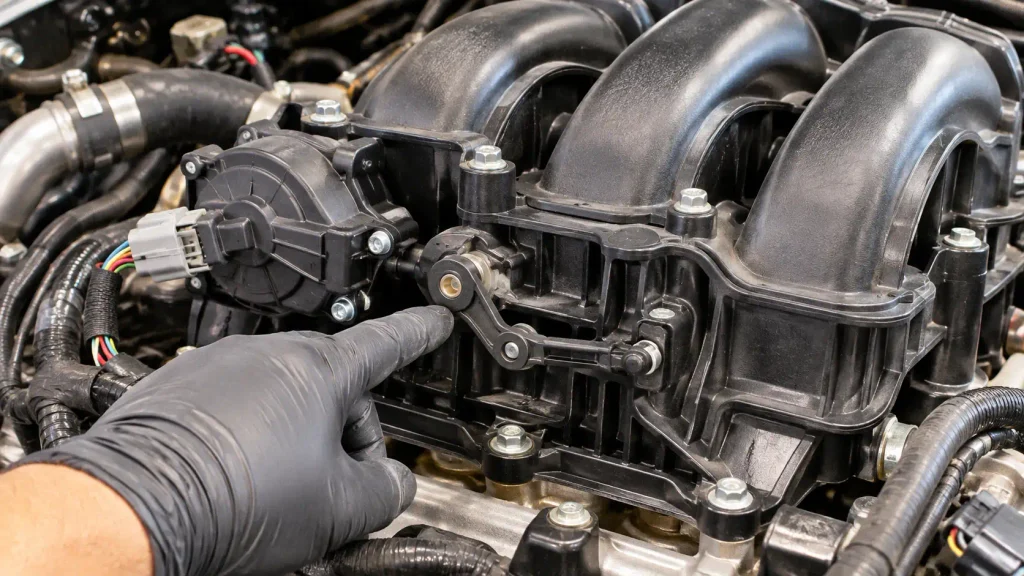
If your 2015 to 2017 F-150 5.0 shows a code between P2004 and P2007, the intake runner system is the first suspect. IMRC stands for Intake Manifold Runner Control. Flaps inside the intake manifold change how air flows into the engine, which improves low-end torque. A DTC (Diagnostic Trouble Code) sets when the PCM sees the flaps stuck in the wrong position.
What P2004 to P2007 Codes Mean
| Code | Meaning |
|---|---|
| P2004 | Runner control stuck open, bank 1 |
| P2005 | Runner control stuck open, bank 2 |
| P2006 | Runner control stuck closed, bank 1 |
| P2007 | Runner control stuck closed, bank 2 |
Related IMRC codes on the Coyote run from P2004 through P2023. Expect hesitation, a flat spot at low RPM, or a check engine light with no other obvious symptom.
Broken Linkage vs Failed Actuator


The most common failure is the plastic linkage at the back of the intake breaking. Because that linkage is part of the manifold assembly, the usual repair is a new manifold. For 2015 to 2017 F-150 5.0L trucks, Ford’s current part is FL3Z-9424-J, which replaces the earlier -B, -E and -F numbers. Online Ford parts dealers list it from about $601 to $709 against an $895 MSRP, and aftermarket copies sell for roughly $105 to $380.
Before you condemn the manifold, check the cheaper parts. A failed actuator (Ford FR3Z-9L492-C fits 2015 to 2020 F-150 and Mustang 5.0L engines), a damaged harness or a cracked vacuum line can set the same codes. Shop labor for a 5.0L manifold swap runs about $250 to $500, or 2 to 4 hours, based on estimates for 2013 and 2014 trucks.
Water Pump Weep and Coolant Leaks
The 5.0 water pump on the F-150 is driven by the external accessory belt and mounted outside the engine. It does not sit behind the timing cover like the pump on some front-wheel-drive Ford V6 engines. A failing Coyote pump usually shows a coolant trail or crust at the pump, not hidden internal loss.
Ford master technician Brian Makuloco (FordTechMakuloco) points to three common Coyote leak points: the upper radiator hose where it clips to its adapter (the most frequent), the water pump itself, and the heater hoses. F150Forum owners report pump leaks anywhere from about 30,000 miles to well past 200,000 miles, so mileage alone does not predict failure.
The 2018 update brought more power and the most documented Coyote problem of all.
How Serious Is 2018 to 2020 Gen 3 Oil Consumption
If you own a 2018 to 2020 F-150 5.0, oil consumption is the one problem Ford has formally acknowledged in writing.
What Ford TSB 19-2365 Says
Ford TSB 19-2365, published in December 2019, replaced the earlier bulletin 19-2338. It applies to 2018 to 2020 F-150s with the 5.0L that consume more than 1 quart (1 liter) of oil every 3,000 miles (4,800 km) with no visible leaks. The procedure starts with a leak inspection, an oil change and a measured consumption test. Ford then determines the causal part case by case and verifies coverage through its OASIS warranty system.
Under Ford’s powertrain warranty of 5 years or 60,000 miles, whichever comes first, that repair should be covered. Outside that window, coverage is at Ford’s discretion.
Where the Lyman Class Action Stands
Owners of 2018 to 2020 F-150s filed a class action over 2018 to 2020 oil consumption in the U.S. District Court for the Eastern District of Michigan, titled Lyman v. Ford. The suit alleges that the cylinder coatings and piston ring assemblies are defective. In 2026, the judge dismissed several claims but allowed many to proceed, noting evidence that Ford knew about the consumption issue before the plaintiffs bought their trucks. The case is unresolved, and no recall has been issued.
How To Run Your Own Oil Consumption Test


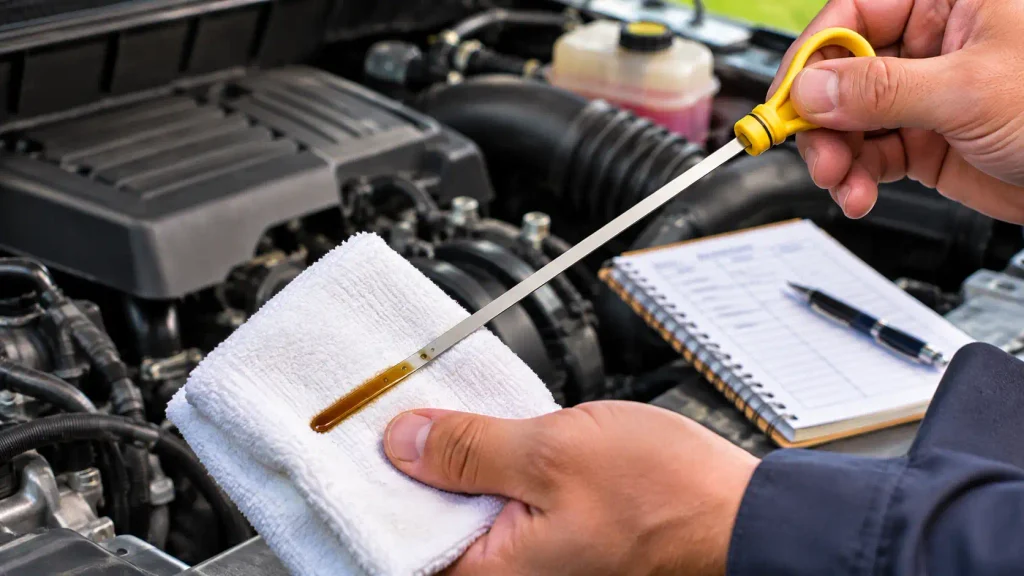
- Change the oil and fill to the full mark on level ground with a cold engine. The Gen 3 F-150 5.0L holds 8.8 quarts with the filter.
- Paint-mark the drain plug and filter so you can prove nothing was removed.
- Record the odometer reading.
- Check the dipstick every 500 miles, same spot, same engine temperature.
- Log every quart you add, then divide by miles driven.
If your truck uses more than 1 quart per 3,000 miles and you see no external leaks, bring the log to a Ford dealer and reference TSB 19-2365.
Gen 3 Rocker and Lifter Tick
Gen 3 engines can carry two different noises. The typewriter tick is light and random. A failing rocker arm (roller follower) or lifter makes a louder, steady tap that does not fade as oil warms up and usually grows over time. That second noise needs a diagnosis, and repair guides commonly tie lifter failure to oil problems such as low levels or stretched change intervals.
For 2021, Ford redesigned parts of the Coyote specifically for the new F-150.
What 2021 to 2026 Gen 4 Owners Should Watch
If you own a 2021 or newer F-150 5.0, the documented failure list is short, but two design changes deserve attention. Long-term failure data on these engines is still limited.
Variable Displacement Cylinder Deactivation
For 2021, Ford rated the 5.0L at 400 horsepower and 410 lb-ft and added a Variable Displacement Engine (VDE) system. Under light load, it shuts down half the cylinders, going from eight to four, to save fuel. GM’s similar systems have a history of lifter failures, which is why F-150 owners watch this one closely. So far, F150gen14.com owner discussions show no documented pattern of Coyote VDE failures.
The Wet Belt Oil Pump
From 2021, the F-150 5.0L drives its oil pump with a belt that runs inside the engine, bathed in oil, replacing the earlier chain drive. Owners reviewing the F-150 owner’s manual report that Ford lists no replacement interval for this belt. On F150gen14.com, an owner reported what may be the first Coyote wet belt failure in 2026. Forum members estimate roughly 900,000 5.0L F-150s were built from 2021 through 2025, so treat that as an isolated case for now.
The practical takeaway is simple. A wet belt depends on clean oil, so stick to Ford’s oil change schedule and avoid stretching intervals.
If you are starting from a symptom rather than a model year, the table below gets you to the likely cause faster.
Which Coyote Symptoms Point to Which Problem
Match the sound or warning you are getting to the row below, then go to that generation’s section.
| Symptom | Most Likely Cause | Generations | First Check | DIY or Shop |
|---|---|---|---|---|
| Light, random tick at warm idle after oil change | Normal typewriter tick | All | Oil level and grade | No repair needed |
| Metallic rattle at idle, front of engine | Timing chain tensioner or arm | Mainly Gen 1 | Stethoscope at timing cover | Shop |
| Oil low between changes, no leaks | Ring and cylinder wear | Gen 3 | Consumption log | Dealer, TSB 19-2365 |
| P2004 to P2007 codes, hesitation | IMRC linkage or actuator | Gen 1 late, Gen 2 | Linkage at rear of manifold | DIY with skills |
| Coolant loss, sweet smell | Hose clip or water pump | All | Upper hose adapter, pump weep area | DIY or shop |
| Loud tapping that never fades | Rocker or lifter failure | Gen 3, Gen 4 | Stethoscope on valve covers | Shop |
| Oil pressure warning on 2021 or newer | Oil pump drive or low oil | Gen 4 | Oil level, then stop driving | Shop, tow if needed |
Before buying parts, scan the PCM with an OBD2 reader so you work from real codes. If a code points to a specific sensor, our 5.0 Coyote sensor location diagram shows where each one sits on the engine.
These same symptoms are what you should check for before buying a used 5.0 F-150.
Should You Buy a Used 5.0 F-150 by Model Year
If you are shopping for a used 5.0 F-150, the model year tells you which inspection matters most.
| Model Years | Verdict | Main Inspection |
|---|---|---|
| 2011 to 2014 | Buy with checks | Cold start and warm idle rattle, recall 19V-075 completed |
| 2015 to 2017 | Buy with checks | Stored IMRC codes, intake linkage |
| 2018 to 2020 | Buy with records | Oil consumption history, TSB 19-2365 work |
| 2021 to 2026 | Buy with service history | On-time oil changes, open recalls |
We rate 2018 to 2020 trucks “buy with records” instead of “avoid” because TSB 19-2365 gives you a clear test. A truck with a documented repair or a clean consumption log is a reasonable buy. A truck with no oil change history is not.
Use this 5-point checklist on any used 5.0 F-150:
- Run the VIN through the NHTSA recall lookup and confirm completed recalls.
- Ask for oil consumption records and dealer invoices on 2018 to 2020 trucks.
- Start the engine cold, after it has sat at least 6 hours, and listen for front-of-engine rattle.
- Plug in an OBD2 scanner and check for stored and pending IMRC codes.
- Inspect the water pump weep area and upper radiator hose adapter for coolant crust.
The downshift problem has not fully gone away for transmission shoppers either. In 2024, NHTSA opened recall query RQ24005 to review whether 19V-075 and 19V-433 went far enough, citing complaints on 2014 F-150s. Our list of F-150 years to avoid covers the other engines and transmissions in the lineup.
What 5.0 Coyote Owners Should Do Next
Most 5.0 Coyote problems come down to your generation. The typewriter tick on every year is normal. IMRC linkage failures are the most common code-setting repair on 2013 to 2017 trucks. Oil consumption on 2018 to 2020 trucks is the one widespread issue Ford has documented, with a clear 1 quart per 3,000 miles test.
If you already own one, run the consumption test, scan for codes, and keep oil changes on schedule, especially on 2021 and newer trucks with the wet belt oil pump. If you are buying, ask for records first and listen to a cold start second. The Coyote remains one of the longest-running naturally aspirated V8s in any half-ton truck, and a well-maintained example is still a strong buy.
5 Common Questions About 5.0 Coyote Problems
Which years of the 5.0 F-150 should I avoid?
No 5.0 F-150 year is an automatic avoid, but 2018 to 2020 trucks need the most scrutiny. Those years are covered by Ford TSB 19-2365 for oil consumption above 1 quart per 3,000 miles. Buy one only with oil change and repair records.
Is the 5.0 Coyote a reliable engine?
Yes, the 5.0 Coyote is broadly reliable when maintained. Its known issues, like IMRC linkage breaks and coolant leaks, are usually moderate repairs rather than engine failures. The main exception is excessive oil consumption on some 2018 to 2020 engines.
What is the best year for the 5.0 Coyote?
No single year is officially the best. The 2015 to 2017 Gen 2 F-150 avoids both the Gen 1 tensioner bulletin and the Gen 3 oil consumption bulletin, though it carries IMRC risk. Service history matters more than the model year.
How many miles can a 5.0 Coyote last?
A well-maintained 5.0 Coyote commonly passes 200,000 miles. F150Forum owners report original 2012 engines at over 213,000 miles still running. Regular oil changes on schedule and fixing coolant leaks early are what get an engine to that mileage without major internal work.
Is the Coyote typewriter tick normal?
Yes. Ford’s SSM 52334 covers 2011 to 2024 Mustang and F-150 5.0L engines that tick at idle after an oil change, and Ford’s earlier SSM 47787 told dealers no repair should be attempted. A loud tap that keeps getting worse is different and needs a diagnosis.