Ford F-150 5.0 Coyote Specs: Generations and Years 2011-2026

Ford 5.0 Coyote specs vary by model year and application. In the F-150, factory output rose from 360 horsepower and 380 lb-ft in the early trucks to 400 horsepower and 410 lb-ft in the current 2026 F-150.
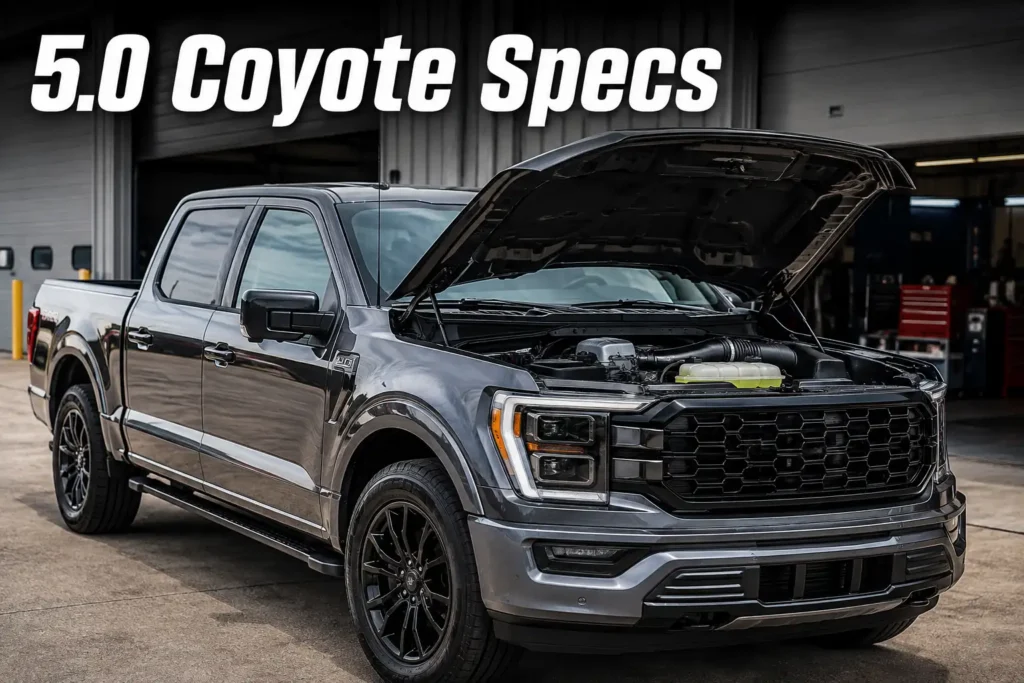
The truck version should not be judged by Mustang GT specifications. Both use Ford’s 5.0L Coyote V8 architecture, but Ford uses application-specific calibrations and hardware changes across model years.
For F-150 owners, the easiest way to identify the correct specs is to start with the model year.
Ford F-150 Engine Reference
5.0 Coyote Specs by F-150 Generation
Factory horsepower, torque, compression, bore, stroke and fuel-system changes across the four major F-150 5.0L Coyote V8 generations.
First F-150 Coyote
2011
Current Output
400 HP
Current Torque
410 LB-FT
Current Compression
12.0:1
2011–2014 F-150
360 HP
380 lb-ft
- Displacement5.0L / 302 cu in
- Compression10.5:1
- Bore3.63 in
- Stroke3.65 in
- Fuel SystemMultiport
2015–2017 F-150
385 HP
387 lb-ft
- Displacement5.0L / 302 cu in
- Compression10.5:1
- Bore3.63 in
- Stroke3.65 in
- Fuel SystemMultiport
2018–2020 F-150
395 HP
400 lb-ft
- Displacement5.0L / 307 cu in
- Compression12.0:1
- Bore3.66 in
- Stroke3.65 in
- Fuel SystemPort + Direct
2021–2026 F-150
400 HP
410 lb-ft
- Displacement5.0L / 307 cu in
- Compression12.0:1
- Bore3.66 in
- Stroke3.65 in
- Fuel SystemPort + Direct
Why Mustang Coyote Specs Can Be Different
Mustang GT and F-150 engines belong to the same Coyote family, but Ford uses different calibrations and application-specific hardware. Always match horsepower, torque and parts to the exact F-150 model year.
F-150 Coyote Factory Power Progression
F-150 figures shown by model-year generation. Mustang GT ratings are intentionally excluded because factory specifications differ by application.
5.0 Coyote Specs by F-150 Model Year
Recommended Best Deal Products

The table below gives the main factory specifications for the four major F-150 Coyote versions.
| F-150 Model Years | F-150 Coyote Generation | Displacement | Horsepower | Torque | Compression | Bore × Stroke | Fuel System |
|---|---|---|---|---|---|---|---|
| 2011–2014 | Gen 1 | 5.0L / 302 cu in | 360 hp @ 5,500 rpm | 380 lb-ft @ 4,250 rpm | 10.5:1 | 3.63 × 3.65 in | Sequential multiport |
| 2015–2017 | Gen 2 | 5.0L / 302 cu in | 385 hp @ 5,750 rpm | 387 lb-ft @ 3,850 rpm | 10.5:1 | 3.63 × 3.65 in | Sequential multiport |
| 2018–2020 | Gen 3 | 5.0L / 307 cu in | 395 hp @ 5,750 rpm | 400 lb-ft @ 4,500 rpm | 12.0:1 | 3.66 × 3.65 in | Port and direct injection |
| 2021–2026 | Gen 4 F-150 | 5.0L / 307 cu in | 400 hp @ 6,000 rpm | 410 lb-ft @ 4,250 rpm | 12.0:1 | 3.66 × 3.65 in | Port and direct injection |
Ford’s 2014 technical specifications list the 5.0L Ti-VCT V8 at 360 horsepower, 380 lb-ft, 302 cubic inches, 10.5:1 compression, and a 3.63-by-3.65-inch bore and stroke.
The 2015 redesign increased output to 385 horsepower and 387 lb-ft while retaining the 10.5:1 compression ratio and sequential multiport injection.
By 2020, Ford listed 395 horsepower, 400 lb-ft, 307 cubic inches, 12.0:1 compression, and dual port/direct fuel delivery.
The current 2026 F-150 5.0L Ti-VCT V8 produces 400 horsepower and 410 lb-ft. Ford also continues to list port fuel and direct injection for the engine.
One naming caveat matters here. Mustang-focused sources often use different Coyote generation boundaries. In this article, Gen 4 F-150 refers to the truck-specific 5.0L revision introduced with the 2021 F-150.
How Gen 1 Coyote Specs Changed From 2011 to 2014
The 5.0L Coyote V8 joined the F-150 lineup for the 2011 model year. Ford rated the truck version at 360 horsepower at 5,500 rpm and 380 lb-ft at 4,250 rpm through the end of this generation.
Gen 1 Engine Dimensions
The Gen 1 F-150 Coyote displaced 302 cubic inches. Its 3.63-inch bore and 3.65-inch stroke produced a nearly square engine geometry that supported both usable truck torque and higher engine speeds.
Compression was 10.5:1. Ford used an aluminum block and aluminum cylinder heads with dual overhead camshafts and four valves per cylinder.
Ford’s Ti-VCT, or Twin Independent Variable Camshaft Timing, allows the intake and exhaust cam timing to change independently. That gives the engine more flexibility across low, middle, and high engine speeds.
Fuel entered through sequential multiport injection. Direct injection had not yet reached the F-150 Coyote.
Ford’s 2014 factory technical sheet confirms the aluminum construction, 302-cubic-inch displacement, 10.5:1 compression ratio, multiport injection, and 360-horsepower rating.
Why Gen 1 F-150 Numbers Differ From Mustang Specs
A same-generation Mustang GT does not automatically have the same Coyote output as an F-150.
Ford tunes the truck engine around pickup requirements, while Mustang calibrations put more emphasis on high-rpm performance. That is why searching only for “Gen 1 Coyote horsepower” can return conflicting numbers.
For truck research, always match the specification to F-150 plus model year.
What Changed in Gen 2 Coyote F-150 Engines
Recommended Best Deal Products


Ford updated the F-150 for 2015 and increased the 5.0L V8 to 385 horsepower at 5,750 rpm and 387 lb-ft at 3,850 rpm. Those ratings continued through the 2017 model year.
That represents a 25-horsepower gain over the 2011–2014 truck engine, while peak torque increased by 7 lb-ft.
Gen 2 Mechanical Specs
The basic engine geometry remained familiar:
- Displacement: 5.0 liters / 302 cubic inches
- Bore: 3.63 inches
- Stroke: 3.65 inches
- Compression ratio: 10.5:1
- Configuration: Naturally aspirated DOHC V8
- Fuel delivery: Sequential multiport injection
- Block and heads: Aluminum
Ford’s 2015 F-150 documentation confirms the 3.63-by-3.65-inch bore and stroke, 10.5:1 compression, naturally aspirated layout, and multiport injection.
The most obvious difference for an F-150 owner is therefore the stronger factory output, not a radical change in displacement or fuel delivery.
| Specification | 2011–2014 Gen 1 | 2015–2017 Gen 2 |
|---|---|---|
| Horsepower | 360 hp | 385 hp |
| Torque | 380 lb-ft | 387 lb-ft |
| Compression | 10.5:1 | 10.5:1 |
| Bore × Stroke | 3.63 × 3.65 in | 3.63 × 3.65 in |
| Fuel System | Multiport | Multiport |
The much bigger technical change arrived for 2018.
How Gen 3 Coyote Specs Changed From 2018 to 2020
The 2018 F-150 5.0L Coyote was more than a calibration update. Ford changed the cylinder design, fuel delivery, compression ratio, transmission pairing, and factory output.
Power increased to 395 horsepower at 5,750 rpm, while torque reached 400 lb-ft at 4,500 rpm.
Port and Direct Injection
The Gen 3 F-150 Coyote adopted Ford’s dual fuel system.
Instead of relying only on injectors positioned in the intake ports, the engine could use both port injection and direct injection. Ford described the change as advanced dual port and direct-injection technology.
This is one of the easiest ways to separate a 2018–2020 truck engine from the earlier 2011–2017 versions.
Higher Compression and Larger Bore
Compression increased from 10.5:1 to 12.0:1.
The bore increased from 3.63 to approximately 3.66 inches while the 3.65-inch stroke remained essentially unchanged. Displacement consequently increased from 302 to 307 cubic inches, or roughly 5.038 liters.
Ford also used spray-on bore-liner technology instead of conventional iron cylinder liners. Ford said the same general technology had been used in the Shelby GT350 application.
Ten Speed Automatic Pairing
The 2018 5.0L V8 was paired with Ford’s 10-speed SelectShift automatic rather than the previous six-speed automatic.
That transmission change matters when comparing complete powertrains. The engine’s extra output was now working through a gearbox with a much wider spread of ratios.
By 2020, Ford still listed 395 horsepower and 400 lb-ft for the 5.0L V8.
What Gen 4 Coyote F-150 Specs Changed From 2021 to 2026
Recommended Best Deal Products


The redesigned 2021 F-150 brought another output increase. Ford raised the 5.0L V8 to 400 horsepower at 6,000 rpm and 410 lb-ft at 4,250 rpm.
Those headline figures remain the same on the current 2026 F-150.
Current Gen 4 Engine Dimensions
Ford’s 2021 technical specifications list:
- Displacement: 5,038 cc / 307 cubic inches
- Bore: 3.66 inches
- Stroke: 3.65 inches
- Compression ratio: 12.0:1
- Block: Aluminum
- Cylinder heads: Aluminum
- Fuel delivery: Port and direct injection
- Horsepower: 400 hp at 6,000 rpm
- Torque: 410 lb-ft at 4,250 rpm
The basic displacement and 12.0:1 compression therefore carried over from the late Gen 3 truck engine.
Variable Displacement Technology
A major 2021 change was Ford’s Variable Displacement Engine technology.
Ford states that the system can shut down half of the V8’s cylinders when full engine output is not required. The engine can then return to eight-cylinder operation as load increases.
The 2021 engine also retained Ford’s PFDI system, meaning it uses both port fuel and direct injection.
For 2026, Ford continues to advertise the 5.0L Ti-VCT V8 at 400 horsepower and 410 lb-ft with port and direct injection.
F-150 vs Mustang 5.0 Coyote Specs Compared
The F-150 and Mustang GT use the same Coyote engine family, but their factory specifications should not be mixed.
| Specification | F-150 Coyote | Mustang GT Coyote |
|---|---|---|
| Primary Application | Pickup truck | Performance coupe |
| Factory Calibration | Truck specific | Performance specific |
| Power Curve Goal | Broad usable output | Greater high-rpm emphasis |
| Intake and Exhaust | Application specific | Application specific |
| Published Output | Must be checked by F-150 year | Must be checked by Mustang year |
| Generation Timing | Truck changes can occur earlier | Mustang generation timing differs |
The clearest example is the current engine. Ford lists the 2026 F-150 5.0L V8 at 400 horsepower and 410 lb-ft, while contemporary Mustang versions carry different factory ratings.
For that reason, do not use a Mustang horsepower figure when identifying an F-150 engine.
How To Identify Your 5.0 Coyote Generation
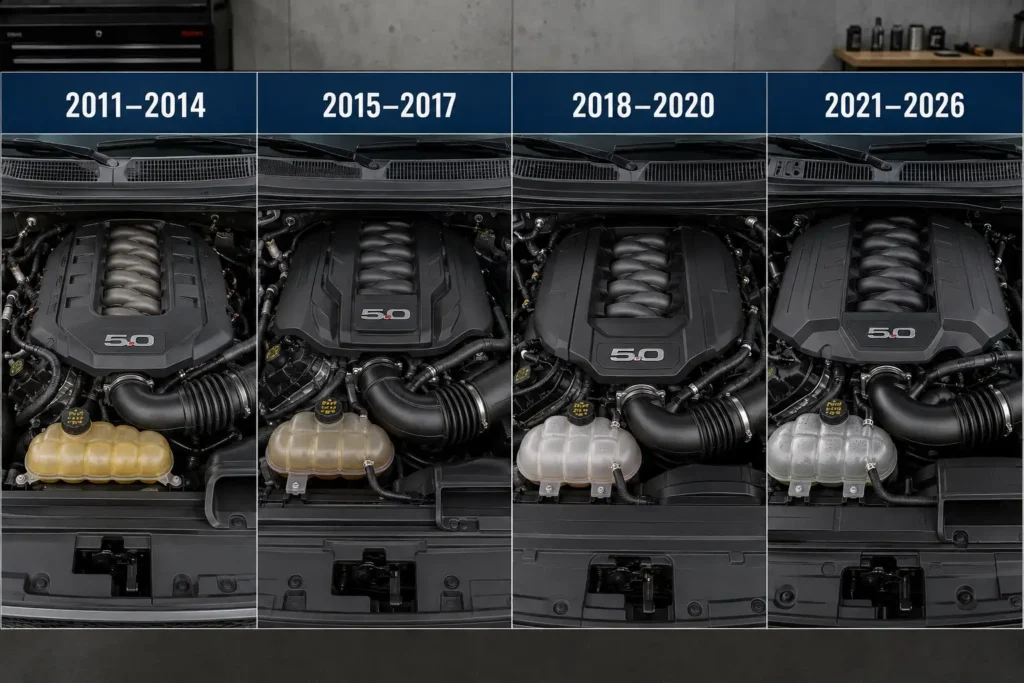
For an F-150, the model year provides the fastest first check.
- 2011–2014 F-150: Gen 1 truck Coyote
- 2015–2017 F-150: Gen 2 truck Coyote
- 2018–2020 F-150: Gen 3 truck Coyote
- 2021–2026 F-150: Gen 4 truck Coyote
Next, confirm that the truck actually has the 5.0L V8. F-150s were sold with several V6 and V8 engines, so model year alone cannot identify the installed engine.
The engine label, build information, VIN-linked build sheet, or Ford service information can confirm the powertrain.
This generation lookup is most useful when buying maintenance or performance parts because a component designed for a 2015 truck should not automatically be assumed to fit a 2018 or 2021 engine.
Which 5.0 Coyote Specs Matter Most
Horsepower gets most of the attention, but several specifications help explain how the Coyote changed.
Horsepower
Horsepower describes the engine’s ability to produce work as engine speed rises.
F-150 Coyote output progressed from 360 hp in 2011–2014 to 385 hp, 395 hp, and finally 400 hp in the 2021–2026 version.
Torque
Torque matters heavily in a pickup because it represents rotational force available from the engine.
The F-150 Coyote increased from 380 lb-ft in the first generation to 410 lb-ft in the current version.
Engine torque alone does not determine trailer capacity. Cab style, axle ratio, drivetrain, Gross Combined Weight Rating, and equipment packages can change the rating substantially.
If you need the truck’s actual trailer limits, use our Ford towing capacity chart rather than calculating towing capacity from horsepower or torque.
Compression Ratio
The early 2011–2017 F-150 Coyote used 10.5:1 compression.
Ford increased compression to 12.0:1 for 2018, and the 2021 technical specifications retained that ratio.
Bore and Stroke
The 2011–2017 engine used a 3.63-inch bore with a 3.65-inch stroke.
From 2018, Ford increased the bore to about 3.66 inches while retaining the 3.65-inch stroke. That change helped increase displacement to 307 cubic inches.
Fuel Injection
The 2011–2017 truck engines used sequential multiport fuel injection.
Ford switched the 5.0L V8 to combined port and direct injection for 2018. The current F-150 still uses Ford’s PFDI system.
How Coyote Specs Affect F-150 Capability
More horsepower and torque do not automatically produce the highest towing or payload number.
F-150 capability also changes with cab configuration, bed length, 2WD or 4WD, axle ratio, Gross Vehicle Weight Rating, and installed towing or payload packages.
For hauling limits, our Ford F-150 payload capacity guide provides a better reference than engine output alone.
Owners comparing older 5.0L trucks can also check the Ford F-150 towing capacity chart for 2013 through 2023 for configuration-specific towing information.
The engine specification tells you what the Coyote can produce. The truck’s certification labels and Ford towing documentation tell you how much that exact F-150 can safely carry or tow.
What the 5.0 Coyote Specs Mean for F-150 Owners
The 5.0 Coyote specs show steady development rather than one unchanged engine lasting from 2011 to 2026.
The 2011–2014 F-150 started at 360 horsepower and 380 lb-ft. Gen 2 increased output to 385 horsepower, while the 2018 revision brought 12.0:1 compression, dual injection, a larger bore, and 395 horsepower.
Current 2021–2026 F-150 trucks produce 400 horsepower and 410 lb-ft. They also use port and direct injection plus Variable Displacement Engine technology.
Match parts, specifications, and maintenance information to the exact F-150 model year before treating two 5.0L Coyotes as identical.
5 Common Questions About 5.0 Coyote Specs
How Much Horsepower Does a 5.0 Coyote Have?
An F-150 5.0L Coyote produces between 360 and 400 factory horsepower, depending on model year. The 2011–2014 trucks make 360 hp, 2015–2017 make 385 hp, 2018–2020 make 395 hp, and 2021–2026 trucks make 400 hp.
How Much Torque Does an F-150 5.0 Coyote Make?
Factory torque ranges from 380 to 410 lb-ft across the F-150 Coyote generations. Current 2026 trucks are rated at 410 lb-ft at 4,250 rpm.
What Years Are Gen 1 Through Gen 4 F-150 Coyotes?
For the truck-focused classification used here, Gen 1 covers 2011–2014, Gen 2 covers 2015–2017, Gen 3 covers 2018–2020, and the revised Gen 4 F-150 engine begins with 2021. Mustang generation boundaries should be checked separately.
Is the F-150 Coyote the Same as the Mustang Coyote?
They belong to the same Ford 5.0L Coyote V8 family, but they should not be treated as identical applications. Factory power ratings, calibration, model-year changes, and some application-specific components differ.
What Is the Bore and Stroke of a 5.0 Coyote?
The 2011–2017 F-150 Coyote uses approximately a 3.63-inch bore and 3.65-inch stroke. From 2018, Ford increased the bore to approximately 3.66 inches while retaining a 3.65-inch stroke.