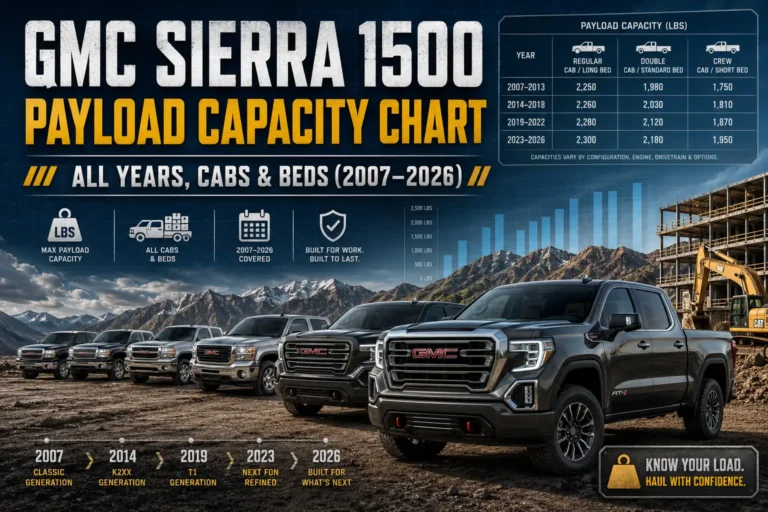
Chevy Silverado 1500 Payload Capacity Chart by Year 2026

A properly configured Chevy Silverado 1500 carries up to 2,260 pounds of payload in its most common trims, though specific Regular Cab configurations rate higher.
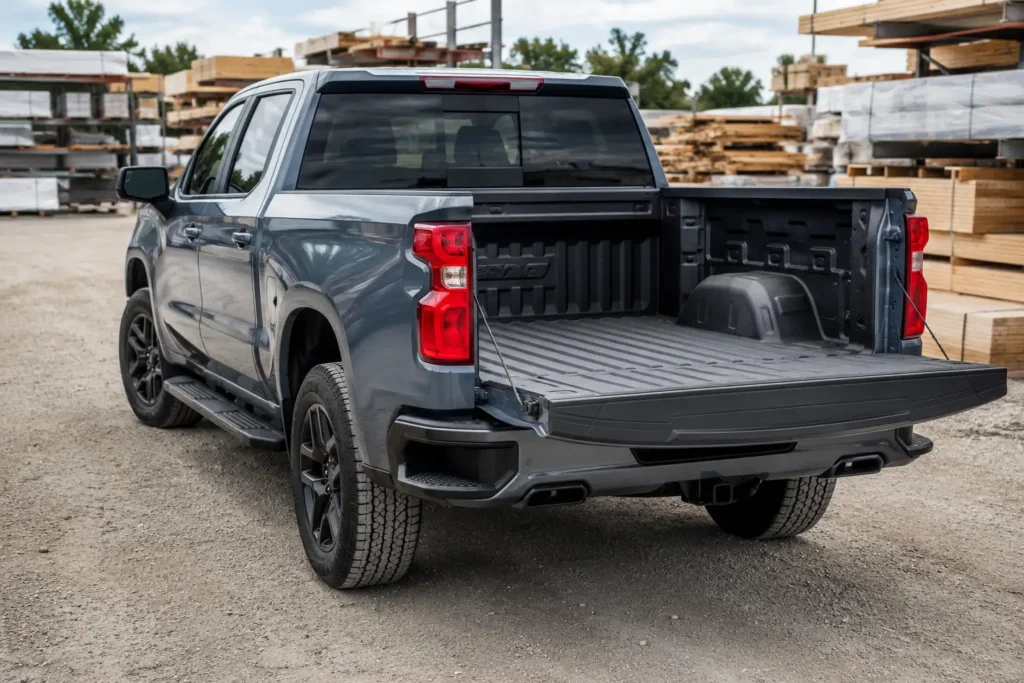
That headline number hides a lot of variation. Cab style, bed length, drivetrain, and engine all push the real figure up or down by hundreds of pounds.


This chart breaks the Silverado 1500’s payload rating down by year, engine, and configuration, so you can find the number that actually applies to your truck.
Chevy Silverado 1500 Payload Capacity
Mainstream max payload by engine, and how it stacks up against the segment
Payload by Engine
Segment Payload Comparison
Quick Payload Tips
- Regular Cab Long Bed 2WD trucks carry the most weight of any configuration.
- 4WD models weigh 200 to 300 lbs more than 2WD, which lowers payload by the same amount.
- Trailer tongue weight counts against payload, not just towing capacity.
- Your exact number is on the yellow door jamb sticker, not this chart.
Source: GM Authority configuration data and Chevrolet published specifications. TruckGuider.com
What Is the Chevy Silverado 1500 Payload Capacity
Payload capacity is the maximum combined weight of passengers, cargo, and gear a truck can carry safely. It is calculated as Gross Vehicle Weight Rating minus curb weight. To protect the bed itself when you carry heavy gear, see our best bed liner for Chevy Silverado 1500 guide.
Published payload figures represent a best-case scenario for a specific configuration, not a guarantee for every truck off the lot. Options like a sunroof, tow package, or heavier wheels all subtract from the number.
The only figure that applies to your exact truck is printed on the Tire and Loading Information sticker inside the driver-side door jamb. Always check that sticker before loading heavy cargo.
Payload is different from Gross Combined Weight Rating, which covers the truck plus an attached trailer. Payload only accounts for what rides inside the truck itself, including passengers, tools, and anything sitting in the bed.
Exceeding your certified payload puts stress on the suspension, brakes, and tires that those components were never engineered to handle. Chronic overloading accelerates wear on leaf springs and shocks, and it can push a truck’s actual weight past its Gross Axle Weight Rating even when the total stays under GVWR.
Payload Capacity by Engine Option
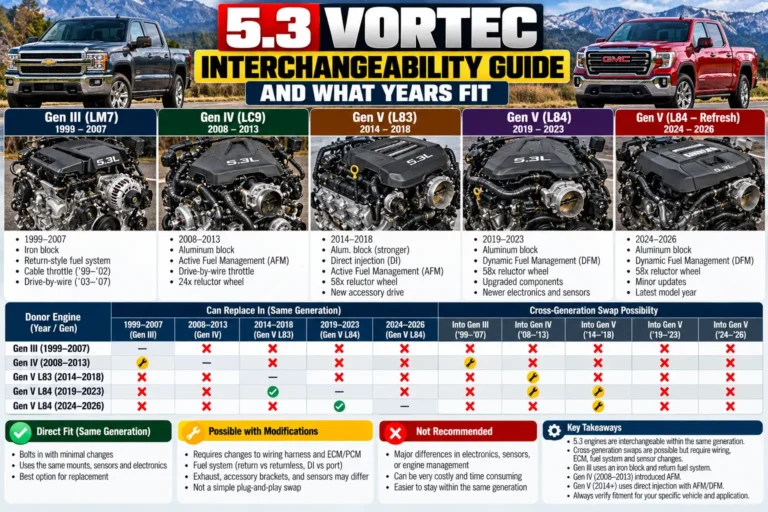
Engine choice is the single biggest factor in Silverado 1500 payload, and the relationship is counterintuitive. A heavier engine block eats into the truck’s GVWR budget, so lighter engines often carry more.
GVWR is largely fixed by axle, brake, and frame ratings for a given cab and bed combination. That means every extra pound sitting over the front axle in the form of iron or aluminum engine block directly subtracts from what the bed and cab can legally carry.
This is why Chevrolet’s own configurators sometimes surprise shoppers who assume the biggest engine automatically wins on every spec sheet. Towing and hauling pull in opposite directions when it comes to engine selection.
2.7L TurboMax
The turbocharged four-cylinder is the volume engine across Work Truck and Custom trims. It produces 310 horsepower and 430 lb-ft of torque, and its light weight makes it a strong payload performer in mainstream Double Cab and Crew Cab builds.
| TurboMax Payload Spec | Rating |
|---|---|
| Maximum Payload | 2,260 lbs |
| Best Configuration | Regular Cab Long Bed 2WD |
| Horsepower | 310 hp |
| Torque | 430 lb-ft |
5.3L EcoTec3 V8
The 5.3L V8 is the Silverado’s volume V8 and, in its lightest Regular Cab Long Bed 2WD form, actually posts the highest payload rating in the entire lineup according to GM Authority configuration data. Most shoppers never see this number because it applies to a narrow, work-focused build.
| 5.3L V8 Payload Spec | Rating |
|---|---|
| Maximum Payload | 2,530 lbs |
| Best Configuration | Regular Cab Long Bed 2WD |
| Horsepower | 355 hp |
| Torque | 383 lb-ft |
6.2L EcoTec3 V8
The 6.2L V8 is the performance flagship, and its extra displacement and weight bring payload down compared to the smaller engines. It still delivers a strong number in Double Cab configurations with the Max Trailering Package.


| 6.2L V8 Payload Spec | Rating |
|---|---|
| Maximum Payload | 2,050 lbs |
| Best Configuration | Double Cab Standard Bed 4WD with NHT |
| Horsepower | 420 hp |
| Torque | 460 lb-ft |
3.0L Duramax Turbo-Diesel
The inline-six diesel trades a small amount of payload for towing efficiency and torque. It posts the lowest maximum payload of the four engines, though the gap is modest in real-world Double Cab builds.
| Duramax Payload Spec | Rating |
|---|---|
| Maximum Payload | 1,970 lbs |
| Best Configuration | Double Cab Standard Bed 2WD with NHT |
| Horsepower | 305 hp |
| Torque | 495 lb-ft |
Buyers cross-shopping engines purely for payload should focus on the Regular Cab and Double Cab body styles, since Crew Cab curb weight tends to compress the gap between engines to a few hundred pounds regardless of which one sits under the hood.
If your Silverado’s payload rating seems lower than expected for its model year, it is worth checking whether your specific configuration has any documented issues in our Chevy Silverado 1500 years to avoid breakdown.
The Complete Silverado 1500 Payload Matrix
Cab style, bed length, and drivetrain change curb weight directly, which changes how much of the GVWR budget is left for payload. Reference this table to match your build.
| Cab and Bed Style | Drive Type | Engine | Max Payload (lbs) |
|---|---|---|---|
| Regular Cab Long Bed | 2WD | 5.3L V8 | 2,530 |
| Regular Cab Long Bed | 2WD | 2.7L TurboMax | 2,260 |
| Double Cab Standard Bed | 4WD | 6.2L V8 with NHT | 2,050 |
| Double Cab Standard Bed | 2WD | 3.0L Duramax with NHT | 1,970 |
| Crew Cab Short Bed | 4WD | 6.2L V8 | 1,790 |
| Crew Cab Short Bed 4WD | ZR2 | 6.2L V8 or Duramax | 1,520 to 1,550 |
The Regular Cab Long Bed configuration consistently posts the highest payload in the lineup because it carries the least curb weight of any body style. The ZR2 sits at the bottom of the chart because its off-road suspension and larger tires add weight without adding to the GVWR.
For a direct brand comparison, our Ram 1500 payload capacity chart breaks down the same configuration-by-configuration detail for Ram’s half-ton lineup.
Chevy Silverado 1500 Payload Capacity Chart by Year
The table below tracks the Silverado 1500’s mainstream maximum payload rating across the fourth-generation T1XX platform and the final years of the third-generation K2XX truck.
| Model Year | Generation | Max Payload (lbs) | Source |
|---|---|---|---|
| 2026 | Fourth (T1XX) | 2,260 | Multiple 2026 dealer sources, corroborated |
| 2025 | Fourth (T1XX) | 2,280 | Ron Carter Chevrolet |
| 2024 | Fourth (T1XX) | 2,260 | Diehl Ford of Beaver |
| 2023 | Fourth (T1XX) | 2,260 | Ray Chevrolet |
| 2022 | Fourth (T1XX) | 2,270 | Lakeside Chevrolet, corroborated by Bud’s Chevrolet |
| 2021 | Fourth (T1XX) | 2,280 | Dyer Chevrolet Lake Wales |
| 2020 | Fourth (T1XX) | 2,280 | Schumacher Chevrolet, corroborated by Country Chevrolet of Benton |
| 2019 | Fourth (T1XX) | 2,500 | The Fast Lane Truck, reporting Chevrolet’s own launch-year announcement |
| 2018 | Third (K2XX) | 1,984 | Autopadre payload archive |
| 2017 | Third (K2XX) | 2,270 | VEHQ, fleet-spec Regular Cab peak for the 2015-2017 span |
| 2016 | Third (K2XX) | 2,270 | VEHQ, fleet-spec Regular Cab peak for the 2015-2017 span |
| 2015 | Third (K2XX) | 2,270 | VEHQ, fleet-spec Regular Cab peak for the 2015-2017 span |
| 2014 | Third (K2XX) | 2,108 | Kelley Blue Book, reporting GM’s 2014 launch announcement for the base 4.3L V6 |
A word on how this chart was built: automotive spec aggregators frequently disagree with each other by 100 to 300 pounds for the same model year, since dealers pull from different trims, press releases, or later spec revisions.
Where sources conflicted, this chart uses the figure with the strongest single citation, generally the one tied most directly to a specific configuration or a manufacturer statement rather than a rounded marketing range.
The 2018 figure sits noticeably below 2017 because it comes from a Crew Cab-weighted source rather than the fleet-spec Regular Cab figure used for 2015-2017, which is a reminder that cab style moves this number far more than model year does.
The general trend still holds despite that noise. Payload climbed from the low-2,100s at the launch of the K2XX generation, dipped in Crew Cab-heavy K2XX sourcing toward the end of that platform, then jumped again with the T1XX redesign and its lighter curb weight.
Shoppers cross-referencing a used truck against this chart should treat the year-by-year figures as a starting point, then confirm the exact number against that specific vehicle’s door sticker before making a purchase decision based on hauling needs.
How Payload Changed Across Silverado Generations
The 2019 redesign to the T1XX platform introduced mixed-material body panels and high-strength steel in the bed, which shaved an estimated 450 pounds off the truck’s curb weight compared to the outgoing K2XX generation.
That weight reduction is the main reason mainstream T1XX payload ratings sit meaningfully above the final K2XX years, even though GVWR did not change dramatically between generations.
The K2XX generation, which ran from 2014 through 2018, introduced the EcoTec3 engine family with direct injection and variable valve timing. Payload gains during that era came from powertrain efficiency rather than major structural weight cuts.
Cab Bed and Drivetrain Effects on Payload
A Regular Cab paired with a Long Bed is the lightest possible Silverado 1500 configuration, and it consistently posts the highest payload rating for any given engine.
Moving up to a Double Cab or Crew Cab adds hundreds of pounds in structure, glass, and seating, which comes directly out of the available payload.


Four-wheel drive models typically weigh 200 to 300 pounds more than their 2WD counterparts because of the added transfer case, front differential, and driveshaft. That extra weight lowers payload by a similar margin.
The ZR2 trim carries the lowest payload in the lineup, around 1,550 pounds according to Kelley Blue Book, because its off-road suspension, skid plates, and larger tires all add curb weight without raising GVWR.
Bed length has a smaller but real effect. A Long Bed carries slightly more sheet metal than a Short Bed, but the difference is minor compared to what cab size and drivetrain contribute.
Trim level also matters beyond the mechanical specs. Loaded High Country and LTZ trims add leather seating, larger touchscreens, and additional sound deadening, all of which increase curb weight compared to a stripped-down Work Truck riding on the same cab and engine.
Silverado 1500 Payload Versus Ford F-150 and Ram 1500
Among the three best-selling half-ton trucks, the Ford F-150 currently leads on maximum payload at 2,440 pounds, with the Ram 1500 close behind at roughly 2,360 to 2,370 pounds. The Silverado 1500’s mainstream maximum of 2,260 pounds puts it third in this specific comparison.
The gap narrows considerably once you compare like-for-like Crew Cab work trims, where all three trucks typically land within a couple hundred pounds of each other.
Buyers cross-shopping the segment can compare exact figures in our Ford F-150 payload capacity breakdown alongside this chart.
How to Calculate Your Exact Payload Capacity
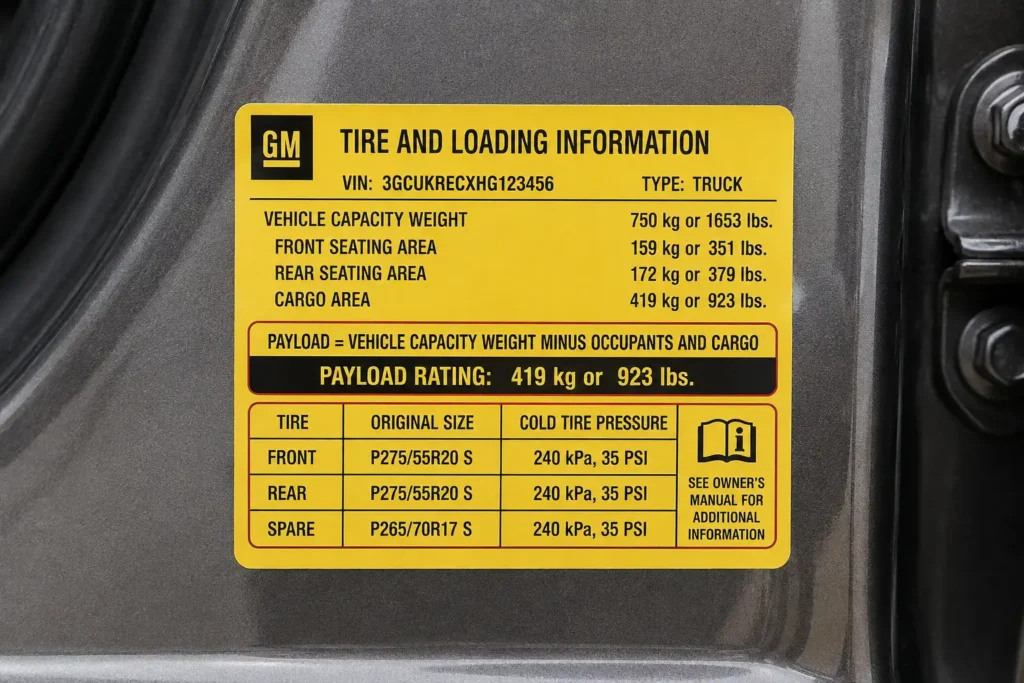
Every Silverado 1500 has its own certified number, and finding it takes less than a minute.
- Open the driver-side door and locate the yellow Tire and Loading Information sticker on the door jamb.
- Find the line labeled “The combined weight of occupants and cargo should never exceed” followed by a specific pound figure.
- That figure is your truck’s actual certified payload, not the published chart maximum.
As a worked example, a Silverado 1500 with a 7,000-pound GVWR and a 5,100-pound curb weight has 1,900 pounds of certified payload. Two adults at 180 pounds each, a 60-pound toolbox, and 200 pounds of building material already use up roughly 620 pounds of that total.
If you plan to tow and haul at the same time, keep in mind that tongue weight from a trailer counts against this same payload number. A 10,000-pound trailer can place 1,000 to 1,500 pounds of tongue weight on the truck, which eats directly into your available cargo capacity.
That interaction is exactly why a truck that looks capable on paper can run out of usable payload before it runs out of pulling power. Anyone regularly towing near their trailer’s rated weight should recalculate available bed capacity every time, not just once at purchase.
Common Payload Mistakes That Overload a Silverado 1500
Forgetting passenger and cab weight. Every passenger, cooler, and tool bag inside the cab counts against payload just as much as gear in the bed.
Ignoring aftermarket accessories. A steel front bumper, toolbox, or bed liner can add 100 to 300 pounds before a single item goes in the bed.
Exceeding rear axle rating while under GVWR. It is possible to overload the rear axle specifically even if total truck weight stays under the GVWR, especially with concentrated loads near the tailgate.
Overlooking tongue weight while towing. Hitching a trailer adds its tongue weight directly to the truck’s payload total, and drivers frequently forget to subtract it before loading the bed.
Trusting the published chart over the door sticker. Two trucks with the same engine and cab can carry different amounts depending on options, so the specific VIN sticker always wins over any general chart, including this one.
Overloading does not usually cause immediate, dramatic failure. It shows up gradually as sagging rear springs, uneven tire wear, longer stopping distances, and a mushy, wandering feel at highway speed that many owners write off as normal wear.




If your Silverado rides on non-factory wheels or larger tires, confirm your fastener specs in our lug nut torque specs for Chevy Silverado 1500 guide before hauling near the max rating.
Frequently Asked Questions
What is the maximum payload capacity of a Chevy Silverado 1500
The current mainstream maximum is 2,260 pounds, achieved in Regular Cab Long Bed 2WD configurations with the 2.7L TurboMax engine. Certain narrow 5.3L V8 configurations rate higher at up to 2,530 pounds.
Which Silverado 1500 engine has the best payload capacity
In mainstream Double Cab and Crew Cab builds, the 2.7L TurboMax posts the strongest payload because it is the lightest engine option. In Regular Cab work-truck configurations, the 5.3L V8 actually rates higher.
How do I find my exact Silverado 1500 payload rating
Check the yellow Tire and Loading Information sticker inside the driver-side door jamb. It lists the certified combined weight of occupants and cargo for your specific truck, which overrides any published chart figure.
Does four-wheel drive reduce Silverado 1500 payload capacity
Yes. Four-wheel drive models typically weigh 200 to 300 pounds more than comparable 2WD trucks because of the added transfer case and front driveline components, which lowers available payload by a similar amount.
Is the Silverado 1500 payload capacity higher than the Ford F-150
No. The Ford F-150 currently leads the segment with a maximum payload of 2,440 pounds, ahead of the Ram 1500 at roughly 2,360 to 2,370 pounds and the Silverado 1500 at 2,260 pounds in mainstream trims.
Matching Your Silverado to the Right Payload Setup
The Chevy Silverado 1500’s payload rating swings by nearly 1,000 pounds depending on cab, bed, drivetrain, and engine, so the published headline number rarely applies to the truck you actually own.
Work-focused buyers chasing maximum capacity should look at Regular Cab Long Bed configurations, while most Double Cab and Crew Cab owners will land closer to the 2,000 to 2,260 pound range.
Before loading close to the limit, check your door jamb sticker for the certified number and remember that towing and hauling draw from the same payload budget.