Chevy Silverado Rear End Compatibility Specification Chart By Year

Quick Answer
Chevy Silverado rear end compatibility varies significantly by generation, chassis (1500 vs. 2500/3500), and axle type (semi-float vs. full-float). While many 1500 axles are interchangeable within specific production runs, structural changes in frame widths and ABS systems often prevent cross-generation swapping. Always verify your specific gear ratio, axle spline count, and electronic sensor configuration against the factory service manual and your vehicle’s RPO code sticker before initiating a swap.
Finding a compatible rear end for your Silverado is more than just matching the lug pattern or counting bolts on the differential cover. Many owners find themselves with an incompatible housing, mismatched ABS sensors, or dangerous drivetrain binding after an improper installation. Because Chevy Silverado rear axle configurations changed significantly between the GMT800, K2XX, and T1XX platforms, proper identification is the only way to ensure safety and functionality. This guide provides a definitive Chevy Silverado rear end compatibility chart, enabling you to select and install the correct axle for your specific truck configuration.
This reference covers Chevy Silverado model years 1999 through 2026. Data encompasses 1500 (Half-Ton) and 2500/3500 (HD) platforms. Because internal factory options vary significantly by trailering package and GVWR, always cross-reference your specific axle code found on the RPO sticker in your glove box or door jamb against the dealer’s service parts catalog. Last reviewed: August 2026.

Chevy Silverado Rear End Compatibility Chart: Axle Specifications by Year
Recommended Best Deal Products


📤 Share Image
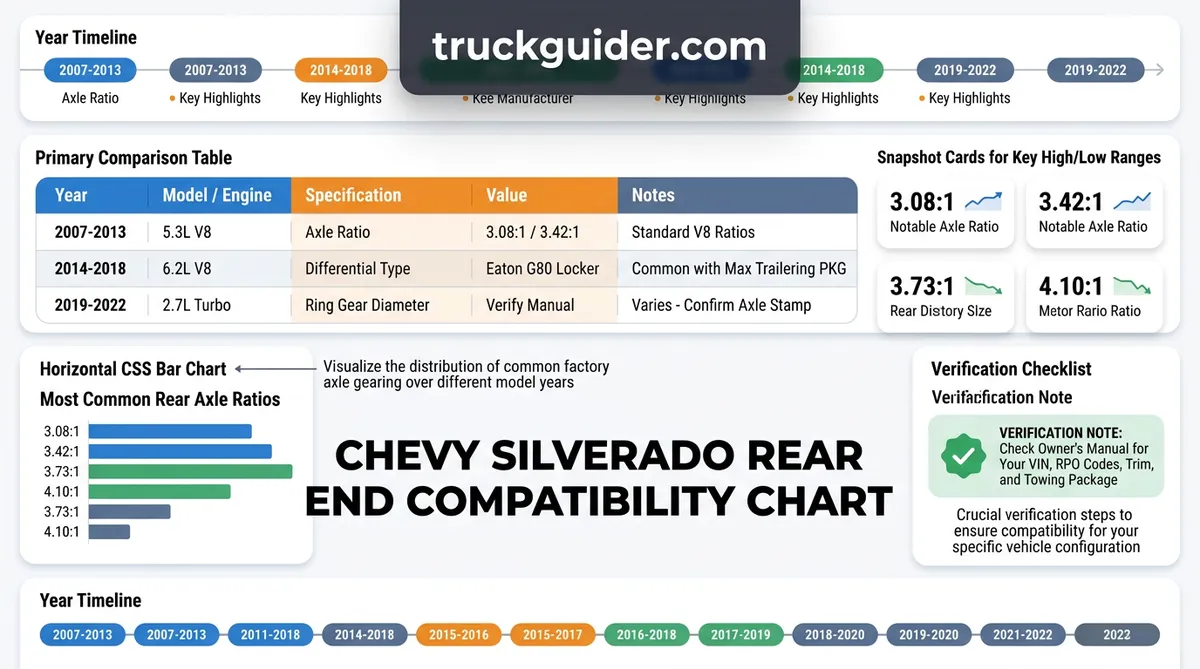
| Model Range | Platform | Common Ring Gear | Notes |
|---|---|---|---|
| 1999–2007 | GMT800 | 8.625″ (1500) | 6-lug patterns common |
| 2007–2014 | GMT900 | 9.5″ / 9.76″ | Stability control integration |
| 2014–2018 | K2XX | 9.5″ / 10.5″ HD | Wide variance in ABS sensors |
| 2019–2026 | T1XX | Varies by Engine | Heavy reliance on electronic logic |

Understanding Ring Gear Diameter and Series Classification
The ring gear diameter is the primary indicator of your axle’s strength and intended application. Half-ton (1500) models typically utilized 8.625-inch or 9.5-inch gears, while HD (2500/3500) models utilize 10.5-inch or 11.5-inch AAM (American Axle & Manufacturing) housings. Note that simply having the same lug pattern—6-lug vs 8-lug—does not guarantee frame mounting compatibility.
Data Scope, Accuracy, and Verification Steps
“Compatibility” in a parts interchange sense is often thwarted by electronic sensors. A 2014 axle might physically bolt into a 2010 chassis, but the tone ring tooth count for the ABS system may differ, leading to a permanent “Service StabiliTrak” light. Always verify the RPO code on your vehicle’s service parts identification sticker before sourcing a replacement.
Navigating Chevy Silverado Rear End Compatibility by Model Year
ABS Sensor Integration Challenges
The transition from the GMT800 to the K2XX platform introduced complex electronic sensor integration. Newer axles use high-frequency sensors that communicate directly with the Electronic Brake Control Module (EBCM). Swapping an older, analog-style tone ring axle into a newer chassis will result in a total loss of traction control and anti-lock braking features.
Frame Widths and Suspension Mounting Variations
Frame width changes between the 1500 and HD models represent a “hard stop” for compatibility. While some aftermarket vendors provide adapter plates, the factory spring perch widths are non-interchangeable. Attempting to weld new perches requires precise frame alignment; failure to maintain the correct pinion angle leads to premature u-joint and driveshaft failure.
Use the sticker in the glove box to match your current gear ratio and locker type.
Compare tone ring tooth counts to ensure the ABS sensor will read correctly.
Essential Components of the Chevy Silverado Rear End Compatibility
Recommended Best Deal Products


Beyond the housing, the internals dictate your truck’s performance and repairability. Consider these factors when evaluating a donor axle:
- Full-Floating vs. Semi-Floating: Full-float axles (standard on 2500/3500) carry the vehicle’s weight on the axle housing, while semi-float axles (standard on 1500) use the axle shaft to support weight. You cannot swap between these without changing the entire suspension/hub assembly.
- Differential Carriers: Moving from an open differential to a G80 locking differential requires verifying that the carrier assembly is compatible with your existing housing depth and spline count.
- Ring and Pinion Gear Sets: When replacing an axle, the gear ratio must match your front differential ratio exactly. In 4WD applications, even a small discrepancy (e.g., 3.42 vs 3.73) will cause drivetrain binding and catastrophic transfer case failure within miles.
- Axle Shaft Splines: Increased engine torque in later models (especially the 6.2L V8) led to beefier spline counts. Ensure your driveshaft yoke matches the replacement pinion spline diameter.
How to Verify Drivetrain and Brake Compatibility During Axle Swaps
Verify if your current driveshaft length is sufficient. Swapping between 1500 and HD housings often requires a custom-length driveshaft or a conversion spacer.
If you move from rear drums to rear discs, your master cylinder may lack the necessary volume to actuate the calipers correctly, creating a “spongy” pedal.
Chevy Silverado Rear End Compatibility Chart: Frequently Asked Questions
Recommended Best Deal Products


Directly? No. The frame widths, spring perches, and bolt patterns (6-lug vs 8-lug) are incompatible. It requires significant custom fabrication, which is generally not recommended for a street-driven vehicle.
Yes. If your truck is 4WD, the front and rear axles must have identical gear ratios. Failure to match them will cause the drivetrain to bind, eventually destroying the transfer case and transmission.
Summary for Successful Replacement
Always verify gear ratios match exactly for 4WD vehicles. Confirm ABS sensor and tone ring compatibility before purchasing. Check axle width and spring perch distance against your specific frame code. Finally, ensure your master cylinder can handle the brake requirements of the replacement axle. Check your door sticker and service manual today to identify your current axle code before beginning your search for a compatible unit.