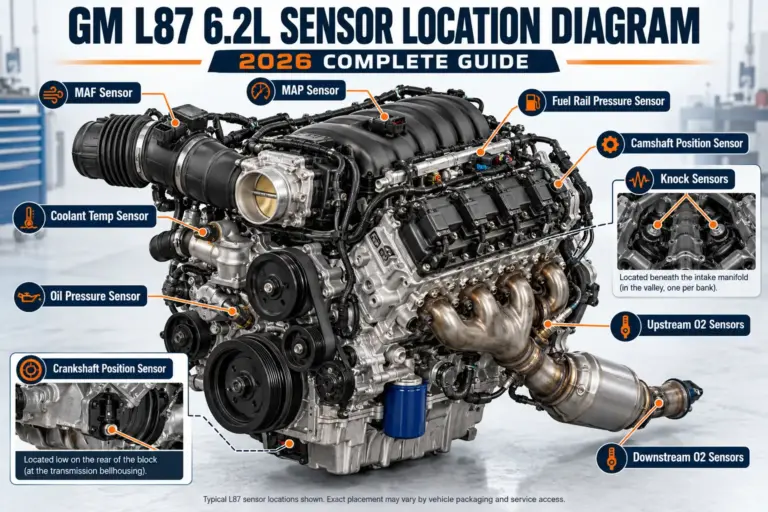
GM L87 Direct Injection Carbon Buildup Symptoms and Fixes Guide 2026

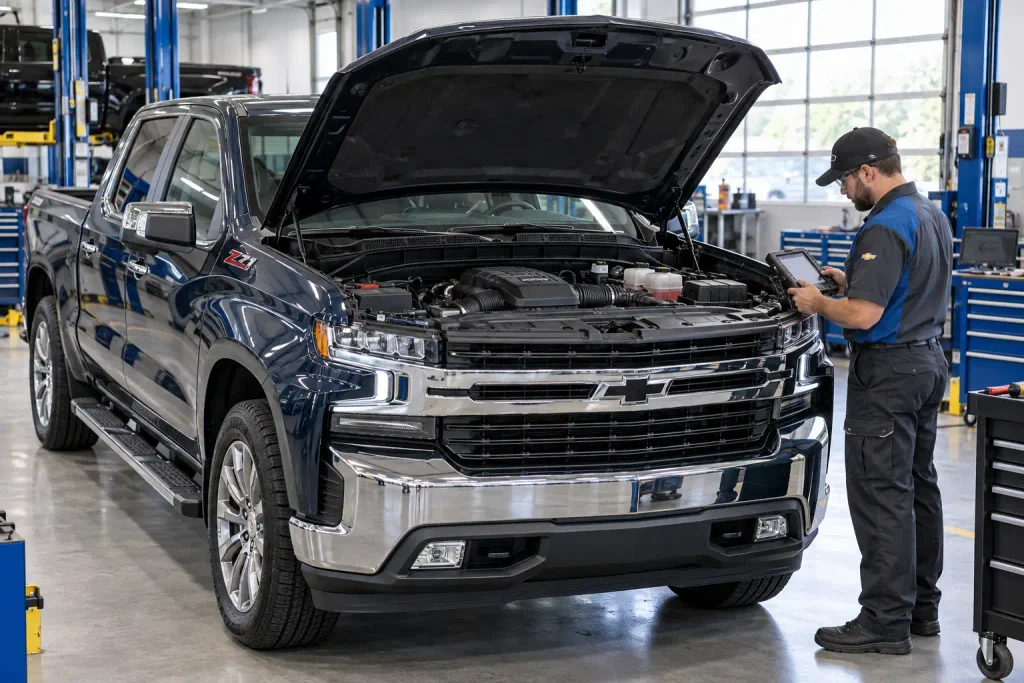
GM L87 direct injection carbon buildup can contribute to rough idle, difficult starting, and misfires, but those symptoms do not prove the intake valves are dirty. A failing ignition component, fuel-delivery problem, air leak, or mechanical fault can produce similar complaints in the 6.2L EcoTec3 V8.
For Silverado 1500 and Sierra 1500 owners, the question is whether deposits actually cause the problem. The answer determines whether cleaning is worthwhile.
Start with the symptoms. Follow the test results. Authorize cleaning only when the evidence supports a deposit-related fault.
Read stored and pending codes, freeze-frame data and misfire patterns.
Test ignition, fueling, intake leaks and related engine faults.
Inspect deposits and test cylinder sealing when indicated.
Important: P0300 is a misfire code, not proof of carbon buildup. There is no verified universal GM L87 intake-valve cleaning interval. Follow current GM service information for the exact VIN.
Educational decision aid. Not a substitute for manufacturer service diagnostics or qualified mechanical inspection.
Why GM L87 Direct Injection Carbon Buildup Develops


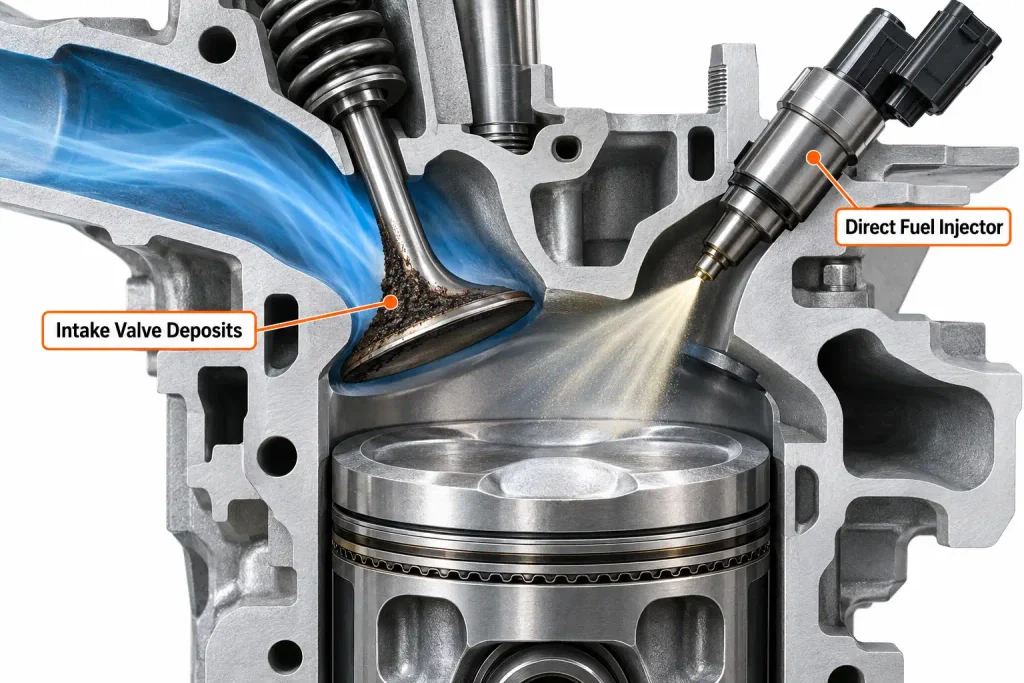
The 6.2L L87 is a naturally aspirated V8 using gasoline direct injection. Fuel enters the combustion chamber rather than being sprayed across the backs of the intake valves, as it is in conventional port fuel injection. GM lists direct injection and positive crankcase ventilation among the engine’s standard systems in its official L87 engine specifications.
That architecture matters because gasoline does not routinely wash the intake-valve surfaces. Oil mist and blow-by vapors carried through the crankcase ventilation system may contact the intake tract, where deposits can accumulate over time. Operating conditions also affect deposits.
Carbon buildup is not unique to the L87, and not every L87 develops severe deposits. GM also discusses carbon on exhaust valves and piston surfaces in its broader gasoline-engine service guidance. They require separate evaluation.
For detailed engine configuration, model-year applications, and factory ratings, see Truck Guider’s 6.2L L87 engine specifications. Those specifications do not establish whether any particular engine needs cleaning.
Which GM L87 Symptoms Suggest Carbon Buildup

Deposits become a possible suspect when an L87 develops drivability complaints that cannot be explained by simpler checks. GM’s Service Bulletin 16-NA-383, updated in June 2024, describes rough idle, extended cranking, crank-no-start, and engine misfires associated with severe valve deposits or sticking valves in applicable GM gasoline engines.
Rough Idle and Cold Starts
A rough idle may be more noticeable shortly after starting, when the engine is cold. However, a rough cold start can also come from ignition, fuel delivery, an intake leak, or other faults. Temperature-related behavior is a clue to record, not a diagnosis.
An extended crank also has multiple causes. GM notes valve-sealing problems in severe cases, but a hard-starting L87 does not automatically need cleaning.
Misfire Codes and Hesitation
P0300 means the powertrain control system detected random or multiple-cylinder misfires. Codes P0301 through P0308 identify individual cylinders with detected misfires. None of those codes identifies carbon deposits as the cause by itself.
Hesitation, uneven acceleration, and a noticeable drop in performance can accompany a misfire. They can also be caused by fuel-pressure, ignition, or engine-control problems. Record when they occur, including during cold starts, at idle, or under load.
Symptoms That Need Urgent Attention
A flashing check-engine light can indicate a misfire severe enough to damage the catalytic converter. Reduce load and stop driving when it is safe; arrange diagnosis rather than continuing to test the truck under acceleration.
Deep knocking, an oil-pressure warning, or sudden major power loss calls for urgent mechanical assessment. Those conditions do not point specifically to intake carbon.
How to Diagnose L87 Carbon Buildup Before Cleaning
The strongest diagnostic process moves from observable symptoms to measured evidence. A scan tool is a useful starting point, but an expensive cleaning service should not be authorized just because P0300 appears.
- Capture stored and pending trouble codes. Record all codes before anyone clears them. Check for fuel, airflow, ignition, or sensor-related codes alongside P0300 through P0308.
- Review freeze-frame and misfire data. Note engine temperature, load, speed, and whether one cylinder or several cylinders are affected. Record cold-only patterns without assuming the cause.
- Check obvious ignition and intake faults. Inspect spark-plug condition, coil connections, accessible intake plumbing, and vacuum-related faults according to GM service information. Replace parts only when testing supports a failure.
- Evaluate the fuel system. Where symptoms point toward fueling, a technician can test injector operation and relevant pressure or control data against the specifications for that VIN. Cleaning an injector is not a substitute for diagnosing a failed injector.
- Test mechanical condition when indicated. Persistent misfires, unusual noises, or suspected valve-sealing problems may justify compression and cylinder leak-down testing. The test findings help distinguish a valve issue from ignition or fuel faults.
- Inspect deposits if the evidence warrants it. A qualified shop may examine accessible intake ports or valves with suitable equipment. Images of deposits are useful, but deposit appearance alone does not prove those deposits caused the complaint.
Ask the shop to document the failed test or suspected mechanism before recommending a service. Intermittent faults may require testing under the original conditions.
What a sound diagnosis looks like: The service estimate identifies the codes, tests performed, findings, and why an intake or upper-engine cleaning is expected to correct the problem. If it cannot identify a reason for cleaning, further diagnosis comes first.
When GM L87 Carbon Cleaning Is Unnecessary
If the engine runs normally and has no relevant test findings, cleaning is not automatically required. No verified GM L87-specific factory interval establishes mandatory intake-valve cleaning at 30,000, 60,000, or 100,000 miles.
Mileage by itself is not proof of excessive deposits. A truck with a misfire caused by a damaged coil, for example, needs its ignition fault corrected rather than a fuel-induction package.
GM also draws a line between routine maintenance and fault-based fuel-injector cleaning. Its fuel-system bulletin does not endorse preventive injector-cleaning services sold simply because the odometer reaches a certain number. That restriction does not prohibit a properly diagnosed repair or an approved gasoline additive used as directed.
If a shop proposes cleaning as part of a standard menu service, ask which symptom or diagnostic result calls for it. An explanation based only on the truck being direct-injected is not enough.
When L87 Intake Valve Deposits Need Cleaning
If testing supports a valve-deposit or sticking-valve condition and major mechanical damage has been ruled out, professional upper-engine cleaning may be appropriate. The June 2024 version of GM bulletin 16-NA-383 discusses a GM-approved air-intake and combustion-chamber cleaning procedure after relevant service diagnostics.
The bulletin is broader than the L87. It covers specified GM gasoline vehicles through the 2025 model year, so a technician should confirm the current, VIN-applicable service information, especially for a 2026 vehicle.
In the serious cases GM describes, technicians may encounter valve-sealing problems or compression loss. They are directed to check for valve damage and displaced cam followers before choosing a cleaning procedure. A visibly dirty valve without those findings is not an automatic instruction to perform the bulletin’s repair.
After a justified repair, the technician should verify the idle, starting behavior, relevant trouble codes, and original complaint. A cleared code is not evidence of success until the underlying symptom has been addressed.
When L87 Engine Problems Require Mechanical Repair
If an L87 has confirmed valve damage, displaced valvetrain components, or another mechanical defect, cleaning alone is not the repair. Mechanical testing and appropriate repairs take priority over a chemical service.
A separate concern affects some L87-equipped vehicles. NHTSA recall 25V274 covers certain 2021–2024 GM trucks and SUVs built within a specified production window because connecting-rod and crankshaft manufacturing defects can lead to bearing damage and engine failure. The official recall report does not identify intake carbon buildup as the recall defect.
This is why a 6.2L V8 with engine knocking or a serious oil-pressure concern should not be sent straight to a carbon-cleaning service. Stop driving if the symptoms indicate possible engine damage, and have the truck assessed promptly.
Recall applicability is VIN-specific, not something to assume from the model year alone. Ask a GM dealer to check open actions and completed repairs for the exact vehicle. Do not change engine-oil viscosity based on a general internet chart; follow the VIN-specific GM instructions.
Which GM L87 Carbon Cleaning Methods Are Appropriate
The phrase carbon cleaning can describe several very different services. Confirm where the cleaner goes, which deposits it targets, and what evidence supports that choice.
Fuel Tank Additive
An approved detergent added to gasoline is part of fuel-system maintenance, not an inspection or mechanical repair. GM’s September 2024 Bulletin 04-06-04-051J identifies ACDelco Fuel System Cleaner 44K, U.S./Canada part number 19435370, and explains its approved preventive role.
Because L87 fuel is injected directly into the cylinders, tank additives do not routinely bathe the rear faces of intake valves. GM discusses deposit-control benefits of approved detergents, but that is not proof that a bottle will remove a severe, confirmed intake-valve obstruction or repair a damaged valve. Follow the vehicle’s owner manual for additive use.
Professional Upper Engine Cleaning
GM’s 16-NA-383 bulletin describes an upper-engine cleaning procedure using approved materials and equipment under controlled conditions. It includes an oil-and-filter change afterward and a check of the repair result.
This is not a casual driveway spray treatment. The bulletin specifically warns that introducing cleaner incorrectly can hydrolock the engine and bend a connecting rod. Have the procedure carried out by a technician using current GM instructions for the vehicle.
Intake Valve Mechanical Cleaning
Some independent specialists offer intake-manifold removal and physical deposit removal, including walnut-shell blasting. This approach exposes intake ports so deposits can be removed while protecting the engine from loose media.
Mechanical cleaning may be an option for a confirmed deposit problem, but it is not established here as GM’s default L87 procedure. Before authorizing it, request evidence of the deposit problem, confirmation that the shop services the specific L87 configuration, and a clear explanation of why the manufacturer-guided approach is insufficient or unsuitable.
What Not to Buy Automatically
Do not assume that an injector flush, throttle-body wipe, fuel-tank additive, chemical induction service, and walnut blasting all perform the same task. A low-priced service advertised as fuel-system cleaning may not access the intake valves at all.
How Much Does GM L87 Carbon Cleaning Cost
There is no reliable single nationwide price for an L87 intake-valve cleaning job. A published generic V8 walnut-blasting rate is not a verified quote for your Silverado or Sierra, and an inexpensive fuel-induction package is not equivalent to manifold-off cleaning.
Request a written estimate that separates diagnosis, approved chemical treatment or mechanical cleaning, intake removal, new seals or gaskets, oil and filter, and post-service verification. Costs depend on access and repair scope.
For the difference between these service categories and their general pricing, see our fuel injection service cost guide. Get a VIN-specific quote before authorizing any work, and do not pay for cleaning before the cause has been demonstrated.
How to Reduce GM L87 Intake Valve Deposits
Deposit prevention starts with correct maintenance rather than a recurring cleaning appointment. GM recommends TOP TIER Detergent Gasoline and describes fuel-quality concerns in its service guidance. Regular oil maintenance is also important for the engine and crankcase-ventilation system.
GM bulletin 04-06-04-051J says an ACDelco Fuel System Cleaner 44K treatment at oil changes is an endorsed gasoline fuel-system maintenance measure, subject to the owner-manual directions. Its listed part number is 19435370 for the United States and Canada. Verify product instructions and applicability before using it.
Do not treat that guidance as a guarantee against all intake deposits. Likewise, aftermarket catch cans, chemical sprays, and unverified cleaning intervals should not be described as factory-required preventive maintenance.
Keep records of rough starts, repeated codes, oil consumption, and changes in drivability. If a problem develops, that history helps the technician separate a new fault from a long-standing operating pattern.
GM L87 Carbon Diagnosis and Cleaning Decision Matrix
Use the following guide to decide which service question to ask first. It is a triage aid, not a substitute for GM service diagnostics.
| Engine Condition | Best Next Step | Carbon Cleaning Decision |
|---|---|---|
| Normal operation and no diagnostic evidence | Follow scheduled maintenance | Not automatically needed |
| Rough idle or P0300 with unknown cause | Scan and diagnose ignition, air, fuel, and mechanical systems | Not yet justified |
| Deposits or sticking-valve condition supported by testing | Review VIN-applicable GM procedures | May be appropriate |
| Compression loss with confirmed valve or valvetrain damage | Diagnose and repair mechanical fault | Cleaning alone is insufficient |
| Severe knock, oil-pressure warning, or sudden major power loss | Stop driving safely and seek urgent assessment | Not the priority |
Cleaning is an option for a supported diagnosis, not a universal repair.
What GM L87 Owners Should Do Next
GM L87 direct injection carbon buildup is a plausible cause of certain drivability problems, but it cannot be established from mileage, a check-engine light, or a rough idle alone. Start with codes and operating data, rule out competing causes, and require a clear explanation of why cleaning is necessary.
If testing supports a deposit-related problem without mechanical damage, ask about the current GM-approved repair procedure. If testing reveals valve damage, heavy knocking, or a possible recall-related fault, mechanical diagnosis and safety come first.
The practical next move is simple: record the symptoms, obtain the diagnostic findings in writing, and authorize only the service those findings support.
What Owners Ask About GM L87 Carbon Deposits
Does the GM 6.2L L87 Engine Get Carbon Buildup?
Yes. The direct-injection design permits intake-valve deposits to develop, and GM documents deposit-related drivability conditions in applicable gasoline engines. However, this does not establish that every L87 has severe deposits or that a particular truck needs cleaning. A diagnosis must connect the deposits to the complaint.
Can Fuel Injector Cleaner Remove L87 Intake Valve Deposits?
An approved gasoline detergent can be part of GM’s recommended deposit-control maintenance, but a tank additive should not be treated as a proven repair for heavy intake-valve buildup. L87 injectors deliver fuel inside the cylinders, not over the intake valves. Severe deposits may require a different, professionally selected repair.
Does a P0300 Code Mean the L87 Has Carbon Buildup?
No. P0300 identifies random or multiple-cylinder misfires, not the root cause. Plugs, coils, fueling, air leaks, and mechanical faults can produce misfires. Review cylinder data, other codes, and the actual operating conditions before considering cleaning.
How Often Does a GM L87 Need Carbon Cleaning?
There is no verified universal factory-mandated L87 intake-valve cleaning interval at 30,000, 60,000, or 100,000 miles. Follow the maintenance schedule for your VIN and investigate actual symptoms. A routine sales recommendation is not the same as a diagnostic finding or an approved repair requirement.
Is the GM L87 Recall Related to Carbon Buildup?
No. NHTSA recall 25V274 addresses certain L87 connecting-rod and crankshaft manufacturing defects that can cause bearing damage and engine failure. It is separate from intake-valve deposits. Check your exact VIN with a GM dealer, especially if you notice knocking, an oil-pressure warning, or significant power loss.