
Gmc Sierra 1500 Payload Payload Capacity Chart By Year

Quick Answer
The GMC Sierra 1500 payload capacity typically ranges from 1,400 to 2,300 lbs depending on the specific engine, cab, bed, and drivetrain configuration. Because payload is calculated by subtracting curb weight from GVWR, the definitive rating is always unique to your specific vehicle. Always consult the Tire and Loading Information label located on your driver-side door jamb for your truck’s exact factory-specified payload capacity.
Ever wonder if your GMC Sierra 1500 can handle that extra load of building materials or a heavy camping trailer? Many owners conflate towing capacity with payload, which often leads to dangerous vehicle overloading. The truth is that payload capacity is not a static number defined by a marketing brochure; it is a calculation specific to your individual truck. This guide provides the GMC Sierra 1500 payload chart and the essential steps to locate your unique factory-specified limit.

Prime for Young Adults — 6 Months Free
Students and 18–24s get six months of Prime free, then half price.
Start 6 Months Free
GMC Sierra 1500 Payload Capacity Chart By Year (2019-2026)
Recommended Best Deal Products


📤 Share Image
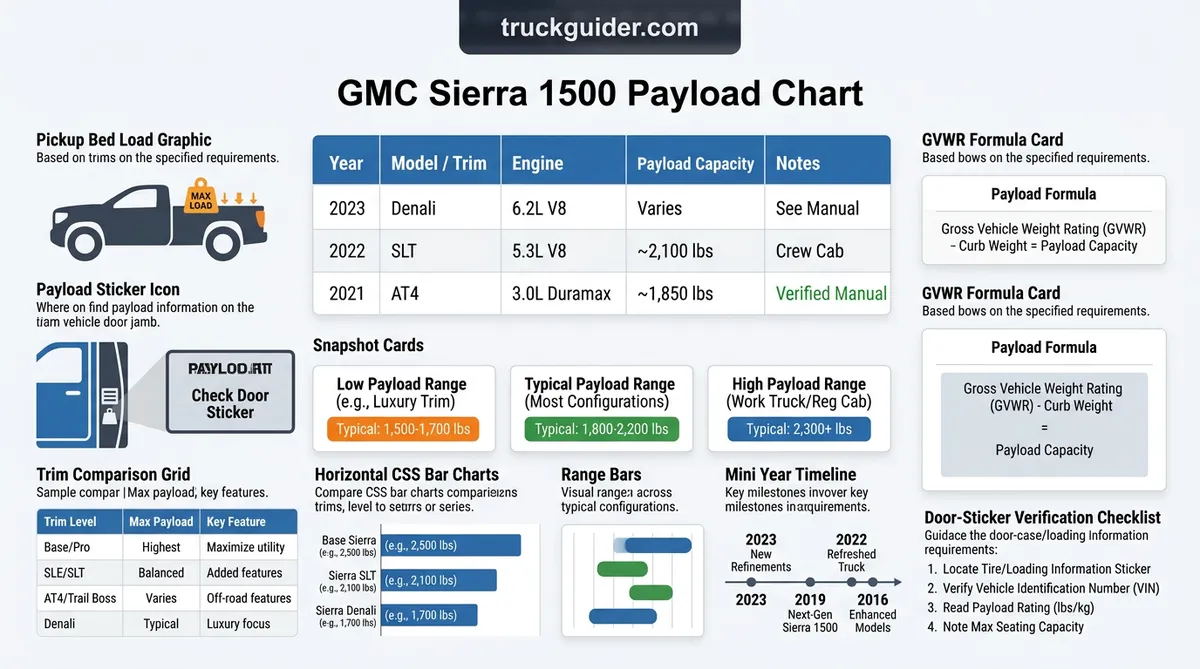
This chart reflects standard factory ranges for the 2019–2026 model years. Payload capacity varies significantly based on engine, drivetrain, and cab/bed configuration. Always refer to your specific vehicle’s door sticker for the precise rating. Last reviewed: August 2026.
| Model Years | Engine | Approx. Capacity | Notes |
|---|---|---|---|
| 2019–2026 | 2.7L Turbo I4 | 1,700–2,200 lbs | Varies by configuration |
| 2019–2026 | 5.3L EcoTec3 V8 | 1,600–2,100 lbs | Max payload often on WT trim |
| 2019–2026 | 6.2L EcoTec3 V8 | 1,500–2,000 lbs | Standard on higher trims |
| 2020–2026 | 3.0L Duramax I6 | 1,400–1,900 lbs | Engine weight reduces payload |

Understanding the Data Scope and Accuracy
The table above provides generalized ranges based on standard equipment packages. It is critical to recognize that a GMC Sierra 1500 “Pro” trim with a 2.7L engine will almost always offer a higher payload than a “Denali Ultimate” trim with the same engine. Why? Because the Denali includes creature comforts—leather seats, power running boards, advanced infotainment, and acoustic glass—that all contribute to the curb weight. Every pound of additional factory-installed equipment subtracts exactly one pound from your payload capacity.
How to Calculate Real-World Payload
To understand the math, consider this simple formula: GVWR – Curb Weight = Available Payload. The Gross Vehicle Weight Rating (GVWR) is the maximum weight the vehicle can safely carry, including its own weight. Since the manufacturer cannot know what aftermarket accessories you might add later, they define the payload capacity at the time of manufacture. If you want to know your current remaining capacity, you must weigh your truck at a commercial scale with a full tank of fuel and subtract that from the GVWR.
What Affects GMC Sierra 1500 Payload Ratings
Inverse Relationship
Why Higher Trim Levels Have Lower Payload
The “luxury tax” on payload is real. Higher trims like the AT4, Denali, and Denali Ultimate are equipped with heavy-duty features that provide comfort but consume your weight capacity. Examples include sunroofs, heavy electronic seat motors, premium sound systems, and 22-inch wheels. These items stay permanently attached to the truck, effectively reducing the amount of cargo you are legally allowed to carry.
Engine Choice and Chassis Stress
The physical weight of the engine block also impacts your ratings. A lightweight 2.7L Turbo I4 has significantly less mass over the front axle than a heavy 3.0L Duramax diesel engine. In some configurations, the cooling systems and structural reinforcements required for the diesel engine take up a portion of the total GVWR, which can lead to slightly lower payload ratings compared to lighter gas-powered counterparts.
Locating Your Truck’s Specific Payload Specification
Recommended Best Deal Products


Locate the yellow and white “Tire and Loading Information” sticker on the inner B-pillar of the door jamb.
Look for the text: “The combined weight of occupants and cargo should never exceed XXX kg or XXX lbs.” This is your specific vehicle’s limit.
Decoding GVWR and GAWR
The Gross Vehicle Weight Rating (GVWR) determines the maximum total weight your truck can handle. Gross Axle Weight Rating (GAWR) tells you the maximum weight each individual axle can support. Always respect both; even if your total payload is within limits, overloading the rear axle by placing all your cargo behind the tailgate can cause mechanical failure.

Audible — Listen Free for 30 Days
One free credit a month and thousands of titles included.
Listen Free for 30 DaysCalculating Payload: Passengers, Cargo, and Equipment
- Passengers: Every person inside the cabin must be accounted for. Use an average weight if you aren’t sure, but be conservative.
- Cargo: Anything you put in the bed or cab—tools, lumber, camping gear—counts.
- Tongue Weight: When towing, the downward force (tongue weight) exerted by the trailer onto the hitch ball is considered “payload” because it is a weight resting directly on the truck’s suspension.
- Aftermarket Gear: Tonneau covers, spray-in bed liners, brush guards, and toolboxes must be subtracted from your payload sticker total.
Never confuse towing capacity with payload. A truck may have a high towing capacity but a relatively low payload capacity. If you hook up a heavy trailer with a high tongue weight, you may run out of payload long before you reach the maximum trailer weight rating.
Frequently Asked Questions
Recommended Best Deal Products


Can I increase my payload capacity with air bags?
While aftermarket air bags or helper springs can improve ride quality and reduce squat under load, they do not legally increase your GVWR or payload capacity. Your maximum rating is fixed by the manufacturer based on the structural limits of the frame, brakes, and drivetrain.
Does a full tank of gas count against payload?
Yes. Manufacturers calculate payload with a full tank of fuel. If you are calculating your available payload at home, ensure you have a full tank to match the factory’s calculation method.
Why is my truck’s payload lower than my neighbor’s?
It likely comes down to trim and options. Your neighbor’s truck may be a stripped-down Work Truck (WT) model with no extra features, while yours may have the premium technology and convenience packages, which consume some of your truck’s weight capacity.
Always check your driver-side door jamb today to confirm your truck’s specific load rating before your next haul. Relying on generic charts without verifying the door sticker is a common mistake that can compromise safety and vehicle longevity.

![PB7 Paint Code Guide: Diagnosis & Repair [2026]](https://truckguider.com/wp-content/uploads/2026/03/pb7-paint-code-featured.webp)
![Frame Mount Running Board Brackets [2026]](https://truckguider.com/wp-content/uploads/2026/03/featured-d90a6df5-768x768.webp)