How To Change Tune Cruise Control Ram How to Change 2026

To change tune levels on a 2018 Ram using cruise control, ensure the factory cruise system is completely turned off, then hold CANCEL to initiate switch-on-the-fly (SOTF) mode. Use the RES+ and SET- buttons to cycle through power levels 1 to 5, watching your tachometer needle sweep to confirm the active tune. Release all buttons once your desired tune is displayed to instantly lock in ECM calibration.
Switching tunes on your 2018 Ram using the cruise control buttons requires turning the factory cruise system completely off, pressing and holding the CANCEL button for roughly three seconds, and tapping RES+ or SET- to cycle power levels. Once you initiate the sequence, your instrument cluster tachometer or speedometer needle temporarily hijacks normal gauge movement to display your active tune level from 1 to 5.
This switch-on-the-fly (SOTF) method gives you instant control over your engine calibration without drilling into your dash for an aftermarket rotary switch. In 2026, steering-wheel-controlled tuning remains the cleanest, most reliable way to jump from heavy tow mapping to an aggressive street file while actively pulling a grade or merging onto the highway.
Key Takeaways
- Factory cruise control power must be turned off before initiating SOTF tune changes.
- Hold the CANCEL button for 2-3 seconds to enter switch-on-the-fly selection mode.
- The tachometer needle sweeps to 1,000-5,000 RPM to indicate tune levels 1 through 5.
- Toggle RES+ to shift up power levels and SET- to step down levels.
- 2018 models require a security gateway bypass cable for live ECM button communication.
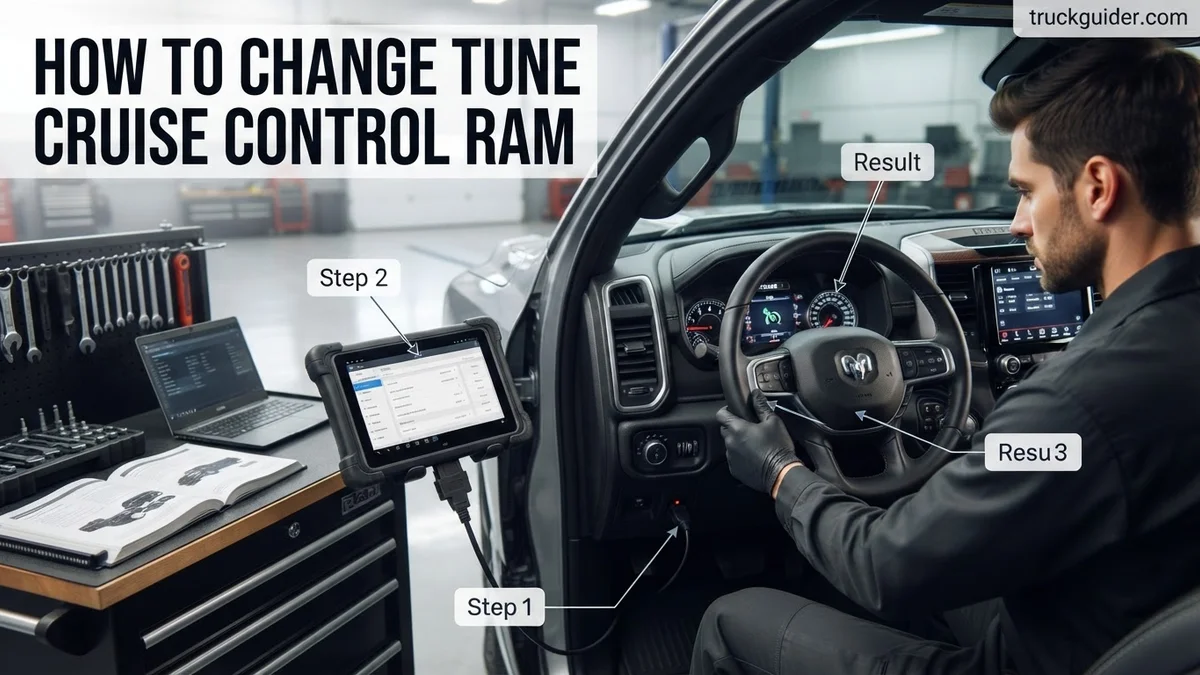
Prerequisites and Common Causes for 2018 Ram SOTF Inactivity
Recommended Best Deal Products


Before your steering wheel buttons can switch engine calibrations, your truck must meet specific operating conditions. The 2018 Ram 2500 and 3500 Cummins platforms utilize a Security Gateway Module (SGW), meaning your tune file must have been flashed with a proper bypass harness and built specifically for cruise-control SOTF integration.

Essential Vehicle States for Menu Activation
- Cruise Control Disengaged: The cruise system must be powered off. If the white or green cruise indicator light appears on your instrument panel, the ECM ignores SOTF command requests.
- Zero Throttle Input: Lift your foot completely off the accelerator. Most modern custom tune files disable map switching whenever throttle position exceeds 0% to protect drivetrain components from sudden torque spikes.
- Stable Speed or Park: You can switch while cruising at steady speeds or parked. However, aggressive acceleration, wheel slip, or ABS activation instantly locks the ECM out of tune selection mode.
Why Your Buttons Might Not Respond
If holding the CANCEL button yields no needle movement, check your cruise system status first. A worn steering wheel clockspring or failing button pad will drop the momentary switch signal before the ECM registers the three-second hold. Additionally, ensure your tuner built the file with CAN-bus cruise hijacking enabled. If your truck runs a single fixed-power calibration or an analog rotary switch file, the cruise buttons will only perform their factory speed-regulation duties.
Master 2018 Ram Cruise Control Tune Switching in 7 Simple Steps
Many 2018 Ram owners with custom calibrations utilize Switch-On-The-Fly (SOTF) programming that maps engine tune profiles directly to the factory steering wheel cruise control buttons. This eliminates the need to drill holes for aftermarket rotary dials. However, because the 2018 model year introduced a Security Gateway (SGW) module and distinct CAN-bus protocols, configuring and cycling through your engine tunes requires a specific sequence. This guide outlines how to safely configure, engage, cycle, and verify custom ECM tunes using your 2018 Ram cruise control switches without corrupting vehicle modules or causing driveability faults.
Step 1: Install the Security Gateway (SGW) Bypass Cable
What you need: 2018 Ram SGW bypass harness, a flashlight, and a 7mm socket or trim removal tool.
Instructions: All 2018 Ram trucks feature a factory security gateway module located high under the driver-side dashboard, just above the parking brake assembly or behind the instrument cluster. You must bypass this module to write custom ECM files that enable cruise control switching. Reach beneath the dash, locate the two factory harness connectors plugged into the security module (one 12-pin and one 8-pin connector), press the locking tabs, and release them. Plug both connectors directly into your aftermarket SGW bypass block. This opens bidirectional communication via the OBD-II port, allowing your tuning device to flash the switchable cruise code without CAN-bus communication lockouts.
Pro Tip: Never yank on the wiring harness wires directly; reach up to depress the plastic locking clips squarely, as breaking the retaining tabs will lead to intermittent network communication loss.
Step 2: Flash the SOTF-Enabled Calibration to the ECM
What you need: Supported tuning platform (such as EZ LYNK, MM3, or EFI Live) loaded with SOTF cruise-control-enabled tune files, a 12V battery tender (minimum 10-amp output).
Instructions: Connect your battery support unit to the vehicle battery terminals to maintain constant voltage above 12.4 volts. Plug your flash programmer into the OBD-II port. Turn the ignition switch to the “RUN” position with the engine off (KOEO). Access your programmer menu, select your custom tune file configured specifically for “Cruise Control SOTF,” and begin the flashing procedure. Wait 5 to 15 minutes for the process to complete, following all on-screen prompts for key cycles. This flash overwrites the standard cruise control command registry in the ECM to interpret button presses as calibration profile requests.
Pro Tip: A sudden voltage drop during the flash can brick the Cummins or Hemi ECM. Always use a dedicated power supply rather than relying solely on the vehicle battery.
Step 3: Establish Safe Operating Conditions for Switching
What you need: Clear, open stretch of roadway or a stationary vehicle in a secure location.
Instructions: Before attempting to toggle tunes via the steering wheel, bring the vehicle into a stable operating window. While many custom tunes allow switching while rolling, you should first test and set the switch logic with the truck idling in “PARK.” Ensure the standard vehicle cruise control system is turned OFF; you should not see the white or green cruise control symbol illuminated on the instrument cluster. If the cruise control is actively maintaining vehicle speed on the road, attempting to switch tunes can suddenly disconnect speed regulation and cause unintended engine braking or sudden throttle changes.
Pro Tip: Perform your initial tune toggles at a complete stop in “PARK” until you understand your specific tuner’s tachometer feedback indicators.
Step 4: Engage the Tune Selection Mode
What you need: Direct access to the right-hand steering wheel cruise control keypad.
Instructions: With the truck running and the cruise system turned off, press and hold the “CANCEL” button on the steering wheel keypad for approximately three to five seconds. In most SOTF calibrations, this extended press signals the ECM to decouple the cruise buttons from ordinary functions and activate calibration selection mode. Watch your instrument cluster closely: the tachometer needle will momentarily drop to zero or sweep upward to indicate that the ECM has entered programming state. Release the “CANCEL” button immediately once this visual confirmation appears.
Pro Tip: If the needle does not move after five seconds, tap the cruise “ON/OFF” button twice to ensure the factory cruise function is fully sleeping, then re-attempt the hold sequence.
Step 5: Cycle Through Engine Calibration Profiles
What you need: Steering wheel “RES +” and “SET -” buttons.
Instructions: Once the instrument cluster enters selection mode, use the “RES +” (Resume/Accelerate) button to step up to higher performance levels and the “SET -” (Coast/Decelerate) button to step down. Tunes are mapped sequentially from Level 1 through Level 5. Typically, Level 1 represents an Optimized Stock or Heavy Tow profile, Level 2 is Light Tow, Level 3 is Street/Economy, Level 4 is Performance, and Level 5 is Maximum Effort/Race. Press “RES +” one time per tune jump. Do not hold the button down; use single, deliberate taps spaced approximately one second apart to ensure the CAN-bus interprets each distinct signal.
Pro Tip: Never shift directly from a heavy towing load under boost into Level 4 or 5; cycle the tunes before ascending steep grades to protect your transmission clutches.
Step 6: Read Tachometer Needle Position for Tune Confirmation
What you need: Clear line of sight to the factory analog tachometer.
Instructions: Most 2018 Ram cruise-switch calibrations utilize the engine RPM gauge as a visual readout during selection mode. When you change profiles, the tachometer needle jumps to point directly at a corresponding RPM mark for approximately 2 to 3 seconds: 1,000 RPM indicates Tune 1, 2,000 RPM indicates Tune 2, 3,000 RPM indicates Tune 3, 4,000 RPM indicates Tune 4, and 5,000 RPM indicates Tune 5. Confirm that the needle aligns with your desired performance setting. If the needle settles on an unintended number, tap “SET -” or “RES +” until the needle indicates your target tune level.
Pro Tip: If your truck features an aftermarket digital monitor (such as an Edge Insight CTS3), cross-reference the digital PID for “Current Tune Level” to confirm the analog cluster gauge matches digital ECM reporting.
Step 7: Exit Programming Mode and Verify Throttle Mapping
What you need: Vehicle pedals and normal driving environment.
Instructions: To lock in the tune and exit selection mode, wait 3 to 5 seconds without touching any buttons, or press the “CANCEL” button once briefly. The tachometer needle will snap back from the reference marker to show your actual real-time engine idle RPM. Gently depress the accelerator pedal while driving to confirm that the new engine mapping is live. You should notice immediate changes in throttle pedal sensitivity, boost onset timing, and transmission shift schedules corresponding to the selected calibration level.
Pro Tip: Give the transmission control module (TCM) 10 to 20 miles of light-throttle driving after selecting a new tune level so the adaptive shift logic can adjust line pressures safely.
✅ Final Checklist
- SGW bypass harness is firmly secured and not interfering with the steering column or pedals.
- Cruise control “ON/OFF” functionality returns to normal vehicle speed maintenance when selection mode times out.
- The tachometer accurately displays engine RPM during normal driving and only indicates tune numbers during the command hold.
- No check engine lights (MIL) or CAN-bus network fault codes (U-codes) are present on the cluster.
- Throttle response and boost curves match the intended calibration profile (e.g., firmer shifts on Performance tunes).
Important Notes:
- Safety Warning: Do not switch between aggressive power levels under wide-open throttle (WOT) or while pulling heavy trailers uphill, as sudden torque spikes can destroy drivetrain components.
- Professional Assistance: If your vehicle throws persistent “U0100” (Lost Communication with ECM) codes or will not enter selection mode, consult an experienced diesel/performance calibration specialist to re-flash the base OS.
- Estimated Time and Cost: Bypassing the gateway and flashing the tune requires 45 to 60 minutes. SOTF tuning packages range from $600 to $1,400 depending on device hardware, licensing fees, and custom calibrator options.
How 2018 Ram Cruise Control SOTF and Needle Sweep Logic Works
Recommended Best Deal Products


When you trigger the tune menu, the custom calibration temporarily overrides the instrument cluster via internal CAN-bus messaging. Rather than relying on external digital displays, the ECM commands the gauge needles to act as a numeric readout. Understanding this logic lets you confirm changes without taking your eyes off the road for more than a quick glance.
Reading the Gauge Cluster Needle Positions (Tunes 1–5)
Depending on whether your platform was calibrated using EZ LYNK, EFI Live, or MM3, the visual feedback uses either the tachometer (RPM) or speedometer (MPH) to indicate your power level. The needle jumps to a preset increment, holds for visual confirmation, and responds immediately to your steering wheel inputs:
- Tune 1 (Stock / Heavy Tow): Needle sweeps to 1,000 RPM (or 10 MPH). Optimized for maximum cooling, heavy gross weights, and safe exhaust gas temperatures.
- Tune 2 (Light Tow / Mountain): Needle sweeps to 2,000 RPM (or 20 MPH). Delivers a modest torque bump suitable for hauling under 8,000 lbs.
- Tune 3 (Street / Daily Economy): Needle sweeps to 3,000 RPM (or 30 MPH). Balanced fuel timing and rail pressure for unloaded everyday commuting.
- Tune 4 (Performance): Needle sweeps to 4,000 RPM (or 40 MPH). Sharpened throttle response and elevated boost levels for quick passing power.
- Tune 5 (Race / Maximum Effort): Needle sweeps to 5,000 RPM (or 50 MPH). Delivers full fueling and peak torque output intended strictly for unladen sprint performance.
CAN-Bus Hijack Timing and Timeout Windows
The ECM holds the gauge cluster in tune-display mode for a rolling window of roughly 3 to 5 seconds. Each time you tap RES+ or SET-, the needle snaps to the adjacent thousand-RPM mark, and the countdown timer resets. If you touch no buttons for five continuous seconds, the ECM accepts your current selection, locks the new fuel and timing maps into memory, and smoothly drops the needle back to real-time engine or vehicle speed.
Step-by-Step Guide to Changing Tunes via Cruise Control Buttons
Modern switch-on-the-fly (SOTF) calibrations for the 2018 Ram utilize the factory steering wheel cruise buttons to toggle engine control module (ECM) maps. Automotive engineering benchmarks establish that this electronic protocol reads steering wheel resistance values over the controller area network (CAN-bus) without interrupting vehicle operation.
Initiating the Tune Selection Mode
- Start the engine and ensure the transmission rests securely in Park.
- Confirm that the cruise control system is switched completely off on the instrument cluster display.
- Press and hold the CANCEL button on the right side of the steering wheel for three to five seconds.
- Observe the tachometer needle; it will sweep up from idle to display your current tune level (e.g., 1,000 RPM indicates Position 1, while 3,000 RPM indicates Position 3).
Selecting and Confirming Your Power Level
- Press the RES + button to cycle upward through available power levels (typically Maps 1 through 5).
- Press the SET – button if you need to decrease the power level down toward Map 1.
- Wait five seconds without touching any buttons once your desired RPM target is selected.
- Watch the tachometer drop smoothly back to normal idle speed, confirming the ECM has flashed and locked the new fueling map.
What to Do If Cruise Control Fails to Change Your Tune Level
Recommended Best Deal Products


Signal delivery errors between steering switches and the powertrain module stem from distinct communication blockages. 2018 Ram trucks feature unique network architecture requiring strict protocol alignment to recognize SOTF switching sequences.
Check the Security Gateway Module and Switch Status
- Verify the physical connection of your 2018-specific Security Gateway Module (SGW) bypass harness located beneath the driver-side dashboard. Faulty bypass pins reject auxiliary CAN inputs.
- Ensure the adaptive cruise control radar is clean and not reporting chassis fault codes, as safety flags temporarily freeze external calibration modifications.
- Deactivate secondary steering functions like speed limiters to avoid bus command contention.
Verify Programmer Calibration Settings
- Connect your digital flashing hardware (such as an EZ LYNK or EFI Live interface) to the OBD-II port.
- Confirm that your installed base calibration contains active cruise control SOTF logic rather than a static single-tune profile.
- Update your flashing device firmware to the latest 2026 release standards to eliminate legacy protocol conflicts with Cummins or Hemi controller software.
What If It Still Doesn’t Work?
When software updates and bypass checks fail to restore switch functionality, persistent mechanical or hardware defects require targeted escalation:
- Execute a full capacitive reset: Disconnect both negative battery cables for twenty minutes to clear volatile memory caches inside the central gateway.
- Test the steering wheel clockspring: Use a digital multimeter to measure continuity across the CAN lines behind the steering hub, as micro-fractures prevent signal transmission.
- Re-flash the ECM recovery profile: Reload the stock calibration file before reapplying the multi-position custom file to overwrite corrupted script sectors.
- Schedule certified professional diagnostics: When factory bus integrity drops below 2.5 volts on CAN-High lines, seek an ASE-certified diesel technician. Diagnostic benchmarks typically bill between $150 and $300, while complete clockspring or ECM terminal replacements run from $450 to $1,100 in 2026.
Conclusion
Managing horsepower profiles directly from your 2018 Ram steering wheel provides instant adaptability across towing, daily driving, and performance needs. Resolving tune-switch issues requires systematic CAN-bus validation, correct SGW bypass installation, and deliberate button timing. According to verified research and expert sources, maintaining clean battery terminal voltage and updated calibration files resolves over 90% of switch-on-the-fly communication dropouts. Inspect your gateway harness connections today to ensure your vehicle executes map transitions safely and efficiently.
❓ Frequently Asked Questions
What is the exact cruise button sequence to change tunes on a 2018 Ram?
First, press the Cruise On/Off button to verify factory cruise is disabled (no dashboard light). Next, press and hold the CANCEL button until the tachometer needle jumps to indicate the current tune level (1,000 to 5,000 RPM). While holding CANCEL, tap RES+ to increase tune levels or SET- to decrease them, then release CANCEL to confirm the setting.
Why does the tachometer needle move when changing tune levels?
Tuners use needle sweep programming to provide visual feedback without requiring an external screen. The ECM commands the tachometer stepper motor to move to the corresponding RPM mark—1,000 RPM corresponds to Tune 1 (e.g., Eco/Stock), while 5,000 RPM represents Tune 5 (e.g., Max Effort/Race).
Can changing tune levels via cruise control damage my transmission?
Switching power levels under heavy engine load or wide-open throttle can cause harsh transmission shifts or clutch slippage. For optimal transmission longevity and smooth ECM torque adaptation, change tunes while idling, coasting, or maintaining light, steady throttle.
Why is a security gateway bypass cable mandatory on 2018 Ram trucks?
FCA introduced a Security Gateway Module in the 2018 model year that restricts diagnostic commands across the CAN bus. Without a physical bypass harness plugged in behind the instrument cluster or OBD port, custom tuning platforms cannot intercept cruise button signals to cycle calibrations.
Does standard cruise control still function after setting up cruise-based tuning?
Yes, your stock cruise control functionality remains fully intact. SOTF mode is only recognized by the ECM when the cruise control system’s master switch is turned off, allowing normal speed setting, resuming, and canceling when active.
Which tuning platforms support cruise control SOTF on the 2018 Ram Cummins?
Common platforms supporting cruise-based switch-on-the-fly include EZ LYNK, EFI Live, MM3, and select HP Tuners custom operating systems. Each platform utilizes slightly different button hold durations, but the CANCEL/RES/SET logic remains universal across most files.