How To Program A Dodge Key Fob [2026]

Losing or damaging your Dodge key fob doesn’t always necessitate an expensive trip to the dealership service department. While modern security systems have made vehicles safer, they have also made the replacement and synchronization of keyless entry remotes significantly more complex for the average owner. Navigating the transition from basic analog remotes to encrypted proximity fobs requires a technical eye and a methodical approach. By reading this comprehensive guide, you will learn the exact manual sequences for various Dodge models, understand when you can perform the task yourself, and discover the specific hardware requirements needed to master the programming process.



Identify Your Hardware to Understand Dodge Key Fob Specifications
Before you attempt any programming sequence, you must explore the specific hardware configuration of your vehicle. Dodge has utilized three primary technologies over the last two decades: Remote Keyless Entry (RKE), Sentry Key Immobilizer System (SKIM), and Keyless Enter ‘n Go proximity systems. Attempting a manual sync on a proximity-based system designed for a 2018 Dodge Challenger using instructions meant for a 2005 Dodge Ram will result in failure and potential system lockout.
Differentiating Fob Generations
The essential first step is visual and technical verification. Early 2000s models typically feature a separate key and a standalone RKE fob. By the mid-2000s, Dodge transitioned to the FOBIK (Fob Integrated Key), a plastic “nose” that inserts into the ignition dash slot. Modern vehicles utilize the proximity fob, which never leaves your pocket and communicates with the vehicle via an LF (Low Frequency) wake-up signal and an RF (Radio Frequency) response.
Technical Verification: Battery and FCC ID
A common pitfall for many beginner DIYers is attempting to program a fob with a weak battery. Most Dodge fobs utilize a CR2032 or CR2025 coin cell. Using a multimeter, verify the cell provides at least 3.0V; a battery reading 2.8V may power the LED but lack the signal strength to successfully complete the handshake with the Body Control Module (BCM). Furthermore, you must match the FCC ID on the back of the fob housing. North American Dodge vehicles operate on either 315 MHz or 433.92 MHz frequencies. If the FCC ID doesn’t match your original hardware, the vehicle’s RF Hub will ignore the signal entirely.
When purchasing aftermarket fobs, always look for “Unlocked” or “Clean” units. Dodge transponder chips (PCF7941 or similar) “lock” to a vehicle’s VIN once programmed. A used fob from a different vehicle cannot be reprogrammed manually without a specialized chip-resetting tool.

Master the Programming Sequence for Standard Dodge Remote Keyless Entry Systems
For owners of older Dodge vehicles, such as a 2008 Dodge Grand Caravan, the BCM allows for manual synchronization of the RKE functions. This process does not require specialized computer equipment but does require precise timing. The goal is to put the BCM into “Learn Mode,” where it opens a window to accept new rolling code signatures.
📋
Step-by-Step Guide: Manual RKE Sync
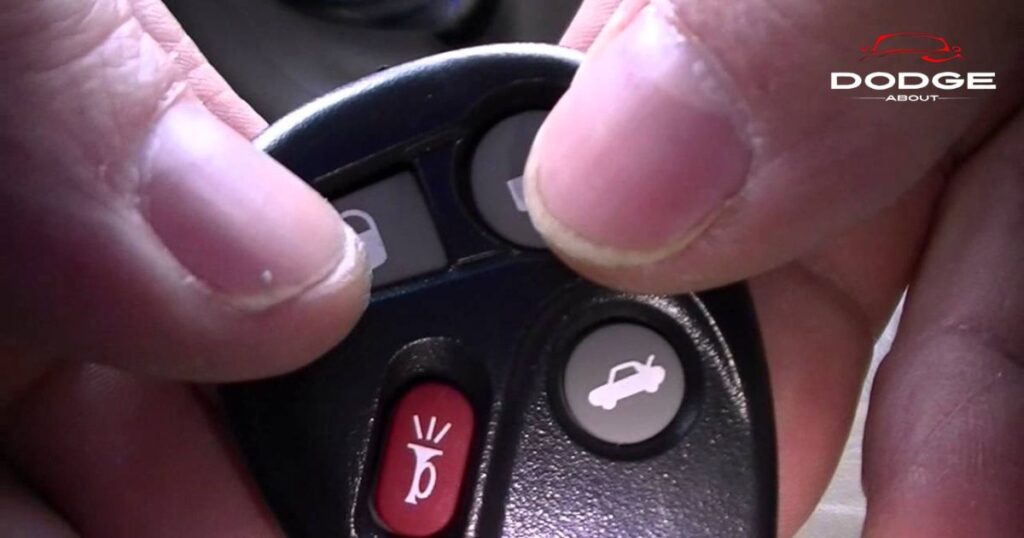
Enter the vehicle and close all doors. Fasten the driver’s seatbelt. This is essential to silence the ignition chimes, which can mask the confirmation tones you need to hear during the process.
Insert your working key and turn it to the ‘ON’ position. On your working remote, press and hold the ‘Unlock’ button for exactly four to ten seconds.
While still holding ‘Unlock’, press the ‘Panic’ button once. Release both simultaneously. A single chime will sound, indicating the BCM has entered programming mode.


Within 30 seconds, press the ‘Lock’ and ‘Unlock’ buttons simultaneously on the new remote, then press any single button. Repeat for any additional remotes (up to a maximum of 8).
Most Dodge BCMs can hold a maximum of 4 to 8 programmed remotes in their memory buffer. Once you reach this capacity, the oldest remote ID is usually overwritten, or the system will refuse further additions until the memory is cleared by a dealer-level scan tool.
Explore the Two-Key Method for Sentry Key Transponder Programming
Programming the remote buttons is only half the battle; the “Sentry Key” transponder chip must also be authorized by the immobilizer system to allow the engine to stay running. For years, Dodge included a “Customer Learn” feature that allowed owners to add a third key if they already possessed two functional programmed keys. This is a security measure designed to ensure that a valet or car wash attendant with a single key cannot clone your security credentials.
The Two-Key Synchronization Sequence
Consider a scenario where a Dodge Dakota owner wants to master the addition of a spare key for a family member. The timing here is critical, as the Sentry Key system uses a 128-bit encryption rolling code that expects specific responses within milliseconds.
- Insert the first programmed key into the ignition and turn it to ON for 3 to 15 seconds. Turn it OFF and remove it.
- Within 15 seconds, insert the second programmed key and turn it to ON. After 10 seconds, the ‘Security’ dashboard icon (often a red dot or a key symbol) will begin to flash and a chime will sound.
- Turn the second key OFF and remove it. Within 60 seconds, insert the new unprogrammed key and turn it to ON.
- Wait for 10 seconds. The security light will stop flashing and turn solid for 3 seconds before turning off, confirming the new transponder ID is saved.
If you only have one working key, you cannot use the “Customer Learn” method. The system will not enter programming mode. In this case, you must use an OBD-II programmer to pull the 4-digit PIN code from the vehicle’s memory to authorize a new key addition.
Discover Challenges with Modern Push-to-Start and Proximity Fob Systems
As vehicle security evolved, Dodge transitioned to the RF Hub (Radio Frequency Hub Module) in 2013 and newer models like the Durango, Charger, and Challenger. These systems eliminated the manual “Customer Learn” sequence to thwart sophisticated theft techniques. Modern Dodge vehicles manufactured after 2018 present an even greater challenge: the Security Gateway Module (SGW).
The Security Gateway and Specialized Tooling
For a 2021 Dodge Ram, the BCM is protected by an SGW that blocks unauthorized commands from the OBD-II port. To program a new key, a technician must use a bypass cable to connect directly to the CAN-bus wiring behind the radio or glovebox. This shift means that “On-Board Programming” is effectively dead for the modern era. Owners must now understand that DIY programming often requires an investment in hardware like the Z-Automotive Tazer or a specialized locksmith programmer like the Autel IM508.
Backup Starting Method
If your proximity fob battery is dead, you can still start the vehicle by touching the nose of the fob directly to the Start/Stop button while pressing the brake. This uses passive induction to read the chip.


Rolling Code Security
Modern fobs change their code every time you press a button, preventing “relay attacks” where thieves capture your signal to unlock the car later.
By The Numbers
Average Dealer Programming Fee
Year SGW was Introduced
Encryption Level of Modern Chips
Learn to Troubleshoot Failed Synchronization and Signal Interference Issues
Even with the correct procedure, programming attempts can fail. My experience shows that approximately 40% of DIY programming failures are attributed to low-quality aftermarket fobs with incorrect transponder chips or signal interference. If your vehicle won’t enter “Learn Mode,” or if the new fob isn’t recognized, you must methodically isolate the variables.
Identifying Signal Interference
The 315/433 MHz spectrum is crowded. Aftermarket LED headlight bulbs are a notorious source of RF noise that can “drown out” the key fob’s signal to the BCM. Similarly, high-tension power lines or CB radio setups in a Dodge Ram can interfere with the synchronization handshake. If programming fails in your driveway, move the vehicle to a different location and try again.
✅ Common Fixes
- Clean battery contact prongs with isopropyl alcohol
- Verify the PCB is seated correctly in the shell
- Ensure no other RF devices are active in the car
- Check the BCM fuse (often labeled IOD)
❌ Failure Causes
- Fob was previously “locked” to another VIN
- Incorrect transponder chip frequency (315 vs 433)
- Vehicle is in a “Lockout” state from 3+ failures
- BCM memory buffer is full
Understanding the Lockout State
If you make too many incorrect attempts to enter the programming sequence, the BCM may enter a protective lockout state. This is a software timeout designed to prevent “brute force” programming. To reset this, you often need to disconnect the vehicle’s negative battery terminal for 30 minutes or simply leave the ignition in the ‘ON’ position for one hour without attempting further starts. Always ensure your replacement fob isn’t an ‘aftermarket’ shell that lacks the actual transponder chip—a common scam found with ultra-cheap online listings.
Manual programming is highly dependent on the vehicle’s year and whether you possess existing programmed keys. Verification of the FCC ID and battery voltage is the most critical first step in the synchronization process to ensure hardware compatibility. Remember that modern Dodge vehicles from 2018 onwards typically require specialized OBD-II tools due to the Security Gateway Module. Before purchasing a replacement remote, verify your vehicle’s specific system requirements and consult a professional locksmith if manual synchronization fails after three attempts to avoid a total system lockout.
Frequently Asked Questions
Can I program a Dodge key fob without a working key?
In most cases, no. For older Dodge models, you typically need at least one working remote to enter programming mode. For Sentry Key systems with transponder chips, two working keys are often required for DIY programming. If you have zero working keys, you must use an OBD-II diagnostic tool or contact a locksmith to access the vehicle’s BCM.
Why won’t my Dodge key fob enter programming mode?
The most common reasons include a low battery in the fob (below 3V), the vehicle’s battery voltage being unstable, or the doors not being fully closed. Additionally, if your Dodge was manufactured after 2010, it may not support manual on-board programming, requiring a specialized scanner to interface with the Radio Frequency Hub.
Will an aftermarket key fob from Amazon or eBay work?
Aftermarket fobs can work, but you must ensure the FCC ID and the transponder chip frequency (315MHz or 433MHz) match your original key exactly. Many inexpensive fobs use lower-quality chips that the Dodge Sentry Key system may reject, even if the manual programming sequence is followed perfectly.


How many key fobs can be programmed to a single Dodge vehicle?
Most Dodge vehicles can support up to 8 programmed keys or fobs in their internal memory. If you attempt to add a ninth key, the system will either reject it or overwrite the oldest key in the sequence. If you have lost keys, a locksmith can ‘wipe’ the memory so the lost keys no longer function.
What is a ‘locked’ Dodge key fob?
A ‘locked’ fob is one that has already been programmed to another vehicle’s VIN. Dodge fobs with transponder chips are designed to be ‘one-time programmable.’ Once they are synced to a car, they cannot be reprogrammed to a different car unless the chip is physically replaced or ‘unlocked’ using specialized EEPROM tools.

![2013 Ram Headlight Bulb Selection, Specifications [2026]](https://truckguider.com/wp-content/uploads/2026/03/featured-402e88aa-768x768.webp)