How to Rotate Truck Tires: Execution Protocol for 2WD and 4×4

Uneven tread wear is the fastest way to compromise your truck’s handling and waste money on premature replacements. Rotating your tires systematically shifts their position on the vehicle, ensuring each tire shares the burden of steering, braking, and load-bearing equally over its lifespan.
To rotate your truck tires effectively, you must identify your vehicle’s specific drivetrain pattern and utilize the proper safety equipment to lift and secure the truck. This guide outlines the necessary tools, identifies the optimal rotation intervals for your specific truck configuration, and provides the step-by-step technical procedures required to perform the job safely and correctly at home.

Prime for Young Adults — 6 Months Free
Students and 18–24s get six months of Prime free, then half price.
Start 6 Months Free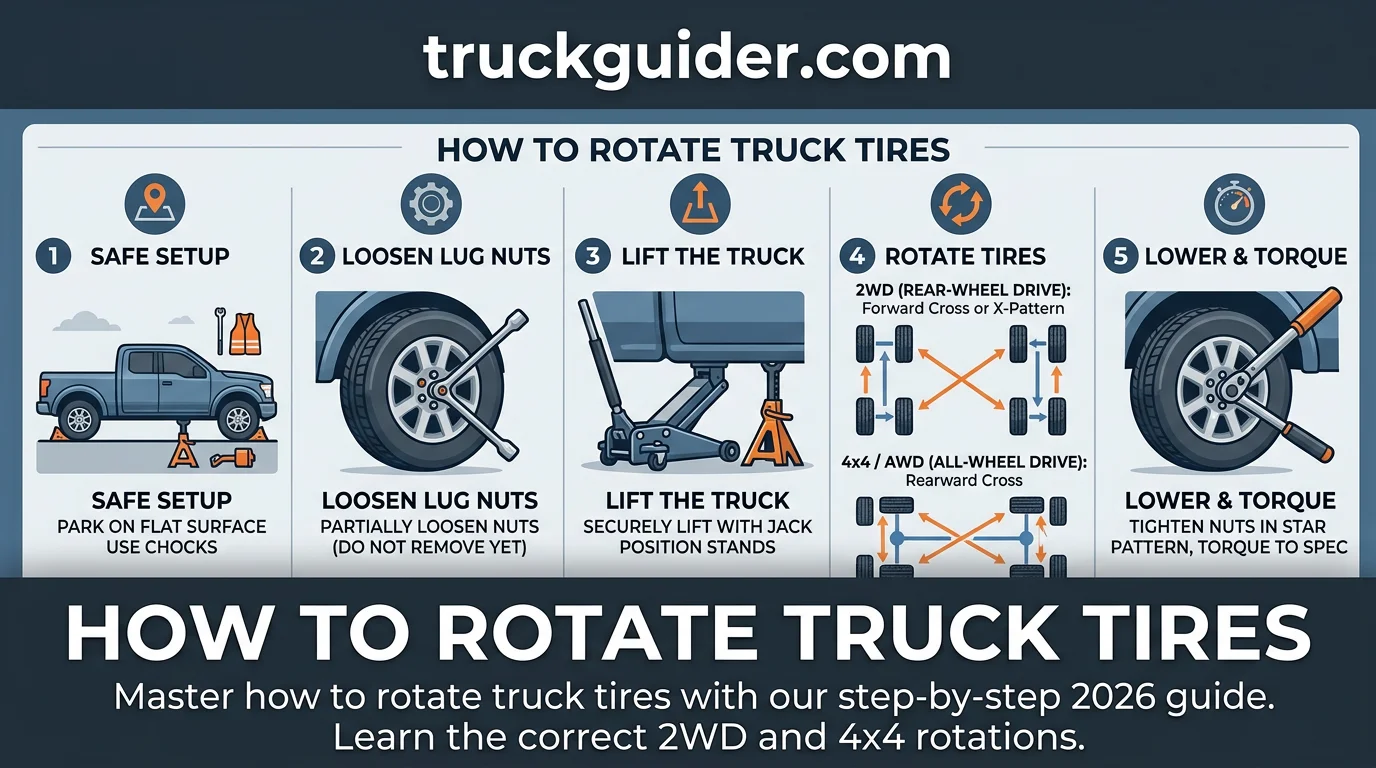
Understanding Why Truck Tire Rotation is Essential
Recommended Best Deal Products


Truck tires rarely wear at the same rate. Due to uneven weight distribution and the unique forces applied during braking and acceleration, tires on your front axle endure different stresses than those on the rear. Since front tires handle steering while rear tires manage power delivery, specific treads degrade faster depending on your truck’s drivetrain.
The primary purpose of tire rotation is to ensure even wear across all tires, which can extend their overall life significantly. By systematically moving each tire to a new position, you balance the tread depletion and maximize the value of your set. Whether you drive a 2WD or 4WD truck, this practice is vital for maintaining consistent grip on the road.
Beyond longevity, regular rotation translates to tangible performance benefits. Balanced tread depth promotes better vehicle handling, improves steering responsiveness, and can even contribute to better fuel efficiency. Neglecting this maintenance leads to uneven patches, potentially compromising your truck’s safety and forcing an expensive premature replacement of your entire tire set.
How Often to Rotate Truck Tires for Optimal Longevity
To ensure even tread wear and maximize your tires’ lifespan, you should typically perform a tire rotation every 5,000 to 8,000 miles. While this is the industry standard for most trucks, your vehicle manufacturer may specify a different interval. Always consult your owner’s manual, as it remains the definitive source for recommended rotation frequency, specific rotation patterns, and precise lug nut torque specifications tailored to your truck’s weight class and drivetrain configuration.
Your driving habits also play a significant role in how quickly your tires wear. If you frequently engage in heavy-duty towing, aggressive off-roading, or consistent high-speed highway driving, you may need to rotate your tires more often. These conditions place unique stresses on rubber compounds and tread blocks. Adjusting your maintenance schedule to account for these environmental factors helps prevent uneven wear patterns before they compromise your truck’s handling or safety.
Many truck owners find it easiest to sync their tire rotation schedule with their oil change intervals, making it a simple habit to maintain.
Essential Tools for Rotating Truck Tires Safely
Recommended Best Deal Products

To rotate your truck tires safely, you need a high-capacity floor jack to lift the vehicle. Never rely solely on the jack; always use properly placed jack stands to support the truck’s weight once raised.
Use a sturdy lug wrench or breaker bar to loosen nuts before lifting. A calibrated torque wrench is mandatory for re-tightening. Always consult your owner’s manual for specific settings, typically ranging from 90 to 150 ft-lbs, rather than tightening by feel to ensure wheel safety.

Audible — Listen Free for 30 Days
One free credit a month and thousands of titles included.
Listen Free for 30 DaysFinally, keep a tire pressure gauge on hand. Trucks often require specific pressure levels, generally between 30 and 80 PSI depending on the load and tire type, to ensure even tread wear and optimal handling performance.
Standard Truck Tire Rotation Patterns for 2WD and 4×4
Rotating Tires on 2WD Trucks
For most rear-wheel drive (RWD) trucks, the Forward Cross pattern is the industry standard. In this configuration, you move the front tires straight back to the rear axle, while the rear tires cross over to the opposite side as they move to the front. This ensures even tread wear across all four corners.
Alternatively, some technicians utilize an X-Pattern for 2WD vehicles, where all four tires are crossed to the opposite sides of their respective axles. Always consult your vehicle owner’s manual first, as it remains the definitive source for the manufacturer’s recommended rotation pattern and specific lug nut torque requirements.
How to Rotate 4×4 and 4WD Truck Tires
Vehicles equipped with 4WD or AWD systems generally require a Rearward Cross pattern to account for the unique stress placed on the drivetrain. In this method, the rear tires are moved straight to the front axle, while the front tires cross over to the opposite sides as they move to the rear.
The optimal rotation pattern depends heavily on your truck’s specific drivetrain and tire type. Because tread patterns on heavy-duty or all-terrain tires can be directional, verify your tire sidewall markings before beginning. Adhering to the manual’s guidance prevents premature wear and maintains optimal handling for your specific 4×4 configuration.
Step-by-Step Instructions: How to Rotate Truck Tires Correctely
Begin on a level surface. Engage the parking brake firmly and place heavy-duty wheel chocks behind the rear tires to prevent rolling. Before lifting the vehicle, use a tire iron or impact wrench to loosen each lug nut about one-half turn while the tires are still touching the ground.
Locate the truck’s reinforced jack points as specified in your owner’s manual. Carefully raise the vehicle using a high-capacity floor jack designed for heavy loads. Once at the desired height, lower the truck onto heavy-duty jack stands. Never rely on the hydraulic jack alone while working under or around the vehicle.
Remove the lug nuts and pull the wheels off the hubs. As you move each tire to its new position based on your chosen rotation pattern, inspect the treads for uneven wear, debris, or sidewall cracks. Use a wire brush to clean any rust or oxidation from the wheel hub mating surfaces.
Audible Premium Plus — Annual Membership
12 audiobook credits up front, plus the full Audible catalogue.
See Annual PlansRemount the wheels onto the hubs and tighten the lug nuts by hand until snug. Lower the truck back to the ground. Finally, use a calibrated torque wrench to tighten the lug nuts in a crisscross pattern to the specific foot-pound requirements found in your service manual to ensure even clamping pressure.
How to Rotate Truck Tires: Critical Considerations and Pitfalls
Dealing with Directional and Staggered Tires
Directional tires feature tread patterns designed to rotate in one specific direction and cannot be swapped across sides. Furthermore, trucks with staggered fitments—where rear wheels are wider than front wheels—require specialized rotation patterns or may be limited to side-to-side swaps. Always verify your specific tire and wheel specifications to avoid catastrophic handling issues.
For trucks equipped with a full-size matching spare, incorporate it into a five-tire rotation pattern to distribute wear evenly across all rubber. Never ignore uneven wear; if you notice cupping or scalloping, rotation will not fix it. You must address underlying alignment or wheel balance issues immediately to prevent rapid, recurring tire degradation.
Post-Rotation: TPMS Reset and Final Checks
After relocating your tires, you must verify air pressure in every tire, as recommended by the placard inside your driver-side door jamb. Because your truck’s Tire Pressure Monitoring System (TPMS) identifies sensors by their specific chassis location, moving tires often triggers a system fault. You must perform a TPMS “relearn” procedure to calibrate the computer to the new positions. Ram owners can find model-specific steps in our Dodge Ram TPMS reset and relearn guide. If your Tacoma tires are due for replacement, our best tires for Toyota Tacoma guide covers the options.
Never work under a truck supported only by a hydraulic jack. Always utilize heavy-duty jack stands rated for your vehicle’s gross weight to prevent fatal crushing injuries if the lifting equipment fails.
Key Takeaways
-
✓
Rotate tires every 5,000 to 7,500 miles to prevent premature tread cupping. -
✓
2WD and 4×4 trucks require different rotation patterns for optimal balance. -
✓
Always use a torque wrench to ensure lug nuts meet manufacturer specifications. -
✓
The process allows for a visual inspection of suspension components and brake pads. -
✓
Proper rotation is the most effective method to ensure maximum tire longevity.
❓ Frequently Asked Questions
1
What is truck tire rotation?
Tire rotation is the practice of moving truck tires from one wheel position to another in a systematic order. This technique accounts for the different ways front and rear tires wear down, ensuring all four tires degrade at the same rate and maintain consistent grip across the entire tread surface.
2
How does the rotation process work?
The process involves lifting the truck safely, removing the wheels, and moving them to new positions based on your truck’s drivetrain. For 2WD, tires typically move in a forward-cross or rearward-cross pattern, while 4×4 trucks often use an ‘X’ pattern to ensure the tread edges face the road correctly after moving.
3
Why is tire rotation important for trucks?
Trucks often carry heavy loads, which places uneven stress on tires. Without rotation, the front tires may wear out on the shoulders from steering, while rear tires may wear flat from weight. Regular rotation prevents these issues, maximizes your investment, and keeps your vehicle handling predictably in adverse weather.
4
What are the benefits of DIY tire rotation?
Performing this maintenance yourself provides a cost-effective method to monitor your truck’s health. Beyond saving on service fees, it gives you direct access to inspect your braking system, CV boots, and suspension bushings, allowing you to catch mechanical issues before they become expensive repairs or roadside breakdowns.
5
How can I get started with tire rotation?
Start by gathering a reliable floor jack, jack stands, and a torque wrench. Consult your owner’s manual for your truck’s specific rotation instructions and factory-recommended torque specs. Once you have the correct pattern mapped out, find a flat, level surface and execute the steps methodically to ensure a professional result.
6
Can I rotate my truck tires myself?
Yes, it’s a common DIY task with the correct tools, especially jack stands for safety and a torque wrench for proper tightening.


![Dodge Dakota Towing Capacity Guide: 1987-2011 Ratings [2026]](https://truckguider.com/wp-content/uploads/2026/03/dodge-dakota-tow-capacity-featured.webp)