P0700 Code Dodge: Diagnosing Hidden Transmission Faults [2026]

The P0700 code in a Dodge vehicle is an informational ‘bridge’ code that indicates the Transmission Control Module (TCM) has detected a fault. To identify the root cause, you must use an advanced scanner to retrieve specific sub-codes, as P0700 alone does not specify which mechanical or electrical component has failed.
🎯 Key Takeaways
- P0700 is a general request from the TCM to turn on the Check Engine Light.
- An OBD-II scanner with TCM access is required to see the actual fault code.
- Faulty solenoid packs are a primary failure point for many Dodge models.
- Limp-in mode often accompanies P0700 to protect the transmission from further damage.
- Corroded wiring harnesses near the transmission are frequent culprits in older Dodge Rams.
If you see code P0700 on your Dodge Ram, Grand Caravan, or Charger, do not rush out to buy a new transmission or even a solenoid pack just yet. This code is essentially a “messenger” alert. It tells you that the Transmission Control Module (TCM) has detected a fault and is requesting the engine computer to turn on the Check Engine Light. The P0700 itself provides zero diagnostic information regarding the actual mechanical or electrical failure occurring inside your gearbox; it simply informs you that the real trouble code is hidden deeper within the transmission’s own dedicated computer.
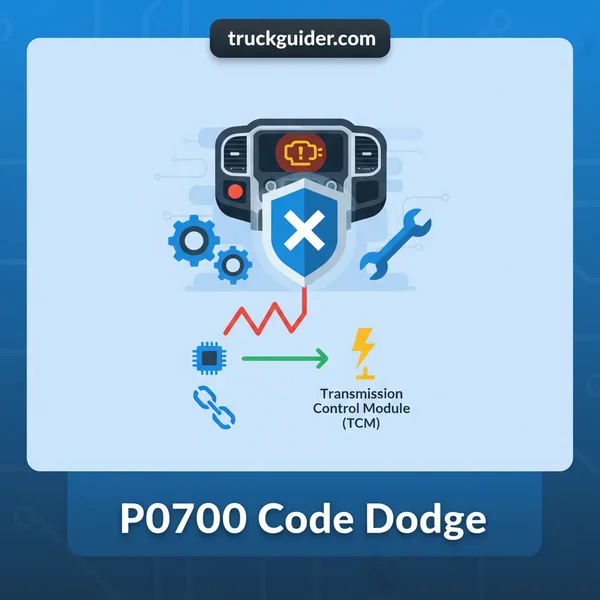
Understanding this distinction is critical for Dodge owners because it prevents the “parts cannon” approach to repairs. To actually fix your vehicle, you must use a scan tool capable of accessing the TCM to retrieve the specific sub-codes, such as P0740 or P0841. Without these specific identifiers, you are essentially guessing. Effectively diagnosing a Dodge transmission requires moving past the engine-level data and speaking directly to the transmission logic that governs your shift points and hydraulic pressures.
The Relationship Between the PCM and TCM in Dodge Vehicles
In most Dodge vehicles, the brain of the car is split into two primary hubs: the Powertrain Control Module (PCM) and the Transmission Control Module (TCM). The PCM manages fuel maps, spark timing, and emissions. The TCM, however, is a specialized computer that monitors shift solenoids, speed sensors, and fluid pressure. When the TCM detects an internal fault—like a slipping clutch or a faulty pressure switch—it sends a high-priority signal across the communication bus to the PCM. The PCM then logs the P0700 code to let the driver know that the transmission is unhappy.

Why Your Basic OBD-II Scanner is Incomplete
Most entry-level code readers sold at local auto parts stores are designed to read “Generic OBD-II” data, which is primarily focused on engine emissions. When these tools encounter a Dodge with a transmission issue, they often only display P0700 because they lack the software “handshake” required to enter the TCM’s private memory. This leads many owners to believe P0700 is the only problem. To see the actual fault, you need a professional-grade scanner or a high-end DIY tool that supports Manufacturer Specific Enhanced Diagnostics. Only then will the “hidden” codes appear.
- The PCM: Acts as the primary interface for the dashboard and the Check Engine Light.
- The TCM: Monitors the health of the 41TE, 62TE, or 68RFE transmissions common in Dodges.
- The Communication: P0700 is a “request for illumination” sent via the CAN-BUS or PCI bus system.
- Limp Mode: If the TCM detects a major fault, it may command the vehicle into “Limp Mode,” locking the transmission in 2nd or 3rd gear to prevent internal damage.
Identifying Common Dodge-Specific Transmission Sub-Codes
Once you gain access to the TCM, you will find the “real” reason your Dodge is acting up. Dodge vehicles, particularly the Caravan and Ram truck lines, tend to trigger a specific set of sub-codes that point toward well-documented hardware failures. Identifying these codes early can save you from a full transmission rebuild if the issue is merely an external sensor or an electronic solenoid block.
The “Dodge Trio” of Transmission Faults
While there are dozens of possible sub-codes, three specific issues represent the majority of P0700 triggers in Dodge vehicles. If your scanner reveals these, you have found the smoking gun. First is the P0740 (Torque Converter Clutch Circuit), which is extremely common on the 41TE and 62TE transmissions found in Grand Caravans. This code often indicates that the torque converter is no longer locking up correctly, often due to internal wear or a failing solenoid. Second is P0841 (Transmission Pressure Sensor), which frequently points to a failing solenoid pack or debris in the fluid blocking the pressure switches.
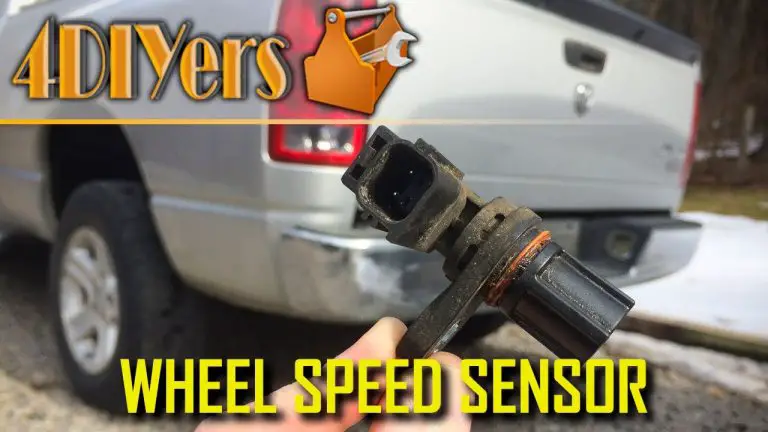
Finally, speed sensor codes (P0720 or P0715) are frequent culprits. Dodge transmissions rely on an Input Speed Sensor and an Output Speed Sensor to calculate “gear ratio.” If these sensors fail—which they often do due to heat and vibration—the TCM loses its place and triggers a P0700. Unlike a mechanical failure, replacing these sensors is inexpensive and can be done from the outside of the transmission case.
- P0740: Torque Converter Clutch (TCC) failure; often felt as a “shudder” at highway speeds.
- P0841: LR Pressure Switch sensing error; common in the 45RFE and 545RFE transmissions found in Ram trucks.
- P0731-P0736: Gear Ratio Errors; these mean the TCM sees the input and output speeds don’t match the expected gear, signaling a slip.
- P1776: Solenoid Switch Valve Latched in TCC Position; a very specific Dodge code often requiring a valve body or solenoid pack service.
Identifying these codes is the only way to determine if you are facing a simple electrical fix or a structural internal failure. In many Dodge models, the solenoid pack is an external component or easily accessible under the pan, making it a common “middle-ground” repair for codes like P0841 or P1776.
Analysis of Dodge Solenoid Pack and Speed Sensor Failures
When a Dodge vehicle throws a P0700 code, the culprit is frequently located within the transmission’s electrical control system. Two of the most common mechanical-electrical failures involve the solenoid pack and the speed sensors. These components act as the bridge between the TCM’s logic and the physical movement of transmission fluid and gears.
The Solenoid Pack: The Transmission’s Gatekeeper
In many Dodge transmissions, like the 42RLE or the 62TE, the solenoid pack is responsible for directing hydraulic pressure to the correct clutch packs. Over time, the internal electromagnetic coils can weaken, or fine metallic debris in the fluid can clog the small passages. When a solenoid fails to react within the millisecond timeframe the TCM expects, the computer logs a fault and triggers the P0700 signal.
- Intermittent Connectivity: Heat cycles can cause the internal wiring of the pack to expand and contract, leading to “ghost” codes that disappear and reappear.
- Fluid Contamination: Even microscopic shavings can prevent a solenoid from seating properly, causing pressure drops.
- Electrical Resistance: Corrosion on the external connector plug is a common Dodge-specific issue that mimics a total hardware failure.
Input and Output Speed Sensors: The TCM’s Eyes
Your Dodge TCM relies on two primary data points to understand what is happening inside the transmission: the Input Speed Sensor (ISS) and the Output Speed Sensor (OSS). These sensors monitor the rotational speed of the shafts. If the OSS reports a speed that doesn’t “mathematically” align with the ISS and the current gear ratio, the TCM assumes the transmission is slipping. This discrepancy is a fast track to a P0700 code and a trip to the dealership.
Understanding Limp-In Mode and Transmission Safety Protocols
One of the most frustrating experiences for a Dodge owner is when the vehicle suddenly loses power and feels “stuck” in a single gear. This isn’t a random failure; it is a calculated safety maneuver known as Limp-In Mode (or Limp Mode). When the TCM detects a potential for catastrophic internal damage, it takes over to protect the expensive mechanical internals.
What Happens During Limp-In Mode?
When the P0700 is triggered alongside a critical sub-code, the TCM will often default the transmission to a single gear—usually 2nd or 3rd gear. It also maximizes line pressure to ensure the clutches stay tightly engaged and don’t slip. While this makes the vehicle feel sluggish and prevents high-speed driving, it is designed to give you just enough mobility to reach a service center without needing a tow truck.
- Fixed Gear Ratio: The transmission will not upshift or downshift, regardless of engine RPM.
- Harsh Shifting: If you move the gear selector from Park to Drive, you may feel a violent “thud” as the TCM applies maximum pressure.
- Limited RPM: Some models may also limit engine power to prevent overheating the transmission fluid.
Why Your Dodge Protects Itself
The primary goal of these protocols is preservation. If a sensor indicates that a clutch is slipping, continuing to shift gears would quickly burn the friction material, turning a sensor replacement into a multi-thousand-dollar rebuild. By locking the transmission into a safe state, the computer effectively “quarantines” the problem until a technician can access the TCM and read the specific underlying fault.
Closing Thoughts on the P0700 Code
The P0700 code in a Dodge is rarely the end of the road, but it is a serious “handshake” between your engine and transmission computers that requires your attention. Remember that this code is an information marker; it tells you that the TCM has a story to tell, usually involving solenoid issues, speed sensor discrepancies, or a protective Limp-In state. Ignoring this light often leads to more expensive mechanical wear that could have been avoided with a simple electronic fix.
To move forward, your next step should always be to use a high-end scan tool that can “talk” specifically to the Transmission Control Module to find the hidden four-digit sub-codes. Once you have that specific data, you can stop guessing and start fixing. Stay proactive with your fluid health and sensor connections, and your Dodge transmission will stay on the road much longer!
❓ Frequently Asked Questions
Why is P0700 called a ‘bridge’ or ‘informational’ code?
In Dodge vehicles, the engine computer (PCM) and transmission computer (TCM) are separate entities. P0700 is simply the TCM telling the PCM that a fault exists, acting as a pointer rather than a specific diagnosis of the mechanical issue.
What are the symptoms of a P0700 code on a Dodge Ram or Caravan?
Common symptoms include erratic shifting, the transmission being stuck in 2nd or 3rd gear (Limp Mode), decreased fuel economy, and the Check Engine Light being illuminated.
Which specific sub-codes are usually hidden behind a P0700?
Common Dodge sub-codes include P0740 (Torque Converter Clutch), P0841 (Pressure Switch Sensor), and P0706 (Transmission Range Sensor), all of which require a professional-grade scan tool to see.
How do Dodge solenoid packs contribute to the P0700 code?
Dodge transmissions, particularly the 41TE and 62TE series, use a solenoid block to route fluid; these blocks often fail internally or develop leaks, triggering the P0700 communication code.
Can electrical ground issues cause a P0700 on Dodge vehicles?
Yes, Dodge vehicles are sensitive to voltage drops; a corroded ground strap or a weak battery can cause the TCM to lose communication or report false sensor data, triggering the code.
Does P0700 always mean I need a new transmission?
No, it rarely means a total transmission failure. Most P0700 triggers are related to external electronics like speed sensors, wiring, or the solenoid pack rather than internal gear failure.

![Are Ram Trucks Made in America? US vs Mexico Plant Locations [2026]](https://truckguider.com/wp-content/uploads/2026/03/are-ram-trucks-made-in-america-featured.webp)