
Ram 3500 Belt Diagram: Step-by-Step Instructions

The 2012 Ram 3500 belt diagram illustrates the specific routing for the serpentine belt around pulleys like the alternator, water pump, and AC compressor. To install, follow the path from the crankshaft pulley over the tensioner, ensuring the ribbed side of the belt seats correctly within each component’s grooves for optimal system performance.
📌 Key Takeaways
- Ensures correct serpentine belt routing to prevent engine overheating and component failure.
- The tensioner pulley is the most important component to identify for belt removal and installation.
- Always check pulley alignment and wear before installing a new belt to avoid premature snapping.
- Use a long-handled serpentine belt tool to gain leverage against the high-tension spring.
- Use this diagram when replacing a squealing belt or after a component repair like an alternator swap.
When you are faced with a squealing engine bay or a sudden loss of power steering, having access to a clear 2012 ram 3500 belt diagram becomes the most critical tool in your arsenal. The serpentine belt is the lifeline of your heavy-duty truck, transferring mechanical energy from the crankshaft to vital engine accessories. Without a proper schematic, attempting to thread a seven-foot-long belt through a maze of pulleys can be an exercise in frustration. This guide is designed to demystify the accessory drive system, providing you with a comprehensive blueprint of the belt’s path, identifying every key component, and offering professional insights into maintaining the structural integrity of your Ram’s cooling and charging systems.
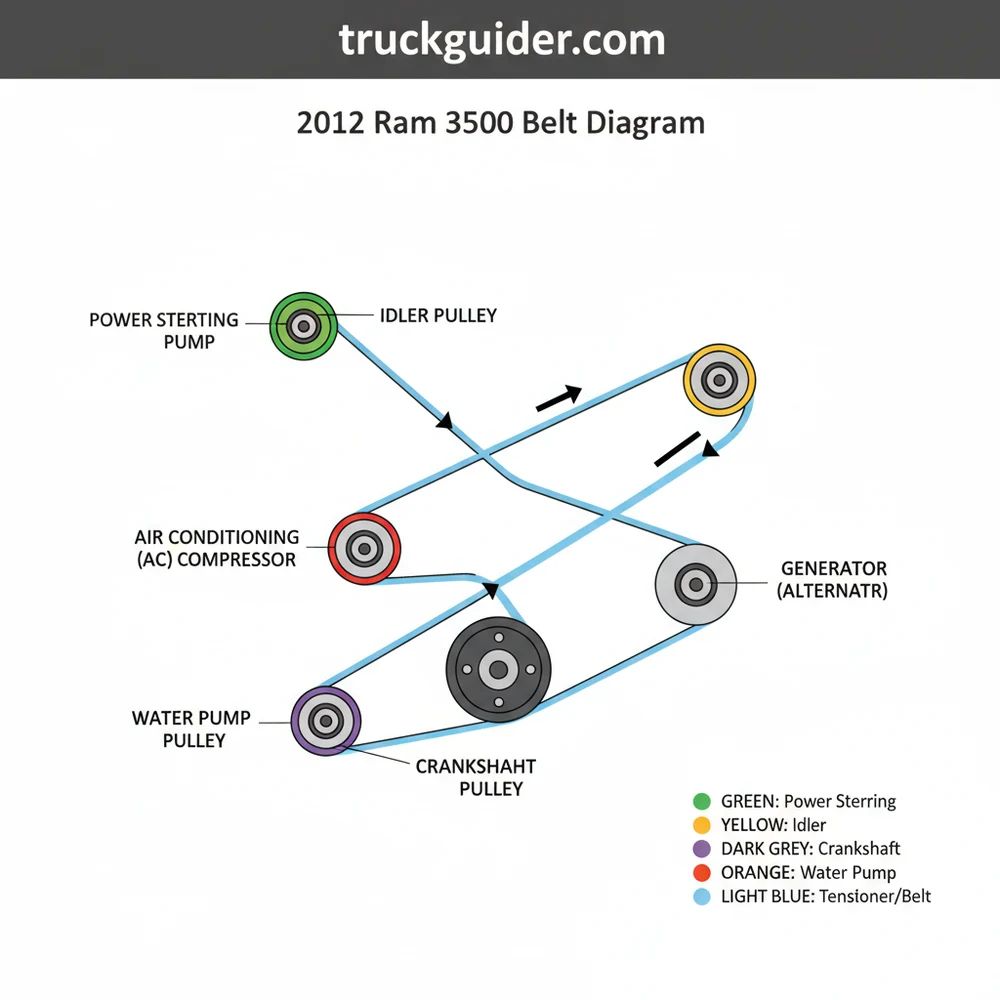
Understanding the System Layout and Component Structure
The 2012 Ram 3500, specifically those equipped with the 6.7L Cummins Turbo Diesel engine, utilizes a complex serpentine system designed to handle high torque loads. The configuration of this system is engineered for maximum efficiency, but its density can make visual identification difficult. The layout is essentially a closed-loop system where the belt’s ribbed side and flat side both play roles in driving different pulleys.
The primary structure of the drive system consists of several rotating assemblies. At the heart of the layout is the crankshaft pulley (also known as the harmonic balancer), which provides the driving force. From there, the belt travels to the alternator, which maintains the electrical system; the water pump, which regulates engine temperature; the air conditioning compressor for cabin comfort; and the power steering pump for maneuverability. Additionally, the system includes an automatic belt tensioner and one or more idler pulleys that maintain the correct belt wrap and tension.
Most 2012 Ram 3500 models feature a single-belt setup, but some specialized chassis-cab models or those with heavy-duty electrical needs may feature a dual-alternator configuration. Always verify if your truck has the optional secondary alternator before following a standard schematic, as the belt length and routing path will differ significantly.
The schematic for this engine relies on a specific sequence of “over” and “under” movements. The ribbed side of the belt must always interface with the grooved pulleys (Crankshaft, Alternator, A/C Compressor, Power Steering), while the smooth back side of the belt typically interfaces with the water pump and the tensioner/idler pulleys. This distinction is vital; if the belt is installed inside-out or incorrectly routed, it will fail within seconds of the engine starting.
[DIAGRAM_PLACEHOLDER: A detailed technical drawing showing the 6.7L Cummins front engine face. The path starts at the bottom at the Crankshaft, goes up to the Water Pump, across to the Alternator, down to the Idler, over to the A/C Compressor, down to the Tensioner, and back to the Crankshaft.]
Detailed Breakdown of the Belt Blueprint
📤 Share
💾 Download
To properly interpret the 2012 ram 3500 belt diagram, you must be able to identify each component by its position and function. The following breakdown provides an overview of the key elements found in the engine’s accessory drive:
- ✓ Crankshaft Pulley: Located at the bottom center of the engine. This is the largest pulley and provides the rotational energy for the entire belt system.
- ✓ Water Pump Pulley: Positioned near the top center. In the Cummins 6.7L, this is usually a smooth pulley driven by the back side of the belt.
- ✓ Alternator: Found at the top left (driver side). It has a small, grooved pulley that requires high-speed rotation to generate power.
- ✓ A/C Compressor: Located on the right side (passenger side) of the engine. It features an electromagnetic clutch that engages and disengages.
- ✓ Power Steering Pump: Typically located on the lower left side. It provides the hydraulic pressure needed for steering a vehicle of this size.
- ✓ Automatic Tensioner: A spring-loaded arm with a pulley that maintains constant pressure on the belt to prevent slipping.
The structure of this system is designed to be “self-adjusting.” Older trucks required manual adjustment of the alternator or a dedicated bolt to tighten the belt. In the 2012 Ram 3500, the tensioner does this work for you. However, this component is also a common point of failure. If the tensioner’s internal spring weakens or its bearing seizes, the belt will either slip or snap.
Step-by-Step Replacement and Installation Guide
📤 Share
💾 Download
Replacing a belt using a 2012 ram 3500 belt diagram is a straightforward task if you follow a logical sequence. Before beginning, ensure the engine is completely cool and the ignition key is removed from the vehicle.
1. Locate the Tensioner: On the 6.7L Cummins, the tensioner is located on the passenger side, lower than the A/C compressor. It features a square hole designed to accept a 1/2-inch drive breaker bar or a dedicated serpentine belt tool.
2. Relieve Belt Tension: Insert your tool into the tensioner’s square drive hole. Rotate the tool (usually clockwise or toward the driver’s side, depending on the specific bracketry) to compress the spring. While holding the tensioner back, slide the old belt off the topmost pulley (the alternator is usually easiest).
3. Remove the Old Belt: Slowly release the tensioner arm. Carefully thread the old belt out through the cooling fan shroud. Pay attention to how the belt is looped around the fan hub, as this is often the most restricted area.
4. Inspect All Pulleys: Before installing the new belt, spin each pulley by hand. They should spin smoothly without noise or “play.” If a pulley feels gritty or wobbles, it must be replaced. Clean the pulley grooves with a wire brush or compressed air to remove any rubber debris from the previous belt.
5. Route the New Belt: Using your 2012 ram 3500 belt diagram as a reference, begin threading the new belt. It is generally best to start at the bottom crankshaft pulley and work your way up. Ensure the ribs are seated perfectly in the grooves of the crank and A/C compressor.
6. Loop the Fan and Water Pump: Feed the belt around the fan assembly and over the smooth water pump pulley. The Cummins engine has a narrow clearance here, so take your time to ensure the belt isn’t twisted.
7. Engage the Tensioner: Once the belt is routed around everything except the alternator, use your breaker bar to compress the tensioner again. Slide the belt over the final alternator pulley.
8. Final Verification: Before starting the engine, double-check the configuration. Ensure the belt is centered on every pulley. A belt that is half-off a pulley will shred instantly upon startup.
Never place your fingers between the belt and a pulley while the tensioner is being held back. If the tool slips, the tensioner will snap back with enough force to cause severe injury. Always handle the belt from the “long runs” between pulleys.
Common Issues and Troubleshooting
Even with a perfect installation, the accessory drive system can encounter issues. Recognizing these early can save you from an expensive tow bill.
Squealing or Chirping: This is the most common symptom. It usually indicates either a worn belt that has become glazed (hardened) or a pulley that is out of alignment. If the noise happens mostly during cold starts, it is likely the belt. If it happens when the A/C is turned on, the A/C compressor clutch may be failing.
Belt “Walking” or Jumping: If the belt keeps coming off the pulleys, check the tensioner. A worn tensioner arm can develop a slight tilt, causing the belt to drift off its path. Use the 2012 ram 3500 belt diagram to ensure no idler pulleys have been bypassed, as missing a pulley in the layout will cause improper tension.
Fraying Edges: If you see “threads” coming off the side of the belt, a pulley is likely misaligned or has a sharp burr on it. This is common if the power steering pump or alternator was recently replaced and not fully seated.
To quickly diagnose a noise, spray a small amount of water on the ribbed side of the belt while the engine is running. If the noise disappears briefly, the belt is the culprit. If the noise persists or gets louder, you likely have a bearing failure in one of the pulleys.
Maintenance Best Practices for Longevity
The 2012 Ram 3500 is a workhorse, often used for towing and heavy hauling. These conditions place extra stress on the serpentine system. To ensure your truck remains reliable, follow these maintenance recommendations:
Inspect Every 30,000 Miles: While modern EPDM belts can last up to 100,000 miles, they do not crack like old neoprene belts. Instead, the grooves wear deeper (similar to tire tread). Use a plastic belt wear gauge to check the depth of the grooves. If the gauge sits deep in the “valves” of the belt, it’s time for a replacement.
Replace the Tensioner with the Belt: Many professional mechanics recommend replacing the automatic tensioner every time you replace the belt. The internal spring has a finite life, and a fresh tensioner ensures the new belt doesn’t slip and glaze over.
Quality Component Selection: Don’t settle for the cheapest belt available. Heavy-duty diesel engines like the 6.7L Cummins produce significant vibration and heat. Look for belts labeled as “Heavy Duty” or those made by reputable manufacturers like Gates (Green Stripe), Continental, or Mopar. These are specifically engineered to withstand the high torque of a Ram 3500.
Keep a Spare: Because a broken belt will leave you stranded without cooling or steering, it is a “best practice” to keep your old belt (if it’s still in one piece) behind the rear seat. In an emergency, having that spare and a copy of the 2012 ram 3500 belt diagram can be the difference between a 20-minute fix and a 4-hour wait for a tow truck.
Conclusion: Mastering the 2012 Ram 3500 Belt Configuration
Mastering the accessory drive system of your truck is an essential skill for any owner. By understanding the 2012 ram 3500 belt diagram, you take control of your vehicle’s maintenance and gain the confidence to handle repairs on the road. The system’s layout, while complex at first glance, follows a logical schematic designed to support the massive power of the Cummins engine.
Whether you are performing a preventative replacement or troubleshooting a persistent squeak, the key is attention to detail. Ensure your pulleys are clean, your tensioner is strong, and your belt routing follows the manufacturer’s blueprint exactly. With regular inspections and high-quality components, your Ram 3500’s belt system will provide years of trouble-free service, keeping your alternator charging, your engine cool, and your steering smooth across every mile. Always remember to keep your 2012 ram 3500 belt diagram handy, as it is the most important map you’ll ever need for your engine bay.
Frequently Asked Questions
Where is the belt tensioner located?
On the 6.7L Cummins engine, the tensioner component is usually found on the lower passenger side of the engine block. It features a spring-loaded arm that keeps constant pressure on the belt layout. Accessing it often requires a 1/2-inch drive breaker bar or specialized tool to release the tension for belt removal.
What does the Ram 3500 belt diagram show?
This diagram provides a visual configuration of how the serpentine belt winds through the engine system. It identifies which pulleys are ribbed and which are smooth, ensuring the belt structure is seated correctly to drive the alternator, power steering pump, and cooling fan without slipping or causing premature wear.
How many pulleys are in the belt system?
The total number of pulleys in the system configuration typically includes the crankshaft, alternator, water pump, AC compressor, power steering pump, idler, and tensioner. Depending on the specific engine variant, you may find six to eight contact points that the belt must navigate properly to power all vehicle accessories.
What are the symptoms of a bad serpentine belt?
Common signs of a failing belt include loud squealing noises, visible cracks or fraying on the rubber structure, and heavy glazed spots. If the belt slips or snaps, you will experience a loss of power steering, charging system failure, and rapid engine overheating due to the water pump stopping.
Can I replace the belt myself?
Yes, replacing a belt is a manageable DIY task for most truck owners. By following the 2012 Ram 3500 belt diagram, you can navigate the complex layout. You will need a belt tool or breaker bar to rotate the tensioner, allowing you to slide the old belt off and the new one on.
What tools do I need for belt replacement?
You primarily need a serpentine belt tool or a long-handled breaker bar with the appropriate socket size for the tensioner. A flashlight is helpful for viewing the lower pulley configuration, and a basic socket set may be required to remove air intake components to gain better access to the engine front.
![Best 2017 Ram 1500 Crew Cab Running Boards: Top Fit Guide [2026]](https://truckguider.com/wp-content/uploads/2026/03/2017-ram-1500-crew-cab-running-boards-featured.webp)

![Dodge Ram Ignition Switch Wiring Harness Color Code Guide [2026]](https://truckguider.com/wp-content/uploads/2026/03/ignition-wire-dodge-ram-ignition-switch-featured.webp)