Toyota Tacoma Gear Ratio Specification Chart By Year (2005–2026)

Quick Answer
Toyota Tacoma gear ratios typically range from 3.58:1 to 4.30:1, depending on the engine, transmission, and towing package configuration. The 4.30:1 ratio is standard for many manual transmission models and V6 automatic tow-equipped trucks, while lower ratios favor fuel economy. Always verify your specific ratio using the door jamb sticker or the Toyota VIN decoder, as axle gearing often varies by trim and factory-installed packages.
Ever feel like your Tacoma lost its punch after upgrading to bigger tires? Many owners notice a significant drop in power and efficiency immediately after installing larger rubber. Factory gear ratios are meticulously calibrated for stock tire diameters to optimize fuel economy and shift points, leaving many modified trucks feeling sluggish during highway merging or towing. This guide provides the definitive Toyota Tacoma gear ratio chart by year to help you verify your current factory specifications and plan your performance upgrades with confidence.

Prime for Young Adults — 6 Months Free
Students and 18–24s get six months of Prime free, then half price.
Start 6 Months FreeThis data covers model years 2005 through 2026. Because Toyota offered multiple configurations (TRD Off-Road, Sport, SR5, and varying engine/transmission pairings), ratios vary by build. Always check your specific axle code located on the driver-side door jamb sticker or run your VIN through a Toyota dealer portal to confirm factory settings.
Last reviewed: August 2026
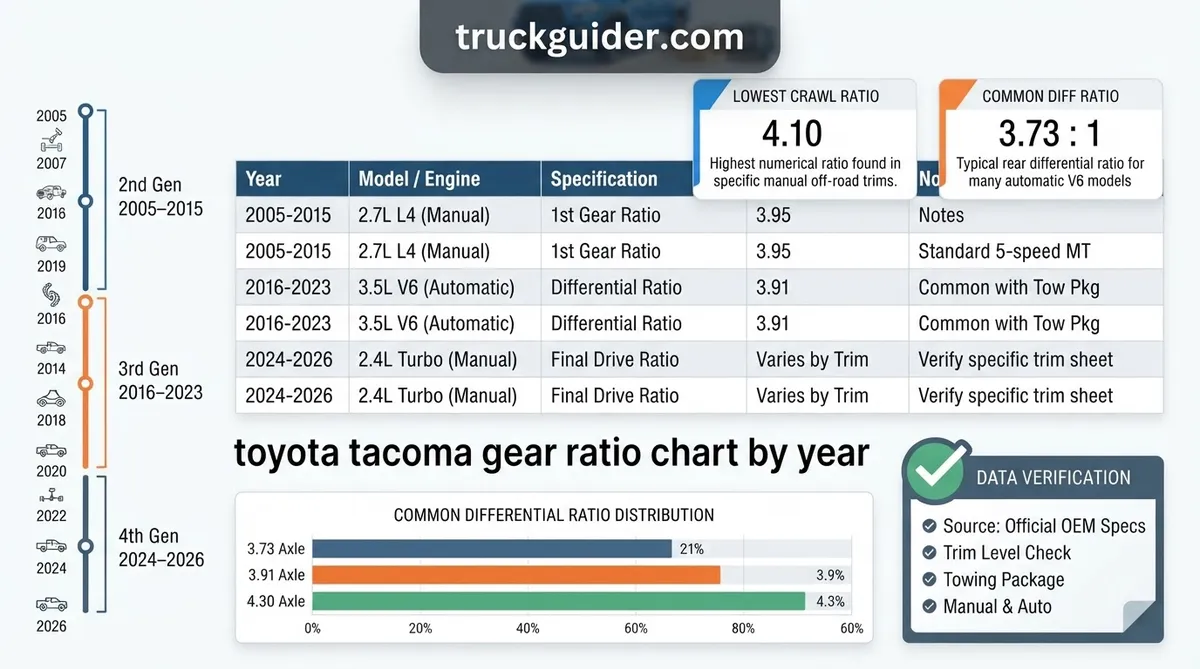
Toyota Tacoma Gear Ratio Chart By Year: Every Part Labeled
Recommended Best Deal Products


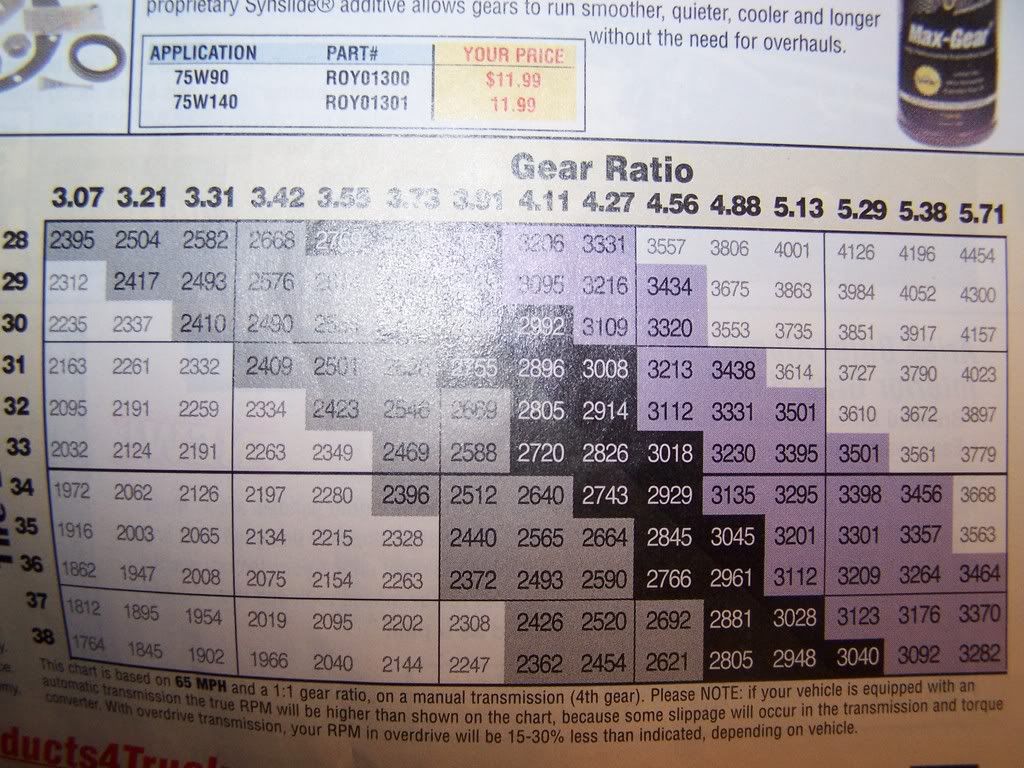
How to read this chart: Locate your model year and engine configuration. Note that 4WD models require identical ratios in both the front and rear differentials; if you change one, you must change the other.
📤 Share Image
| Year | Model / Engine | Spec (Ratio) | Notes |
|---|---|---|---|
| 2005-2015 | 4.0L V6 (Auto) | 3.73 | Standard for Tow Package |
| 2005-2015 | 4.0L V6 (Manual) | 3.91 | Better low-end torque |
| 2016-2023 | 3.5L V6 (Auto) | 3.91 | TRD Off-Road trims |
| 2016-2023 | 3.5L V6 (Manual) | 4.30 | Common in TRD Pro/OR |
| 2024-2026 | 2.4L Turbo (i-FORCE) | Varies | Verify via VIN/Axle code |

Data Accuracy and Model Year Caveats
The Toyota Tacoma uses a differential identification tag system. On the door jamb sticker, look for the “Axle” code. An axle code such as “B06A” indicates specific ring gear sizes and ratios. Never rely solely on hearsay for your year, as mid-generation changes—particularly with the 2016 transition to the 3.5L engine—introduced different final drive setups for towing versus fuel efficiency.
Toyota Tacoma Gear Ratio Chart by Year: How Tire Diameter Impacts
When you install larger tires (e.g., moving from 30.5-inch stock tires to 33-inch or 35-inch aftermarket tires), you effectively “gear down” your truck. This is because the larger tire covers more distance per single revolution, forcing the engine to work harder to maintain speed and causing the transmission to hunt for gears.
The Math Behind Tire Size and RPM
The effective gear ratio is a product of your transmission’s output multiplied by the differential gear ratio. When you increase the diameter, the engine RPM at a set highway speed drops below the factory power band. This leads to reduced fuel economy—contrary to popular belief—because the engine lacks the mechanical advantage to stay in its peak torque range, resulting in excessive downshifting.
Divide the new tire diameter by the old, then multiply by your current ratio to find the target ratio for stock-like feel.
Performance Regearing: Choosing the Right Ratio for Your Tacoma
Recommended Best Deal Products


For off-road enthusiasts, regearing is the gold standard for performance. By installing a higher numerical ratio (e.g., 4.88 or 5.29), you physically shorten the gear to compensate for the larger tires and added weight of armor and overlanding gear.
Torque Recovery
Higher numerical ratios restore low-end torque, essential for technical crawling and climbing steep mountain grades.

Audible — Listen Free for 30 Days
One free credit a month and thousands of titles included.
Listen Free for 30 DaysTransmission Logic
Automatic transmissions benefit greatly from 5.29 ratios when running 35-inch tires to stay out of constant overdrive gear-hunting.
Manual vs. Automatic Regearing Needs
- Automatic: Generally requires a more aggressive (higher numerical) jump to compensate for the torque converter’s behavior. 5.29 is a popular choice for 35-inch tires.
- Manual: You have more flexibility with clutch control, but 4.88 is usually the sweet spot for 33-inch tires to maintain drivability.
Essential Steps for Installing Toyota Tacoma Ring and Pinion Gears
Regearing is a high-precision operation. If the gear mesh is off by even a few thousandths of an inch, your differential will howl, overheat, and eventually experience catastrophic failure.
In 4WD models, the front and rear differential ratios MUST match. Mismatched ratios will bind the drivetrain the moment you engage 4WD, destroying the transfer case.
Use gear marking compound. The contact pattern should be centered on the tooth face. If it is “heel” or “toe” biased, you must adjust the shims.
New gears require a break-in. Avoid heavy towing or sustained high-speed driving for the first 500 miles, followed by an oil change to clear metal shavings.
Gear installation requires specialized tools like a torque wrench, bearing puller, and dial indicator for backlash. Unless you are highly experienced, this is a job for a professional drivetrain shop.
Toyota Tacoma Gear Ratio Chart By Year: Frequently Asked Questions
Recommended Best Deal Products


Can I change my gear ratio without changing my transmission?
Yes. Regearing happens entirely within the differential housing (the ring and pinion gears). Your transmission remains untouched, though its shift logic may need recalibration via an aftermarket tuner to account for the different final drive ratio.
Will regearing improve my fuel economy?
If you are running oversized tires, regearing often improves “real world” fuel economy by allowing the engine to operate efficiently. However, if you gear too aggressively for your tire size, your highway RPMs will increase, leading to higher fuel consumption.
Audible Premium Plus — Annual Membership
12 audiobook credits up front, plus the full Audible catalogue.
See Annual PlansConclusion
Understanding the gear ratios in your Toyota Tacoma is the foundation of a successful build. Always verify your specific axle code before ordering parts to ensure compatibility. Remember that regearing is a permanent, precision-based upgrade that demands identical front and rear ratios for 4WD reliability. Professional installation is highly recommended to protect your investment and ensure your truck remains a reliable daily driver.
Action Plan: Check your door jamb for your axle code today. Use the chart above to identify your factory ratio, then research the best gear set for your specific tire diameter and driving habits to restore your Tacoma’s factory-like power delivery.