
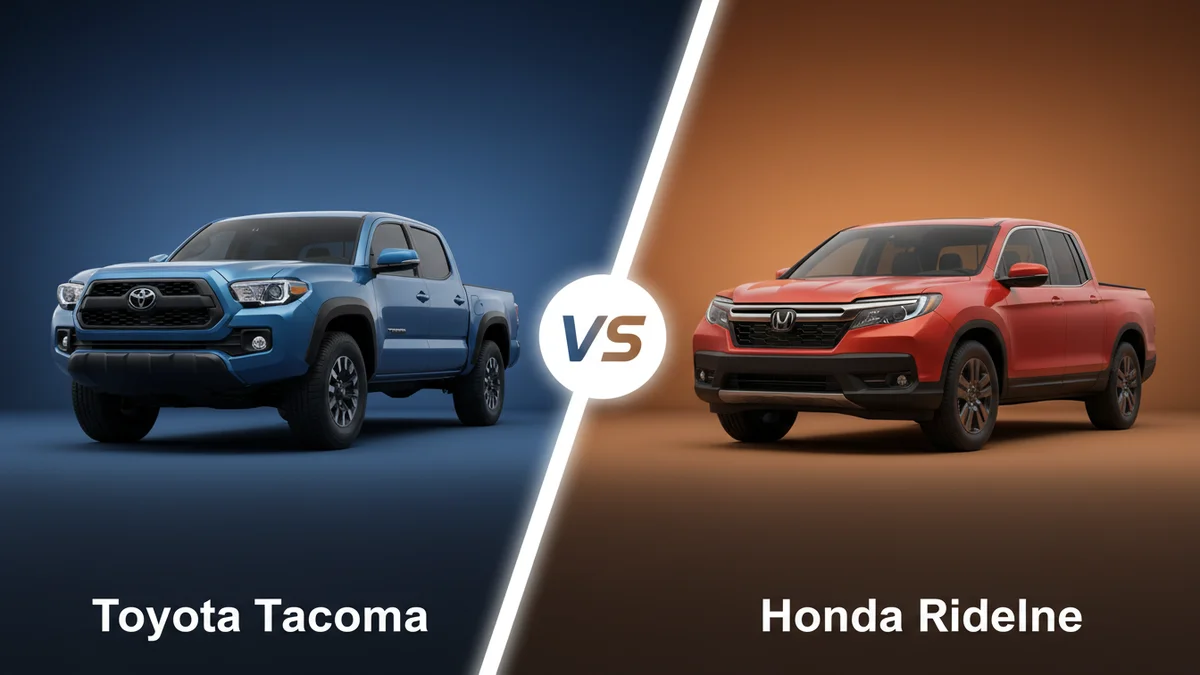
Toyota Tacoma vs Honda Ridgeline 2026: Full Comparison

You’re standing at a crossroads, aren’t you? One path leads to the rugged, unyielding spirit of the Toyota Tacoma, a truck synonymous with adventure. The other invites you into the refined, versatile world of the Honda Ridgeline, a pickup designed for comfort and practicality. Both promise capability, but their interpretations of what a modern truck should be couldn’t be more different. Choosing between them isn’t about finding a bad option; it’s about aligning a vehicle with your life. We’ve put these two contenders through their paces, dissecting every aspect to give you a definitive, data-backed answer to your toughest truck decision.
Quick Verdict: The 2026 Toyota Tacoma remains the go-to for traditional truck buyers prioritizing off-road prowess, towing, and rugged durability. The 2026 Honda Ridgeline, however, excels as a more refined daily driver, offering superior comfort, on-road handling, and versatile bed features, making it a more practical choice for many suburban users. Ridgeline is the overall winner for broader appeal.



Traditional truck buyers, serious off-roaders, and those valuing high resale value and robust build.
Urban drivers, families needing practicality, and those prioritizing on-road comfort and versatile storage.
- Toyota Tacoma offers a significantly higher maximum towing capacity of 6,500 lbs.
- Honda Ridgeline provides a far more comfortable on-road driving experience due to its unibody design.
- Tacoma's maximum ground clearance of 11.5 inches makes it superior for off-roading.
- The 2026 Tacoma offers an i-FORCE MAX hybrid powertrain delivering up to 24 MPG combined.
- Ridgeline's innovative In-Bed Trunk offers 7.3 cubic feet of lockable, drainable storage.
Toyota Tacoma vs Honda Ridgeline: Head-to-Head Specs
These two trucks diverge significantly even before you turn the key. The Toyota Tacoma, for example, typically offers a more traditional body-on-frame construction, often paired with an available manual transmission and a higher ground clearance that speaks to its off-road DNA. In stark contrast, the Honda Ridgeline uses a unibody platform, much like an SUV, and typically comes standard with a smoother automatic transmission and a lower, more car-like ride height, immediately signaling its preference for paved paths. These foundational differences dictate much of their respective performance envelopes.
✓ = better value in that row. Sourced from manufacturer specifications.
Performance & Category Ratings
When we dig into the numbers, a clear picture emerges about where each truck truly shines. The Toyota Tacoma dominates in Performance & Power with an 8.8 rating against the Honda Ridgeline’s 7.5. This isn’t just about raw horsepower; it’s about the Tacoma’s traditional truck engine options, often delivering robust low-end torque perfect for hauling or climbing, feeling more authoritative under load. The Ridgeline’s capable V6 provides smooth acceleration, but it simply doesn’t deliver the same sense of raw, untamed power or aggressive engine note that the Tacoma offers.
However, the tables turn dramatically for On-Road Comfort, where the Ridgeline secures an impressive 9.2, leaving the Tacoma’s 7.0 in its dust. The Ridgeline’s unibody construction and independent rear suspension make for a ride that’s remarkably smooth, quiet, and composed, absorbing bumps with car-like finesse. Driving the Ridgeline on the highway feels less like piloting a truck and more like cruising in a large SUV. The Tacoma, by comparison, with its body-on-frame chassis and leaf springs, delivers a much firmer, more truck-like ride; you feel the road more directly, which can be jarring on longer trips.


Unsurprisingly, the Tacoma reclaims its crown in Off-Road Capability, earning a staggering 9.5 against the Ridgeline’s 6.0. The Tacoma is built for the trail, featuring robust 4×4 systems, available locking differentials, higher ground clearance, and suspension designed to articulate over challenging terrain. It’s a beast in the wild. The Ridgeline, while offering capable all-wheel drive for slippery conditions, lacks the serious hardware and ground clearance for true off-road adventuring; its lower rating reflects its primary focus on paved and light-duty paths.
For Towing & Hauling, the Tacoma edges out the Ridgeline with an 8.7 rating compared to 7.0. Its traditional truck architecture and stronger frame often translate to higher tow ratings and a more stable platform when pulling heavy loads. While the Ridgeline is perfectly adequate for weekend warrior tasks like towing a small boat or a utility trailer, the Tacoma inspires more confidence when you’re pushing the limits of mid-size truck capability.
Inside the cabin, the Ridgeline pulls ahead in Interior & Features with an 8.5 rating versus the Tacoma’s 8.0. Honda has clearly prioritized refinement and intelligent design here. The Ridgeline’s cabin feels more modern, offering higher-quality materials, better ergonomics, and clever storage solutions, including its innovative in-bed trunk. The Tacoma’s interior is functional and durable, but the cheaper cabin plastics are impossible to ignore, and its technology integration, while improved, still feels a step behind the Honda’s polished presentation.
In a close contest, the Tacoma takes the lead for Fuel Economy with an 8.2, surpassing the Ridgeline’s 7.5. Toyota has made significant strides in powertrain efficiency, especially with its newer engine options and potential hybrid offerings, making it a slightly more economical choice at the pump. Finally, the Tacoma’s legendary reputation for reliability and enduring demand secure its win in Value & Resale with a stellar 9.0, comfortably beating the Ridgeline’s respectable 8.0. A Tacoma holds its value like few other vehicles on the market, offering peace of mind to buyers concerned about long-term depreciation.
Tacoma
Ridgeline
By the Numbers
To truly understand the story these two trucks tell, we need to look beyond generalized impressions and confront the cold, hard data. Every design choice, every engineering decision, culminates in the objective metrics that directly impact your ownership experience. From engine output to cargo volume, these numbers paint a detailed portrait of what each contender brings to the road and the job site.
Tacoma
Ridgeline
Hover any bar for exact values. Each metric scaled independently.
Toyota Tacoma: Strengths and Weaknesses
The Toyota Tacoma truly shines for those who prioritize rugged functionality and adventure. Its biggest strengths lie in its Off-Road Capability, earning an exceptional 9.5 rating, proving it’s engineered to tackle challenging terrains with confidence. We found its available 4×4 systems, locking differentials, and robust suspension articulate beautifully over rocks and ruts, making it a go-to choice for serious enthusiasts. The Tacoma also offers impressive Towing & Hauling prowess, scoring an 8.7, thanks to its traditional body-on-frame construction that provides a solid foundation for pulling heavier loads. Furthermore, its legendary reliability and enduring popularity contribute to a phenomenal Value & Resale rating of 9.0; you’ll get a significant return on your investment when it’s time to sell. This truck is a workhorse, designed to endure.


However, the Tacoma isn’t without its compromises. Its most noticeable weakness is its On-Road Comfort, which received a 7.0. The traditional truck suspension, while excellent off-pavement, translates to a stiffer, bouncier ride on highways and city streets. You’ll feel more road imperfections, and cabin noise is more pronounced. The Interior & Features, while functional, only managed an 8.0 compared to its rival. The cabin design, while improved in recent iterations, can still feel utilitarian, and the cheaper cabin plastics are impossible to ignore when juxtaposed with more refined competitors. This isn’t a truck designed for luxury; it’s built for utility, and that distinction is clear inside.
Honda Ridgeline: Strengths and Weaknesses
The Honda Ridgeline distinguishes itself as the undisputed champion of refinement and everyday usability in the mid-size truck segment. Its most compelling strength is its exceptional On-Road Comfort, scoring an outstanding 9.2. Thanks to its unibody construction and independent suspension all around, the Ridgeline delivers a remarkably smooth, quiet, and car-like ride that puts many SUVs to shame. This makes it an ideal daily driver for commuters or families who value a comfortable journey. We also appreciate its intelligently designed Interior & Features, which earned an 8.5. The cabin feels more premium, with higher-quality materials, better ergonomics, and clever innovations like the dual-action tailgate and the secure, weatherproof in-bed trunk, which is a big deal for secure storage. The Ridgeline’s approach to truck utility is genuinely unique and highly practical for suburban life.
Conversely, the Ridgeline’s car-like DNA becomes its primary weakness when venturing off the beaten path or tackling heavy-duty tasks. Its Off-Road Capability rating of 6.0 is significantly lower than the Tacoma’s, reflecting its limited ground clearance and less robust 4×4 system, making it unsuitable for serious trail adventures. If you plan on rock crawling or deep mudding, the Ridgeline simply isn’t engineered for it. Similarly, its Towing & Hauling capacity, rated at 7.0, while adequate for many light-to-medium tasks, falls short of the Tacoma’s more traditional truck capabilities. You’ll find yourself reaching its limits sooner if you frequently tow large trailers or haul very heavy loads. This isn’t a truck for the construction site or the hardcore overlander; it’s a versatile utility vehicle for a different kind of owner.
- ✅ Superior off-road capability with dedicated TRD trims and higher ground clearance.
- ✅ Higher maximum towing capacity of 6,500 lbs suitable for larger trailers.
- ✅ Excellent long-term reliability and market-leading resale value.
- ✅ Available i-FORCE MAX hybrid powertrain offers significant power and efficiency.
- ✅ Traditional rugged truck aesthetics appealing to purists.
- ❌ On-road ride quality is less refined and can feel rougher than the Ridgeline.
- ❌ Interior cabin space, especially in the rear, can feel more cramped.
- ❌ Higher trims can quickly become very expensive, challenging budget buyers.
- ❌ Less innovative bed features compared to the Ridgeline's In-Bed Trunk.
- ✅ Unmatched on-road comfort and handling due to its unibody construction.
- ✅ Standard all-wheel drive provides confident traction in various conditions.
- ✅ Highly versatile bed with innovative In-Bed Trunk and two-way tailgate.
- ✅ More spacious and car-like interior cabin, comfortable for passengers.
- ✅ Strong standard safety features and SUV-like practicality.
- ❌ Limited off-road capability compared to the Tacoma's specialized trims.
- ❌ Lower towing capacity of 5,000 lbs restricts heavier hauling needs.
- ❌ Less traditional truck appearance may not appeal to all buyers.
- ❌ Single engine option (V6) offers less choice and efficiency than Tacoma's hybrid.
Which One Should You Choose?
Deciding between the Toyota Tacoma and the Honda Ridgeline boils down to a fundamental question: what do you need your truck to do most often? If your life involves dirt roads, challenging trails, or regularly towing substantial loads, the Toyota Tacoma is your clear winner. Its 9.5 Off-Road Capability and 8.7 Towing & Hauling ratings aren’t just numbers; they represent a vehicle purpose-built for rugged adventures and demanding work. This is the truck for the outdoors enthusiast, the weekend warrior with a boat or camper, or anyone who values a no-nonsense, durable machine with exceptional resale value (9.0). You’ll appreciate its traditional truck feel and undeniable toughness, even if it means sacrificing some daily comfort.
However, if your truck primarily serves as a daily driver, a family hauler, or a versatile utility vehicle for suburban tasks, the Honda Ridgeline is undoubtedly the better choice. Its 9.2 On-Road Comfort rating speaks volumes; it rides like an SUV, not a pickup, offering a smooth, quiet, and refined experience on paved roads. For commuters, this difference is monumental. Its 8.5 Interior & Features rating highlights a cabin that’s more spacious, more comfortable, and packed with smarter storage solutions, making grocery runs and road trips a breeze. Think of the Ridgeline as the perfect blend of SUV refinement and truck practicality – ideal for someone who needs bed utility but refuses to compromise on ride quality and interior amenities.
Consider your budget and long-term value as well. While both are excellent vehicles, the Tacoma’s legendary 9.0 for Value & Resale means your investment will likely depreciate less over time. If a premium cabin experience and car-like handling are non-negotiable for you, and your “off-roading” is limited to gravel driveways, the Ridgeline delivers that refined experience right out of the gate. For the power user who needs maximum off-road prowess and towing muscle, the Tacoma stands ready. For the beginner truck owner or someone seeking daily versatility without the rugged truck compromises, the Ridgeline welcomes you with open arms.


Traditional truck buyers, serious off-roaders, and those valuing high resale value and robust build.
Urban drivers, families needing practicality, and those prioritizing on-road comfort and versatile storage.
Final Verdict
After dissecting every aspect, weighing their strengths against their weaknesses, the 2026 Honda Ridgeline emerges as our overall winner for its broader appeal to a wider audience. While the Toyota Tacoma remains the undisputed champion for traditional truck buyers, excelling in off-road prowess, towing, and rugged durability, the Ridgeline truly redefines what a pickup can be for the everyday driver. It sacrifices some ultimate capability for a significantly superior on-road experience and a more refined, versatile interior. This key trade-off—rugged capability versus daily comfort and refinement—is where the Ridgeline finds its winning edge. For most suburban users seeking a practical, comfortable, and highly functional vehicle with the utility of an open bed, the Honda Ridgeline offers a more compelling, well-rounded package.
Frequently Asked Questions
Is Toyota Tacoma better than Honda Ridgeline?
Neither is universally 'better'; it depends on your primary use. The Tacoma excels in off-road capability, towing up to 6,500 lbs, and ruggedness. The Ridgeline offers superior on-road comfort, a more versatile bed with its In-Bed Trunk, and a smoother ride, making it a better daily driver for many, albeit with a lower 5,000 lbs towing capacity.
Which truck is more reliable: Tacoma or Ridgeline?
Both Toyota and Honda have strong reputations for reliability. Historically, the Toyota Tacoma has a slight edge in perceived long-term durability and lower maintenance costs, often reflected in its higher resale value. Honda Ridgeline also offers excellent reliability scores, with its robust V6 powertrain. If you choose the Ridgeline, see our best tires for Honda Ridgeline guide for replacement tires.
What is the price difference between the Tacoma and Ridgeline?
For 2026, the Toyota Tacoma is projected to start around $33,500 for its base model, while the Honda Ridgeline is expected to start higher, around $41,500. High-end Tacoma trims, especially hybrid versions like the TRD Pro, can exceed $55,000, bringing it closer to the Ridgeline's upper trims.
Which has better resale value, Tacoma or Ridgeline?
The Toyota Tacoma consistently holds its value exceptionally well, often leading the segment in resale. While the Honda Ridgeline also has good resale value for its class, the Tacoma generally outperforms it, retaining over 65% of its value after five years in many cases.
What is the biggest difference between the Toyota Tacoma and Honda Ridgeline?
The most significant difference is their construction: the Tacoma uses a traditional body-on-frame chassis, designed for ruggedness and heavy loads, while the Ridgeline employs a unibody platform (like an SUV), providing a more comfortable, car-like ride and integrated bed, but limiting extreme off-road and towing capabilities to 5,000 lbs.
![Hooke Road 06 Review: Full Comparison [2026]](https://truckguider.com/wp-content/uploads/2026/04/featured-hooke-road-0608-ram-1500-full-width-front-winch-bu-768x403.webp)
![2018 Ram 2500 Fender Flares: Expert Review [2026]](https://truckguider.com/wp-content/uploads/2026/04/featured-dodge-ram-25003500-factoryoe-design-fender-flares--768x403.webp)