Truck Heater Not Blowing Hot Air Fix It With These Checks [2026]

When your truck heater not blowing hot air despite a warm engine, the problem could cost you $10 or $1,200 — and the difference comes down to which part is actually failing. Most guides give you a list of possibilities.
This one gives you a branching diagnostic sequence so you find your specific cause before spending a dollar.


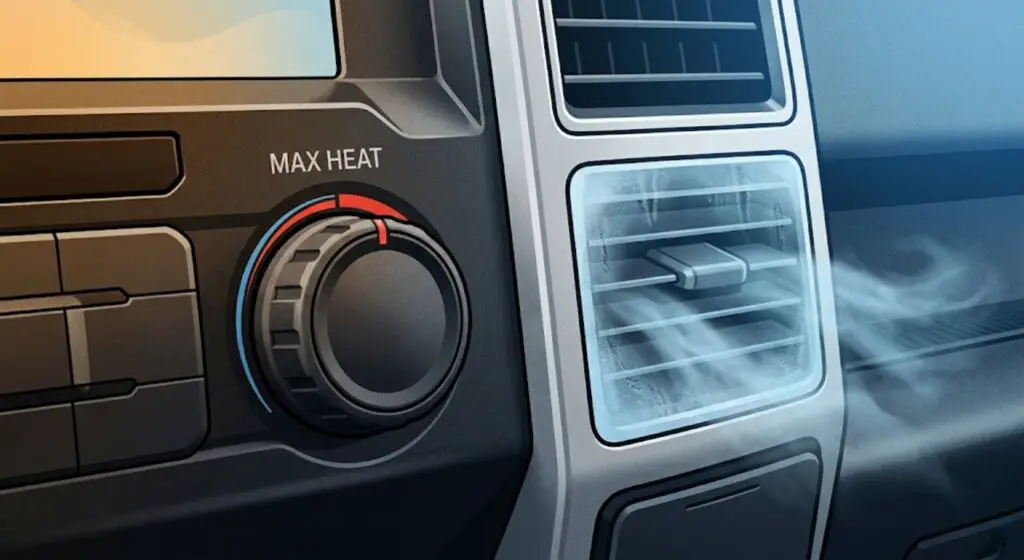
Start with the three checks below before touching anything else.
Why Your Truck Heater Blows Cold Air When the Engine Is Warm
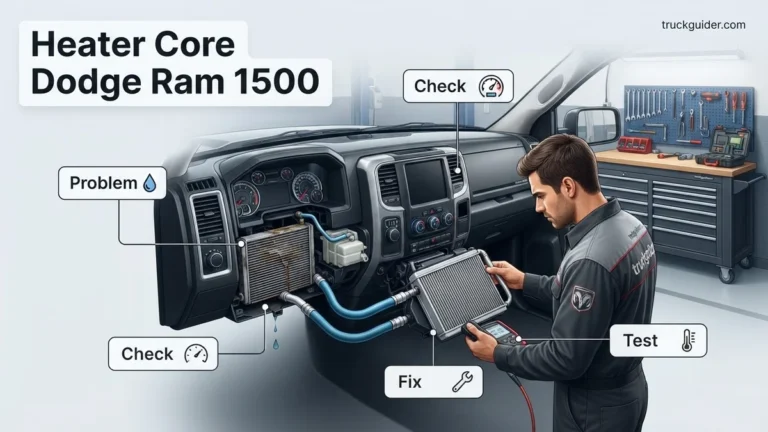
Your truck’s heating system has one job — move hot coolant through the heater core and blow that heat into the cab. When that loop breaks anywhere, you get cold air regardless of what the temperature dial says.
The loop works like this: your engine heats coolant to operating temperature, that hot coolant flows through a small radiator behind your dashboard called the heater core, and your blower motor pushes cabin air across it. Five things can break this loop.
- Low coolant — not enough fluid to transfer heat through the heater core
- Stuck thermostat — coolant circulates too fast and never builds enough heat
- Clogged or leaking heater core — hot coolant can’t flow through the core properly
- Blend door actuator failure — the flap that directs air over the heater core won’t move
- Heater control valve failure — coolant flow into the heater core is blocked at the valve
The frustrating part is that all five causes produce the same symptom from the driver’s seat: cold air. The next section separates them by what you actually notice beyond the cold air itself.
4 Symptoms That Tell You Which Part Is Failing
Before running any diagnostic, match your situation to one of these symptom profiles. Each one points to a different branch of the repair.
- Heat works for a few minutes then goes cold — points to an air lock in the cooling system or a failing blend door actuator. The system produces heat briefly, then loses it.
- Always cold air and coolant reservoir is visibly low — points to low coolant or an active coolant leak. This is the most common cause and the easiest to fix if caught early.
- Always cold air and coolant level is full — points to a stuck thermostat, a clogged heater core, or a failed heater control valve. The coolant is there but not doing its job.
- Clicking or ticking noise from the dash when you adjust the temperature — points directly to a blend door actuator. The motor is trying to move the blend door but failing.
- Sweet smell inside the cab combined with cold air — points to a leaking heater core. Stop driving immediately. Coolant vapor entering the cabin is a health hazard.
Match your symptom above, then follow the corresponding branch below.
Check These 3 Things Before You Touch Anything Else
These three checks take five minutes and cost nothing. Do them before you assume the worst.
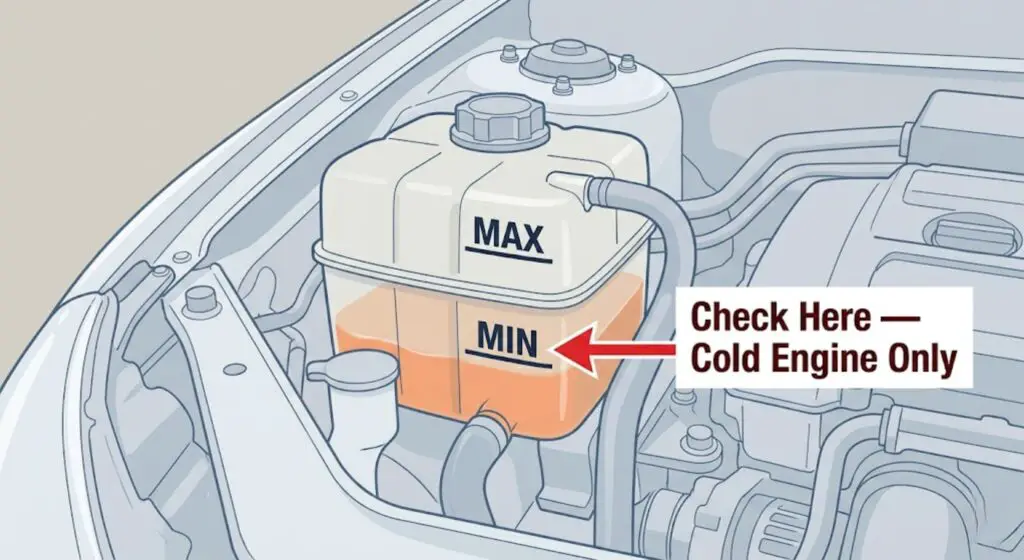
1. Check your coolant level — cold engine only
Open your hood and locate the translucent coolant reservoir. Check the level against the MIN and MAX lines marked on the side. Do this when the engine is cold — never open the radiator cap on a warm or hot engine. Pressurized coolant will spray and cause serious burns.
If the level is at or below MIN, you have found your starting point. Go to Section 5.
If the level is between MIN and MAX or at MAX, coolant is not your primary issue. Go to Section 6.
2. Watch your temperature gauge after startup
Start the engine and watch the temp gauge for the first 10 minutes. On most trucks, the gauge should rise steadily and settle in the middle of the normal range — typically between 195°F and 220°F according to OEM specifications for common truck platforms including the F-150, Ram 1500, and Silverado 1500.
If your Ram 1500 temperature gauge goes up and down repeatedly or never reaches midrange, your thermostat is the most likely suspect. That goes to the thermostat branch in Section 6.
If the gauge reaches normal operating temperature and holds there, the thermostat is working.
3. Confirm your heater settings are actually at maximum heat


Set your temperature dial to the highest heat setting and your fan to maximum. Make sure you are not in recirculation mode — recirculation pulls air from inside the cab rather than heating it from the heater core. Switch to fresh air mode and retest.
If cold air continues after all three checks, follow the branch that matches your coolant level result.
hold steady.
Check 3.
Thermostat.
Coolant Branch.
further diagnosis.
If Your Coolant Is Low the Fix Takes Under 30 Minutes
If your coolant is at or below the MIN line, this is your most likely cause and your easiest fix. Low coolant means there is not enough hot fluid reaching the heater core to produce cabin heat.
Refill the Coolant Correctly
Check your owner’s manual for the correct coolant type before adding anything. Using the wrong type causes corrosion and coolant system damage over time. Common types across major truck platforms:
- Ford F-150 (2015–present): Motorcraft Orange VC-3DIL-B (OAT formula)
- Ram 1500 (2013–present): MOPAR OAT coolant (orange)
- Chevrolet Silverado 1500 (2014–present): AC Delco DEX-COOL (orange OAT)
Fill the reservoir to the MAX line. Use a 50/50 premix or mix distilled water with concentrate at 50/50 ratio. Do not use tap water — minerals accelerate scaling inside the heater core.
Start the engine with the heater set to MAX heat and fan on high. Let it idle for 10 to 15 minutes. Heat output should return within the first few minutes once the thermostat opens and hot coolant begins circulating.
Check for Air Locks After Refilling
If heat returns briefly and then disappears again after refilling, you have an air lock — a trapped air bubble in the cooling system blocking consistent coolant flow.
To purge the air lock on most trucks:
- Fill the reservoir to MAX with the engine cold
- Leave the reservoir cap loose but on
- Start the engine and set heat to MAX, fan to HIGH
- Squeeze the upper radiator hose firmly several times while the engine idles — this helps move trapped air toward the reservoir
- Watch the reservoir — you may see bubbles rise as air escapes
- Top off the coolant once bubbling stops and cap it properly
- Run the engine for 15 minutes and recheck heat output
If your coolant level drops below MIN again within two to three days of refilling, you have an active coolant leak — not just a reservoir that needed topping off. Look for puddles under the truck (coolant is usually green, orange, or pink), white smoke from the exhaust, or a rising temperature gauge. An active leak requires a mechanic before the engine overheats.
If Your Coolant Is Full but Heat Still Fails
If your coolant level is normal and your engine reaches operating temperature but the cab stays cold, the problem is inside the system. Two components are most likely: the thermostat or the heater core.
Stuck Thermostat
The thermostat controls how fast coolant circulates. When it is stuck open, coolant moves through the engine too quickly to build enough heat — and the heater core never gets hot fluid.
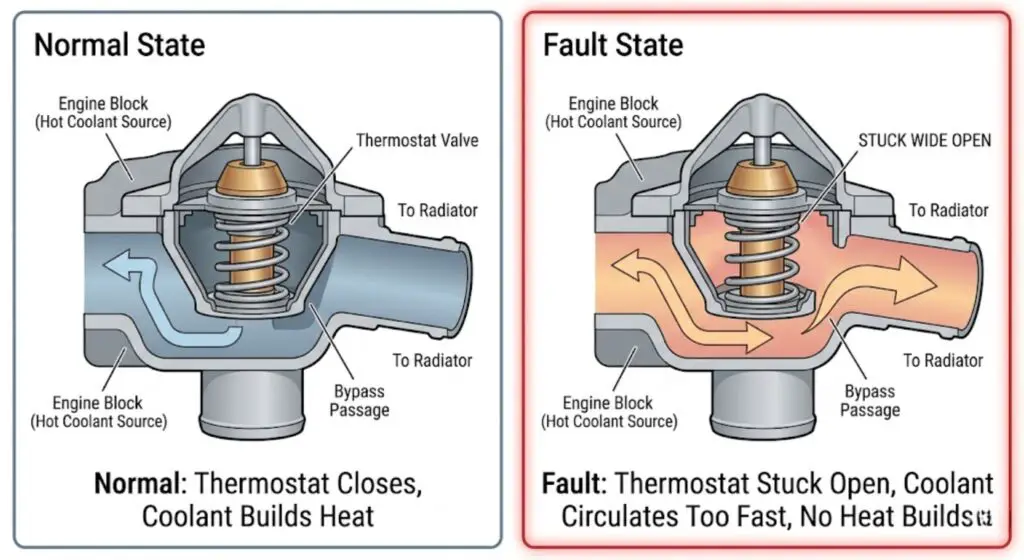
The diagnostic is simple. Watch your temp gauge during the first 10 minutes of driving. If it climbs to around the midpoint (195°F–220°F) and holds steady, the thermostat is working. If it rises then drops back down, rises again, and never stabilizes — or if it stays noticeably below center — the thermostat is stuck open.
Thermostat replacement is a medium-difficulty DIY job. The part itself costs $15 to $50 depending on your truck make and model. If you have a Ram 1500, the full procedure is covered in our 2016 Ram 1500 3.6 thermostat replacement guide. Shop labor runs $150 to $300 total for most trucks according to RepairPal’s 2024 labor estimates.
Most experienced DIYers complete the job in one to two hours with basic hand tools. You can find the full procedure in our truck thermostat replacement guide.
Clogged or Leaking Heater Core
If your thermostat checks out but you still have no heat, the heater core is the next suspect. The heater core is a small radiator tucked inside the dashboard. It clogs with sediment and old coolant over time, especially if the coolant has not been flushed on schedule. According to NAPA’s maintenance guidelines, coolant should be flushed every 30,000 miles or 5 years — whichever comes first.
The quickest field diagnostic: with the engine fully warm, carefully feel both heater hoses where they enter the firewall from the engine bay. Both hoses should feel hot to the touch. If one hose is hot and the other is noticeably cooler or cold, coolant is not flowing through the heater core — it is clogged.


Feel both hoses where they pass through the firewall — with the engine
fully warm after 10+ minutes of running.
door actuator or heater control valve as the next suspect.
If that fails, the heater core needs replacement ($800–$1,200).
A heater core flush is worth attempting before replacement. You can disconnect the two heater hoses at the firewall and flush the core with a garden hose at moderate pressure to clear sediment. If heat returns after flushing and the coolant flush interval was overdue, you may be done.
If the flush fails, heater core replacement is a hard DIY job on most trucks. It requires dashboard removal, which runs three to six hours of labor even for experienced mechanics. Total repair cost at a shop ranges from $800 to $1,200 for most half-ton trucks based on RepairPal national averages. See our full heater core replacement guide for a model-specific breakdown before deciding on DIY vs shop.
When a Blend Door Actuator or Control Valve Is the Problem
If your coolant system is healthy, your thermostat holds temperature, and both heater hoses are hot — but you still get cold air — the problem is in the airflow or flow control components, not the coolant itself.
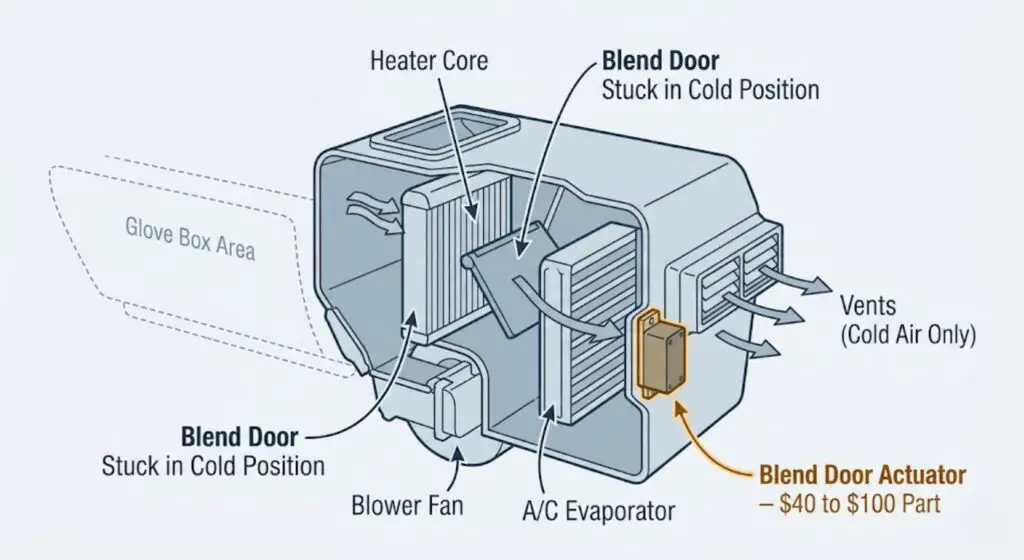
Blend Door Actuator Symptoms
The blend door actuator is a small electric motor that controls a flap inside the HVAC box. That flap (the blend door) mixes hot air from the heater core with cool air to reach your set temperature. When the actuator fails, the door gets stuck — usually in the cold air position.
The signature symptom is a clicking, ticking, or grinding noise from behind the dashboard when you move the temperature dial from cold to hot. The noise is the failed actuator motor trying to move a door it can no longer control. You may also notice heat that is stuck at one fixed temperature regardless of where you set the dial.
Blend door actuator replacement is a medium-difficulty DIY repair. On many trucks the actuator is accessible behind the glove box without full dashboard removal. See the exact blend door actuator location for Dodge Ram before starting the job. The part costs $40 to $100, and labor at a shop runs $100 to $250 depending on location and truck model, according to AutoZone’s 2024 repair estimate data.
Heater Control Valve Symptoms
The heater control valve sits on the heater hose and regulates how much coolant flows into the heater core. On trucks that use a mechanical or vacuum-operated valve, failure means the valve stays closed — and no hot coolant reaches the core at all.
The diagnostic overlap with a clogged heater core is why this one gets missed. Both produce the same symptom: one heater hose hot, one cold. The difference is location. If the cool hose is cold right at the valve rather than downstream at the firewall, the valve is not opening.
Replacement is a medium-difficulty DIY job. The part costs $20 to $80. Shop labor is typically $100 to $200. Ford F-150 models from 2004 to 2008 have a known heater control valve failure pattern — if your truck falls in that range and the valve has never been replaced, it is a strong candidate regardless of mileage.
Truck Heater Diagnosis at a Glance
Use this table to match your exact symptom to the most likely cause before spending anything.
| Symptom | Most Likely Cause | Difficulty | Est. Cost | |
|---|---|---|---|---|
Always cold — coolant low Reservoir at or below MIN line | Low coolant or active leak | Easy |
$10–$30 Top-off / $150–$800 if leak | |
Heat works then stops Returns briefly then goes cold | Air lock in cooling system | Easy |
$0–$20 DIY purge procedure | |
Always cold — temp gauge low
Gauge rises then drops or stays below mid | Stuck thermostat (open) | Medium |
$150–$300 Part + shop labor | |
Clicking dash + temp stuck Noise when moving temp dial | Blend door actuator failure | Medium |
$140–$350 Part + labor (behind glove box) | |
No heat — one hose cold at valve Coolant full, thermostat working | Heater control valve failure | Medium |
$120–$280 Part + labor | |
Always cold — inlet hot, outlet cold Sweet smell / both hoses tested | Clogged or leaking heater core | Hard |
$800–$1,200 Dash removal required |
Easy DIY
Medium DIY
Hard — Consider a Shop
| Symptom | Most Likely Cause | DIY Difficulty | Est. Repair Cost |
|---|---|---|---|
| Always cold air — coolant reservoir low | Low coolant or active leak | Easy | $10–$30 (top off) / $150–$800 (leak repair) |
| Heat works then stops — coolant full | Air lock in cooling system | Easy | $0–$20 (DIY purge) |
| Always cold air — coolant full — temp gauge low | Stuck thermostat | Medium | $150–$300 |
| Always cold air — coolant full — temp gauge normal | Clogged or failed heater core | Hard | $800–$1,200 |
| Clicking from dash — temperature stuck | Blend door actuator | Medium | $140–$350 |
| No heat — both hoses not hot — coolant full | Heater control valve | Medium | $120–$280 |
When to Stop Diagnosing and Call a Mechanic
Some heater problems are straightforward. These are not.
- Sweet antifreeze smell inside the cab — coolant is entering the passenger compartment through a leaking heater core. Stop driving. Ethylene glycol vapor is toxic and the leak will worsen.
- Temperature gauge rising above normal or spiking — shut the engine off. Continuing to drive risks warping the cylinder head, which turns a $1,200 heater core job into a $4,000 engine repair.
- Coolant level drops repeatedly after refilling with no visible external leak — this pattern indicates an internal leak, potentially a failing head gasket. This is beyond DIY territory.
- Heater core replacement on your specific truck requires full dashboard removal — this is a 5 to 7 hour job. One incorrectly reconnected HVAC duct or wiring harness creates a new problem. Factor shop labor honestly against your confidence level.
If any of the above apply, take the truck to a shop before the repair scope grows. Catching a coolant system issue early is always cheaper than managing the downstream damage. For ongoing prevention, see our truck HVAC maintenance guide to keep the heating system clean between seasons.


![SteadMax [2 Pack] Hot Water Bottles, 2L (68oz) Natural Rubber -BPA Free-…](https://m.media-amazon.com/images/I/51gW39PCn5L._SS500_.jpg)
Frequently Asked Questions
Why is my truck heater blowing cold air when idling?
At idle, coolant circulates more slowly and engine heat output is lower. If your heater works at highway speed but blows cold at idle, low coolant or a partially clogged heater core is the most likely cause. Check the reservoir level first — it is the fastest thing to rule out.
How do I know if my heater core is bad or just clogged?
Feel both heater hoses at the firewall with the engine fully warm. If one hose is hot and one is cold, coolant is not flowing through the core. Try a garden hose flush before assuming the core needs replacement — a clog from old coolant often clears with a basic flush.
Can low coolant cause heat to stop working in a truck?
Yes — and it is the most common cause of sudden heat loss. The heater core needs a consistent flow of hot coolant to transfer heat to the cab. Even a slightly low reservoir can reduce heat output noticeably. Check the level cold, before starting the engine.
How much does it cost to fix a truck heater that blows cold air?
Costs range from $10 for a coolant top-off to $1,200 or more for a heater core replacement. A stuck thermostat runs $150 to $300 at a shop. A blend door actuator runs $140 to $350. Diagnose the specific cause before budgeting — the difference between causes is significant.
Is it safe to drive a truck with no heat in winter?
Mechanically, a cold cabin does not damage the engine. However, if the lack of heat is caused by a coolant leak or a failing heater core, continuing to drive risks overheating the engine or exposing passengers to coolant vapor. Diagnose the cause before deciding whether driving is safe.
Conclusion
A truck heater not blowing hot air points to one of five causes — and each one has a different fix at a very different price. The diagnostic sequence is straightforward: check coolant level first, watch your temp gauge second, then follow the branch that matches your symptom. The cost difference between a $15 thermostat and a $1,200 heater core makes getting the diagnosis right before buying parts worth the extra 10 minutes.
Start with the three-check sequence above, match your symptom to the table, and follow the correct branch. Most truck owners find their cause within the first two checks.