1997 Dodge Ram 1500 Transmission: 42RE vs 46RE Guide [2026]

The 1997 Dodge Ram 1500 uses either the 42RE or 46RE automatic transmission, depending on whether you have the 5.2L or 5.9L V8 engine. Understanding these models is critical for fixing common governor pressure solenoid failures and determining if a remanufactured unit or a rebuild kit is the best financial choice for your truck.
🎯 Key Takeaways
- The 5.9L V8 engine uses the heavier-duty 46RE transmission model.
- The 3.9L V6 and 5.2L V8 engines utilize the 42RE transmission.
- Limp mode is frequently caused by a faulty governor pressure solenoid.
- Always use ATF+4 fluid to ensure proper clutch engagement and longevity.
- Remanufactured transmissions typically include updated parts to fix factory defects.
If you are driving a 1997 Dodge Ram 1500, your truck is equipped with one of two automatic transmissions: the 42RE or the 46RE. Knowing exactly which one you have is the difference between ordering a part that fits and wasting hundreds of dollars on a unit that won’t bolt up or communicate with your truck’s computer. This guide cuts through the confusion to help you identify your specific model and decide whether a simple solenoid swap or a full remanufactured replacement is your best path forward.
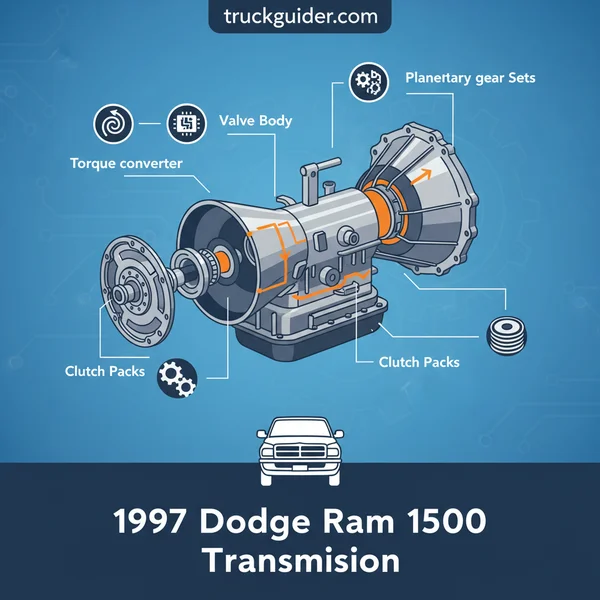
Identifying the correct transmission is critical because while these units look similar externally, they are not interchangeable. The 42RE (part of the A500 family) was designed for lighter loads, whereas the 46RE (A518 family) features a beefier internal structure and a larger case to handle the torque of the 5.9L engine. Misidentifying your transmission leads to torque converter mismatching and electronic compatibility issues that can leave your truck stranded in the driveway.
Identifying Your Transmission: 42RE vs. 46RE Compatibility
The most reliable way to identify your transmission is by looking at the engine under your hood. Dodge paired specific transmissions with specific powerplants to ensure the drivetrain could handle the output. Because the 1997 Ram 1500 used a fairly rigid production standard, you can usually determine your transmission model without even crawling under the chassis.

The Engine Displacement Rule
For the 1997 model year, the transmission model follows the engine size. If you aren’t sure which engine you have, check the emissions sticker under the hood or the eighth digit of your VIN. Use the following breakdown to match your equipment:
- 42RE Transmission: This unit is found behind the 3.9L V6 and the 5.2L (318 ci) V8 engines. It is a lighter-duty 4-speed automatic.
- 46RE Transmission: This unit is found exclusively behind the 5.9L (360 ci) V8 engine. It features a larger rotating mass and more robust clutch packs.
While both are 4-speed overdrive automatics, you cannot simply swap a 42RE into a 5.9L truck; it will fail prematurely under the stress. It is also important to note that the 1997 model year is specific regarding its electronics. While a 46RE from a 1998 or 2000 might look the same, the internal wiring harness and the pin-out on the main connector often changed. Always verify that the replacement unit is specifically listed for the 1997 model year to ensure the PCM (Powertrain Control Module) can communicate with the internal sensors.
Visual ID and Part Numbers
If your engine has been swapped or you want to be 100% certain, look at the driver’s side of the transmission case just above the oil pan rail. You will find a series of stamped numbers. A 46RE will often have “46RE” stamped directly into the metal or on a specialized ID tag. Additionally, the 46RE features a larger, more rounded “bulge” on the passenger side of the bellhousing compared to the more compact 42RE. The 46RE also utilizes a larger torque converter and a different starter motor offset, making physical dimensions slightly different when placed side-by-side.
1997 Dodge Ram 1500 Transmission Made Easy: Your Essential Action Plan
The 1997 Dodge Ram 1500 is a legendary workhorse, but its transmission—typically the 42RE or 46RE—requires specific maintenance to ensure a long life and smooth shifting. This guide covers a comprehensive service walkthrough, including fluid replacement, filter renewal, and the critical “hidden” step that most owners forget: band adjustments. Following these steps correctly can prevent common issues like “hunting” for gears or slipping, saving you thousands in potential rebuild costs while keeping your classic second-gen Ram on the road for years to come.
Step 1: Preparation and Safety Setup
What you need: 3-ton jack stands, a floor jack, wheel chocks, a large drain pan (at least 10 quarts), a basic socket set (specifically a 1/2-inch socket), and safety glasses.
Instructions: Before you begin, drive the truck for about 10 minutes to warm the transmission fluid; warm fluid flows better and carries more contaminants out of the system. Park the vehicle on a level surface, engage the parking brake, and chock the rear wheels. Jack up the front of the truck and secure it firmly on jack stands. You need enough clearance to work comfortably under the transmission pan. Ensure the vehicle is stable by giving it a firm shake before sliding underneath. Wearing safety glasses is non-negotiable here, as transmission fluid is a skin irritant and can cause serious eye injury if it drips while you are looking upward at the valve body.
Pro Tip: Place a large piece of cardboard or a specialized oil mat under your drain pan. The 1997 Ram transmission pan famously lacks a drain plug, and the “controlled tilt” method of draining almost always results in some splashing.
Step 2: Draining the Fluid and Removing the Pan
What you need: 1/2-inch socket, extension, and your drain pan.
Instructions: Position your drain pan directly under the transmission pan. Begin by loosening the bolts around the entire perimeter of the pan, but do not remove them yet. Once they are loose, remove the bolts from the rear and the sides, leaving the front two or three bolts partially threaded. Use a flathead screwdriver to gently pry the rear of the pan downward. The fluid will begin to pour out over the rear edge. Once the flow slows down, support the pan with one hand while removing the final front bolts. Lower the pan carefully—it will still be heavy and full of about 4 to 5 quarts of fluid. Pour the remaining fluid into your catch container and set the pan aside for cleaning.
Pro Tip: If the pan is stuck to the housing, never use a metal scraper to pry it, as you can gouge the aluminum sealing surface. Use a rubber mallet to give the side of the pan a sharp tap to break the seal.
Step 3: Inspecting and Cleaning the Pan and Magnet
What you need: Brake cleaner, lint-free rags, and a small scraper or wire brush.
Instructions: Take a close look at the bottom of the pan and the round magnet located inside. It is normal to see a fine, grey metallic “fuzz” on the magnet—this is standard wear. However, if you find large metal chunks, brass-colored flakes, or pieces of snap rings, your transmission is likely suffering from internal mechanical failure. Clean the magnet thoroughly until it is shiny. Use brake cleaner to spray out the inside of the pan and wipe it down with a lint-free rag until it is spotless. Ensure the mating surface where the gasket sits is completely free of old gasket material or RTV silicone. A clean surface is the only way to ensure a leak-free seal upon reassembly.
Pro Tip: Spend extra time cleaning the exterior rim of the pan. Even a tiny speck of dirt or old cork gasket can create a path for fluid to weep out under pressure.
Step 4: Replacing the Internal Filter
What you need: T25 Torx bit or a small socket (depending on specific year/model variations), and a new transmission filter.
Instructions: With the pan removed, you will see the filter attached to the bottom of the valve body. It is typically held in place by two or three small screws. Carefully remove these screws, being mindful that a small amount of residual fluid will drain out once the filter is pulled down. Discard the old filter. Take your new filter and ensure the seal or gasket on the neck of the filter is properly seated. Align the new filter with the ports on the valve body and hand-tighten the screws. Snug them down firmly, but do not over-torque them, as the valve body is made of soft aluminum and can strip easily. The filter should sit flush and feel solid against the assembly.
Pro Tip: Compare the old filter to the new one before installing. There are minor variations in the 42RE and 46RE filters; ensuring the intake port shape matches exactly will prevent cavitation and shifting issues.
Step 5: Adjusting the Front (Kickdown) Band
What you need: 3/4-inch wrench, 5/16-inch square socket (or an 8-point socket), and an inch-pound torque wrench.
Instructions: This is the most skipped step in Ram maintenance. The front band adjustment screw is located on the outside of the transmission, on the driver’s side, just above the shift linkage. Loosen the large locknut (3/4-inch) by several turns. Using the 5/16-inch socket, tighten the inner adjustment screw to exactly 72 inch-pounds. Once reached, back the screw off exactly 2-7/8 turns (for a 46RE) or 3-5/8 turns (for a 42RE). Holding the adjustment screw perfectly still with your wrench, tighten the locknut down to 30 foot-pounds. This adjustment ensures the band grabs the drum correctly during the 1-2 shift, preventing the common “slip-bump” feeling many Dodge owners experience.
Pro Tip: Use a paint pen to mark the adjustment screw before you back it off. This helps you track exactly how many rotations you have made, as it is easy to lose count on the fractional turns.
Step 6: Adjusting the Rear (Low/Reverse) Band
What you need: 9/16-inch wrench, 1/4-inch socket, and an inch-pound torque wrench.
Instructions: Unlike the front band, the rear band adjustment is located inside the transmission case. You will find the adjustment screw near the rear of the valve body area. Loosen the locknut about 3 turns. Tighten the adjustment screw to 72 inch-pounds. Once tightened, back the screw off exactly 2 turns (for 46RE) or 4 turns (for 42RE). Just like the front band, hold the screw steady while you tighten the locknut back down to 25 foot-pounds. This band is responsible for your reverse gear and manual first gear; if your truck feels sluggish when backing up or fails to engine brake in low gear, this adjustment is usually the culprit.
Pro Tip: Since you are working upside down, ensure your torque wrench is set to “inch-pounds,” not “foot-pounds.” Using foot-pounds here will snap the adjustment bolt and require a total transmission teardown to fix.
Step 7: Installing the Pan and Gasket
What you need: New pan gasket (Mopar reusable or high-quality rubber), and a 1/2-inch socket.
Instructions: Place the new gasket onto the clean pan. Avoid using RTV sealant if you are using a high-quality rubber or reusable plastic gasket, as the sealant can actually cause the gasket to “squish” out of place. Raise the pan back into position against the transmission case and start all bolts by hand. Using a crisscross pattern (similar to tightening lug nuts on a wheel), tighten the bolts in several stages. This ensures the pan applies even pressure to the gasket. The final torque for these bolts should be approximately 13 foot-pounds. Over-tightening is a common mistake that warps the pan flange and leads to permanent leaks.
Pro Tip: If your pan flange is slightly bent from previous over-tightening, use a small hammer and a flat block of wood to flatten the bolt holes on the pan before you reinstall it.
Step 8: Refilling with ATF+4 Fluid
What you need: 4 to 6 quarts of ATF+4 transmission fluid and a long-neck funnel.
Instructions: Insert the funnel into the transmission dipstick tube located at the rear of the engine bay. Pour in 4 quarts of licensed ATF+4 fluid. Do not use Dexron or “Universal” fluids, as Chrysler transmissions of this era are highly sensitive to friction modifiers. Start the engine and let it idle. With your foot firmly on the brake, cycle the shifter through every gear (P-R-N-D-2-1), holding each for 5 seconds to circulate the fluid through the valve body. Shift the truck into NEUTRAL (not Park) and check the dipstick. Add fluid in half-quart increments until the level reaches the “Cold” mark. Drive the truck until it reaches operating temperature, then check again in Neutral to ensure it is at the “Hot” mark.
Pro Tip: On 1997 Rams, the fluid does not circulate through the cooler while the truck is in Park. You must check the fluid level in Neutral to get an accurate reading, otherwise, the dipstick will show a false “Full” level.
✅ Final Checklist
- Verify that the pan bolts are torqued to 13 ft-lbs and no fluid is weeping from the gasket.
- Confirm the front and rear band locknuts are tight to prevent the adjustment screws from backing out.
- Ensure the fluid level was checked while the engine was running and the transmission was in Neutral.
- Check that only ATF+4 fluid was used, as other types will cause shift shudder and premature clutch wear.
- Inspect the cooling lines near the radiator for any leaks that may have been disturbed during the process.
Important Notes:
- Safety Warning: Transmission fluid is flammable; keep it away from hot exhaust manifolds during the refill process.
- When to Seek Help: If you find large metal chunks in the pan or if the fluid smells severely burnt (like charred toast), a simple fluid change will not fix the underlying mechanical damage.
- Estimated Time: 2 to 3 hours for a DIYer.
- Cost Range: $60 – $120 for fluid, filter, and gasket, depending on the brand of ATF+4 chosen.
Common 1997 Dodge Ram Transmission Failure Symptoms
Before you spend thousands on a replacement, you need to know if your issue is a simple sensor fix or a total internal collapse. The RE series transmissions are electronically governed, which means many “catastrophic” feeling failures are actually just electrical hiccups in the governor circuit.
Governor Pressure and Solenoid Failures
The most common “failure” in a 1997 Ram is the truck getting stuck in second or third gear, often called Limp Mode. This usually does not mean the hard gears are broken. It typically points to the electronic control system within the valve body.
- Hunting for Gears: If the transmission shifts erratically between 1st and 2nd gear while cruising, the Governor Pressure Solenoid is likely clogged or failing.
- Late or Harsh Shifts: Often caused by a failing Governor Pressure Sensor, which provides incorrect data to the truck’s computer.
- No Overdrive Engagement: This is frequently a result of a failed Overdrive/TCC Solenoid pack or a faulty engine coolant temperature sensor telling the computer the engine is too cold to allow the fourth gear to engage.
Mechanical Slipping and Fluid Clues
If your engine revs up but the truck doesn’t move faster, you are experiencing mechanical slip. This is a sign that the friction material on the clutch plates or bands has worn away. To confirm this, check your transmission fluid immediately using the dipstick while the engine is warm and in neutral.
- Burnt Smell: If the fluid smells like burnt toast and looks dark brown or black, your clutch packs are likely fried.
- Metal Shavings: Drop the transmission pan for an inspection. A fine, grey “dust” on the magnet is normal wear, but chunks of metal or “silver glitter” indicate a broken hard part, such as a snap ring or a failing planetary gear set.
If you find heavy metal debris in the pan, a solenoid kit will not save you. At this point, you must decide between a DIY rebuild kit, a used unit from a salvage yard, or a professionally remanufactured transmission.
Cost Analysis: Rebuild Kits vs. Used vs. Remanufactured Units
When your 1997 Dodge Ram 1500 starts slipping or loses reverse, you face a tough financial crossroad. Because these trucks are aging, the cost of the transmission repair often rivals the market value of the vehicle itself. Deciding which path to take depends entirely on your mechanical skill level and how much longer you plan to keep the truck on the road.
Comparing Your Replacement Options
The “cheap” route is almost always a used unit from a salvage yard. While you might find a 42RE for as low as $300 to $600, it is a significant gamble. You are essentially buying someone else’s maintenance history. If the donor truck was used for heavy towing without an auxiliary cooler, that used transmission might only last a few months.
- Rebuild Kits ($200 – $500 for parts): This is the most cost-effective DIY method. However, if you hire a shop, labor will push the total to $1,800 – $2,600.
- Used Units ($400 – $900): Best for “get it running to sell it” scenarios, but carries the highest risk of immediate failure.
- Remanufactured Units ($2,500 – $3,800): The premium choice. These units are corrected for factory defects and usually come with a 3-year warranty.
Why Remanufactured Often Wins
For a 1997 Dodge Ram that you intend to keep, a remanufactured unit is often the smartest investment. Unlike a standard rebuild that simply replaces worn clutches, remanufactured units often include updated valve bodies and improved seals that address the specific cooling and pressure issues known to plague the 46RE. It turns a “weak link” into a reliable component for another 100,000 miles.
Performance Upgrades to Extend Second Gen Ram Transmission Life
Heat is the absolute number one killer of the 42RE and 46RE transmissions. These units were designed in an era where cooling wasn’t always prioritized for heavy-duty cycles. If you’ve just installed a fresh transmission or want to protect your current one, a few targeted upgrades can significantly extend the lifespan of your Second Gen’s drivetrain.
Improving Cooling and Fluid Capacity
The factory cooling loop in the radiator is rarely enough, especially if you live in a warm climate or use your Ram for hauling. Installing an auxiliary plate-and-fin cooler is the single best modification you can make. By bypassing or supplementing the radiator loop, you can drop operating temperatures by 20 to 30 degrees.
- Deep Sump Pans: Adding an aftermarket aluminum deep pan increases fluid capacity by 2-4 quarts, providing a larger “heat sink” for the system.
- High-Flow Filters: Upgrading to a premium filtration system ensures that the sensitive solenoids in the 46RE stay free of microscopic debris.
- Shift Kits: A TransGo or similar shift kit reduces “shift overlap,” which minimizes the friction and heat generated when the transmission moves between gears.
The Torque Converter Factor
The stock torque converters in the 1997 Ram 1500 are known for being somewhat inefficient. If you are doing a swap, consider upgrading to a heavy-duty converter with a lower stall speed or a reinforced cover. This improvement helps the 46RE put power to the ground more effectively, reducing the “slushy” feeling often associated with these older Dodge trucks and preventing premature wear on the input shaft.
Conclusion
The 42RE and 46RE transmissions are the backbone of the 1997 Dodge Ram 1500, but they require consistent care to thrive. Whether you are nursing an original unit or deciding between a budget-friendly rebuild and a high-quality remanufactured replacement, understanding the differences in torque capacity and cooling needs is vital. By prioritizing temperature control and addressing factory weaknesses, you can ensure your Second Gen Ram stays on the road for years to come.
Next Steps: Check your transmission fluid color and smell today. If it looks dark or smells burnt, it’s time to drop the pan and inspect for metal shavings. Don’t wait for total failure—early maintenance is the only way to avoid a heavy repair bill. Keep those gears turning!
❓ Frequently Asked Questions
How can I tell the difference between a 42RE and a 46RE transmission?
The easiest way is by engine size: 5.2L and 3.9L engines use the 42RE, while 5.9L engines use the 46RE. Physically, the 46RE has a larger overall case diameter and a slightly different pan shape compared to the 42RE.
Why is my 1997 Dodge Ram 1500 stuck in second gear?
This is known as ‘Limp Mode,’ a failsafe triggered by the computer. It is most often caused by a failed governor pressure solenoid or a faulty output speed sensor that prevents the transmission from shifting properly.
Is it worth rebuilding a 1997 Dodge Ram transmission myself?
A rebuild kit is the cheapest option (approx. $300-$500), but these transmissions are complex. Unless you have specific experience with Chrysler RE units, a remanufactured unit is usually a better investment due to the included upgrades and warranty.
What are the signs that my torque converter is failing?
Common signs include excessive heat, a ‘shuddering’ feeling while driving at highway speeds (often mistaken for an engine misfire), and contaminated fluid containing metallic ‘glitter.’
Can I swap a 46RE into a truck that originally had a 42RE?
While physically similar, it is not a direct ‘plug-and-play’ swap because the 46RE is longer and requires a different driveshaft. Additionally, the engine computer (PCM) tuning may differ between the two models.
How long do these transmissions typically last?
With regular fluid changes and the addition of an external oil cooler, these transmissions can last 150,000 to 200,000 miles. However, heavy towing without cooling upgrades often leads to failure much sooner.


![2003 Dodge Ram Dashboard Replacement: Causes & Fixes [2026]](https://truckguider.com/wp-content/uploads/2026/03/2003-dodge-ram-dashboard-replacement-featured.webp)