2003 Dodge Ram 1500 Bolt Pattern And Wheel Fitment Specifications [2026]

Finding the perfect set of wheels for a 2003 Dodge Ram 1500 requires more than just an aesthetic eye; it demands precise technical knowledge of the vehicle’s hub geometry. As a cornerstone of the third-generation Ram lineup, the 2003 model features a specific engineering profile that dictates which aftermarket upgrades will perform safely and which will lead to disaster. Inaccurate measurements or ignoring critical hub-centric requirements can lead to dangerous wheel vibrations, sheared lug studs, or expensive fitment failures that compromise the integrity of your truck. This comprehensive, expert-led guide provides a professional breakdown of the 2003 Dodge Ram 1500 bolt pattern, torque specifications, and offset requirements to ensure a reliable and safe installation that stands the test of time.
Understanding the 2003 Dodge Ram 1500 Bolt Pattern Measurements
📤 Share Image
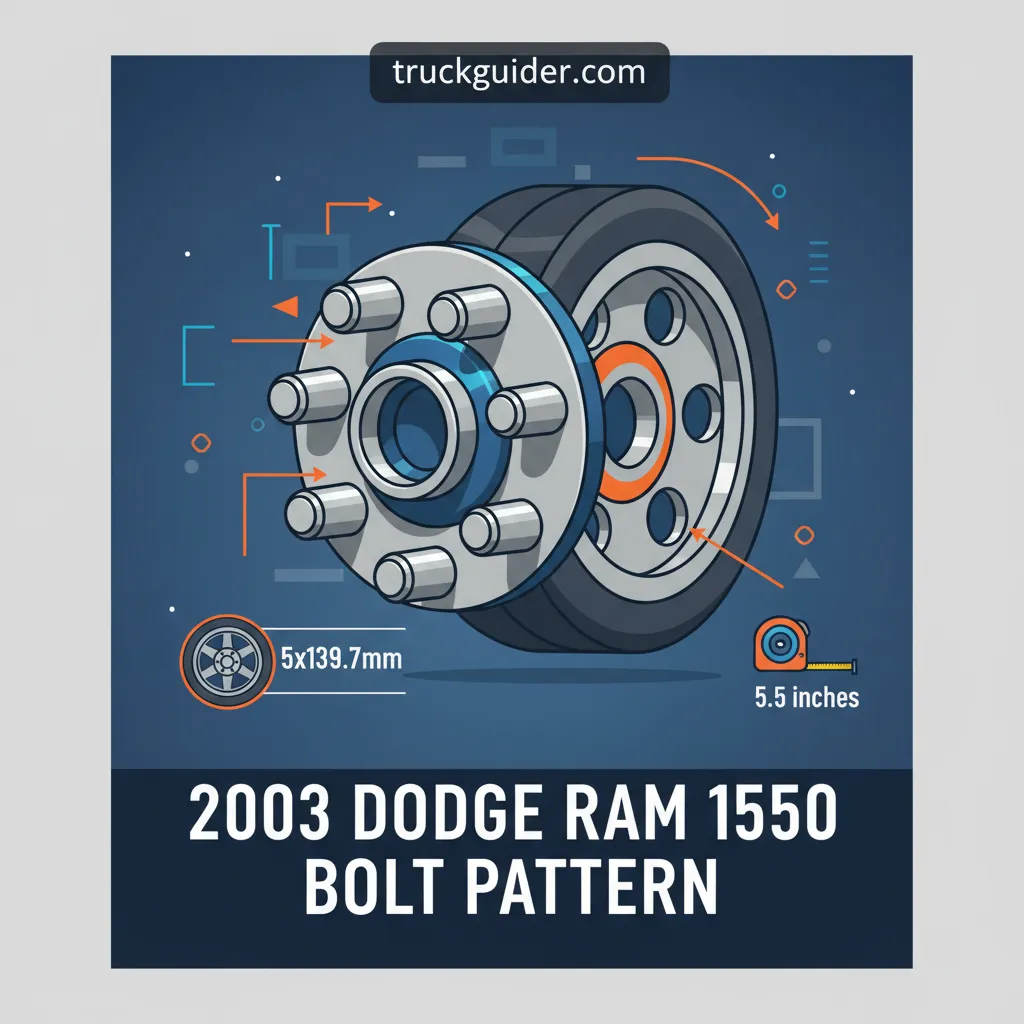
The foundation of any wheel purchase is the bolt pattern, a measurement that must be exact to within a fraction of a millimeter. For the 2003 Dodge Ram 1500, the standard is the 5×5.5 inch lug configuration. In the modern wheel industry, you will frequently see this expressed in its metric equivalent: 5×139.7mm. This measurement indicates that there are five lug holes arranged in a circle with a diameter of exactly 5.5 inches (or 139.7 millimeters).
In my 15 years of industry experience, the most common error I see involves DIY owners attempting to measure a 5-lug pattern incorrectly. Unlike a 4, 6, or 8-lug pattern where you measure directly across from center to center, a 5-lug pattern requires a different approach for field verification. To measure a 5×5.5 pattern accurately, you measure from the center of one hole to the back of the third hole (skipping one). This specialized measurement accounts for the geometry of the pentagonal layout. If you measure center-to-center on a 5-lug wheel, you will get an incorrect, smaller reading every time.
The 2003 model year is a significant part of the third-generation (2002–2008) Ram evolution. During this era, Dodge maintained a consistent 5-lug architecture for the light-duty 1500, but it is vital to distinguish this from the heavy-duty variants. A common pitfall occurs when buyers source wheels from a 2003 Ram 2500 or 3500. Those heavy-duty trucks utilize a massive 8×6.5 inch (8×165.1mm) pattern. Because the body styles are identical, many assume the wheels are interchangeable. They are not. Attempting to force an 8-lug wheel onto a 5-lug hub is physically impossible, and using “adapters” to bridge such a massive gap is professionally discouraged as it severely compromises the truck’s payload capacity and safety.
By The Numbers: Bolt Pattern
Number of Lugs
Imperial Diameter
Metric Equivalent
Critical Hub Centricity and Center Bore Requirements
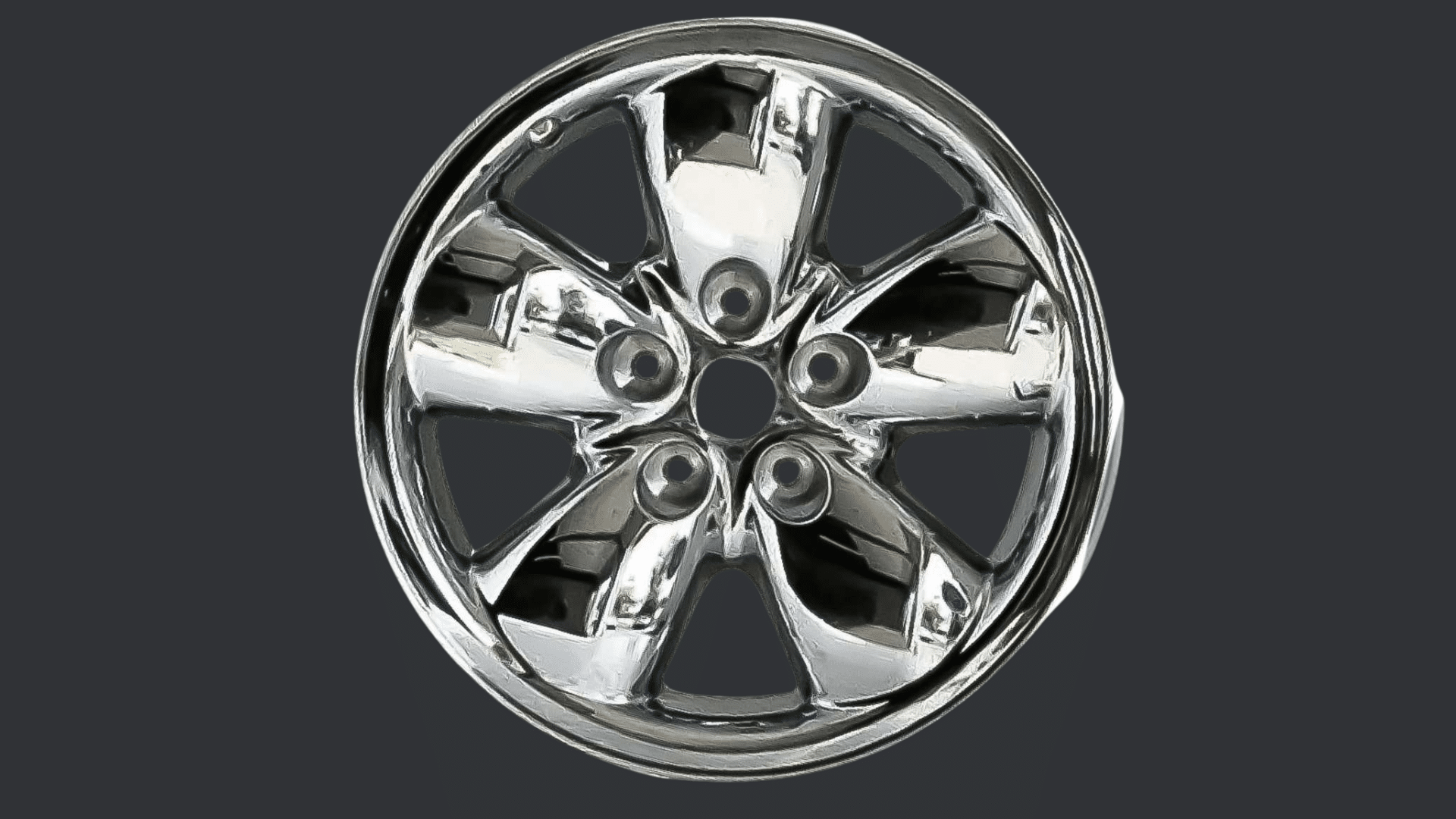
While the bolt pattern gets most of the attention, the center bore is arguably the most critical factor for ride quality and long-term mechanical health. For the 2003 Dodge Ram 1500, the hub pilot diameter is exactly 77.8mm. This is a hub-centric design, meaning the wheel is centered by the precision-machined hub lip of the truck, not by the lug nuts themselves. The hub carries the weight of the vehicle, while the lug nuts are strictly responsible for providing the clamping force to keep the wheel against the hub face.
The most frequent complaint I hear from Ram owners who have installed aftermarket wheels is a persistent “steering wheel shake” or vibration at approximately 60 MPH. In 90% of cases, this is caused by installing “lug-centric” aftermarket wheels without the proper adapters. Many aftermarket wheels are manufactured with a generic, larger center bore—such as 108mm or 110mm—to fit a wide variety of vehicles. If you bolt a 108mm bore wheel onto a 77.8mm Ram hub, the wheel will likely be slightly off-center. Even a deviation of 0.5mm is enough to cause significant high-speed vibration and place “shear stress” on the lug studs, which are not designed to support the vertical load of the truck.
To rectify this, I always recommend using high-quality hub-centric rings. These rings act as a shim to bridge the gap between the 77.8mm hub and the larger bore of the aftermarket wheel. When selecting these, opt for machined aluminum or high-density polycarbonate rings. This simple, inexpensive addition ensures that the wheel is perfectly centered, eliminating vibrations and protecting your studs from failure.
Before mounting a new wheel, slide it onto the hub without the lug nuts. If there is visible “play” or wiggle room between the center hole and the hub lip, you must use hub-centric rings to ensure a safe, vibration-free fitment.
Lug Nut Torque Specifications and Hardware Standards
Hardware is often an afterthought, but using the wrong lug nuts on a 2003 Ram 1500 can be catastrophic. These trucks utilize a heavy-duty 9/16″-18 TPI (Threads Per Inch) stud. This is a larger and more robust thread than what is found on many half-ton competitors of the same era. You cannot use 1/2″-20 or M14x1.5 nuts; they will either not fit or will strip the threads instantly.
Furthermore, you must ensure the lug nut seat style matches your wheel. The factory 2003 Ram wheels and the vast majority of aftermarket wheels use a 60-degree conical (acorn) seat. If you attempt to use a flat “mag seat” or a ball seat nut on a conical wheel, the contact patch will be insufficient, leading to the nut loosening while driving. For those moving to aftermarket wheels with narrow lug pockets, you may need “spline drive” nuts, but ensure they still maintain the 9/16″-18 thread and 60-degree taper.
📋
Professional Installation Sequence
Use a wire brush to remove rust and debris from the hub face and the back of the wheel. Even a thin layer of scale can prevent a flush fit, leading to torque loss.
Hand-tighten all nuts first. Using a calibrated torque wrench, tighten the nuts in a 5-point star pattern (1-3-5-2-4) to 135 lb-ft (183 Nm). This ensures even pressure across the brake rotor hat, preventing warping.
One of the most dangerous practices in shops today is the reliance on pneumatic impact wrenches without a torque stick. An impact wrench can easily over-tighten a nut to 200+ lb-ft, stretching the stud beyond its elastic limit, or under-tighten it, allowing the wheel to back off. Always insist on a hand-torque with a calibrated wrench. Furthermore, it is mandatory to re-torque your wheels after the first 50 and 100 miles of driving. New wheels can “settle” against the hub, causing a slight drop in clamping force.
Wheel Offset and Backspacing for Performance and Clearance
The “stance” of your 2003 Ram 1500 is determined by offset and backspacing. Offset is the distance from the wheel’s mounting surface to its true centerline, measured in millimeters. The factory 17-inch and 20-inch wheels for the 2003 Ram 1500 typically feature an offset range of +19mm to +25mm. This positive offset keeps the tire tucked neatly inside the fender wells and maintains the scrub radius for which the suspension was designed.
Backspacing is a related imperial measurement (measured from the back edge of the wheel to the mounting surface). For a standard factory 20×9 inch wheel, the backspacing is approximately 5.75 inches. If you are upgrading to larger 33-inch or 35-inch tires, backspacing becomes your most critical metric. If you choose a wheel with too much backspacing (greater than 6 inches), the inner sidewall of the tire will likely rub against the upper control arms or the sway bar during tight turns.
✅ Positive Offset (+19mm to +25mm)
- Maintains factory steering geometry
- Reduces wear on wheel bearings
- Keeps tires inside fenders (cleaner look)
- Ideal for stock suspension heights
❌ Low/Negative Offset (0mm to -24mm)
- Increases stress on hubs and bearings
- Tires may rub on fender liners (trimming required)
- Alters scrub radius, causing “darting” on highways
- Requires fender flares to prevent paint damage
For example, many owners opt for a 20×9 inch wheel with a 0mm offset to achieve a more aggressive, wider stance. This move pushes the wheel/tire assembly roughly 0.75 to 1 inch further outward compared to stock. While this often provides the necessary clearance for larger 35-inch tires to avoid hitting the control arms, it simultaneously increases the leverage on your wheel bearings. If you choose this path, be prepared for slightly accelerated wear on your front-end components and consider high-quality replacement hubs from trusted brands.
Interchangeability with Other Vehicle Years and Brands
One of the advantages of the 2003 Ram 1500 is the wide availability of used wheels from other model years. The 5×139.7mm pattern was used by Dodge for the 1500 series from 1994 all the way through 2018. This means you can successfully swap wheels from a 2014 Ram 1500 “Sport” or “Laramie” directly onto your 2003 model. These “take-off” wheels are often a cost-effective way to update the look of an older truck while maintaining professional OEM quality.
Starting with the 2019 model year (5th Gen), the Ram 1500 transitioned to a 6×139.7mm bolt pattern. Wheels from a 2019 or newer Ram will not fit your 2003 truck without unsafe adapters. Always count the lugs before buying used.
While the bolt pattern may be the same as some other manufacturers, compatibility is rarely universal. A common myth is that pre-1997 Ford F-150 wheels will fit a Ram because they both share a 5×5.5 pattern. However, the Ford wheels have a significantly smaller center bore (usually around 87mm for the Ford vs 77.8mm for the Ram sounds compatible, but in many older Ford iterations, the machining depth or hub-pilot thickness differs). More importantly, many older Jeep CJ and International Scout wheels share the 5×5.5 pattern but feature center bores that are too small to clear the massive 77.8mm Ram hub. Never attempt to “bore out” a wheel center hole yourself, as this compromises the structural integrity of the wheel.
In summary, the 2003 Dodge Ram 1500 utilizes a 5×5.5 inch (5×139.7mm) bolt pattern with a 77.8mm center bore. Adhering to the 135 lb-ft torque specification using the correct 9/16″-18 lug nuts is non-negotiable for road safety. While there is a high degree of cross-compatibility among 1994–2018 Ram 1500 models, you must always verify the center bore and offset before finishing an installation. Always verify your aftermarket wheel specifications with a professional technician before finalizing your purchase to guarantee road safety and vehicle longevity.
Frequently Asked Questions
Will wheels from a 2021 Dodge Ram 1500 fit my 2003 model?
No, they will not fit. Starting in 2019, the Dodge Ram 1500 transitioned from a 5-lug pattern to a 6-lug (6×139.7mm) pattern. For your 2003 model, you must stick with wheels specifically designed for the 5×5.5 inch (5×139.7mm) configuration used on 1994–2018 Ram 1500 models.
What is the correct lug nut size for a 2003 Dodge Ram 1500?
The 2003 Dodge Ram 1500 uses 9/16″-18 thread size lug nuts. It is vital to use the correct thread pitch, as many other trucks use 14×1.5mm or 1/2″-20. Additionally, ensure the lug nut has a 60-degree conical seat to match the wheel’s mounting surface.
Can I use 5x135mm wheels on my 2003 Dodge Ram?
No. While 5x135mm (commonly found on older Ford F-150s) looks similar to the Ram’s 5×139.7mm, the 4.7mm difference is significant. Attempting to force these wheels on will cause the lug studs to bend or snap, leading to catastrophic wheel failure while driving.
What happens if I don’t use the correct torque on my lug nuts?
Under-torquing can lead to the lug nuts backing off and the wheel detaching from the vehicle. Over-torquing is equally dangerous, as it can stretch the 9/16″ studs beyond their yield point or warp the brake rotors. Always use a torque wrench set to 135 lb-ft.
Do I need hub-centric rings for aftermarket wheels?
If the aftermarket wheels have a center bore larger than 77.8mm, hub-centric rings are highly recommended. These rings fill the gap between the vehicle’s hub and the wheel’s center hole, ensuring the wheel is perfectly centered, which eliminates vibrations and reduces the shear load on the lug studs.