
2011 Ford Ranger Fuse Box Diagram: Configurations, Model Differences, and Safety Protocols Mapped Out

Are you struggling with an electrical failure in your truck? A 2011 Ford Ranger fuse box diagram is the essential roadmap for diagnosing issues with your radio, fuel pump, or headlights. Whether you are dealing with a blown fuse or a malfunctioning relay, locating the correct panel is the first step toward a successful DIY repair.

How to Read This Chart
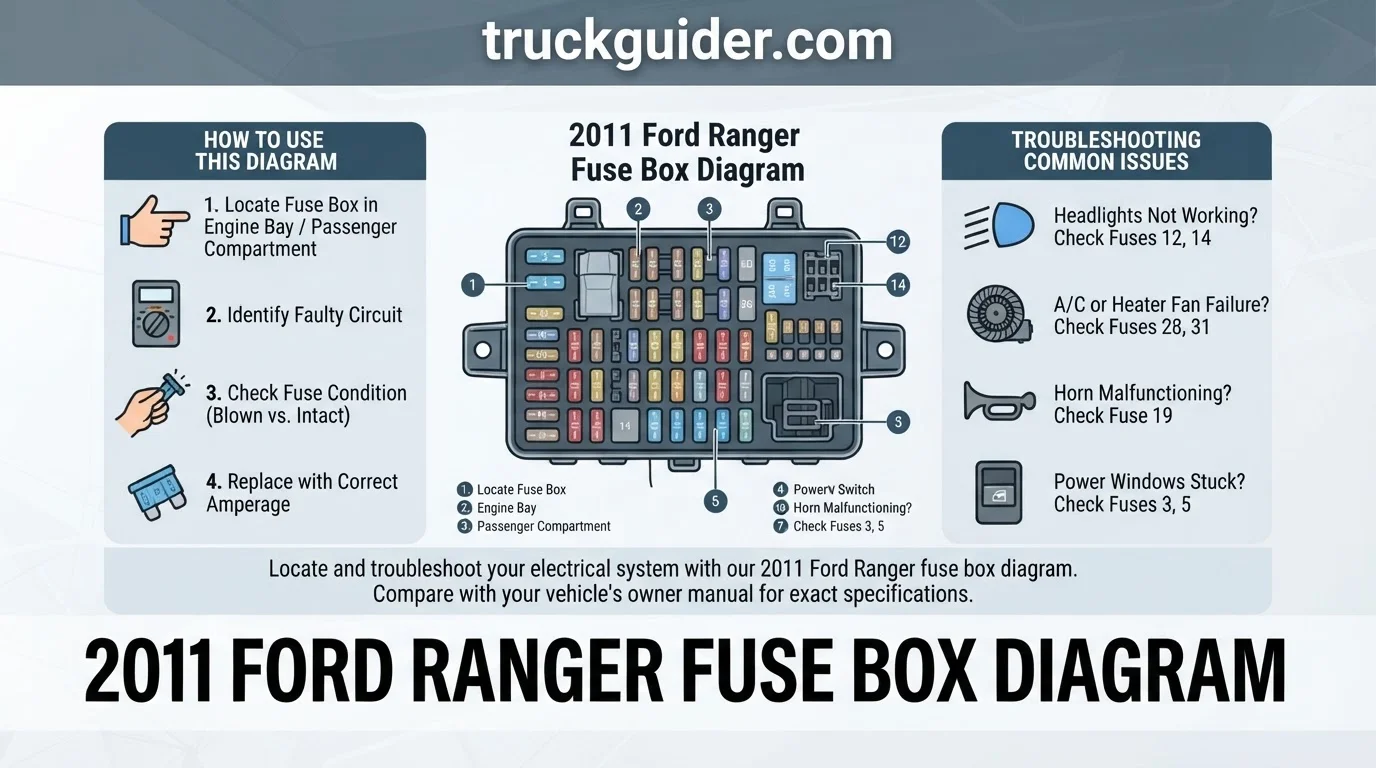
The chart above outlines the physical locations for the two main electrical distribution points in your 2011 Ford Ranger. The “Battery Junction Box” is the Power Distribution Center (PDC) located under the hood; it manages high-amperage components like the fuel pump and cooling fans. The “Smart Junction Box” (SJB) is located behind the kick panel in the passenger footwell and controls interior accessories.

Because engine sizes (2.3L vs 4.0L) affect certain relay positions in the engine bay, always verify your specific owner’s manual before pulling a fuse. The labels in your manual correspond to the physical grid printed on the inside of the protective plastic cover of each fuse box.
Understanding 2011 Ford Ranger Fuse Box Diagram Features
Recommended Best Deal Products


The 2011 Ranger design represents the final iteration of this classic platform, and the fuse box layout reflects a mature electrical system. One of the main advantages of this specific year is the clear labeling system provided by Ford. Unlike earlier iterations, the 2011 model utilizes high-visibility text on the underside of the panel covers.

The features of the internal Smart Junction Box include integrated solid-state logic for interior comfort features. A distinct disadvantage for some owners is the tight space in the passenger footwell, which makes accessing the lower row of fuses difficult without a proper fuse-puller tool. However, the modular nature of the engine bay power distribution center remains a major pro for maintenance efficiency.
📋
How to Safely Troubleshoot 2011 Ford Ranger Fuse Box Diagram Circuits
Ensure the ignition is in the OFF position and the key is removed. Open the hood to access the Battery Junction Box or the passenger door for the Smart Junction Box.
Match your electrical symptom (e.g., no radio power) with the corresponding fuse number on the diagram label. Use a test light or multimeter to check for continuity across the metal prongs.
Replace the blown fuse with one of the exact same amperage (color-coded). Never use a higher rating, as this can lead to wiring harness damage or electrical fires.
Specifications and Comparison: Electrical Configurations
Recommended Best Deal Products


When conducting a comparison of 2011 Ranger models, the primary differentiator in the fuse box layout is the engine displacement. The 4.0L V6 engine utilizes specific relays in the Battery Junction Box for cooling fan control that are absent in the 2.3L I4 model. These minor configuration differences are critical during troubleshooting.
The 2011 model year features a highly refined, durable electrical architecture. While some modern trucks have moved to complex electronic control modules for basic functions, the Ranger’s reliance on traditional fuses makes it a winner for DIY enthusiasts. The specifications are standardized across the model range, ensuring that common replacement fuses are readily available at any local parts store.

Audible — Listen Free for 30 Days
One free credit a month and thousands of titles included.
Listen Free for 30 Days✨ Benefits of Proper Diagram Usage
Diagnostic Speed
Correctly using the diagram saves hours of random testing, allowing you to pinpoint the specific circuit culprit immediately.
Preventative Safety
Using the correct amperage ratings ensures your vehicle’s wiring remains protected from over-current conditions.
🔎 How to Find Your Specific Fuse Box Label
Recommended Best Deal Products


To verify the exact diagram for your truck, locate the physical fuse box cover. Both the engine bay and interior panels have a diagram printed directly on the inside of the removable lid. If the sticker is faded or missing, consult the VIN-specific digital manual available on the Ford Owner support website. Always ensure your VIN matches the manual edition to account for late-year production changes.
Never attempt to bridge a blown fuse with wire or metal objects. This bypasses the safety mechanism and carries a severe risk of vehicle fire or permanent damage to your wiring harness.
What If Your Electrical Issues Persist?
If you have replaced a blown fuse and it blows again immediately, you likely have a short-to-ground in the circuit. Follow these steps to narrow down the issue:
- Disconnect the electrical component being powered by the circuit and insert a new fuse to see if it holds.
- Inspect the wiring harness for signs of fraying, heat damage, or pinching against the chassis.
- Check for moisture intrusion in the fuse box, which can cause internal corrosion.
If these steps do not reveal the issue, the problem may be an internal short within the Smart Junction Box itself. In such cases, contact a professional automotive electrician. Diagnostic labor costs typically range from $100 to $250, depending on the complexity of the trace-down required.
2011 Ford Ranger Fuse Box Diagram Questions Answered
Can I use a higher amperage fuse if the correct one keeps blowing?
No. Using a fuse with a higher rating than specified by the manufacturer is dangerous and can lead to melting wires, smoke, or an engine compartment fire.
Are all 2011 Ranger fuse boxes the same?
Not entirely. While the basic architecture is the same, some fuse locations and relay configurations differ based on whether you have a 2.3L, 3.0L, or 4.0L engine configuration.
Audible Premium Plus — Annual Membership
12 audiobook credits up front, plus the full Audible catalogue.
See Annual PlansWhat is the difference between a fuse and a relay?
A fuse is a safety device that breaks the circuit if current is too high. A relay is an electrically operated switch used to turn high-power components on and off using a low-power signal.
The 2011 Ford Ranger remains a reliable workhorse, and understanding your fuse box diagram is a key skill for any owner. By identifying the correct power distribution centers and following proper safety protocols, you can resolve most electrical gremlins quickly. For further details on your specific build, always refer to your factory owner’s manual or a verified digital service guide to ensure absolute accuracy during your repairs.
Key Takeaways
-
✓
Locate the Power Distribution Box on the driver’s side of the engine bay. -
✓
Identify the Passenger Compartment Fuse Panel behind the kick panel on the passenger side. -
✓
Compare the electrical architecture changes between 2010 and 2011 Ranger models. -
✓
Learn the pros and cons of aftermarket versus OEM fuse replacements. -
✓
Follow a step-by-step methodology to troubleshoot blown fuses safely.
❓ Frequently Asked Questions
1
What is the 2011 Ford Ranger fuse box diagram?
The fuse box diagram is a technical map outlining the position, amperage, and function of every fuse and relay in your truck. It is essential for identifying which circuit is responsible for specific electrical features like headlights, fuel pumps, or infotainment, allowing for quick troubleshooting during a power failure.
2
How does the fuse box configuration change between 2010 and 2011 models?
While the core architecture remains largely similar, 2011 models saw minor refinements in relay assignment to accommodate updated emission and electrical safety standards. Comparing these diagrams is vital if you are swapping components between model years, as a direct crossover could lead to intermittent electrical faults.
3
Why is this diagram important for maintenance?
Having the correct diagram is the primary advantage for DIY mechanics. It prevents the disadvantage of guessing which circuit is faulty, which saves time and protects your wiring harness from shorts. It provides a visual guide to the electrical architecture, ensuring each feature receives the correct voltage.
4
What are the benefits of DIY fuse replacement?
The main advantage of replacing your own fuses is cost savings and self-sufficiency. By understanding your vehicle’s electrical layout, you avoid expensive shop diagnostic fees. However, the disadvantage is that if you ignore the root cause—such as a short circuit—a replacement fuse will simply blow again, indicating deeper issues.
5
How can I get started with electrical troubleshooting?
Start by identifying the malfunctioning component, then locate the corresponding fuse using our diagram. Inspect the fuse for a broken metal wire inside the transparent plastic. If broken, replace it with an identical amperage fuse. If the new fuse blows immediately, consult a professional to diagnose a deeper electrical short.
6
Where is the fuse box located on a 2011 Ford Ranger?
The Ranger has two: the Battery Junction Box under the hood (engine compartment) and the Smart Junction Box located in the passenger side kick panel.


![Dodge Ram Extended Cab Guide: Quad Cab vs. Crew Cab [2026]](https://truckguider.com/wp-content/uploads/2026/03/dodge-ram-extended-cab-featured-768x403.webp)
![How to Tow a Car with a Truck Long Distance: Step-by-Step Guide [2026]](https://truckguider.com/wp-content/uploads/2026/03/how-to-tow-a-car-with-a-truck-long-dista-featured-1.webp)