2015 Ford F150 Front Bumper Parts Diagram: Mapped Out by Trim and Year-Over-Year Compatibility

The 2015 Ford F-150 marked a historic transition to aluminum-alloy body construction, rendering traditional steel-focused repair diagrams obsolete for many DIY enthusiasts. Understanding the specific 2015 Ford F-150 front bumper parts diagram is essential for ensuring structural integrity, as the mounting points and crumple zones were completely redesigned to accommodate the lighter, high-strength material while maintaining safety standards.

Reference Data for 2015 Ford F150 Front Bumper Parts
Recommended Best Deal Products


How to Read This Chart
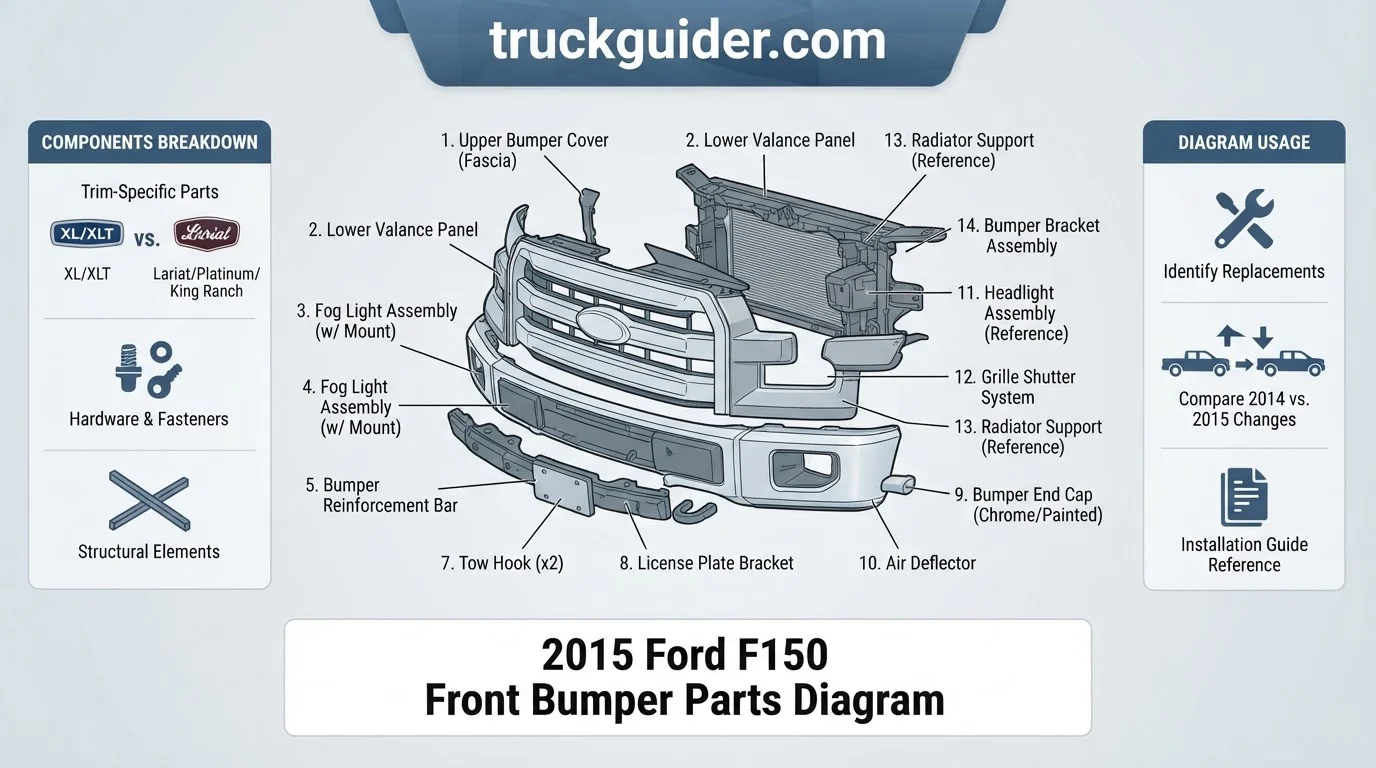
The chart above outlines critical OEM components for the 2015-2017 Ford F-150 front bumper assembly. The “Part Number” column refers to specific Ford-manufactured catalog items. When cross-referencing your 2015 Ford F150 front bumper parts diagram, note that the inclusion of an “engine heater” or specific “end cap molding” options drastically changes the required part ID.

Always verify your specific trim level (XL, XLT, Lariat, etc.) and engine displacement against these part numbers. Because the 2015 model was the first in the aluminum-body generation, manufacturing tolerances are tight; purchasing non-OEM parts may lead to alignment issues with these specific mounting points.

Structural Features and Specifications
The 2015 Ford F-150 front bumper design introduced an integrated approach to cooling and aerodynamics. Unlike previous steel generations, the 2015 bumper interacts directly with the active grille shutter system. If you are reviewing a 2015 Ford F150 front bumper parts diagram, you will notice that the air ducting (FL3Z-17F804-A) is not merely decorative; it is a functional component designed to manage airflow to the radiator and cooling modules.

The advantages of this modular design are significant for collision repair. Technicians can replace individual trim pieces or the bumper end cap without needing to swap the entire front cross-member assembly. However, the disadvantages include the need for precise torque settings, as the aluminum frame is highly susceptible to thread stripping if over-tightened during reassembly.
Comparing OEM vs. Aftermarket Parts
Recommended Best Deal Products


Reading the 2015 Ford F150 Front Bumper Parts Diagram
When you look at an official Ford parts schematic for your 2015 truck, the complexity can be overwhelming. To interpret it successfully, start by identifying your specific engine displacement. The 2.7L EcoBoost, 3.5L, and 5.0L V8 models each feature slightly different clearance requirements around the cooling intake.
Look specifically for the “end cap molding” indicator. Many diagrams will show a base bumper unit, then offer “with” or “without” add-on sections. If your F-150 features an engine heater, the diagram will show an additional wire-routing clip on the passenger side near the frame horn. Missing these small, icon-level details is the most common reason for part returns.
Always use the last 8 digits of your VIN when checking a parts diagram. Because 2015 was a mid-year transition for some electrical components, relying strictly on “model year” can occasionally lead to ordering the wrong harness clips for the bumper sensors.
🔎 How to Find Your Specific Parts Requirements
Recommended Best Deal Products


To ensure you have the correct information before ordering:
1. Open the hood and locate the Vehicle Identification Number (VIN) plate at the base of the windshield on the driver’s side.

Audible — Listen Free for 30 Days
One free credit a month and thousands of titles included.
Listen Free for 30 Days2. Access a verified Ford OEM parts catalog website and enter your VIN to filter the database to your specific build sheet.
3. Navigate to the “Body” category, then “Bumper and Components.”
4. Compare the exploded view on the screen to your actual truck. Specifically, confirm if your bumper has the parking sensor cutouts, as these are often displayed as a separate “trim” option in the diagrams.
What If the Assembly Still Doesn’t Align?
If you are reassembling your front bumper and it refuses to sit flush, the issue is rarely the part itself but rather the underlying support brackets. Follow these steps to diagnose alignment issues:
1. Loosen all mounting bolts by two full turns to allow the assembly to “float” into position.
2. Center the bumper by measuring the distance from the fender to the edge of the bumper on both sides.
3. Check for debris or leftover plastic debris from the old, damaged bumper in the frame mount holes.
4. If the bumper still sits unevenly, inspect the “crush cans”—the structural members designed to deform during an impact. If these are bent, no amount of adjustment will result in a clean look.
Audible Premium Plus — Annual Membership
12 audiobook credits up front, plus the full Audible catalogue.
See Annual PlansIf these steps fail to rectify the issue, the truck may have sustained hidden frame-horn damage. At this point, consult a professional body shop, as modern aluminum frames require specialized equipment to pull back into spec without weakening the structural alloy.
Conclusion
Successfully navigating a 2015 Ford F150 front bumper parts diagram requires patience and attention to the fine details of your vehicle’s configuration. By utilizing your VIN to cross-reference parts like the FL3Z-17E810-CA trim panel, you can ensure a factory-standard repair. Remember that the 2015 shift to aluminum construction prioritizes precision over brute force. Based on verified manufacturer technical specifications, always ensure that your mounting hardware is tightened to the recommended torque specs to avoid damaging the frame. If you remain unsure, your local Ford service department can provide the exact build-sheet diagram for your truck’s chassis.
Key Takeaways
-
✓
Identify specific front bumper brackets and valance panels unique to 2015 XL, XLT, and Lariat trims. -
✓
Evaluate the pros and cons of OEM versus aftermarket bumper replacements for structural integrity. -
✓
Compare hardware compatibility between the 2015 redesign and the previous 2014 steel-frame architecture. -
✓
Locate mounting points for parking sensors and adaptive cruise control modules integrated into the bumper. -
✓
Master the installation sequence to prevent gaps and misalignment between the bumper and fender flares.
❓ Frequently Asked Questions
1
What is a 2015 Ford F150 front bumper parts diagram?
A parts diagram is a technical schematic showing the explosion of the front bumper assembly, including the main steel shell, plastic bumper ends, impact bars, and valance panels. It is essential for identifying individual clips, brackets, and hardware necessary for repair or upgrading your truck’s front end.
2
How does 2015 bumper compatibility work with other years?
The 2015 model introduced a major redesign, making its bumper components largely incompatible with 2014 and older versions. While some fasteners may share dimensions, the mounting geometry differs significantly from the 2016 and later models, which underwent minor updates to accommodate new accessory mounting locations.
3
Why is choosing the correct bumper trim important?
Choosing the correct trim is critical because features like parking sensors and adaptive cruise control reside within specific bumper bezels. Installing the wrong trim level can result in missing mounting points for sensors, leading to ‘Check Park Assist’ errors or faulty cruise control performance.
4
What are the benefits of OEM bumper replacements?
OEM parts offer the primary advantages of guaranteed fitment, factory-grade corrosion resistance, and verified crash-test safety. While the disadvantage is a higher cost compared to aftermarket alternatives, the pros include seamless integration with existing body lines and sensor harnesses, ensuring your truck looks and functions as originally intended.
5
How can I get started with a bumper repair?
Start by identifying your specific bumper configuration using a VIN-based parts catalog. Once you have the correct diagram, organize your hardware, procure a basic socket set, and ensure you have a helper to support the weight of the steel bumper while you secure the main mounting bolts.
6
How do I remove the front bumper on a 2015 F-150?
Detail the removal of fog light wiring, the release of push-pins near the wheel well, and the access to the main frame-to-bumper mounting bolts.