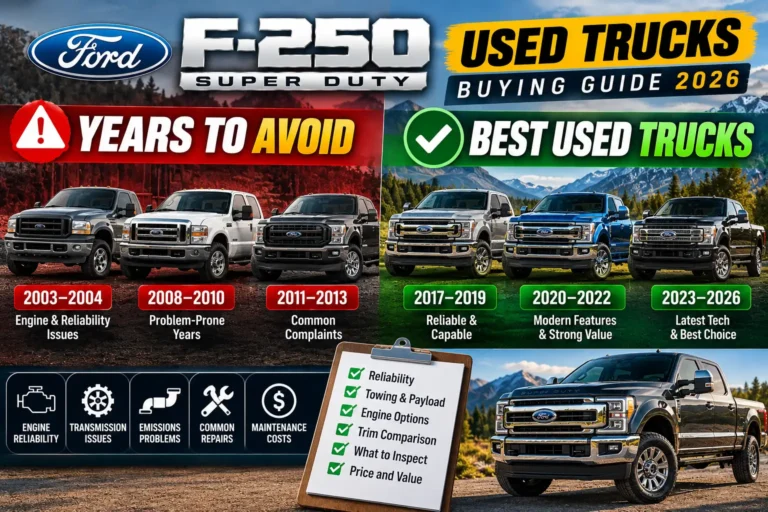
What Year Ford F-250 Parts Are Interchangeable: Full Guide 2026

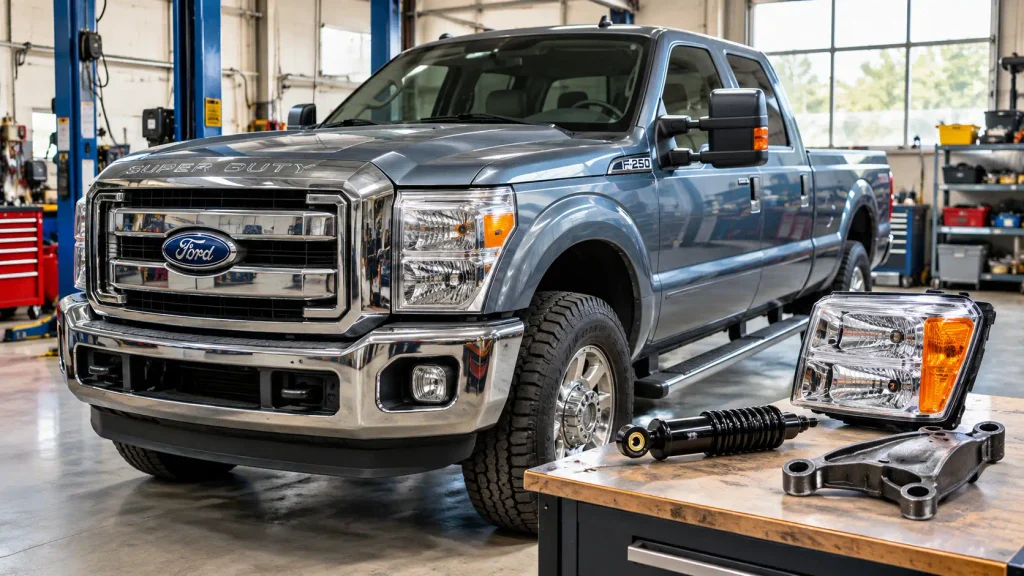
What year F250 parts are interchangeable depends on the part, not just the truck’s model year. The best donor usually matches your truck’s configuration, although some parts cross design eras.
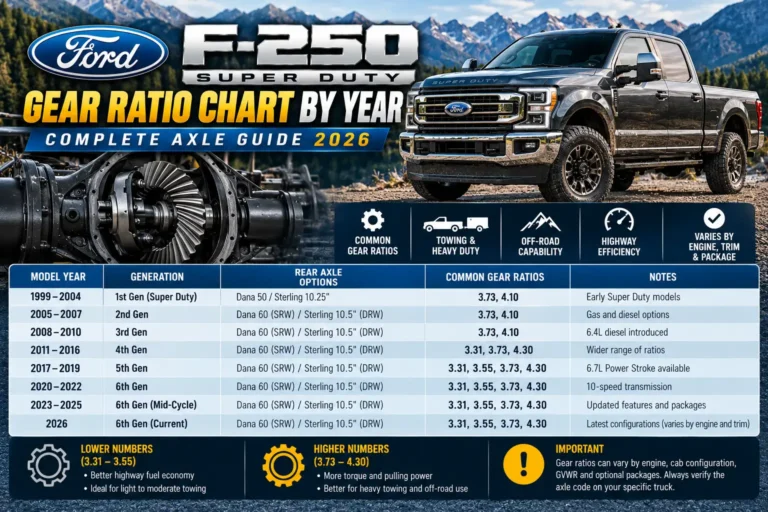
Start your search with 1999–2004, 2005–2007, 2008–2010, 2011–2016, 2017–2019, 2020–2022, or 2023–2026. These are practical research groups, not universal direct-fit ranges. Bed swaps may span more years than suspension or transmission swaps. Verify the specific component before buying.


TruckGuider / F-250 fitment reference
Which F-250 Years Should You Search for Parts?


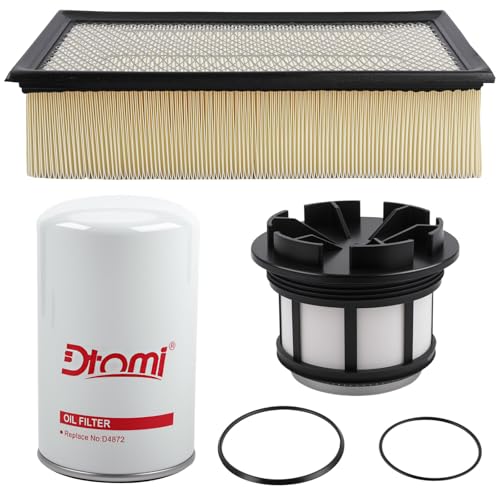
Use these year bands to narrow your donor search. An exact OEM part application, not the model year alone, determines whether a part fits.
| Your F-250 | Start Donor Research With | Critical Fitment Check |
|---|---|---|
| Pre-1999 | Same legacy model family | Old-body, light-duty and Heavy Duty distinctions |
| 1999–2004 | 1999–2004 | Engine transition, cab, bed and drivetrain |
| 2005–2007 | 2005–2007 | 2005 4WD coil-spring front suspension change |
| 2008–2010 | 2008–2010 | Front-end panels, wiring and diesel components |
| 2011–2016 | 2011–2016 | Engine, transmission and front styling |
| 2017–2019 | 2017–2019 | Aluminum body, sensors and equipment |
| 2020–2022 | 2020–2022 | Transmission type, engine and electrical options |
| 2023–2026 | Same year first | Redesigned body, electronics and OEM applications |
These groups are search starting points, not confirmed interchangeable ranges. A physical match does not guarantee correct wiring, safety rating or complete function.
Some 1999–2016 steel pickup beds can cross these groups when length matches. Wiring, fuel filler and attachments may need changes.
Prefer the same-year, same-configuration part. For cross-year swaps, confirm the exact service number, supersessions and donor VIN.



What Factors Determine Ford F250 Parts Interchangeability


Two F-250 trucks can look almost identical while using different replacement parts. Identify your truck, part and original Ford service number first.
Model Year and Production Date
Ford revised the Super Duty several times after its 1999 introduction. Changes in 2005, 2008, 2011, 2017, 2020, and 2023 make year-specific research essential. Check the Ford Super Duty generations by year for the broader platform history. Production dates can matter too.
Engine and Drivetrain Configuration
A 4WD F-250 may have different front suspension, transmission output, and transfer-case components than a 2WD truck. Axle code, spring rating and equipment also matter.



OEM Part Number Match


An original equipment manufacturer (OEM) service number is stronger evidence than an online listing that says a part fits several years. A casting number may differ from the orderable service number. Request donor details too.
Which Parts Fit 1999 to 2007 F250 Trucks


The 1999–2007 Super Duty era is useful for older replacement-part searches, but 2005 is a major dividing line for 4WD front suspension. Never treat them as one mechanical fitment range.
1999 to 2004 Donor Parts
For a 1999–2004 truck, begin with a same-year F-250 or F-350 of the same cab, bed length, engine, and drivetrain. Later steel pickup beds may fit, but mounting, lighting and fuel-filler details require checking.
Engine components need even tighter matching. Early trucks used the 7.3L Power Stroke V8 Turbo Diesel, while the 6.0L Power Stroke V8 Turbo Diesel appeared during the 2003 model-year transition. Check the engine before ordering.


2005 to 2007 Suspension Changes
Ford changed the 4WD Super Duty’s front suspension to coil springs for 2005. A pre-2005 leaf-spring suspension part is not a routine direct replacement for its 2005–2007 counterpart.
As one concrete example, Ford lists coil spring service number 5C3Z-5310-M, identified with spring code W and a 4,400-pound code application for certain F-250 and F-350 trucks. That does not prove it fits your truck. Match the spring code, axle rating and VIN using Ford’s coil spring listing.
Which Parts Fit 2008 to 2016 F250 Trucks


The 2008–2010 and 2011–2016 trucks are separate starting points for front-end and powertrain parts. They can share some components, but a common Super Duty badge does not prove direct fit.
2008 to 2010 Body Parts
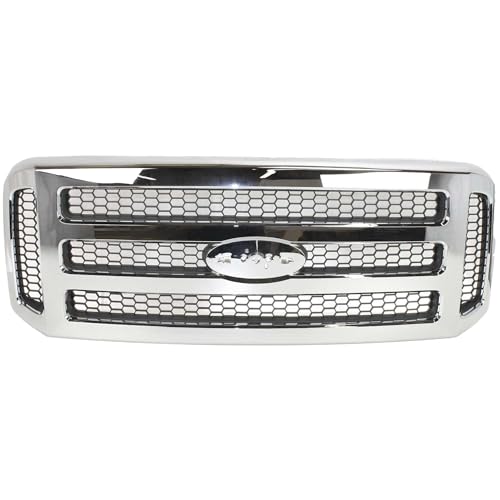
Ford restyled the Super Duty for 2008. When sourcing a grille, headlight, hood, fender, or bumper, compare the donor’s complete front-end assembly with your truck. Additional brackets or panels may be necessary.
The 6.4L Power Stroke V8 Turbo Diesel belongs to this model-year group. Do not substitute earlier 6.0L engine parts based on appearance.
2011 to 2016 Mechanical Parts


For 2011, Ford introduced the 6.7L Power Stroke V8 Turbo Diesel and 6.2L gas V8, alongside a new six-speed automatic transmission family. Do not assume earlier powertrains directly fit.
A steel pickup bed from 2011–2016 may still be a candidate for an older truck, provided its dimensions match and the installer accounts for year-specific wiring and mounting details. Evaluate drivetrain parts separately.
Which Parts Fit 2017 to 2022 F250 Trucks


The 2017 Super Duty moved to an aluminum-alloy cab and pickup bed with a substantially revised frame. Treat 2017 as a major boundary when shopping for sheet metal, beds, structural brackets, and bed accessories.
2017 to 2019 Body Compatibility
Start with 2017–2019 donors for body and interior parts. Even here, confirm door equipment, cameras, parking sensors, mirrors, lighting type, and trim before paying. Their wiring may differ.
The 2017 redesign also means a 2016 steel-body panel is not a normal drop-in substitute for the corresponding 2017 aluminum-body assembly.
2020 to 2022 Powertrain Changes
Ford updated the Super Duty again for 2020, including the available 7.3L gas V8 and wider use of a ten-speed automatic. A 2020 F-250 could use a six-speed or ten-speed transmission depending on configuration, so the year 2020 alone cannot identify the gearbox.
Compare transmission code, engine, electronics and 2WD or 4WD output. Updated lights and sensors also need checking.
Which Parts Fit 2023 to 2026 F250 Trucks
Ford introduced a redesigned Super Duty for 2023, bringing new styling, technology and powertrain choices. The new lineup included a 6.8L gas V8, an updated 7.3L gas V8, and standard-output and high-output versions of the 6.7L Power Stroke V8 Turbo Diesel. Ford also specified a ten-speed TorqShift automatic across the 2023 lineup in its 2023 Super Duty launch information.
If you have a 2023–2026 F-250, use a same-year, matching-equipment donor first. Do not assume compatibility with 2017–2022 parts. Cameras, lights and tailgate equipment may differ.
There is no verified blanket rule that every 2023–2026 component interchanges. Confirm 2026 applications separately.
Which Ford F250 Beds and Body Panels Interchange
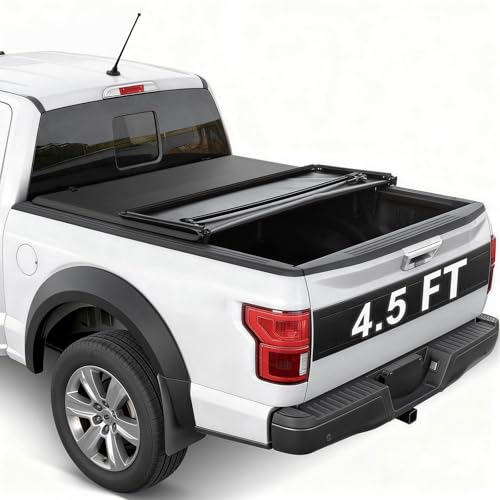
Pickup beds show why interchangeability needs part-specific answers. Documented owner swap discussions identify 1999–2016 F-250 and F-350 pickup beds as cross-year mounting candidates when the bed length and truck configuration match. Wiring and appearance may differ. See the Ford F-250 bed-swap research.
Pickup Bed and Tailgate Swaps
A 6.75-foot bed must be compared with another short bed, and an 8-foot bed with another long bed. Fuel filler, lighting, wiring and attachments may need modification.
The 2017 and 2023 redesigns require separate checks. For exact cargo-floor measurements and cab combinations, use our F250 bed sizes and dimensions rather than relying on the advertised box length.
Doors and Front Body Panels


Check door shells, hardware and wiring separately. A mounting door may still have incompatible electronics.
Hoods, fenders and grilles are especially sensitive to front-end styling changes in 2008, 2011 and 2023. Compare brackets and adjacent panels too.
Bumper and Lighting Fitment
Bumpers may require donor brackets or sensor changes. Halogen and LED lamps may differ electrically. Verify connectors and control modules.
Which F250 Suspension and Steering Parts Interchange
If you need a steering or suspension part, first divide the trucks by drivetrain and suspension design. A 2004 F-250 4WD front leaf spring and a 2005 F-250 4WD front coil spring are not interchangeable service parts. Their mounts differ.
F-250 and F-350 components sometimes share part numbers, but axle ratings, brakes and hubs may differ. Match the load rating, not just mounting holes.
Verify the axle code, drivetrain, brake package and Ford application. Steering and brake repairs deserve additional professional verification because a wrong part can affect control of the truck.
When Do F250 Engines and Transmissions Interchange
Equal displacement does not prove direct-fit engine compatibility. The F-250 has used distinct Power Stroke diesel families, including the 7.3L, 6.0L, 6.4L and Ford-built 6.7L Power Stroke V8 Turbo Diesels, as well as several gas V8 and V10 engines.
Diesel and Gas Engine Matching
Match the engine family, mounts, sensors, fuel system, emissions equipment and engine computer. The Powertrain Control Module (PCM) or Engine Control Module (ECM) may require a compatible calibration.
The 2020 update means 2019 and 2021 6.7L engines cannot be presumed directly interchangeable. Confirm the particular service assembly and all required supporting systems.
Transmission and Transfer Case Matching
Ford’s 2020 Super Duty owner’s manual identifies transmission code S as the 6R100 six-speed and code G as the 10R140 ten-speed. These are different transmission types, not interchangeable units simply because both appear in F-250 applications.
Match transmission family, controls, output and transfer-case connection. Bolt patterns alone do not prove compatibility.
Electronic Control and Wiring Requirements
Control modules may need matching software and security programming. A used module with the right connector is not proof of functional compatibility. For a complete powertrain swap, obtain a documented parts list and a professional compatibility assessment before buying.
Can Ford F250 and F350 Parts Interchange
Yes, some F-250 and F-350 parts can interchange, especially when Ford lists the same OEM service number for the exact year, body style and equipment. Check same-era F-350 body and trim parts.
The limit is the truck’s duty rating. An F-350 may have different axle, brake and spring ratings. A shared exterior design does not establish that a chassis or braking component is the correct specification for an F-250.
F-150 parts are an even less reliable donor shortcut for modern F-250 Super Duty trucks. Their chassis components differ. Only a component-specific OEM cross-reference can establish a genuine match.
Pre-1999 F250 Model Exceptions
Older F-250 trucks need a separate search. Old-body and late-1990s light-duty versus Heavy Duty names confuse listings. First identify the truck by VIN, body style, production year and drivetrain. Do not apply the 1999-onward Super Duty interchange ranges to an older F-250.
Which Used F250 Parts Require Extra Caution
Treat airbags, seatbelts, crash sensors, steering, brakes, structural parts and electronic security modules differently from ordinary trim. Appearance does not establish safe condition.
Check recall status and Ford repair guidance before replacing safety-related components. For crash-restraint systems, steering and brakes, use approved service procedures and qualified professional support. Never substitute a salvage part for a required recall remedy.
How to Verify F250 Part Fitment Before Buying
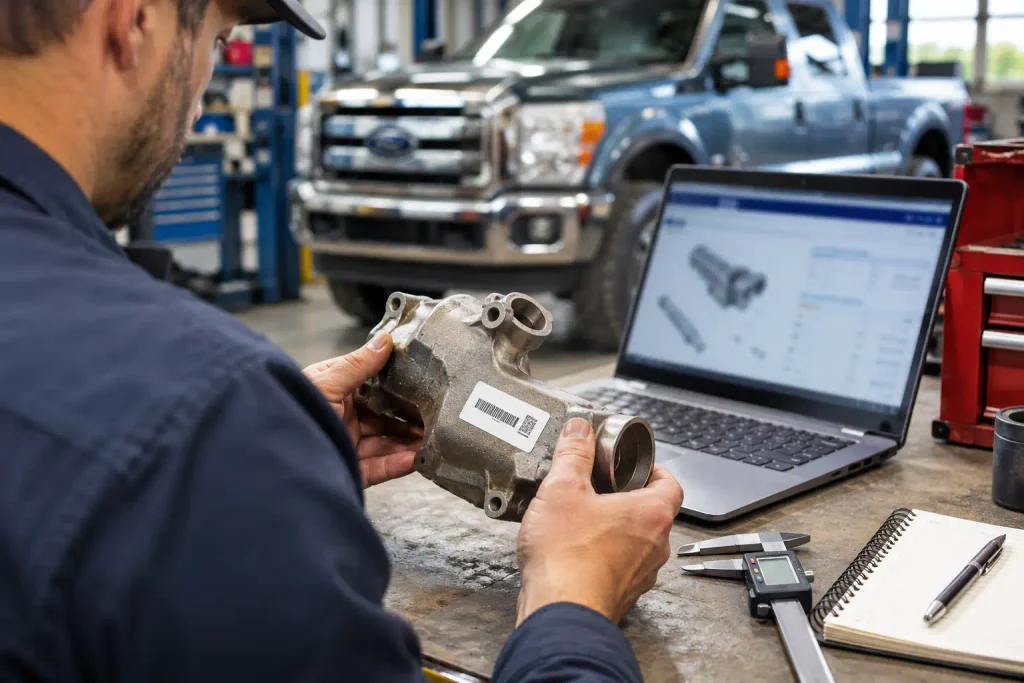
A listing is only a fitment lead. Use this five-step process before spending money.
- Record your truck’s identity. Note the VIN, model year, production date, engine, 2WD or 4WD, cab, bed length and relevant axle or equipment codes.
- Identify the original component. Obtain the complete Ford service number, plus photographs of any engineering, casting or supplier labels. These numbers are not always interchangeable identifiers.
- Identify the donor truck. Request its VIN, exact year, engine, drivetrain, equipment and clear photographs of the removed part.
- Compare the applications. Check Ford’s catalog for the recipient and donor, including number supersessions, connectors, mounting details and production-date restrictions. Start with Ford’s genuine parts catalog or ask a Ford parts department to check both VINs.
- Check condition and installation requirements. Inspect damage, corrosion, missing hardware and any needed programming. For safety-critical parts, have the replacement approved and installed using appropriate service procedures.
When a seller provides only a stamped or partial number, the OEM part number lookup can help you identify the correct verification path. It does not guarantee fitment.
Which F250 Donor Years Should You Choose
Start with the same year and configuration, then expand only when OEM applications support the swap. The chart below shows sensible starting groups, not confirmed direct-fit promises.
| Your F-250 | First Donor Years to Research | Check Before Buying |
|---|---|---|
| Pre-1999 | Same legacy model and body family | Old-body versus light-duty or Heavy Duty designation |
| 1999–2004 | 1999–2004 | Engine transition, cab, bed, drivetrain |
| 2005–2007 | 2005–2007 | Coil-spring 4WD front suspension, axle and spring codes |
| 2008–2010 | 2008–2010 | Front body, 6.4L diesel, wiring |
| 2011–2016 | 2011–2016 | Engine, transmission and front-end application |
| 2017–2019 | 2017–2019 | Aluminum body, equipment, electronics |
| 2020–2022 | 2020–2022 | Six-speed versus ten-speed, engine and sensor options |
| 2023–2026 | Same model year first, then 2023–2026 applications | Redesigned body, trim, electronics and OEM catalog restrictions |
Exception for pickup beds: Documented 1999–2016 steel-bed swaps can cross several of these search groups, provided box length and fitment details are addressed. That exception does not extend automatically to doors, engines, transmissions or suspension parts.
The truck parts interchange database offers more donor leads, not final fitment confirmation.
How to Choose Compatible Ford F250 Donor Parts
The answer to what year F250 parts are interchangeable starts with the part itself. Some 1999–2016 pickup beds can cross year boundaries with changes, but the 2005 front suspension, 2017 body redesign, 2020 transmission differences and 2023 redesign create important restrictions.
Prefer a part verified for your exact truck. Compare donor and original numbers and equipment. If the catalog does not confirm a match, treat the swap as unverified rather than risking an expensive part that only looks correct.
Common Questions About F250 Parts Compatibility
Will a 2016 F250 Bed Fit a 2006 F250?
A 2016 pickup bed can be a mounting candidate for a 2006 F-250 when both trucks use the same bed length. Documented 1999–2016 swaps may still need fuel-filler, tail-lamp harness or other modifications. Inspect the complete donor bed and installation details before purchase.
Are 2004 and 2005 F250 Suspension Parts Interchangeable?
Not as a general rule. Ford changed the 4WD Super Duty front suspension from leaf springs to coil springs for 2005, so key front suspension parts are different. Other individual components require their own OEM application checks.
Do F250 and F350 Use the Same Body Parts?
Some F-250 and F-350 trucks share body components, particularly within the same design era. Matching cab, bed, trim and service numbers is essential. Their axles, brakes and load-rated components should never be assumed to interchange just because the body panels look alike.
Can a 2019 F250 Engine Fit a 2021 F250?
It is not a verified direct swap based on year and displacement alone. Both years may use a 6.7L Power Stroke diesel, but Ford made powertrain changes for 2020. Compare the precise service engine assembly, sensors, fueling, emissions equipment, wiring and calibration before considering the swap.
Can I Verify Ford F250 Parts Using a VIN?
Yes. A VIN helps identify your F-250’s original configuration and can narrow the applicable Ford parts listings. Final fitment may still depend on production date, option codes and the exact OEM service number. Confirm both recipient and donor applications before ordering.