Ford Super Duty Generations Chart: F-250, F-350 & F-450 1999-2026

The Ford Super Duty generations chart from 1999 to 2026 can be organized into five commonly used design eras. The modern standalone Super Duty pickup line starts with the 1999 model year and continues through today’s F-250, F-350, and F-450 pickups.
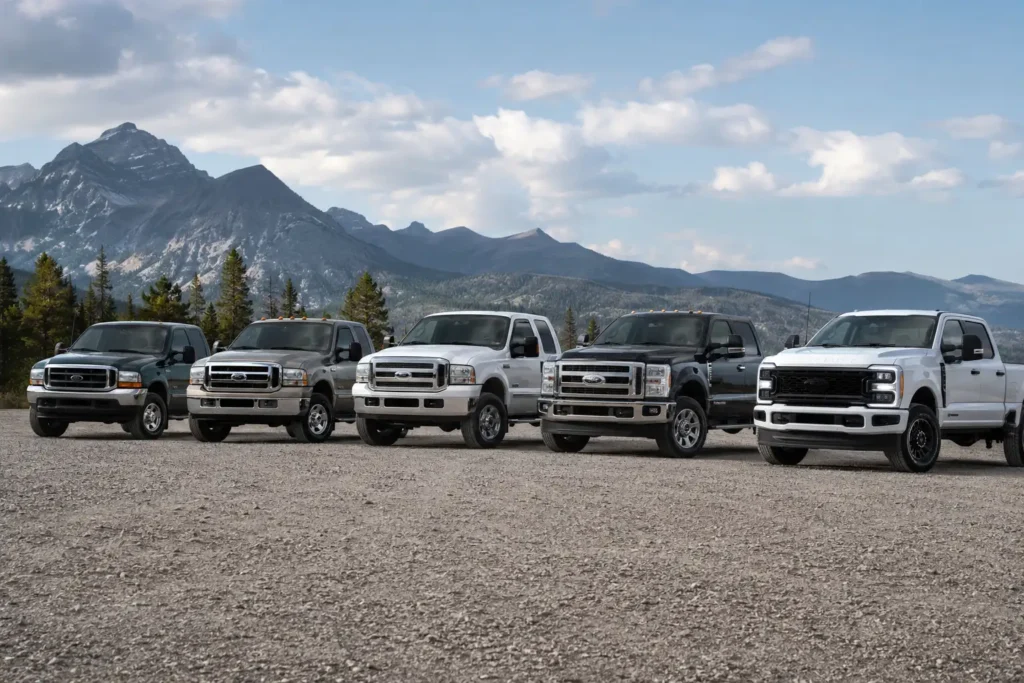
Ford has not consistently marketed these trucks as “Generation 1” through “Generation 5.” Ford itself described the 2017 truck as its first all-new F-Series Super Duty in 18 years, so generation labels used by parts catalogs and automotive databases can differ.


For that reason, the chart below separates major Super Duty design eras from mid-cycle refreshes such as 2005 and 2020.
Five commonly recognized design eras showing the main Power Stroke diesel, major body and chassis changes, and key mid-cycle refresh years.
Ford Super Duty Generations Chart From 1999 to 2026
| Common Super Duty Era | Model Years | Pickup Models | Main Gas Engines | Power Stroke Diesel | Important Change |
|---|---|---|---|---|---|
| First Generation | 1999–2007 | F-250, F-350 | 5.4L Triton V8, 6.8L Triton V10 | 7.3L, then 6.0L Power Stroke V8 | Standalone Super Duty line begins, major 2005 refresh |
| Second Generation | 2008–2010 | F-250, F-350, F-450 | 5.4L Triton V8, 6.8L Triton V10 | 6.4L Power Stroke V8 | New sheet metal, interior, diesel and F-450 pickup |
| Third Generation | 2011–2016 | F-250, F-350, F-450 | 6.2L gas V8 | 6.7L Power Stroke V8 | Ford-designed diesel, new six-speed automatic |
| Fourth Generation | 2017–2022 | F-250, F-350, F-450 | 6.2L gas V8, 7.3L gas V8 from 2020 | 6.7L Power Stroke V8 | All-new aluminum-alloy body and new high-strength steel frame |
| Fifth Generation | 2023–2026 | F-250, F-350, F-450 | 6.8L gas V8, 7.3L gas V8 | 6.7L and High Output 6.7L Power Stroke V8 | All-new exterior, interior, technology and expanded engine lineup |
This five-era system is useful for owners because it groups trucks around the major engineering and body changes. Some databases split the 2005 and 2020 facelifts into separate visual generations, which explains why you may occasionally see a higher generation count.
Ford’s own history places the major break in 1999, when the F-Series Super Duty became a standalone product line aimed at heavier commercial and towing work.
How the 1999 to 2007 First Generation Changed
The 1999 model year established the Super Duty architecture most owners recognize today. Ford separated heavy-duty F-Series trucks from the lighter F-150 platform and offered dedicated F-250 and F-350 pickups.
Ford’s truck history records the Super Duty introduction in 1998 for the upcoming 1999 model year, while production references identify 1999 as the first model year of the standalone line.
Original 1999 Super Duty Powertrains
Early first-generation pickups used three major engine families:
- 5.4L Triton V8 gas
- 6.8L Triton V10 gas
- 7.3L Power Stroke V8 Turbo Diesel
By 2002, Ford literature still listed the 5.4L Triton V8 as standard, with the 6.8L Triton V10 and 7.3L Power Stroke diesel available.
Owners researching the diesel version can use our 2003 7.3L Power Stroke specs reference for a closer look at that engine’s final Super Duty model year.
The 2003 Power Stroke Transition
The 2003 model year is important because both Power Stroke generations appeared during the year.
Ford’s 2003 Super Duty information listed the 7.3L Power Stroke while announcing the new 6.0L Power Stroke V8 Turbo Diesel for availability later in the model year. The new 6.0L initially produced 325 horsepower and 550 lb-ft of torque and paired with the new five-speed TorqShift automatic.
That means a 2003 F-250 or F-350 cannot be identified as a 7.3L or 6.0L truck from model year alone. Build date and engine identification matter.
What Changed for 2005
Ford gave the first-generation Super Duty a major mechanical and styling refresh for 2005.
The 5.4L and 6.8L Triton gas engines moved to three-valve designs. Ford also upgraded the frame, brakes, steering and instrument panel. Four-wheel-drive F-250 and F-350 pickups switched from front leaf springs to a monobeam axle with coil springs.
The grille and headlights also changed substantially. For parts such as bumpers, headlights, suspension components and front axles, 1999–2004 and 2005–2007 trucks should not automatically be treated as interchangeable.
What Changed for the 2008 to 2010 Super Duty
The 2008 Super Duty introduced another clear body and powertrain break.
Ford gave the truck new sheet metal, a larger grille, a redesigned interior and the new 6.4L Power Stroke V8 Turbo Diesel. Ford’s 2008 material rated the diesel at 350 horsepower and 650 lb-ft of torque in most pickup applications.
The gas lineup continued with the 5.4L Triton V8 and 6.8L Triton V10.
F450 Pickup Arrives for 2008
The 2008 model year also matters because Ford added the F-450 pickup to the retail Super Duty lineup.
Earlier F-450s were primarily chassis-cab work trucks rather than factory pickup-bed models. Ford’s 2008 truck literature specifically identifies the F-450 pickup as new for that model year.
This distinction matters when comparing F-450 generations because chassis-cab specifications and pickup specifications are not always interchangeable.


How the 2011 to 2016 Super Duty Changed
The 2011 Super Duty replaced both the 6.4L diesel and older Triton gas engines used in the previous pickup generation.
Two new powertrains became central to the F-250 and F-350 lineup:
- 6.2L gas V8
- 6.7L Power Stroke V8 Turbo Diesel
Ford described the 6.7L as Ford-designed, Ford-engineered and Ford-built. At launch it produced 390 horsepower and 735 lb-ft of torque, while the 6.2L gas V8 produced 385 horsepower and 405 lb-ft. Both were paired with the new 6R140 TorqShift six-speed automatic.
Ford later released a software calibration that raised 2011 diesel output to 400 horsepower and 800 lb-ft for pickup customers, including previously delivered trucks through a dealer update.
Important 2015 Power Stroke Update
The 2015 model year brought a substantial second-generation update to the Ford-built 6.7L Power Stroke.
Ford rated the 2015 diesel at 440 horsepower and 860 lb-ft of torque. Ford’s product sheet also identifies the 6.2L gas V8 and 6.7L Power Stroke as the primary pickup engines for that model year.
The 2015 update did not start another Super Duty generation. It was an important powertrain revision inside the 2011–2016 design era.
Why the 2017 to 2022 Super Duty Was Different
The 2017 Super Duty represented a much larger engineering change than the 2005, 2011 or 2020 updates.
Ford called it the first all-new F-Series Super Duty in 18 years. The redesign introduced a high-strength aluminum-alloy body and an extensively redesigned high-strength steel frame.
Ford said the new body contributed to substantial weight savings, while the stronger frame allowed the company to reinvest that weight into capability and hardware.
The pickup engine lineup initially centered on the 6.2L gas V8 and second-generation Ford-built 6.7L Power Stroke V8 Turbo Diesel.
This generation is also where Super Duty technology moved forward quickly, including available LED lighting, additional cameras, trailer-assistance technology and adaptive steering.
For configuration-specific hauling numbers rather than generation history, see our Ford F-350 payload capacity chart.
What Changed for the 2020 Super Duty
The 2020 Super Duty was a major refresh inside the 2017–2022 generation, not an all-new platform.
Ford added the 7.3L gas V8, updated the 6.7L Power Stroke to its third major version and expanded use of the TorqShift ten-speed automatic transmission. Ford’s 2020 documentation also confirms that the 6.2L gas V8 remained available.
The 2020 model also received updated front styling, lighting and technology.
This is why aftermarket catalogs frequently divide fourth-generation fitment into 2017–2019 and 2020–2022 groups even though both belong to the same broader Super Duty design era.
How the 2023 to 2026 Super Duty Changed
Ford introduced another all-new Super Duty for the 2023 model year with redesigned exterior styling, a new interior and a larger set of connected work and towing technologies.
The engine lineup also changed significantly.
Ford introduced a new 6.8L gas V8 and retained an updated 7.3L gas V8. Diesel buyers could choose between the standard 6.7L Power Stroke V8 Turbo Diesel and a new High Output 6.7L Power Stroke.


The 2023 engine ratings were:
| Engine | Horsepower | Torque |
|---|---|---|
| 6.8L gas V8 | 405 hp | 445 lb-ft |
| 7.3L gas V8 | 430 hp | 485 lb-ft |
| 6.7L Power Stroke V8 Turbo Diesel | 475 hp | 1,050 lb-ft |
| High Output 6.7L Power Stroke V8 Turbo Diesel | 500 hp | 1,200 lb-ft |
Ford paired the four-engine lineup with ten-speed automatic transmissions. Because Ford reuses TR codes on Super Duty trucks, see how to identify a Ford transmission by TR code before ordering parts.
What Changed for 2025
The 2025 model remained part of the 2023 generation.
Ford added styling options, revised trailering packages and introduced technology and upfitter-related changes rather than launching another basic platform.
The F-250, F-350 and F-450 pickup lineup continued.
What Changed for 2026
The 2026 Super Duty also remains part of the 2023 design era.
Changes include a newly available 148-inch SuperCab wheelbase, revised drivetrain availability, new colors, connectivity changes, package revisions and standard Tire Pressure Monitoring System equipment. Ford did not announce a new performance or engine-generation change for 2026.
Ford’s current technical specifications confirm the same four core engines for 2026.
| 2026 Engine | Horsepower | Torque |
|---|---|---|
| 6.8L gas V8 | 405 hp | 445 lb-ft |
| 7.3L gas V8 | 430 hp | 485 lb-ft |
| 6.7L Power Stroke V8 Turbo Diesel | 475 hp | 1,050 lb-ft |
| High Output 6.7L Power Stroke V8 Turbo Diesel | 500 hp | 1,200 lb-ft |
If you are comparing towing capability across Ford trucks rather than body generations, our Ford towing capacity chart covers configuration-specific ratings.
Which Super Duty Years Were Redesigns or Refreshes
Not every important Ford Super Duty model year marks the start of another generation.
| Model Year | Type of Change | Why It Matters |
|---|---|---|
| 1999 | New standalone Super Duty line | F-250 and heavier trucks separate from the light-duty F-Series direction |
| 2005 | Major refresh | New front styling, stronger frame, revised gas engines and coil-spring 4WD front suspension |
| 2008 | Major design change | New exterior and interior, 6.4L Power Stroke, factory F-450 pickup |
| 2011 | Major design and powertrain change | Ford-built 6.7L Power Stroke, 6.2L gas V8 and new six-speed automatic |
| 2017 | All-new redesign | New aluminum-alloy body and high-strength steel frame |
| 2020 | Major refresh | 7.3L gas V8, third-generation 6.7L diesel and ten-speed transmission expansion |
| 2023 | All-new redesign | New exterior, interior, technology and four-engine lineup |
| 2025 | Feature update | Styling, trailering and technology package changes |
| 2026 | Feature update | Wheelbase, drivetrain, package and connectivity changes |
The key distinction is platform-era versus fitment-era.
A bumper manufacturer may treat a 2020 truck as different from a 2019 truck because the front fascia changed. A historical generation chart can still correctly group both trucks within the broader 2017–2022 design era.
How to Identify Ford Super Duty Generations Visually
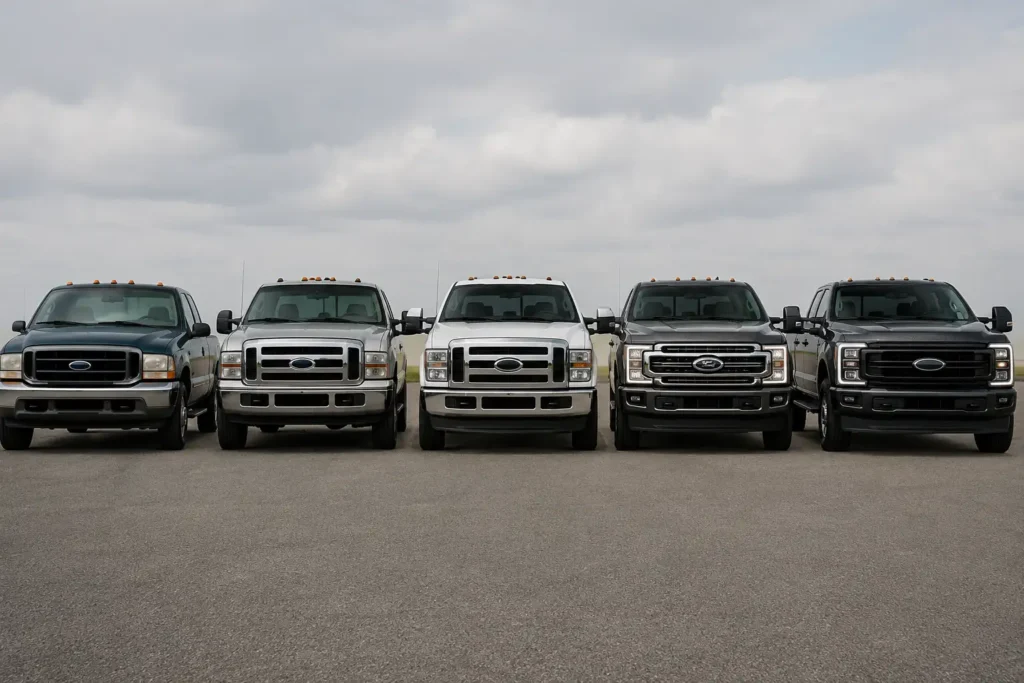
The model year or VIN is the safest way to identify a Super Duty generation. Exterior parts can be replaced, especially grilles, headlights, bumpers and beds.
Still, several visual clues make the five major eras relatively easy to separate.
Identify 1999 to 2007 Trucks
The original trucks use the early Super Duty cab and body profile with a tall rectangular front end.
The 2005–2007 facelift is easy to separate from 1999–2004 trucks because of its revised grille, headlights and bumper. Underneath, 2005-up 4WD F-250 and F-350 trucks also use the newer coil-spring front suspension.
Identify 2008 to 2010 Trucks
Look for the much larger grille and more upright front-end treatment.
These trucks also represent the only Super Duty pickup era built around the 6.4L Power Stroke diesel, making engine identification especially useful.
Identify 2011 to 2016 Trucks
The 2011 redesign retained a large grille but changed the front fascia, hood and lighting treatment.
Engine identification helps here because 2011 marks the beginning of the Ford-built 6.7L Power Stroke and 6.2L gas V8 combination.
Identify 2017 to 2022 Trucks
The aluminum-alloy body is the major engineering clue.


Visually, 2017–2019 trucks use the first version of this body style. The 2020–2022 refresh changed the grille and lighting, so front-end parts may have different fitment even within the same broad generation.
Identify 2023 to 2026 Trucks
The latest body uses Ford’s newer C-clamp-inspired lighting treatment and a redesigned grille, tailgate and interior.
These trucks can also be identified by the newer engine lineup, especially the 6.8L gas V8 and available High Output 6.7L Power Stroke.
What Five Ford Super Duty Generations Show
The modern Ford Super Duty generations chart starts with the 1999 model year and runs through the current 2026 F-250, F-350 and F-450 lineup.
For a clean historical reference, the most useful breakdown is 1999–2007, 2008–2010, 2011–2016, 2017–2022 and 2023–2026. Within those periods, 2005 and 2020 deserve separate attention because both introduced major mechanical and styling changes without creating an entirely new basic platform.
When buying bumpers, suspension parts, headlights, engine components or drivetrain parts, always verify the exact model year, engine, drivetrain and F-250, F-350 or F-450 configuration. Generation alone is not a reliable fitment guarantee.
Ford Super Duty Generation FAQs
What Years Are the Ford Super Duty Generations
The five commonly used modern Super Duty eras are 1999–2007, 2008–2010, 2011–2016, 2017–2022 and 2023–2026. Some fitment databases count 2005 and 2020 facelifts separately, so generation numbering can vary.
What Generation Is a 2016 Ford F250
A 2016 Ford F-250 falls in the 2011–2016 Super Duty design era. It uses the generation that introduced Ford’s 6.7L Power Stroke V8 Turbo Diesel and 6.2L gas V8.
What Generation Is a 2020 Ford F250
A 2020 Ford F-250 belongs to the 2017–2022 design era, but 2020 received a major mid-cycle refresh. The update brought the 7.3L gas V8, revised 6.7L Power Stroke and expanded ten-speed automatic transmission use.
When Did Ford Start Making Super Duty Trucks
Ford launched the standalone F-Series Super Duty line for the 1999 model year. Ford had used the Super Duty name earlier, but 1999 marks the modern F-250 and heavier standalone Super Duty product family.
When Did the Ford F450 Become a Pickup
The factory F-450 Super Duty pickup joined the lineup for the 2008 model year. Earlier F-450 trucks were mainly commercial chassis-cab configurations rather than regular factory pickup-bed models.