2015 Ram 2500 Lug Pattern: Bolt Pattern & Torque Specs [2026]

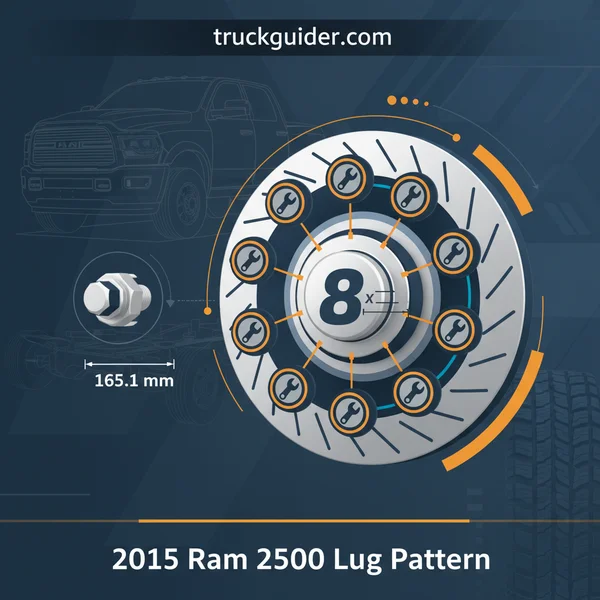
The 2015 Ram 2500 lug pattern is 8 x 165.1mm (or 8 x 6.5 inches), a standard configuration for heavy-duty Ram trucks. For optimal safety, these wheels require 14mm x 1.5 lug nuts tightened to a torque specification of 130 ft-lbs.
🎯 Key Takeaways
- The bolt pattern is 8×165.1mm (8×6.5 inches).
- Lug nut thread size is 14mm x 1.5.
- Factory recommended torque is 130 lb-ft.
- The hub center bore diameter is 121.3mm.
- Stock wheel offset typically ranges from +43mm to +57mm.
If you are looking for the exact bolt pattern for your 2015 Ram 2500, the answer is 8 x 165.1mm (commonly referred to as 8 x 6.5 inches). This heavy-duty eight-lug configuration is standard across all trim levels for this specific model year, including the Tradesman, SLT, Laramie, and Power Wagon. Knowing this precise measurement is the difference between a wheel that mounts safely and one that simply won’t fit over your wheel studs.
Why does this specification matter so much for your truck? Because the Ram 2500 is built for heavy hauling and high-stress environments. Even a few millimeters of difference in the bolt pattern can lead to severe vibrations, snapped wheel studs, or the catastrophic loss of a wheel while driving. Whether you are upgrading to aggressive aftermarket rims or searching for a replacement spare, you must stick to these exact dimensions to ensure your truck remains capable and safe on the road.
Understanding the 8×165.1mm Bolt Pattern and Hub Dimensions
The 8 x 165.1mm bolt pattern is a classic measurement in the world of heavy-duty trucks. The “8” represents the number of lug nut holes on the wheel, while the “165.1mm” (or 6.5 inches) represents the diameter of the imaginary circle formed by the centers of those eight holes. This specific pattern has been a staple for Ram’s 2500 series for decades, providing the necessary surface area to distribute the massive torque and weight loads these trucks handle daily.
Metric vs. Imperial Measurements
In the automotive world, you will often see this pattern listed as both 8×165.1mm and 8×6.5 inches. They are exactly the same thing. Manufacturers transitioned to metric labeling years ago, but many wheel retailers still use the imperial 6.5-inch designation. When shopping for your 2015 Ram 2500, you can use these terms interchangeably. However, you must be careful not to confuse this with the 8x170mm pattern used by Ford or the 8x180mm pattern used by newer GM trucks. Those will not fit your Ram studs, and attempting to “make them fit” will result in permanent damage to your hub assembly.
The Importance of the Hub-Centric Bore
Beyond the bolt pattern, the center bore is a critical specification for your 2015 Ram 2500. The stock center bore for this truck is 121.3mm. The Ram 2500 uses a hub-centric design, meaning the wheel is centered by the hub itself rather than just the lug nuts. This design transfers the weight of the truck from the studs to the heavy-duty axle hub.
- Factory Wheels: Always have a 121.3mm bore for a perfect fit.
- Aftermarket Wheels: Often have a larger bore to fit multiple truck brands.
- Hub-Centric Rings: If your new wheels have a bore larger than 121.3mm, you should use hub-centric rings to prevent high-speed vibrations.
Never install a wheel with a center bore smaller than 121.3mm, as it will physically not slide onto your truck’s hub.
The Ultimate 2015 Ram 2500 Lug Pattern Walkthrough
Whether you are upgrading to aggressive off-road rims or simply replacing a damaged wheel, understanding the specific lug pattern and mounting requirements of your 2015 Ram 2500 is the most critical step in the process. This heavy-duty truck utilizes a specific configuration designed to handle immense towing capacities and payload weights. Getting these specifications wrong can lead to wheel vibration, stud failure, or even a wheel detaching while driving. This comprehensive guide covers everything from physical measurements to the final torque sequence to ensure your truck remains safe and road-worthy.
Step 1: Confirming the 8×6.5 Standard
What you need: Access to your vehicle‘s owner’s manual or a digital specification sheet for the 2015 Ram 2500 series.
Instructions: The 2015 Ram 2500 utilizes an 8-lug pattern, specifically categorized as 8×6.5 inches (which is also frequently listed in metric as 8×165.1mm). This is a legacy bolt pattern that has been used on heavy-duty trucks for decades. Before purchasing new wheels, you must confirm that the wheel is drilled specifically for this 8×6.5 layout. Be careful not to confuse this with the 8x170mm or 8x180mm patterns used by Ford or GM, as they will not fit your Ram. Even a few millimeters of difference will prevent the wheel from seating properly on the studs, potentially damaging the threads or the wheel itself.
Pro Tip: When searching for wheels online, always filter by “8×165.1mm” rather than just “8-lug,” as many modern heavy-duty trucks have transitioned to different metric spacings that look identical to the naked eye.
Step 2: Physically Measuring the Lug Pattern
What you need: A tape measure or a lug pattern gauge tool.
Instructions: If you are unsure if your current wheels are stock or if you are dealing with a modified hub, you can verify the pattern yourself. For an even-numbered lug pattern like the 8-lug setup on your Ram 2500, measurement is straightforward. Measure from the center of one wheel stud directly across the hub to the center of the opposite wheel stud. On a 2015 Ram 2500, this distance should be exactly 6.5 inches (165.1mm). If you measure from the outer edge of one stud to the inner edge of the opposite stud, you should get the same result. Ensure you are measuring from the center points to maintain accuracy.
Pro Tip: Avoid using a standard ruler if possible; a sliding caliper or a dedicated plastic bolt pattern template is much more accurate for detecting the slight differences between similar metric and imperial patterns.
Step 3: Verifying the Hub Bore Diameter
What you need: Digital calipers or the technical specifications of your new wheels.
Instructions: The “hub bore” is the hole in the center of the wheel that fits over the hub of the truck. The 2015 Ram 2500 features a hub-centric design with a center bore diameter of 121.3mm. This means the hub of the truck, not just the lug nuts, supports the weight of the vehicle and ensures the wheel is perfectly centered. If you buy aftermarket wheels with a larger bore (e.g., 125mm or 130mm), you must use hub-centric rings to fill that gap. Using wheels where the bore is too small is impossible, as the wheel will not sit flush against the brake rotor, leading to immediate failure.
Pro Tip: Always prioritize “hub-centric” aftermarket wheels over “lug-centric” versions to reduce the risk of steering wheel shimmy or “death wobble” at highway speeds.
Step 4: Understanding Thread Pitch and Lug Nut Selection
What you need: A new set of lug nuts (if upgrading wheels) and a thread pitch gauge.
Instructions: The 2015 Ram 2500 uses a metric thread pitch: M14 x 1.5. This means the studs are 14mm in diameter with a 1.5mm distance between each thread. When buying new wheels, your factory lug nuts may not fit if the new wheel has a narrower lug hole or a different seat type. Most aftermarket wheels require a “Conical Seat” (acorn style), whereas some specialty or heavy-duty wheels might use a “Flat Seat” or “Mag Seat” with a washer. Ensure your lug nuts match the wheel’s seat precisely to prevent the nuts from backing off under the vibration of heavy towing.
Pro Tip: Never use an impact wrench to start your lug nuts. Always thread them on by hand for at least 3-4 full rotations to avoid cross-threading the M14 studs, which are expensive to replace.
Step 5: Checking Offset and Backspacing
What you need: A straight edge and a measuring tape.
Instructions: The lug pattern is only half the battle; the offset determines how far the wheel sticks out or tucks into the fender. Factory 2015 Ram 2500 wheels typically have a high positive offset (around +43mm to +57mm). If you choose a wheel with a “0” or negative offset, the 8×6.5 pattern will fit the studs, but the tires may rub against the wheel liners or suspension components when turning. Check the backspacing—the distance from the mounting surface to the back edge of the wheel—to ensure clearance for the large heavy-duty brake calipers found on the 2500 series.
Pro Tip: For a “flush” look with the fenders on a stock height 2015 Ram 2500, look for an offset between +18mm and +25mm.
Step 6: Preparation and Mounting Surface Cleaning
What you need: A wire brush, brake cleaner, and a clean rag.
Instructions: Before sliding the wheel onto the 8-lug pattern, you must clean the mounting surfaces. Use a wire brush to remove rust, corrosion, or road salt from the face of the brake rotor and the back of the wheel mounting pad. Even a tiny piece of debris can prevent the wheel from sitting perfectly flat, which can cause the lug nuts to lose torque over time. After brushing, wipe the area down with brake cleaner. Inspect the eight studs for any signs of stretching, localized discoloration (indicating heat damage), or stripped threads. If a stud is damaged, replace it before attempting to mount the wheel.
Pro Tip: Apply a very thin layer of anti-seize only to the hub pilot (the center ring), but keep it away from the lug stud threads. Lubricating threads can lead to over-torquing and snapped studs.
Step 7: Executing the Star Torque Sequence
What you need: A calibrated torque wrench and a 22mm (or 7/8 inch) deep-well socket.
Instructions: Once the wheel is on the studs, tighten the nuts by hand in a star pattern (crisscross). For an 8-lug pattern, imagine the studs are numbered 1 through 8. Move from 1 to 5, 2 to 6, 3 to 7, and 4 to 8. This ensures the wheel is pulled evenly against the hub. Lower the truck until the tire just touches the ground to prevent spinning, then use your torque wrench to tighten them to the factory specification: 130 to 140 lb-ft (pound-feet). Do this in two stages: first to 90 lb-ft, then a final pass at 140 lb-ft.
Pro Tip: Re-torque your wheels after the first 50 to 100 miles of driving. New wheels can “settle,” and the lug nuts may lose a small amount of clamping force during the initial heat cycles.
✅ Final Checklist
- Confirmed the pattern is exactly 8×6.5″ (8×165.1mm) and not a similar metric size.
- Verified the hub bore is 121.3mm or used appropriate hub-centric rings.
- Ensured lug nuts are M14x1.5 thread pitch with the correct seat style for the wheel.
- Cleaned all mating surfaces of rust and debris before installation.
- Performed a final torque check to 130-140 lb-ft using a calibrated torque wrench in a star pattern.
Important Notes:
- Safety: Never work under a vehicle supported only by a floor jack; always use heavy-duty jack stands rated for at least 3 tons.
- Professional Help: If you experience persistent vibrations after installation, visit a tire shop for a “Road Force Balance,” as heavy-duty wheels and tires are prone to balancing issues.
- Estimated Time: 45 to 90 minutes for a full set of four wheels.
- Cost Range: $0 (if just checking/cleaning) to $800–$2,000+ for a new set of wheels and hardware.
Critical Lug Nut Torque and Thread Pitch Specifications
Once you have the correct wheels, securing them properly is the next vital step. For the 2015 Ram 2500, the lug nuts are not just fasteners; they are the primary hardware holding thousands of pounds of pressure. Using the wrong thread pitch or failing to hit the correct torque spec can lead to the lug nuts backing off or the studs shearing off under load.
Thread Pitch and Stud Dimensions
The 2015 Ram 2500 uses a 14mm x 1.5 thread pitch. This means the stud is 14 millimeters in diameter, and there is 1.5 millimeters of space between each thread. If you are buying aftermarket lug nuts, you must verify this thread pitch. Using a 14mm x 2.0 or a 9/16-18 nut will strip the threads instantly. Additionally, most factory lug nuts require a 22mm or 7/8-inch socket. Always keep the correct socket size in your truck’s emergency kit, as aftermarket “spline drive” lug nuts will require a specific key that differs from your factory lug wrench.
Recommended Torque Specs for Safety
For a 2015 Ram 2500, the manufacturer-recommended torque specification is typically 130 to 140 ft-lbs. Proper torque ensures that the wheel is clamped tightly against the hub surface without overstretching the metal of the studs.
- Use a Torque Wrench: Never rely on an impact gun or “hand-tightening” with a lug wrench. Impact guns often over-tighten, which can warp brake rotors or stretch studs to their breaking point.
- The Star Pattern: Always tighten your lug nuts in a crisscross or “star” pattern. This ensures even pressure across the wheel face.
- Re-Torquing: After installing new wheels, you should re-check the torque after the first 25 to 50 miles of driving. Parts can settle, and lug nuts can occasionally loosen during the initial “break-in” period.
Ignoring these specs can lead to “wheel walk,” where the wheel moves slightly against the hub, eventually oblonging the holes and ruining both the wheel and the studs.
Aftermarket Wheel Fitment: Offset and Backspacing Analysis
Choosing the right wheels for your 2015 Ram 2500 involves more than just matching the 8×165.1mm bolt pattern. To get that perfect stance without rubbing your wheel wells or suspension components, you must account for offset and backspacing. These measurements determine how far the wheel sticks out or tucks into the fender, which is critical when upgrading to larger, more aggressive tires.
Understanding Positive vs. Negative Offset
The factory wheels on a 2015 Ram 2500 typically feature a high positive offset (around +57mm). This design keeps the wheels tucked neatly inside the wheel arches, providing a narrow profile for towing and fuel efficiency. If you are looking for a wider, more aggressive “deep dish” stance, you will likely move toward a lower positive or even a negative offset. A 0mm offset is a popular choice for leveled trucks, as it pushes the tire out just enough to align with the edge of the fender flares without requiring major trimming.
Backspacing for Suspension Clearance
Backspacing is the distance from the mounting surface to the inner edge of the wheel. For a heavy-duty truck like the Ram 2500, maintaining proper clearance for the brake calipers and control arms is vital. If your backspacing is too high, the wheel may make contact with the radius arms during tight turns.
- Stock Backspacing: Usually around 6 inches, providing maximum clearance for internal suspension components.
- The “Sweet Spot”: Most owners find that 4.5 to 5.5 inches of backspacing works best when moving to wider 12.5-inch tires.
- Radius Arm Rub: Going too deep with backspacing (higher numbers) can cause the tire to hit the radius arms during full-lock turns, especially with wider tires.
Compatibility and Comparison with Other Ram Heavy Duty Years
One of the best things about the Ram heavy-duty platform is the high degree of cross-compatibility. However, while many years share the same 8×165.1mm (8×6.5″) pattern, there are nuances in hub bore size and lug nut threading that you need to be aware of before swapping wheels from a donor truck. Knowing what fits can save you a lot of money on the “Take-Off” market.
The 2014-2018 Compatibility Window
The 2015 Ram 2500 sits right in the middle of the fourth-generation refresh. Generally, wheels from any Ram 2500 manufactured between 2014 and 2018 are a direct “plug-and-play” fit. They share the same 121.3mm hub bore and the 9/16-18 thread pitch for the studs. If you find a set of premium wheels from a 2017 Laramie, for example, they will bolt onto your 2015 without any modifications or specialized hardware.
Comparison with Ram 1500 and 3500 Models
It is a common misconception that all Ram trucks share parts. Here is how the 2500 compares to its siblings in the lineup:
- Ram 1500: These use a 5-lug or 6-lug pattern (depending on the year) and are never compatible with the 8-lug 2500.
- Ram 3500 (SRW): Single Rear Wheel (SRW) 3500 models from the same era share the same wheel specs as the 2500. These are perfectly interchangeable.
- Ram 3500 (DRW): Dual Rear Wheel (Dually) trucks use a completely different offset and convex wheel design to accommodate the dual-rear setup, despite having the same 8-lug pattern.
- Older Generations: Pre-2012 Ram heavy-duty trucks used the same bolt pattern but sometimes featured different lug nut seats or smaller hub bores. Always measure the center hole diameter to ensure it fits over the 2015 hub.
Conclusion
Understanding the 2015 Ram 2500 lug pattern is the foundation for any wheel upgrade or routine maintenance. By sticking to the 8×165.1mm bolt pattern and keeping your torque at the recommended 130 lb-ft, you ensure your truck remains safe and capable on the road. Remember that while the bolt pattern is standard, the offset and backspacing are what truly define how your truck looks and performs in the real world.
Before you purchase your next set of rims, verify the hub bore and ensure your lug nuts match the 9/16-18 thread pitch. Once your new wheels are mounted, make it a habit to re-check your lug torque after the first 50 miles of driving. This simple step prevents hardware from loosening as the wheels seat into place. Now that you have the specs, you’re ready to find the perfect set of wheels for your heavy-duty Ram!
❓ Frequently Asked Questions
Is the 2015 Ram 2500 lug pattern the same as older models?
Yes, Ram has used the 8×165.1mm (8×6.5″) pattern for decades. However, the thread pitch changed from 9/16″ to 14mm x 1.5 in 2012, so older lug nuts will not fit a 2015 model.
Can I use 8x170mm wheels on my 2015 Ram 2500?
No, 8x170mm is the standard pattern for Ford Super Duty trucks and will not line up with the Ram’s 8×165.1mm studs. You must use wheels specifically drilled for the 8×6.5″ pattern.
Why is the center bore measurement important for 2015 Ram 2500 wheels?
The 121.3mm center bore ensures the wheel is hub-centric, meaning the hub carries the weight of the vehicle rather than the studs. This design minimizes vibration and prevents stud failure during heavy towing.
What happens if I over-torque the lug nuts on my Ram 2500?
Over-torquing beyond 130-140 ft-lbs can stretch or snap the wheel studs and warp the brake rotors. Always use a calibrated torque wrench rather than an impact gun for the final tightening.
What is the typical offset for factory 2015 Ram 2500 wheels?
Stock 17-inch and 18-inch wheels usually have a high positive offset between +43mm and +57mm. If upgrading to wider tires, you may need a lower offset wheel to avoid rubbing on the suspension components.
Do I need to re-torque my lug nuts after a wheel change?
Yes, it is highly recommended to re-check the torque after the first 25 to 50 miles of driving. This ensures that the wheel has seated properly and the nuts haven’t loosened during initial thermal expansion.
![2022 RAM 2500 Fender Flares: Top Styles & Fitment Guide [2026]](https://truckguider.com/wp-content/uploads/2026/03/2022-ram-2500-fender-flares-featured.webp)
![2016 Ram 1500 Radiator Specifications, Maintenance [2026]](https://truckguider.com/wp-content/uploads/2026/03/featured-475df863-768x768.webp)