
2017 Ram 1500 Towing Capacity Chart: Engine, Cab, And Axle Ratio Specifications

For owners and prospective buyers of the 2017 Ram 1500, understanding the precise limits of your vehicle is the difference between a successful haul and a dangerous mechanical failure. With dozens of configurations spanning three engines, three cab styles, and various axle ratios, finding the exact towing capacity for a specific 2017 Ram 1500 can be confusing for even experienced truck owners. This comprehensive guide provides a definitive towing capacity chart and professional analysis of the technical factors that determine your truck’s reliable hauling limits, ensuring you make informed decisions every time you hitch up.


Section 1: Essential Towing Terminology for the 2017 Ram 1500
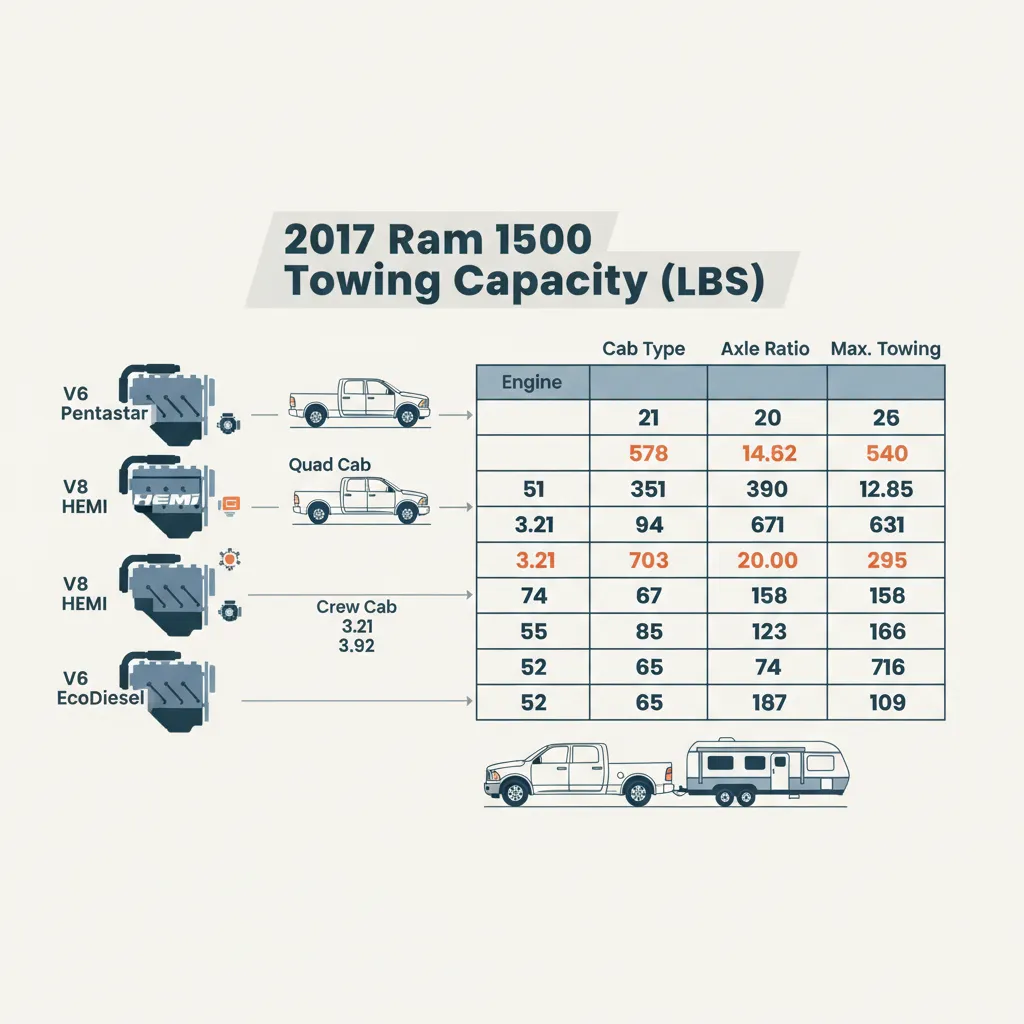
Before diving into the charts, a professional operator must master the technical metrics that govern safe hauling. In my 15+ years of industry experience, I have seen many drivers focus solely on “Max Towing,” which is a dangerous oversimplification. The most critical metric is actually the Gross Combined Weight Rating (GCWR). This is the maximum allowable weight of the fully loaded truck and the fully loaded trailer combined. If you add heavy aftermarket steel bumpers or a winch to your Ram, you are consuming GCWR before even attaching a trailer.
GVWR vs. Payload vs. Tongue Weight
The Gross Vehicle Weight Rating (GVWR) defines the maximum weight the truck’s chassis, suspension, and tires can handle. This includes the curb weight of the truck plus all passengers, cargo, and the Tongue Weight of the trailer. A common pitfall occurs when a driver loads the bed with 1,000 lbs of gear and then tries to tow a 9,000 lb trailer. Because the tongue weight (typically 10-15% of the trailer weight) would add another 900-1,350 lbs to the truck’s chassis, the vehicle would likely exceed its GVWR even if it remains under the max towing capacity.
Exceeding any of these ratings—GVWR, GCWR, or Payload—voids warranties and, more importantly, compromises your braking distance and steering control. Research indicates that the official guide should always be consulted for your specific VIN-based limits.
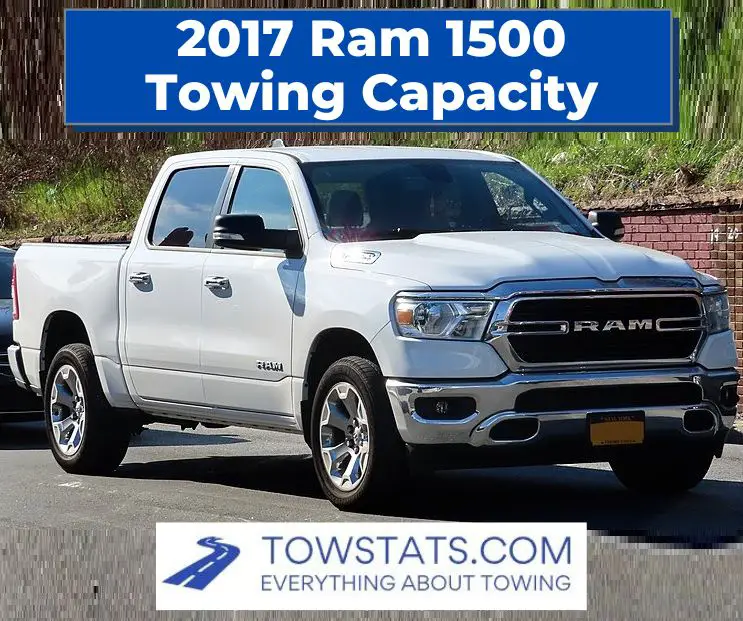
Section 2: 2017 Ram 1500 Engine Options and Performance Capabilities
The heart of your 2017 Ram 1500’s capability lies in its powertrain. Ram offered three distinct engines this year, each serving a specific niche in the light-duty market. Choosing the right engine is about more than just horsepower; it is about the torque curve and thermal management during sustained climbs.
3.6L Pentastar V6
Producing 305 hp and 269 lb-ft of torque, this engine is ideal for weekend utility. It is best suited for small utility trailers or jet skis.
5.7L HEMI V8
The gold standard with 395 hp and 410 lb-ft of torque. This engine delivers the maximum 10,640 lbs towing capacity for heavy campers.
3.0L EcoDiesel V6
Boasts 420 lb-ft of torque at low RPMs. It offers a reliable, fuel-efficient balance for long-distance hauling up to 9,200 lbs.


The TorqueFlite 8-speed automatic transmission is a silent hero in this equation. Unlike older 6-speed units, the 8-speed keeps the engine in its power band more effectively and utilizes sophisticated cooling systems to manage the intense heat generated when towing on 6% grades. For those looking for trusted performance, the EcoDiesel provides effortless torque for horse trailers, while the V6 is perfect for the light-duty homeowner.
Section 3: 2017 Ram 1500 Towing Capacity Chart by Configuration
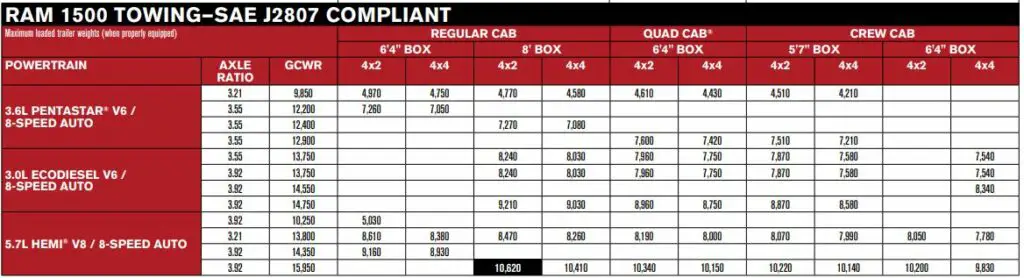
Configuration is the single most important factor for determining your actual reliable towing limit. As a rule of thumb: the heavier the truck itself (Crew Cab + 4WD), the lower its available towing capacity will be, as the truck’s weight “consumes” some of the GCWR. Conversely, a Regular Cab 4×2 model is lighter, allowing more of the GCWR to be allocated to the trailer.
The data above highlights a crucial expert insight: the axle ratio matters as much as the engine. A Crew Cab 4×4 with the HEMI and a 3.21 axle ratio is limited to roughly 8,000 lbs, whereas changing that single mechanical component to a 3.92 ratio bumps the capacity by over 2,000 lbs. For specific part replacements or upgrades, checking the Mopar site is recommended to maintain factory standards.
Section 4: Factors That Influence Real-World Towing Performance
In a laboratory setting, numbers are absolute. On a cross-country haul, they are fluid. Several real-world variables will dictate how trusted and reliable your towing experience feels. Professional drivers know that the “maximum” rating is a ceiling, not a suggested cruising weight.
The Role of Wheelbase and Suspension
A longer wheelbase (Crew Cab with a 6’4″ bed) provides a more stable platform that resists “the tail wagging the dog” during high-wind scenarios. Additionally, many 2017 Ram 1500 models came equipped with the Active-Level Four-Corner Air Suspension. This system is a game-changer for professional towing, as it automatically levels the truck under load, ensuring the headlights remain pointed at the road and the front tires maintain steering traction.
For every 1,000 feet of elevation gain, internal combustion engines lose about 3-4% of their power. If you are towing in the Rockies at 10,000 feet, your effective towing capacity is significantly lower than the sea-level rating on the chart.
The difference between a 3.21 and a 3.92 axle ratio is most evident on steep grades. A 3.21 ratio is designed for fuel economy; under load, the transmission will “hunt” for gears constantly. The 3.92 ratio provides the mechanical leverage needed to hold a gear, reducing transmission wear and providing a more complete sense of control.



Section 5: Professional Towing Equipment and Maintenance Standards
Having the capacity to tow is only half the battle; having the right equipment ensures you arrive safely. For the 2017 Ram 1500, any trailer exceeding 5,000 lbs requires a Class IV trailer hitch receiver and, critically, a weight-distribution hitch. Weight-distribution hitches are essential for maintaining the truck’s front-end steering geometry by distributing weight across both axles of the truck and the trailer.
📋
Step-by-Step Pre-Tow Checklist
Check the sticker on your driver-side door jamb. This provides your specific GVWR and axle ratio, which are the final words on your truck’s limits.
Ensure the integrated trailer brake controller is set to the correct gain for your trailer’s weight to ensure professional-level stopping power.
Check transmission fluid and differential oil. Towing is considered “severe duty” by Ram; adjust your maintenance intervals accordingly.
Furthermore, always use power-folding trailer-tow mirrors. These mirrors extend outward to give you a clear line of sight past the trailer’s edges, which is a professional safety requirement for changing lanes. For more community-tested expert tips on towing upgrades, enthusiast forums can provide real-world feedback on various hitch setups.
By The Numbers
Max Towing (lbs)
EcoDiesel Torque (lb-ft)
Optimum Axle Ratio
Max V6 Towing (lbs)
In summary, the 2017 Ram 1500 offers a broad towing range from 4,500 lbs to a maximum of 10,640 lbs. Engine choice and axle ratios (specifically the 3.92 ratio) are the primary drivers of high-capacity performance. Always account for payload, tongue weight, and professional equipment like weight-distribution hitches for safe operation. Before you head out, consult your specific door-jamb VIN sticker for your truck’s exact GVWR before hitching up your next load to ensure a safe and professional towing experience.
Frequently Asked Questions
What is the towing capacity of a 2017 Ram 1500 with a HEMI engine?
The 2017 Ram 1500 equipped with the 5.7L HEMI V8 engine features a wide towing range depending on the axle ratio and cab configuration. When paired with a 3.21 axle ratio, capacity is typically limited to around 8,000 lbs. However, when properly equipped with a 3.92 axle ratio, the HEMI can reach the model’s peak towing capacity of 10,640 lbs, making it the most professional choice for heavy-duty tasks.



How does cab size affect the towing capacity of a 2017 Ram 1500?
Cab size inversely affects towing capacity because larger cabs, such as the Crew Cab, add more curb weight to the truck’s chassis. Since the Gross Combined Weight Rating (GCWR) remains constant for a specific engine/axle combo, the extra weight of a larger cab reduces the remaining capacity available for a trailer. Generally, a Regular Cab model will have a higher maximum towing capacity than a luxury-trim Crew Cab.
What is the difference in towing capacity between the V6 and V8 engines?
The performance gap is significant. The 3.6L Pentastar V6 is designed for light-to-medium loads, offering a maximum capacity of roughly 7,600 lbs in its most capable configuration. In contrast, the 5.7L HEMI V8 is engineered for heavy-duty hauling, providing up to 10,640 lbs of capacity. For those seeking a reliable middle ground with high torque, the 3.0L EcoDiesel offers up to 9,210 lbs of towing capacity.
Where can I find the official towing chart for my specific configuration?
While general charts provide excellent estimates, the most trusted and expert way to find your specific truck’s capacity is by checking the door-jamb sticker on the driver’s side. This label lists the GVWR and GAWR specific to your VIN. You can also use the Ram Trucks official towing guide portal by entering your unique 17-digit VIN to get a precise, professional report of your vehicle’s capabilities as built.
What is the payload capacity of a 2017 Ram 1500 and how does it relate to towing?
Payload capacity is the total weight your truck can carry in the cabin and bed, including passengers and the trailer’s tongue weight. For the 2017 Ram 1500, payload typically ranges from 1,200 to 1,900 lbs. It is critical to remember that every pound of passengers or cargo in the truck reduces your available towing capacity, as you must remain under the Gross Combined Weight Rating (GCWR) for safe operation.
![Best Dodge Ram 1500 Truck Bed Liners [2026]](https://truckguider.com/wp-content/uploads/2026/03/truck-bed-liner-dodge-ram-1500-featured.webp)
![P0457 Dodge Ram 1500: Complete Repair Guide [2026]](https://truckguider.com/wp-content/uploads/2026/03/p0457-dodge-ram-1500-featured.webp)