2019 Toyota Tacoma Wheel Torque Specs: Lug Nuts, Hubs and Brakes

The 2019 Toyota Tacoma wheel torque specs start with one number every owner should know: 83 lb-ft (113 N·m) for the lug nuts. Toyota prints that figure in the 2019 owner’s manual, and it covers every wheel on the truck, steel or alloy.


This guide gives you that number plus the full picture. You will find the torque sequence, the re-torque interval, and the torque values for the brake caliper bolts and other wheel-area fasteners.
Every figure here is tied to the 2019 Tacoma or its third-generation service data. Where Toyota does not publish a value, we say so plainly instead of guessing.
2019 Toyota Tacoma Wheel Torque Specs in 3 Key Numbers


Three numbers cover most wheel jobs on a 2019 Tacoma. The lug nuts take 83 lb-ft. The wheel studs are M12 x 1.5, and the bolt pattern is 6×139.7 with a 106.1 mm center bore.
Use the table below as your quick reference at the truck. Print it or save it on your phone before you start a wheel job.
| Specification | 2019 Toyota Tacoma Value |
|---|---|
| Lug nut torque | 83 lb-ft (113 N·m, 11.5 kgf·m) |
| Lug nut thread | M12 x 1.5 |
| Socket size | 21 mm |
| Lug nuts per wheel | 6 |
| Bolt pattern | 6×139.7 (6×5.5 in) |
| Center bore | 106.1 mm |
The 2019 owner’s manual lists 83 ft·lbf (113 N·m, 11.5 kgf·m) in its tire-change section. Toyota tells owners to tighten each nut two or three times in the order shown in the manual diagram.
The 83 lb-ft figure converts cleanly to metric. Multiply 83 by 1.3558 and you get 112.5 N·m, which Toyota rounds to 113 N·m. If your wrench reads in N·m, set it to 113.
Torque is a measure of twisting force, not tightness you can feel by hand. Two nuts can feel equally tight yet hold very different clamp force.
That is why Toyota gives a number instead of a feel, and why a torque wrench is the only tool that can set it right.
Does Wheel Type Change the 2019 Tacoma Lug Nut Torque
No. Toyota gives one lug nut torque figure for the 2019 Tacoma, and it applies to steel wheels, alloy wheels, and the spare. The owner’s manual does not split the value by wheel material.
| Wheel Type | Lug Nut Torque | Source |
|---|---|---|
| Steel wheels | 83 lb-ft (113 N·m) | 2019 owner’s manual |
| Alloy wheels | 83 lb-ft (113 N·m) | 2019 owner’s manual |
| Spare wheel | 83 lb-ft (113 N·m) | 2019 owner’s manual |
This surprises owners who drive newer trucks. The 2024 Tacoma splits its spec by wheel type, with a higher figure for steel wheels. That split does not apply to the 2019 truck, so do not borrow the newer numbers.
That split exists because the fourth-generation truck uses larger M14 studs that can hold more clamp force. The 2019 truck uses M12 studs, and its 83 lb-ft figure matches what those studs were built to hold.
Wheel choice still matters for fitment, even when the torque stays the same. Our guide to the best wheels for a Toyota Tacoma covers bolt pattern, bore, and offset for third-generation trucks.
Six Lug Torque Sequence and Re-Torque Steps for 2019 Tacoma
The Tacoma has six lug nuts, so the pattern is a crisscross, not a five-lug star. Number the nuts clockwise from the top as 1 through 6.
Tighten in the order 1, 4, 2, 5, 3, 6, so each nut you tighten sits opposite the last one.
Toyota’s manual says to tighten each nut two or three times in the order shown. That means you make more than one pass around the wheel.
The first pass seats the wheel flat against the hub, and the final pass brings every nut to 83 lb-ft.
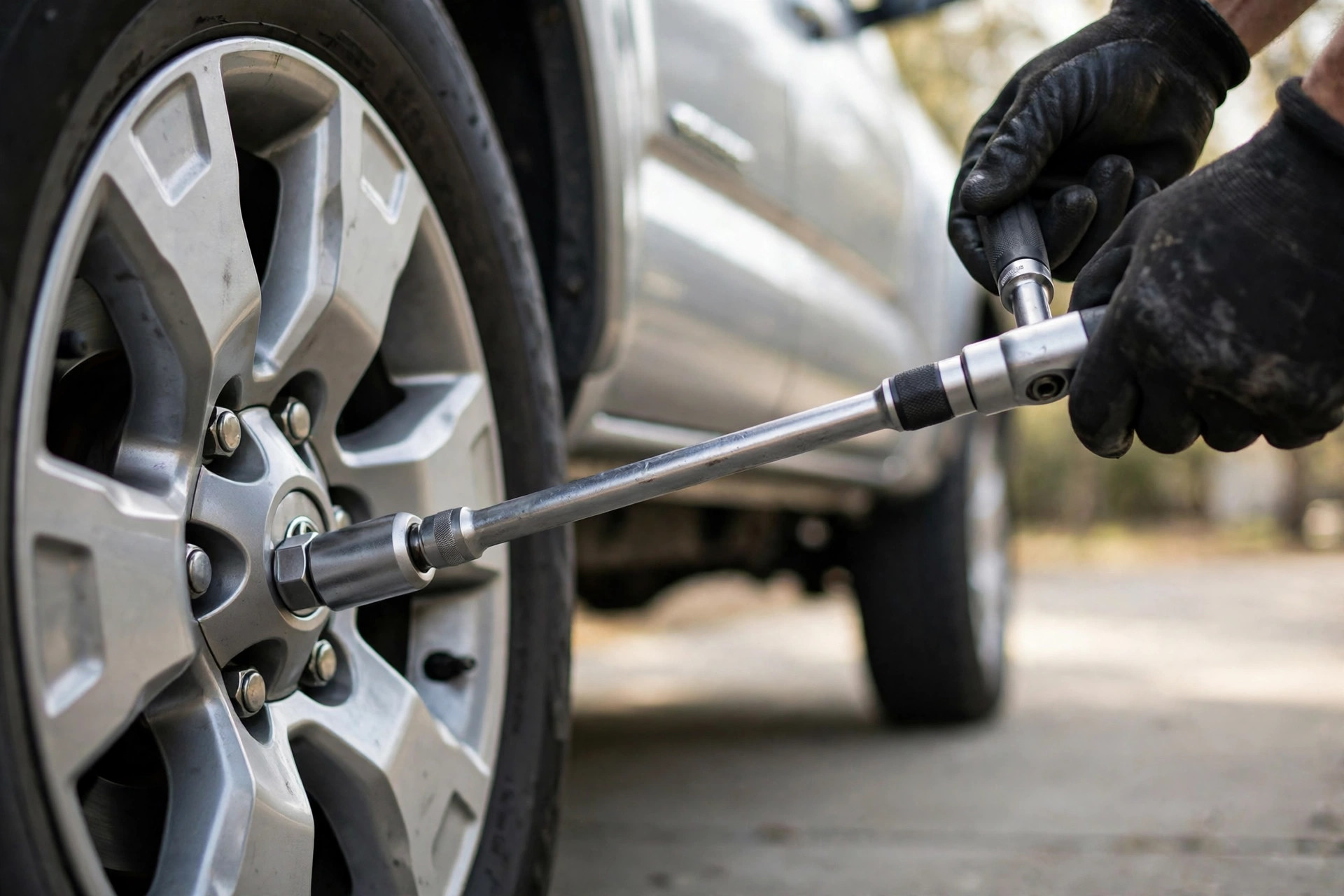
Use two torque stages for a clean result. Snug all six nuts to about half the final value in the crisscross order, then go to the full 83 lb-ft in the same order.
A single hard pull on one nut can tilt the wheel and leave the others loose.
The crisscross order matters because a wheel centers on the hub as the nuts tighten. Tightening one side first pulls the wheel off center and leaves a small gap on the other side.
That gap lets the wheel shift under load, and the nuts that were tight can work loose.
Do the final torque with the tire on the ground. Lower the truck until the tire grips the pavement, then apply the final torque. A wheel that spins freely in the air cannot be torqued right.
Re-torque the lug nuts after a short drive. Toyota’s 2019 manual says to check that the wheel nuts are still tight after 1,000 miles.
That is a long interval, so many shops also check after 50 to 100 miles. Do each re-check with the same wrench and the same 83 lb-ft setting.
5 Wheel Area Fastener Torques for the 2019 Tacoma
Lug nuts are only part of wheel work. Brake jobs and hub work touch other fasteners, and each one has its own torque value. The table below lists what we could verify for the 2019 Tacoma and marks the rest honestly.
| Fastener | Torque | Notes |
|---|---|---|
| Wheel lug nuts | 83 lb-ft (113 N·m) | 2019 owner’s manual, all wheel types |
| Front brake caliper bracket bolts | 91 lb-ft (123 N·m) | Third-generation factory service manual data, 17 mm bolts |
| Front wheel hub bearing bolts | Not listed | No verified 2019 Tacoma figure found in public service data |
| Front axle nut | 173 lb-ft (235 N·m) | 4WD only; 2WD trucks have no front axle nut |
| Rear brake caliper bolts | Not listed | The 2019 Tacoma uses rear drum brakes, so there is no rear caliper |
The 91 lb-ft caliper bracket figure comes from third-generation Tacoma service data compiled from the factory service manual. The same reference lists the front rotor minimum thickness at 26.0 mm and the pad minimum thickness at 1.0 mm.
Torque the bracket bolts to 91 lb-ft whenever the caliper comes off for pads or rotors. If you need pads, see our picks for the best brake pads for a Toyota Tacoma before you order parts.
Do not use a figure from another Toyota truck for the hub bearing bolts. The 4Runner shares the Tacoma 6×139.7 bolt pattern, but its hub hardware differs.
Wait for a verified 2019 Tacoma figure before touching those fasteners.
How to Torque 2019 Tacoma Wheels in 8 Steps
You need a torque wrench that covers 83 lb-ft, a 21 mm deep socket, a jack, and a jack stand. A breaker bar helps with stuck nuts, but never use it for the final torque.
- Park on flat ground. Set the parking brake and chock the wheels on the opposite side.
- Break the nuts loose. Loosen each lug nut about a quarter turn while the tire is still on the ground.
- Lift and support the truck. Jack up the corner and set it on a jack stand. Never work under a truck held by a jack alone.
- Remove the wheel. Take the nuts off, lift the wheel clear, and clean the hub face and the wheel mounting surface.
- Mount the wheel by hand. Set the wheel on the hub and thread all six nuts on by hand. Each one should turn freely for several turns.
- Snug in crisscross order. Tighten the nuts to about half the final value in the 1, 4, 2, 5, 3, 6 order.
- Torque to 83 lb-ft on the ground. Lower the truck until the tire touches the pavement, then torque every nut to 83 lb-ft in the same order. Repeat the pass until each nut holds at 83.
- Re-check after driving. Check every nut again at 83 lb-ft after 50 to 100 miles, and again after 1,000 miles as the 2019 manual directs.
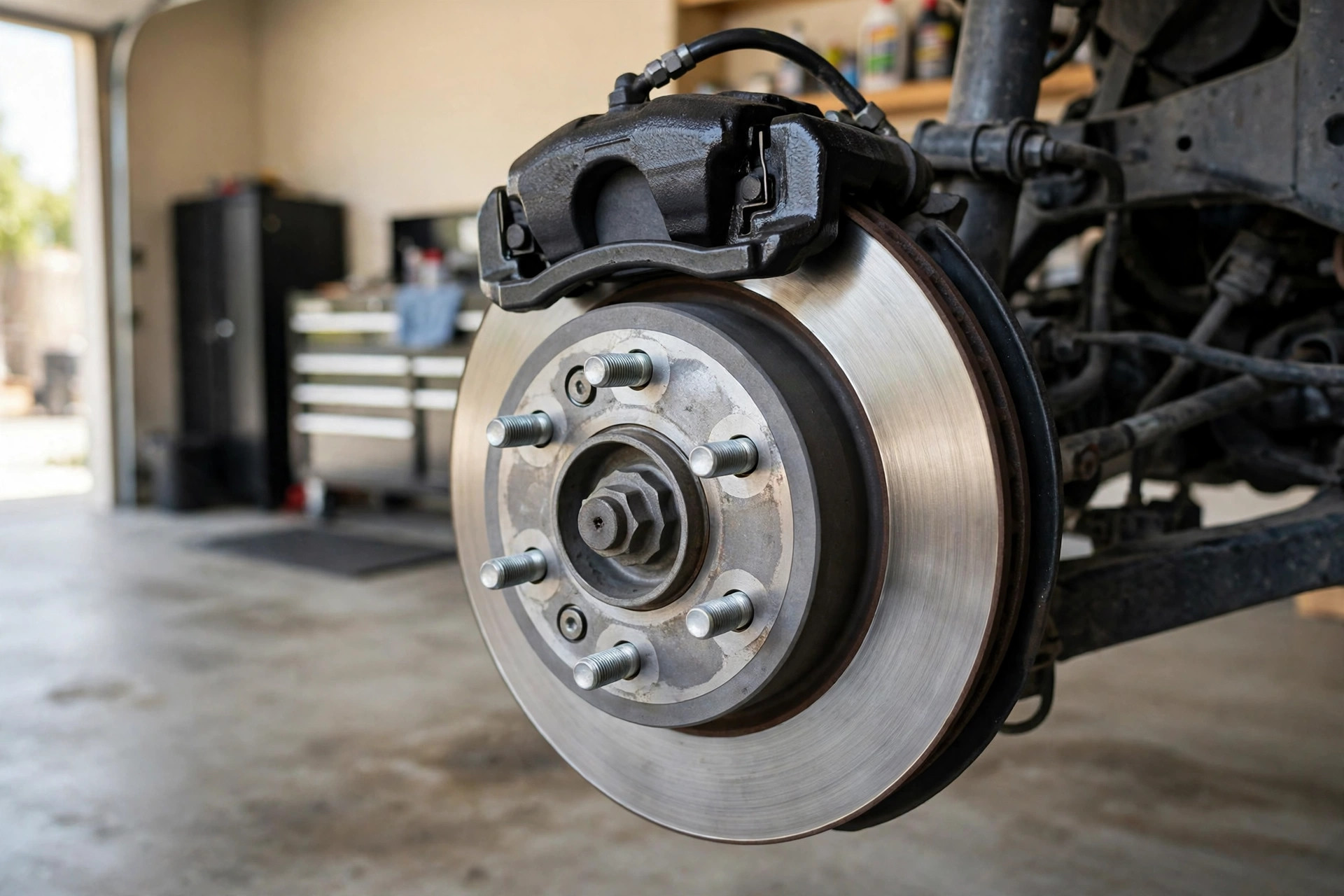
With the wheel off, the six studs and the brake rotor are fully visible. That is the right time to check the rotor face and the caliper bracket bolts before the wheel goes back on.
An illustrated front brake pad replacement guide shows the 17 mm bracket bolts and the 91 lb-ft setting in photos.
Keep the studs clean and dry. Lubricant changes the friction between the nut and the stud, so the wrench reading no longer matches the real clamping force. Wipe off any oil or grease before the nuts go on.
A click-type torque wrench is the right tool for this job. Set the handle to 83 lb-ft, pull slowly until it clicks once, then stop.
Beam-style wrenches work too, but you must watch the scale as you pull. Have the wrench checked for calibration if it has been dropped or stored under load.
7 Mistakes That Ruin Tacoma Wheel Torque
Most wheel problems start with a torque mistake, not a bad part. These seven errors show up again and again in Tacoma wheel jobs.
- Using an impact wrench for the final torque. An impact gun cannot measure torque. It can stretch a stud or leave a nut far above 83 lb-ft.
- Torquing in a circle. Going around the wheel one nut at a time pulls the wheel crooked. Always use the 1, 4, 2, 5, 3, 6 crisscross order.
- Torquing with the wheel in the air. A spinning wheel gives a false reading. The tire must grip the ground for the final pass.
- Using 2024 Tacoma numbers on a 2019 truck. The fourth-generation truck uses 97 lb-ft for alloy wheels and 154 lb-ft for steel wheels. Those figures will over-torque a 2019 Tacoma.
- Skipping the re-torque. Newly seated wheels settle as they heat and cool. A check after 50 to 100 miles, and again after 1,000 miles, catches the nuts that moved.
- Oiling the studs. Oil or grease lets a nut turn further at the same wrench reading. The result is more clamp force than the stud was built for.
- Reusing damaged nuts or studs. A nut that cross-threads or a stud with stretched threads will not hold torque. Replace the damaged part instead of forcing it.
A loose wheel gives warning signs before it fails. Vibration at highway speed, a clicking sound from one corner, or a nut that turns freely by hand all mean the same thing.
Stop, re-torque to 83 lb-ft, and have the studs checked if any nut feels damaged.
How 2019 Tacoma Torque Compares With Other Tacoma Years
The 83 lb-ft figure has been the Tacoma standard for decades. Toyota used it on the first, second, and third generations, and it only changed with the fourth-generation redesign.
| Tacoma Model Years | Lug Nut Torque | Stud Size |
|---|---|---|
| 1995 to 2004 | 83 lb-ft (110 N·m) | M12 x 1.5 |
| 2005 to 2015 | 83 lb-ft (113 N·m) | M12 x 1.5 |
| 2016 to 2023 | 83 lb-ft (113 N·m) | M12 x 1.5 |
| 2024 and newer, alloy wheels | 97 lb-ft (131 N·m) | M14 x 1.5 |
| 2024 and newer, steel wheels | 154 lb-ft (209 N·m) | M14 x 1.5 |
Base two-wheel-drive Tacomas from 1996 to 2015 used five lug nuts on a 5×114.3 pattern, but the torque was still 83 lb-ft.
The 2024 change came with bigger M14 studs and a smaller 95.1 mm hub bore. The 2019 truck keeps M12 studs and a 106.1 mm bore, so the older and newer wheels do not swap directly.
Used-wheel buyers should check the hub bore before they buy. A 2024 or newer Tacoma wheel has a 95.1 mm bore that will not fit over a 2019 hub.
Older wheels with the 106.1 mm bore can fit a newer truck only with hub-centric rings and the correct M14 lug nuts.
Other Toyota trucks use different numbers, so do not borrow a Tundra or 4Runner figure for your Tacoma. Our lug nut torque chart for other trucks lists the factory values side by side when you need to compare.
5 Questions About 2019 Tacoma Wheel Torque Answered
What Is the Lug Nut Torque for a 2019 Tacoma
The lug nut torque is 83 lb-ft (113 N·m) for every wheel on the 2019 Tacoma. Toyota prints this figure in the 2019 owner’s manual tire-change section.
Do Steel and Alloy Wheels Use the Same Torque


Yes, the 2019 Tacoma uses 83 lb-ft for steel wheels, alloy wheels, and the spare. The steel and alloy split only applies to the redesigned 2024 and newer Tacoma.
What Socket Size Fits 2019 Tacoma Lug Nuts
A 21 mm socket fits the factory lug nuts. Use a six-point deep socket so it grips the nut fully and does not round the corners.
How Often Should You Re-Torque Tacoma Lug Nuts
Check the torque after 50 to 100 miles as an early precaution, and again after 1,000 miles as Toyota’s 2019 manual directs. Toyota’s second-generation manual called for a check after 100 miles.
Can You Use 2024 Tacoma Torque Specs on a 2019 Truck
No, the 2024 Tacoma uses larger M14 studs with 97 lb-ft for alloy wheels and 154 lb-ft for steel wheels. Using those figures on a 2019 truck with M12 studs would over-torque the lug nuts.
The 2019 Toyota Tacoma wheel torque specs are simple once you know the numbers. Set the lug nuts to 83 lb-ft in the 1, 4, 2, 5, 3, 6 crisscross order, and use 91 lb-ft for the front caliper bracket bolts.
Re-check the nuts after 50 to 100 miles and again after 1,000 miles, and keep the studs clean and dry. A torque wrench and five extra minutes are all it takes to keep a wheel seated right.
Do the job once, do it to spec, and the truck will not remind you about it later.