2020 Ram 1500 Lug Pattern & Wheel Specs: The Complete Guide in 2026

Navigating wheel fitment for the 2020 Ram 1500 requires precise differentiation between two distinct vehicle architectures sold concurrently during this specific model year. Stellantis manufactured the fifth-generation platform, known internally as the DT, alongside the continuation of the fourth-generation platform, branded as the Ram 1500 Classic (DS/DJ).
This generational overlap created a fundamental divergence in foundational wheel specifications. Understanding the exact lug pattern, hub bore measurements, thread pitches, and offset tolerances is critical for ensuring safe load distribution, preserving steering geometry, and properly sizing aftermarket upgrades.


This report provides a comprehensive, data-driven analysis of wheel specifications, cross-compatibility metrics, and suspension-specific fitment limits.
2020 Ram 1500 Lug Pattern
Upgrading your wheels or doing routine maintenance? The 2020 Ram 1500 features a specific 6-lug configuration that differentiates it from older models. Dive deep into the exact measurements, torque specifications, and cross-brand compatibility matrix.
Core Specifications: The 6×139.7mm Pattern
If you are searching for the 2020 Ram 1500 bolt pattern, the short and definitive answer is 6×139.7mm, which is also commonly referred to by its imperial measurement of 6×5.5 inches. This represents a fundamental shift from the classic 5-lug design used by Dodge and Ram for decades prior to the fifth generation (DT) redesign. Understanding this measurement is critical: the “6” indicates the total number of lug nuts securing the wheel, while the “139.7mm” measures the diameter of the imaginary circle that passes through the exact center of each of those six lugs (known as the Pitch Circle Diameter or PCD).
Visualizing the Bolt Circle
The chart maps the precise geometric layout of the 2020 Ram 1500 hub. The central point represents the 77.8mm hub bore, while the six outer points represent the M14 x 1.5mm lug studs arranged on the 139.7mm diameter circle.
Quick Reference Matrix
| Bolt Pattern (Metric) | 6 x 139.7 mm |
| Bolt Pattern (Standard) | 6 x 5.5 inches |
| Thread Pitch / Size | M14 x 1.5 |
| Center Bore (Hub Bore) | 77.8 mm |
| Lug Nut Hex Size | 22mm (or 7/8″) |
| Factory Torque Spec | 130 ft-lbs (176 Nm) |
Data sourced from Wheel-Size.com
The Generational Shift: Why 6 Lugs?
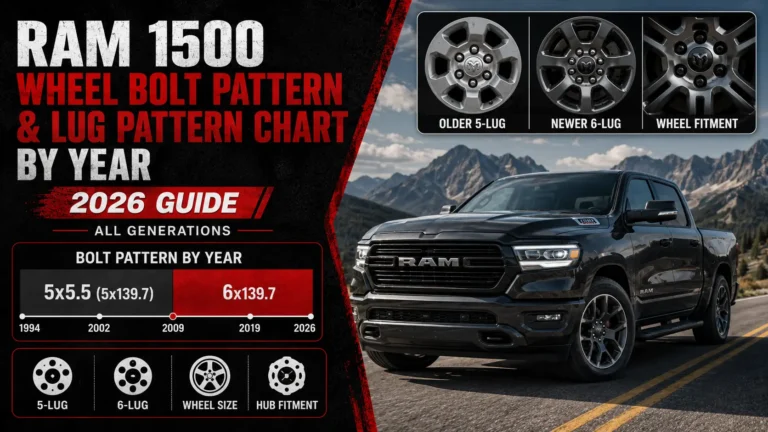
One of the most frequent points of confusion for Ram owners involves the transition between the 4th and 5th generation trucks. If you own a 2018 or older Ram 1500 (or a 2019+ Ram 1500 “Classic” which uses the older DS body style), your truck has a 5×139.7mm bolt pattern. However, when Ram introduced the all-new DT body style in 2019, they upgraded the entire hub assembly to a 6-lug configuration. This wasn’t merely a cosmetic change. The shift to six lugs allowed engineers to increase the vehicle’s maximum payload and towing capacities, bringing the hub strength in line with industry competitors who had largely already adopted 6-lug setups for their full-size, half-ton pickups.
Note: The 2019+ “Classic” model retains the 5-lug pattern of the 4th generation.
Aftermarket Wheel Fitment & Cross-Compatibility
Because 6×139.7mm is a highly common lug pattern across the truck industry, you might assume wheels from a Chevy Silverado, GMC Sierra, or Toyota Tundra will bolt right onto your 2020 Ram 1500. While the lug pattern matches, the Center Bore determines true compatibility.
The 2020 Ram 1500 utilizes a 77.8mm center bore. The hub ring on the truck carries the weight of the vehicle (hub-centric design), not the lug studs themselves.
- Chevy/GMC (78.1mm bore): Since their bore is slightly larger, GM wheels will physically fit onto the Ram’s hub. However, there will be a 0.3mm gap. Relying solely on the lug nuts to center the wheel (lug-centric) can cause high-speed vibrations and place dangerous shear stress on the wheel studs. You must use hub-centric rings (78.1mm outer diameter to 77.8mm inner diameter) if attempting this.
- Toyota (106.1mm bore): Toyota 6-lug wheels will fit over the Ram hub, but the massive gap requires thick, custom hub-centric rings. Additionally, wheel offset differences often cause clearance issues with brake calipers.
- Ford F-150: Totally incompatible. Modern F-150s use a 6x135mm bolt pattern.
For verified fitment guarantees, consult experts at Tire Rack or Discount Tire.
Compatibility with older Ram 1500 wheels
Do not attempt to mount 5-lug rims from a 2018 or older Ram onto a 2020 model. Adapters exist, but adding 5-to-6 lug adapters introduces weak points in the drivetrain and drastically alters wheel offset, heavily impacting suspension geometry and safety.
Torque Specifications & Installation Safety
Properly torquing your lug nuts is paramount for safety. The factory specification for the 2020 Ram 1500 is 130 ft-lbs (176 Nm). Under-torquing can lead to wheel separation at highway speeds, while over-torquing can stretch the M14 wheel studs, strip the threads, or warp the brake rotors. Always use a calibrated torque wrench, and never rely solely on an impact gun. Furthermore, lug nuts should be tightened in a specific “star” or crisscross pattern to ensure even pressure across the hub face. For a 6-lug wheel, the sequence is typically: 1, 4, 2, 5, 3, 6 (moving roughly opposite each time).
Lug Nut Seating Styles
When buying aftermarket wheels, ensure you purchase lug nuts with the correct seat type. The 2020 Ram 1500 factory wheels require conical seat (acorn) lug nuts with a 60-degree taper. Using flat-seat or ball-seat lug nuts on a wheel designed for conical seats will result in the wheel coming loose, regardless of how tightly you torque them.


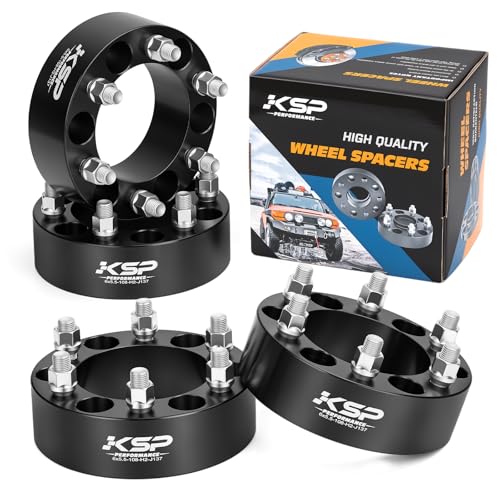
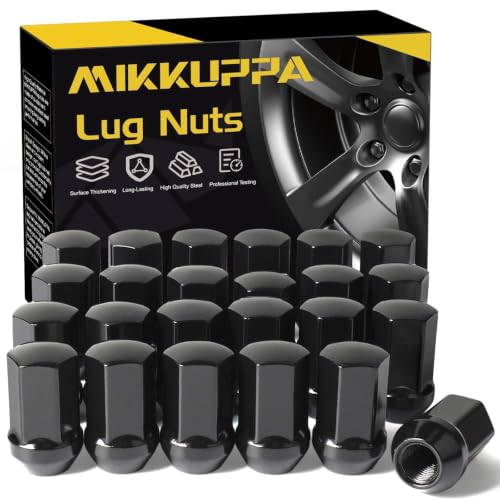
Pro Tip: Re-torque your wheels after the first 50 to 100 miles of driving after installation, as the metal can compress and the lug nuts may loosen slightly during initial use.
The Generational Divide: Fifth-Generation (DT) vs. Classic (DS) Platforms
The bolt pattern—also referred to as the pitch circle diameter (PCD) or lug pattern—dictates the exact layout of the wheel fasteners. For the 2020 Ram 1500 lineup, identifying the correct pattern rests entirely on whether the vehicle is a standard fifth-generation (DT) model or a fourth-generation Classic (DS) model.
The 2020 Ram 1500 (DT platform) features a 6×139.7mm (6×5.5″) lug pattern. Beginning in 2019, Ram transitioned the standard 1500 platform from a traditional 5-lug design to a modernized 6-lug architecture. This engineering shift increased the clamping force between the wheel and the hub, facilitating improved load-bearing capabilities.
The addition of the sixth lug nut provides superior weight distribution, directly supporting the DT generation’s heightened maximum towing capacity of up to 12,750 pounds when equipped with the 5.7L HEMI V8 eTorque engine.
Conversely, the 2020 Ram 1500 Classic retains the legacy 5×139.7mm (5×5.5″) lug pattern. As a continuation of the fourth-generation chassis produced initially from 2009 to 2018, the Classic model maintains the five-lug configuration. Consequently, aftermarket wheels designed for a standard 2020 Ram 1500 (DT) will fundamentally fail to bolt onto a 2020 Ram 1500 Classic, and vice versa.
| Specification | 2020 Ram 1500 (DT – 5th Gen) | 2020 Ram 1500 Classic (DS – 4th Gen) |
| Lug Pattern (Metric) | 6×139.7 mm | 5×139.7 mm |
| Lug Pattern (Standard) | 6×5.5 inches | 5×5.5 inches |
| Center Bore (Hub Bore) | 77.8 mm | 77.8 mm |
| Lug Nut Thread Pitch | M14 x 1.50 | M14 x 1.50 |
| Hex Socket Size | 22 mm (7/8″) | 22 mm (7/8″) |
| Factory Offset Range | +17.1 to +21.1 mm | +17.1 to +27.4 mm |
Exacting Hub Dimensions, Thread Pitch, and Hardware Fasteners
Beyond the bolt pattern, securing a wheel to the vehicle hub relies on three critical dimensions: the center bore, the stud thread pitch, and the lug nut seating style. Both the DT and DS configurations for the 2020 model year share a center bore (hub bore) diameter of 77.8 millimeters.
Modern Ram trucks are engineered with a hub-centric wheel design. This means the central hole of the wheel rests perfectly on the lip of the vehicle’s hub, which carries the sheer vertical weight of the vehicle. The lug nuts serve primarily to clamp the wheel laterally against the mounting face, rather than bearing the primary payload stress.
All 2020 Ram 1500 models feature an M14x1.50 thread pitch for the wheel studs. This represents a modernization in Ram’s engineering history; prior to the 2012 model year, Dodge and Ram half-ton trucks utilized an imperial 9/16″-18 thread size. The transition to a hardened metric M14x1.50 stud provides a finer thread pitch, which better resists vibratory loosening under heavy payload and towing stress. Fastener removal requires a standard 22 mm (or 7/8-inch) hex socket.
The 2020 Ram 1500 uses two primary styles of lug nuts depending on the specific wheel equipped from the factory, which typically correlates with the use of steel versus aluminum alloy wheels. Cone seat (conical or acorn) lug nuts feature a 60-degree tapered end that wedges into a corresponding recess on the wheel, focusing pressure on a smaller contact patch to ensure precise centering.
Flanged seat (flat) lug nuts feature a flat, washer-like base. The flanged design disperses the clamping load over a much wider surface area, reducing localized stress on the wheel mounting face, making them common on specialized factory wheels and heavy-duty applications.
Manufacturer Torque Specifications and Safety Protocols
Proper tightening of wheel fasteners is paramount for operational safety. Inadequate torque can result in wheel wobble and ultimate detachment, while excessive torque can yield (stretch) the wheel studs, warp brake rotors, and fracture wheel seats. The official manufacturer wheel torque specifications for the 2020 Ram 1500 vary based strictly on the style of lug nut utilized.
The official 2020 Ram 1500 Owner’s Manual cites 130 ft-lbs (176 N·m) for cone-type lug nuts and 129 ft-lbs (175 N·m) for flanged-type lug nuts. However, widely accepted service data from Stellantis dealerships standardizes flanged hardware to 140 ft-lbs for consistency across various half-ton towing applications.
An impact wrench should never be used for final tightening, as the risk of over-torquing is severe. A calibrated click-type, beam-type, or digital torque wrench is strictly mandated to prevent hardware failure.
The critical nature of exact torque specifications is underscored by a recent Stellantis recall (Campaign Y26/Y36) affecting over 500,000 Ram Heavy Duty (3500/4500/5500) trucks. While the 1500 series was not part of this specific wheel stud recall, the incident was caused by incorrect torque specifications printed in the service manuals,
which led to yielded studs and the risk of catastrophic wheel separation. This serves as an acute engineering reminder that guessing torque values or relying on pneumatic impact tools compromises the integrity of the M14x1.50 studs.



| Lug Nut Style | OEM Manual Torque Spec | Dealership Service Spec | Socket Size |
| Cone Seat (Tapered) | 130 ft-lbs (176 N·m) | 130 ft-lbs | 22 mm (7/8″) |
| Flanged Seat (Flat) | 129 ft-lbs (175 N·m) | 140 ft-lbs | 22 mm (7/8″) |
Factory Wheel Geometry: Offset and Backspacing Dynamics
Offset and backspacing define how far a wheel protrudes outward toward the fender or sinks inward toward the internal suspension components. Offset is the metric distance from the wheel’s absolute centerline to its mounting hub face. A positive offset pushes the wheel deeper into the wheel well, while a negative offset pushes it outward away from the vehicle. Backspacing measures the physical distance in inches from the mounting surface to the inner lip of the wheel.
For the 2020 Ram 1500 (both DT and DS variants), factory original equipment (OE) wheels are engineered with a conservative, high-positive offset. Typical 18×8-inch and 20×9-inch factory wheels feature an offset ranging from +17.1 mm to +21.1 mm, commonly centralized as +19.05 mm.
This geometry equates to a backspacing of approximately 5.24 inches on 18-inch rims and 5.75 inches on 20-inch rims. This positive offset ensures the tires remain tucked safely behind the fenders to minimize aerodynamic drag, prevent road debris kick-up, and maintain factory scrub radius parameters for precise steering feedback.
Cross-Manufacturer Compatibility: Ram vs. Chevrolet/GMC
A frequent point of inquiry in the automotive aftermarket is whether the 2020 Ram 1500 (DT) can utilize wheels sourced from General Motors vehicles, such as the Chevrolet Silverado 1500 or GMC Sierra 1500. Both the fifth-generation Ram 1500 and the modern Chevrolet Silverado 1500 share the exact same 6×139.7mm (6×5.5″) bolt pattern. However, bolt pattern parity does not equate to complete mechanical interchangeability.
The determining factor is the center bore. The Ram 1500 utilizes a 77.8 mm center bore, while the Chevrolet and GMC 1500 platforms utilize a slightly larger 78.1 mm center bore. Because the GM hub bore is marginally larger by 0.3 millimeters, a Chevrolet Silverado wheel will physically slide onto a 2020 Ram 1500 hub.
However, this mounting creates a microscopic gap. Installing a 78.1 mm wheel onto a 77.8 mm hub transforms the setup from a safe hub-centric design to a volatile lug-centric design, forcing the wheel studs to bear the vehicle’s entire vertical weight. Over time, this leads to high-speed vibrations, premature wheel bearing wear, and potential stud shear.
To run GM or aftermarket wheels with a 78.1 mm bore on a Ram safely, an aluminum or polycarbonate hub-centric ring (measuring 78.1mm outer diameter to 77.8mm inner diameter) is strictly required to close the gap and restore the hub-centric load bearing. Conversely, factory 2020 Ram 1500 wheels (77.8 mm) cannot be mounted onto a Chevrolet Silverado (78.1 mm) without mechanically machining the center bore of the Ram wheel wider to accommodate the larger GM hub.
Comprehensive Aftermarket Fitment Guidelines by Suspension Setup
Modifying the stance of a 2020 Ram 1500 demands a nuanced understanding of how altered suspension heights interact with wheel offset and tire dimensions. Leveraging data from aftermarket fitment specialists, specific offset adjustments can push the wheels flush with the fenders or outward for an aggressive stance without necessitating invasive plastic or metal trimming.
For a 2020 Ram 1500 (DT) without any suspension modifications, the maximum allowable tire diameter is generally 33 inches. Upgrading to a wider stance is achievable by lowering the offset. The benchmark setup for a stock suspension utilizes a 20×10 wheel with a -18mm offset, wrapped in 33×12.5R20 tires.
This setup pushes the wheel outward, providing an aggressive stance that clears the internal control arms, though minor rubbing on the front inner fender liners may occur at full steering lock. A more conservative daily-driver alternative involves 18×9 wheels with a -12mm offset, utilizing 265/70R18 tires.
Installing a front strut spacer or leveled coilover system (typically a 2-inch to 2.5-inch raise) eliminates the factory “rake” and vastly improves front-wheel clearance within the wheel well. The standard configuration for a leveled Ram 1500 involves 20×10 wheels with a -25mm offset and 33×12.5R20 tires. The level allows for a more negative offset—pushing the wheels further outward—while mitigating the risk of fender rub during aggressive suspension compression.
True suspension lift kits drop the front crossmember, enabling the use of heavy-duty 35-inch mud-terrain or all-terrain tires. A standard 3-inch lift allows for 20×10 wheels with a -12mm offset and 35×12.5R20 tires. Scaling up to a 6-inch lift allows owners to utilize 20×12 wheels with an aggressive -44mm offset and 35×12.5R20 tires.
The drastic 6-inch elevation provides the vertical clearance necessary to accommodate the vast sweep radius of a 12.5-inch wide tire on a deeply offset wheel turning lock-to-lock.
Trim-Specific Tire Sizing and Clearances
The 2020 Ram 1500 lineup features a vast array of trim levels, each engineered with distinct standard and optional wheel packages. These packages range from utilitarian 17-inch steel wheels on the Tradesman to luxury 22-inch forged alloys on the Limited. To ensure accurate speedometer calibration and drivetrain synchronization, replacing tires requires matching the overall diameter of the original equipment.


The data below outlines the primary factory original equipment tire sizes mapped across the fifth-generation (DT) trims :
| 2020 Ram 1500 Trim Level | Primary OE Tire Sizes | Associated Wheel Diameter |
| Tradesman / HFE | 275/70R18, 275/55R20 | 18-inch, 20-inch |
| Big Horn / Lone Star | 275/65R18, 275/55R20 | 18-inch, 20-inch |
| Laramie / Laramie Longhorn | 275/65R18, 275/55R20, 285/45R22 | 18-inch, 20-inch, 22-inch |
| Limited | 275/55R20, 285/45R22 | 20-inch, 22-inch |
| Rebel | LT275/70R18 (All-Terrain) | 18-inch |
| TRX (2021+ relevant) | 325/65R18 | 18-inch |
The off-road-focused Rebel model features a factory 1-inch suspension lift over standard models, allowing it to clear aggressive LT275/70R18 tires straight from the factory. The high-performance Ram 1500 TRX, which utilizes the exact same 6×139.7mm bolt pattern as the standard DT platform, relies on a significantly widened track width and distinct Bilstein Black Hawk e2 shock architecture to fit massive 325/65R18 (35-inch) tires without modification.
People Also Ask
How do I manually measure the bolt pattern on my Ram 1500?
Measuring a bolt pattern requires determining the diameter of the imaginary circle intersecting the center of all wheel studs. For the 5-lug Ram 1500 Classic, measurement is taken from the absolute center of one lug directly across the hub to the outer edge of the lug hole furthest away.
For the 6-lug standard DT platform, the measurement process is more straightforward: measure from the center of one lug directly across the hub to the center of the lug hole perfectly opposite. In the DT’s case, this measured distance will precisely equal 139.7 millimeters (or 5.5 inches).
Why did Ram change from a 5-lug to a 6-lug pattern in 2019/2020?
The migration to a 6×139.7mm pattern on the fifth-generation platform was driven simultaneously by payload engineering demands and supply chain standardization. The addition of a sixth stud distributes sheer and rotational torque across a 20 percent larger fastener surface area, an absolute requirement for the DT generation’s fortified tow ratings.
Furthermore, 6×139.7mm has become an overarching industry standard for half-ton trucks, utilized natively by Toyota, Nissan, and General Motors. Adopting this standardized footprint massively increased aftermarket wheel availability for Ram owners, eliminating the brand’s reliance on niche 5×5.5″ blanks.
Will a 5x127mm (5×5″) wheel fit a Ram 1500 Classic?
No. The 5x127mm (5×5″) pattern is exclusive to the Jeep Wrangler (JK/JL) and Jeep Gladiator platforms. While both the Ram and Jeep marques fall under the Stellantis corporate umbrella, the 5x127mm circle is dimensionally smaller than the Ram Classic’s 5×139.7mm (5×5.5″) lug requirement.
Attempting to mount a Jeep wheel on a Ram requires a specialized, high-quality billet wheel adapter to bridge the dimensional gap. Even if adapted, the load ratings of passenger-centric Jeep wheels must be carefully verified against the heavy-duty half-ton towing requirements of the Ram.