
275/55R20 vs 33×12.50R20: Specs & Fitment Guide [2026]

Upgrading to 33×12.50R20 tires adds roughly 1.1 inches in height and a significant 1.7 inches in width compared to the stock 275/55R20 size. This extra width is the primary cause of rubbing on suspension components, typically requiring a leveling kit and specific wheel offsets for proper clearance.
🎯 Key Takeaways
Recommended Best Deal Products

- Takeaway 1:33×12.50 tires are significantly wider, increasing the risk of rubbing during turns.
- Takeaway 2:A 2-inch leveling kit is usually required to clear 33×12.50 tires comfortably.
- Takeaway 3:Expect a speedometer error of roughly 3-4% due to the larger diameter.
- Takeaway 4:Stock wheels often lack the offset needed to clear 12.5-inch wide tires.
- Takeaway 5:Moving to 33s will likely cause a slight drop in fuel economy.
If you are looking to swap your stock 275/55R20 tires for a set of 33×12.50R20s, you are moving toward a much more aggressive, “stuffed” look for your truck. The short answer is that while the height increase is manageable, the massive jump in width is what will cause most of your installation issues. A 33×12.50 tire is roughly one inch taller than your stock 275/55R20, but it is nearly two inches wider, creating a significantly larger footprint that demands extra clearance.

Prime for Young Adults — 6 Months Free
Students and 18–24s get six months of Prime free, then half price.
Start 6 Months Free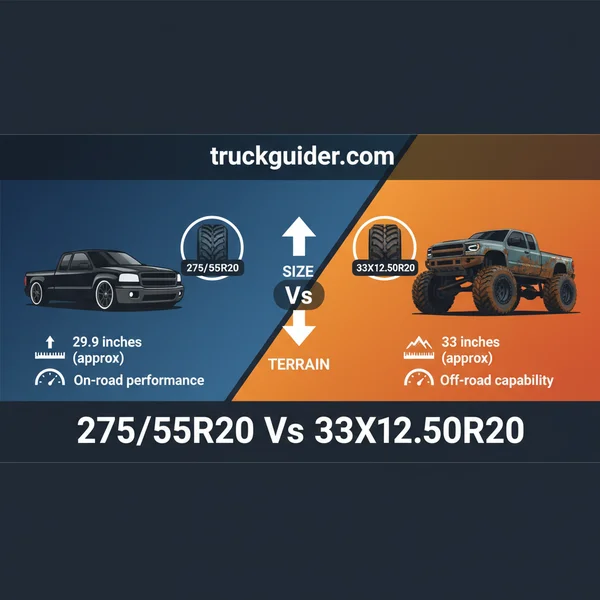
Getting this right matters because guessing on tire fitment usually leads to ruined inner fender liners or, worse, damage to your suspension components. You need to know exactly where that extra rubber is going to sit before you hit the tire shop. While many modern trucks can handle the height of a 33-inch tire on a simple leveling kit, the 12.50-inch width introduces clearance problems that the stock 275mm (10.8-inch) width simply doesn’t have.
Dimensional Breakdown: 275/55R20 vs. 33×12.50R20
To understand how these tires differ, we have to look past the marketing labels and get into the hard math. The 275/55R20 is a metric-sized tire typically found as original equipment on half-ton trucks like the Ford F-150, Chevy Silverado, and Ram 1500. The 33×12.50R20 is a flotation-sized tire designed specifically for off-road performance and a wide, muscular stance.
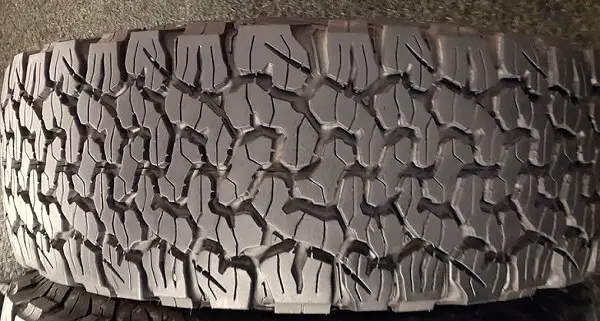
The Numbers Side-by-Side
- 275/55R20: Approximately 31.9 inches tall and 10.8 inches wide.
- 33×12.50R20: Approximately 33.0 inches tall and 12.5 inches wide.
- Height Difference: An increase of about 1.1 inches in total diameter.
- Width Difference: An increase of about 1.7 inches in total section width.
When you look at the height, you are only gaining about half an inch of ground clearance because the radius only increases by half the total diameter change. However, the width is the real story. Adding nearly two inches of width means the tire will sit significantly closer to your suspension components on the inside and much closer to your bumper and fender flare on the outside during a turn.
Ground Clearance vs. Stance
The 275/55R20 is designed to stay tucked neatly inside the wheel wells to maximize fuel economy and minimize road spray. When you switch to the 33×12.50, you aren’t just getting a taller tire; you are changing the entire profile of the vehicle. This extra width creates a larger contact patch, which is great for traction on dirt or sand, but it forces the tire to occupy space that engineers didn’t originally account for in the stock suspension design.
Fitment Realities: Will 33×12.50 Rub on My Truck?
The biggest question every truck owner asks is whether the 33×12.50 will rub. The answer is almost always “yes” if you are running stock wheels without spacers or a lift. Because the 33×12.50 is nearly two inches wider than the 275/55R20, the inner sidewall of the tire will move about 0.85 inches closer to your truck’s frame and suspension parts if you use the same wheel offset.
The Control Arm Conflict
On most modern trucks, the clearance between the stock 275mm tire and the upper control arm (UCA) is surprisingly tight. When you add that extra 1.7 inches of width, that gap often disappears entirely. If you try to mount 12.50-wide tires on factory wheels with high positive offsets, you will likely find the tire sidewall scrubbing against the UCA or the sway bar as soon as you turn the steering wheel. This isn’t just a noise issue; it is a safety hazard that can lead to tire failure over time.
Full Lock and Reverse Rubbing
Even if you clear the suspension, the 33×12.50’s width creates problems at “full lock”—when your steering wheel is turned as far as it can go. As the wide tire pivots, its outer edges swing in a wider arc than the narrower 275/55R20. This often results in the tire catching on several common friction points:
- Plastic Inner Fender Liners: Especially at the rear of the wheel well when backing up.
- Front Bumper Valance: The plastic “air dam” under your front bumper.
- The Frame Rails: Usually occurring only during tight U-turns or parking maneuvers.
- Crash Bars: A common issue for newer Ford F-150 owners where the tire hits the safety bars inside the wheel well.
To clear these tires properly, most owners find they need at least a 2-inch leveling kit to help with the height. More importantly, you will likely need a wheel with a lower offset to push that extra width away from the suspension components. If you insist on keeping your factory wheels, high-quality hub-centric wheel spacers are usually the only way to prevent the 33×12.50 from rubbing the frame and control arms.
Performance Impacts: Speedometer, MPG, and Gearing
Switching from a stock 275/55R20 to a 33×12.50R20 isn’t just about the look; it significantly alters how your truck communicates with you. Because the 33-inch tire is wider and often slightly taller than the standard 275/55R20 (which measures about 31.9 inches), your drivetrain has to work harder to move the extra mass. This change is felt most in your truck’s acceleration and braking response.

Audible — Listen Free for 30 Days
One free credit a month and thousands of titles included.
Listen Free for 30 DaysSpeedometer Accuracy and Odometer Reading
When you move to a larger diameter tire, your speedometer will likely read lower than your actual speed. For instance, if your speedometer says 60 mph with 33s, you might actually be traveling 62 or 63 mph. This happens because the larger circumference covers more ground with each revolution. This also affects your odometer, which will record fewer miles than you have actually driven over time.
- Pro Tip: Use a GPS-based speed app on your phone to verify your actual speed after upgrading.
- Recalibration: Many modern trucks allow you to recalibrate the ECU for larger tire sizes using a handheld tuner to fix these discrepancies.
Fuel Efficiency and Rotational Weight
The 33×12.50R20 is significantly heavier than the 275/55R20. This “unsprung weight” requires more torque to get moving and more energy to keep spinning. Expect a drop in your MPG—usually between 1 and 3 miles per gallon depending on the tread pattern. A heavy Mud-Terrain (MT) tire will be much more taxing on your fuel tank than a mild All-Terrain (AT) tire.
- Heavy LT-rated 33s can weigh 15-20 lbs more per corner than standard P-rated 275s.
- Stop-and-go city driving is where you will see the most significant drop in fuel economy.
Choosing the Right Setup: Leveling Kits and Wheel Offset
The biggest hurdle when choosing between these two sizes is fitment. While the 275/55R20 is designed to clear everything on a factory suspension, the 33×12.50R20 is a different beast entirely due to its massive width. It is the “width” rather than the “height” that usually causes the most headaches for truck owners.
Clearance and Rubbing Issues
A 12.50-inch wide tire is roughly 1.7 inches wider than the 275mm counterpart. On most stock half-ton trucks (like the F-150, Silverado, or Ram 1500), this extra width will cause the tire to rub against the upper control arms or the frame during tight turns. You cannot simply slap a 12.50-wide tire on a stock truck and expect a clean turn.
- Leveling Kits: A 2-inch or 2.5-inch leveling kit is usually the minimum requirement to clear 33×12.50 tires without major metal trimming.
- Inner Fender Liners: Even with a level, you may still need to pull back or trim your plastic wheel well liners to prevent rubbing at full lock.
The Role of Wheel Offset
Your choice of wheels is just as important as the tire size. Stock wheels usually have a high positive offset, which tucks the tire inward toward the suspension. This is fine for a 275/55R20 but often impossible for a 12.50-inch wide tire as it will hit the suspension components.
- Aftermarket Wheels: A wheel with a 0mm or slightly negative offset pushes the tire outward, providing necessary clearance from the control arms.
- Visual Stance: 33×12.50s on a 0-offset wheel will give your truck a “poke” where the tires stick out past the fenders, whereas 275s usually sit flush or tucked.
Conclusion
Deciding between the 275/55R20 and the 33×12.50R20 comes down to your priorities and your budget. If you value fuel economy, a quiet ride, and “bolt-on” simplicity, the 275/55R20 is the superior, practical choice. However, if you want a rugged, aggressive stance and don’t mind investing in a leveling kit and a set of aftermarket wheels, the 33×12.50R20 will completely transform your truck’s appearance.
Before you pull the trigger, verify your current wheel offset and decide if you are comfortable with a slight dip in MPG. Ready to upgrade? Check out our fitment gallery to see how these sizes look on your specific year and model!
💬 Quick Questions & Answers
How much wider is a 33×12.50 than a 275/55R20?
The 33×12.50 is approximately 1.7 inches wider than the 275/55R20.
Audible Premium Plus — Annual Membership
12 audiobook credits up front, plus the full Audible catalogue.
See Annual PlansDo I need a lift for 33×12.50R20 tires?
Most trucks require at least a 2-inch leveling kit to avoid rubbing the fenders or liners.
Will 33×12.50 tires fit on stock 20-inch wheels?
They will physically fit the rim, but will likely rub the upper control arms without spacers.
Is the 275/55R20 considered a 33-inch tire?
No, it is technically a 31.9-inch tire, making it about an inch shorter than a 33×12.50.
How much will my speedometer change?
Your speedometer will read about 3% slower than your actual speed.
❓ Frequently Asked Questions
What is the main difference between 275/55R20 and 33×12.50R20?
The main difference is the width and height. A 275/55R20 is roughly 31.9″ x 10.8″, while the 33×12.50R20 is 33″ x 12.5″. This means the 33-inch tire is an inch taller and nearly two inches wider, giving it a much more aggressive stance.
Will 33×12.50 tires rub on a stock height truck?
Yes, in almost all cases, a 33×12.50 tire will rub on a stock height truck. The width of the tire usually interferes with the wheel well liners at full lock or hits the upper control arms due to the high offset of factory wheels.
Do I need new wheels for 33×12.50R20 tires?
You don’t necessarily need new wheels, but you may need wheel spacers if using factory rims. To avoid spacers, many owners switch to aftermarket wheels with a lower offset (such as 0mm or +18mm) to push the tire away from the suspension.
How does the tire change affect fuel economy?
You should expect a drop of 1-2 MPG. The 33×12.50 tire is significantly heavier and has a larger contact patch, which increases rolling resistance and requires more energy to turn.
Which size is better for off-roading?
The 33×12.50 is superior for off-roading because it provides a larger footprint and better flotation in mud or sand. It also offers slightly more ground clearance than the 275/55R20.
Can I recalibrate my truck for the larger 33-inch tires?
Yes, most modern trucks can be recalibrated using a handheld programmer or by a dealership. This will correct the speedometer readings and ensure your transmission shift points remain accurate with the larger diameter.

![Ram 1500 Bed Replacement [2026]](https://truckguider.com/wp-content/uploads/2026/03/featured-714c2e0f.webp)
![Automatic Exhaust System Regeneration in Progress: What to Do [2026]](https://truckguider.com/wp-content/uploads/2026/03/automatic-exhaust-system-regeneration-in-featured.webp)
![How to Tow a Car with a Truck Long Distance: Step-by-Step Guide [2026]](https://truckguider.com/wp-content/uploads/2026/03/how-to-tow-a-car-with-a-truck-long-dista-featured-1.webp)