6.7 Cummins Crankcase Pressure Sensor Location: Identification And Maintenance Guide

For owners of the 6.7 Cummins, maintaining optimal internal engine pressure is the difference between a high-performing workhorse and an expensive repair bill. Locating the crankcase pressure sensor can be difficult due to engine clutter and varying placements across different model years, leading to confusion when troubleshooting P051B codes. This guide provides the exact 6.7 Cummins crankcase pressure sensor location, identifies common failure symptoms, and offers a comprehensive replacement walkthrough to restore your engine’s efficiency and prevent secondary damage to your turbocharger or seals.



The Vital Role of the 6.7 Cummins Crankcase Pressure Sensor
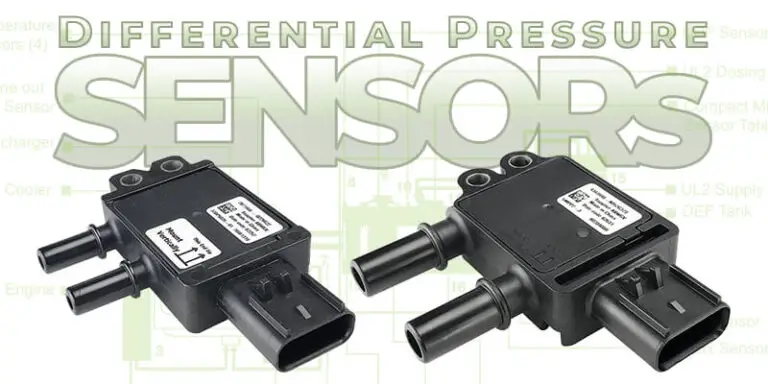
The crankcase pressure sensor is a technical necessity for modern diesel engines, serving as the primary monitor for internal atmospheric conditions within the engine block. Its main objective is to detect excessive blow-by—gas escaping past the piston rings—which can signal internal wear or a failing Crankcase Ventilation (CCV) filter. In the 6.7 Cummins, this sensor acts as a communication bridge to the Engine Control Module (ECM). The ECM relies on real-time data to adjust fueling parameters and air-to-fuel ratios, ensuring the engine stays within its designed efficiency envelope.
Modern emissions standards necessitate a closed-loop CCV system. This system recirculates gases back into the intake to be burned, rather than venting them to the atmosphere. The crankcase pressure sensor ensures this loop remains intact. If the sensor detects a blockage or a leak, it triggers defensive protocols. According to official guide documentation, the sensor typically operates within a signal range of 0.5 to 4.5 volts. In this scale, 0.5V represents minimum atmospheric pressure, while 4.5V indicates maximum rated pressure capacity.
Ignoring a malfunctioning sensor is a recipe for disaster. Excessive backpressure, if unmonitored, can lead to blown oil seals, front/rear main seal failures, or even turbocharger oiling issues. I have seen scenarios where a simple clogged CCV filter mimicked catastrophic engine failure because the pressure readings triggered by a faulty or over-pressurized sensor led the owner to believe the piston rings had completely failed. Maintaining this sensor is not just about clearing a light; it is about protecting the structural integrity of your 6.7 Cummins.
Finding the 6.7 Cummins Crankcase Pressure Sensor Location by Model Year
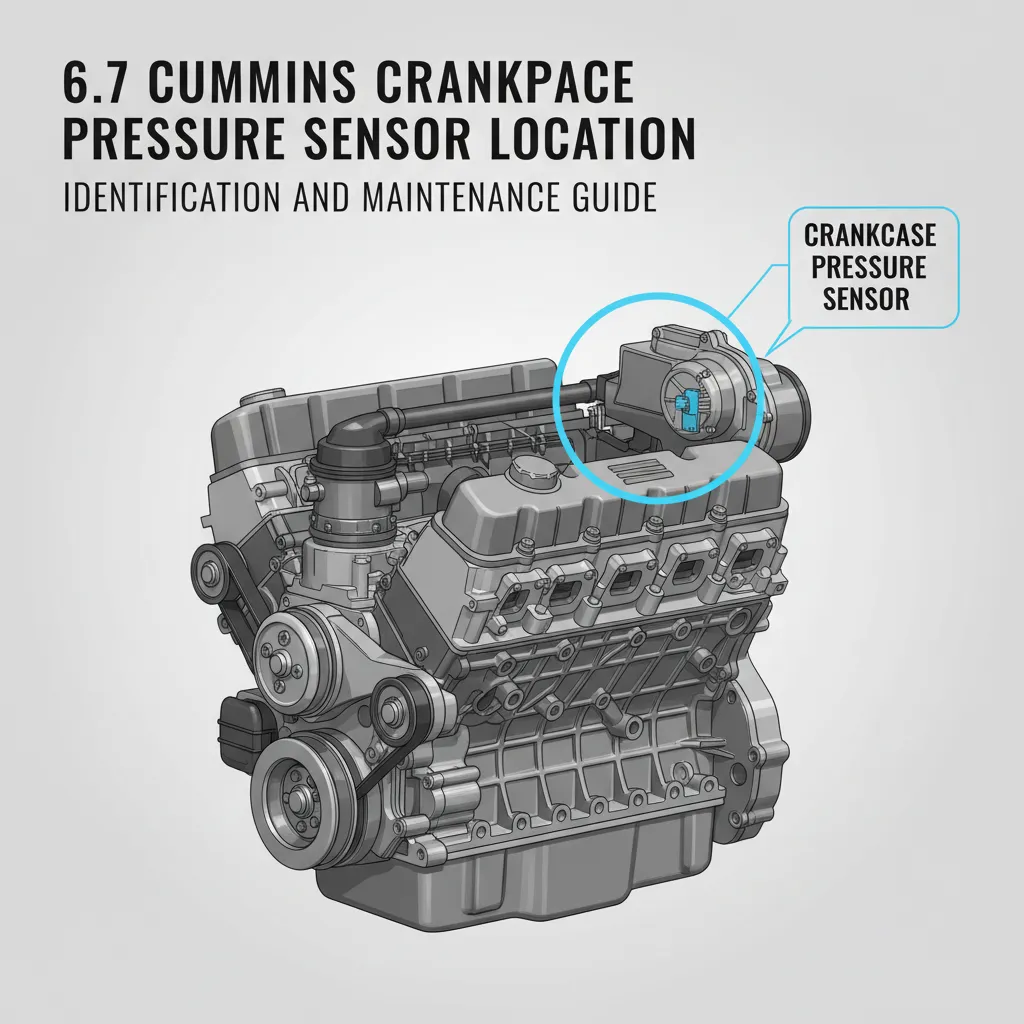
Pinpointing the 6.7 Cummins crankcase pressure sensor location requires understanding the subtle evolution of the engine platform. While the core block remains consistent, the packaging has changed significantly between generations. For the vast majority of Ram 2500 and 3500 models produced between 2007.5 and 2018, you will find the sensor situated directly on top of the valve cover. Specifically, you must look toward the rear of the engine, tucked close to the firewall. It is often hidden under the plastic engine beauty cover and may require the removal of the acoustic foam insulation panel, a task that typically adds 5-10 minutes to the process but is necessary for accessible maintenance.
On the 2019 and newer High Output (HO) models, Cummins redesigned the CCV housing. In these later versions, the sensor is often integrated more closely with the CCV filter housing on the driver-side of the valve cover. This location is slightly more convenient for quick inspections but requires a different approach if you are used to the older rear-mounted setup. To identify the sensor, look for a small plastic body with a two- or three-pin electrical connector. It is usually secured by a single 10mm bolt or, in some cases, a Torx-head bolt.
If you are having trouble spotting it, follow the electrical harness branching off the main loom near the back of the cylinder head. It will lead you directly to the mounting point. Always verify your specific Ram specs before ordering parts.
Visual verification is key. On a 2012 model, the sensor sits squarely on the flat breather cover. Contrast this with a 2021 model, where the sensor might be part of a larger modular assembly. Regardless of the year, the sensor’s function remains the same: transmitting vital data to the ECM to prevent over-pressurization.

Recognizing Symptoms of a Faulty Crankcase Pressure Sensor
Early diagnosis of a failing sensor can save thousands in secondary repairs. The most obvious indicator is the illumination of the Check Engine Light (CEL). When scanning for codes, you will typically find P051B (Crankcase Pressure Sensor Circuit Range/Performance) or P051C (Crankcase Pressure Sensor Circuit Low). These codes indicate that the ECM is receiving data that falls outside of the expected parameters, or no data at all.


By The Numbers
Drop in Fuel Economy
Standard Signal Range
Beyond the dashboard lights, keep an eye on your performance. A faulty sensor often forces the engine into a derated “limp mode” to protect the turbocharger and seals. This results in a noticeable drop in throttle response and overall power. Research from aftermarket diesel parts suppliers indicates that a faulty crankcase pressure sensor can lead to a decrease in fuel economy by up to 10% because the ECM cannot accurately calculate the load and internal pressure variables, leading to inefficient mapping.
In severe cases, you may notice physical symptoms such as excessive smoke from the exhaust or oil leaks appearing around the valve cover gasket. This is often due to unmonitored pressure spikes forcing oil through the weakest points. I recall a case study of a driver in a cold-weather climate who experienced persistent P051B codes. It was discovered that moisture had frozen inside the sensor port, giving a false high-pressure reading. This is common in trusted local fleet vehicles that operate in freezing temperatures without adequate warm-up times.
Step-by-Step Replacement Guide and Tool Requirements
Replacing the sensor is a relatively straightforward DIY task that can be completed in under an hour. Before beginning, ensure the engine is cool. The sensor’s location near the back of the block retains heat significantly longer than outer components like the alternator or air box.
📋
Replacement Guide
Disconnect the negative battery terminals. This prevents electrical shorts and prompts the ECM to reset once the new sensor is installed. Remove the plastic engine cover and any foam insulation at the rear of the valve cover.
Unplug the electrical connector and use a 10mm deep socket with a 6-inch extension to remove the mounting bolt. Gently twist the sensor to break the O-ring seal and pull it straight up. Use electronic contact cleaner to clean the harness plug.

Wipe the sensor port to remove carbon or oil sludge. Lubricate the new sensor’s O-ring with a drop of clean 15W-40 oil. Seat the sensor, hand-tighten the bolt, and then torque it to 89 inch-pounds (10 Nm). Reconnect the harness and batteries.
A common mistake is forgetting to clean the sensor port. Residual carbon can clog the new sensor’s small intake hole immediately, leading to a repeat failure within days. Always inspect the port with a flashlight before installation.
Cost Analysis and Nearby Professional Service Options
When it comes to sourcing parts, you have several options available. An OEM Cummins or Mopar sensor typically ranges from $80 to $150. While aftermarket options are available starting at $40, I generally recommend sticking with OEM for sensors that communicate directly with the ECM to ensure proper calibration and longevity. Many members of the community have reported that cheaper sensors fail within months or provide inconsistent voltage readings.
If you prefer professional installation, local diesel specialty shops serving your area often have these sensors in stock as they are high-failure items. Professional labor costs generally fall between $100 and $200, which includes a 0.5 to 1.0-hour labor charge and a diagnostic scan. While a dealership service visit might run upwards of $350 total, a DIY replacement remains the most cost-effective path at roughly $90 total.
Choosing a nearby specialist can be beneficial if your engine is throwing multiple codes. A professional technician can verify if the high pressure is caused by a faulty sensor or a legitimately clogged CCV filter, which is a different maintenance task altogether. After replacing the sensor, always clear the ECM codes using a scan tool to ensure the engine exits any derated performance modes immediately.
Conclusion
The 6.7 Cummins crankcase pressure sensor is located primarily on the rear of the valve cover and is critical for ECM calibration and engine longevity. Recognizing symptoms like a 10% drop in fuel economy or P051B codes early on can save your engine from serious seal damage and performance loss. Replacement is a straightforward DIY task requiring basic hand tools and an OEM-quality replacement part. If you are experiencing persistent pressure codes or a drop in performance, consult a nearby diesel specialist or order a replacement sensor today to keep your Cummins running at peak performance for hundreds of thousands of miles to come.
Frequently Asked Questions
What does a crankcase pressure sensor do?
The crankcase pressure sensor monitors the amount of pressure building up inside the engine’s crankcase. It sends this data via a 0-5V signal to the ECM, which manages the CCV system and engine load. This prevents excessive pressure from forcing oil past seals or into the intake system, ensuring the engine stays within emissions and safety parameters.
How do I know if my crankcase pressure sensor is bad?
Common signs include a ‘service engine soon’ light with codes P051B or P051C, a noticeable loss of power, and decreased fuel economy. You may also see oil leaks at the main seals or blue smoke from the exhaust. If the sensor sends an out-of-range voltage signal, the truck may enter ‘limp mode’ to prevent turbocharger damage.
Where is the crankcase pressure sensor located on a 6.7 Cummins?
On most 6.7 Cummins engines from 2007.5 to 2018, the sensor is located on the top of the valve cover, specifically at the very back near the firewall. On 2019 and newer models, look for it integrated near or on the CCV filter housing on the driver’s side of the engine. It is recognizable by its small electrical connector and single mounting bolt.
How much does it cost to replace a crankcase pressure sensor?
The total cost usually ranges from $150 to $350. An OEM Cummins sensor costs between $80 and $150. If you choose a professional installation, labor at a local diesel shop will typically add another $100 to $200. DIY replacement is highly recommended for this part as it requires only basic hand tools and about 30 minutes of time.
Can a bad crankcase pressure sensor cause engine damage?
Yes, indirectly. A failing sensor may fail to alert the ECM of high crankcase pressure caused by a clogged CCV filter. This excessive pressure can blow out the front or rear main oil seals, contaminate the turbocharger compressor wheel with oil, or cause significant oil consumption issues. Prompt replacement is essential to avoid these costly secondary repairs.