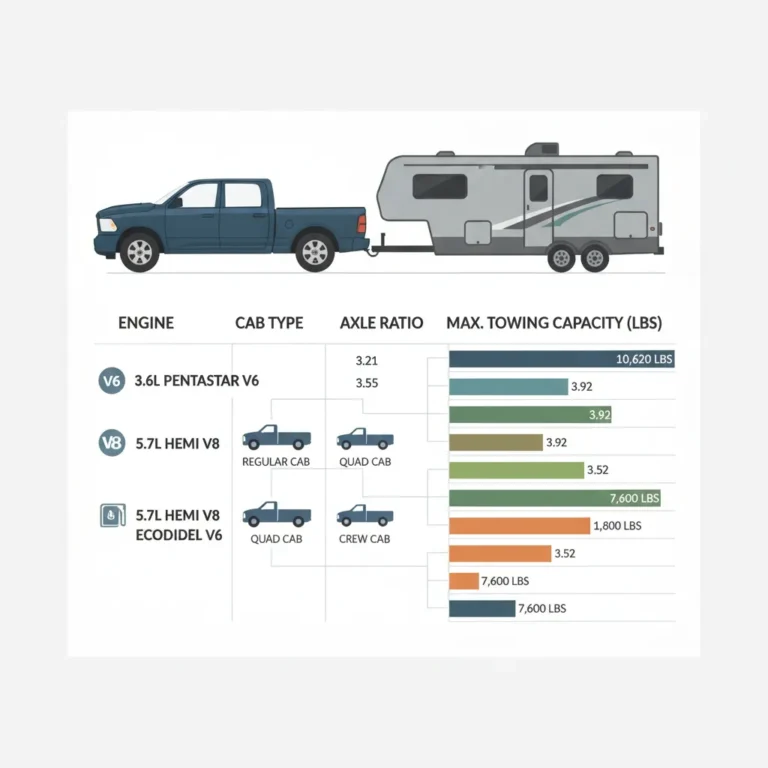
2020 Ram 1500 Towing Capacity Chart: Engine And Configuration Guide

The 2020 Ram 1500 redefined the light-duty pickup market by blending luxury with a class-leading 12,750-pound maximum towing capacity. However, for many owners and prospective buyers, navigating the intersection of four engine options, multiple axle ratios, and various cab configurations can be overwhelming. Miscalculating these variables often leads to safety risks, mechanical strain, or legal liabilities. This comprehensive guide provides a quality-vetted, professional breakdown of the 2020 Ram 1500 towing capacity chart, ensuring you have the reliable data needed for safe and efficient hauling.


Essential Towing Terminology for Professional Hauling

Before diving into the numbers, a trusted professional must understand the foundational terminology that governs towing. The most critical figure is the Gross Combined Weight Rating (GCWR). This represents the absolute maximum permissible weight of the truck, the trailer, all cargo, passengers, and fluids. Research indicates that the 2020 RAM 1500 features a GCWR that can reach up to 18,200 lbs depending on the specific powertrain and axle configuration. Exceeding this limit places immense stress on the transmission and braking systems.
Equally important is the relationship between Gross Vehicle Weight Rating (GVWR) and Payload Capacity. Payload is the weight of everything inside or on the truck. A common industry pitfall is forgetting that trailer tongue weight—usually 10% to 15% of the total trailer weight—counts directly against your payload. For example, if your truck has a payload capacity of 1,800 lbs and you are towing a trailer with an 800-lb tongue weight, you only have 1,000 lbs remaining for passengers, tools, and fuel.
The Axle Ratio also plays a pivotal role. In my 15+ years of industry experience, I have seen many owners overlook this “hidden” spec. A 3.92 axle ratio provides a significant mechanical advantage over a 3.21 ratio, allowing the engine to stay in its powerband more effectively when moving heavy loads from a standstill. Finally, differentiate between “Max Towing” (using a braked trailer) and “Unbraked” limits. For any load exceeding 3,000–5,000 lbs, an integrated trailer brake system is not just a professional recommendation; it is often a legal requirement.
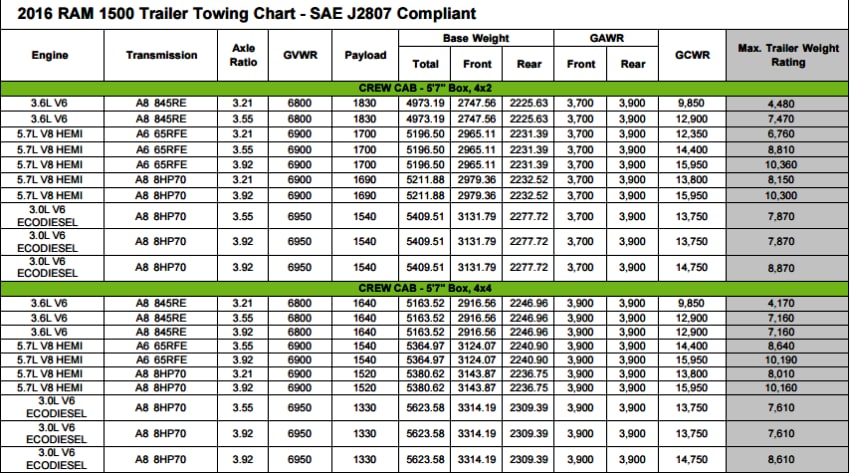
2020 Ram 1500 Towing Capacity Chart by Engine Type
The heart of the 2020 Ram 1500’s capability lies in its diverse engine lineup. Each engine is designed for a specific use case, from daily commuting to heavy-duty site work. To find your exact limits, consult the official guide for your specific model year.
3.6L Pentastar V6 with eTorque
This engine serves as the efficient entry point. Utilizing the eTorque mild-hybrid system, it provides seamless stop-start functionality and supplemental torque. A 2020 RAM 1500 with the 3.6L Pentastar V6 engine, a Quad Cab, and a 6’4″ bed has a towing capacity of around 7,730 lbs. This configuration is ideal for light utility trailers, small speedboats, or 20-foot pontoon boats.
5.7L HEMI V8 (Standard and eTorque)
The 5.7L HEMI V8 is the reliable workhorse of the lineup. The standard HEMI remains a favorite for its simplicity, but the 5.7L HEMI V8 engine with eTorque provides the highest towing capacity compared to other engine options. While the standard V8 performs admirably, the eTorque version allows the truck to reach that legendary 12,750-pound peak when properly configured. This is the choice for those pulling multi-car haulers or large toy-haulers.
3.0L EcoDiesel V6
For long-distance haulers, the EcoDiesel is the expert choice. With 480 lb-ft of torque available at low RPMs, it offers a towing capacity of 12,560 lbs. The diesel’s efficiency under load is significantly better than its gasoline counterparts, making it the preferred option for frequent cross-country trips with large travel trailers.
By The Numbers
Maximum Towing Capacity
Max Payload Capacity
EcoDiesel Peak Torque
How Cab and Bed Configurations Influence Towing Performance
A common mistake in the light-duty truck world is assuming that a “top-of-the-line” truck pulls the most. In reality, there is a “Weight Penalty” associated with luxury. Every additional square inch of cabin space or pound of premium leather reduces your net capacity. The more the truck weighs (curb weight), the less it can tow while staying under the GCWR.


- The Quad Cab Advantage: The Quad Cab with a 6’4″ bed is the sweet spot for maximum utility. A 2020 RAM 1500 Quad Cab 4×2 with a 5.7L HEMI eTorque can tow up to 11,610 lbs or more depending on options.
- The Crew Cab Penalty: While the Crew Cab offers massive interior space, its heavier frame and larger body reduce the available towing capacity compared to a similarly equipped Quad Cab.
- Drivetrain Impact (4×2 vs. 4×4): 4×2 models typically offer higher towing ratings. The transfer case and front-drive hardware of 4×4 models add several hundred pounds of curb weight, directly subtracting from the towing ceiling.
- Trim Level Factors: A base Tradesman will almost always out-tow a Limited or Longhorn. Luxury features like panoramic sunroofs and 22-inch wheels increase vehicle weight and decrease payload capacity.
✅ Pros (Quad Cab 4×2)
- Maximum towing reach
- Higher payload potential
- Better fuel economy
- Longer 6’4″ bed standard
❌ Cons (Crew Cab 4×4)
- Reduced towing capacity
- Lower payload capacity
- Increased curb weight
- Smaller 5’7″ bed common
The Critical Role of the Axle Ratio in Hauling Capacity
Think of the axle ratio as the final gear in a bicycle. A higher numerical ratio (like 3.92) is like using a shorter gear—it makes it much easier to pedal (or for the engine to rotate the wheels) when starting from a stop with a heavy load. Conversely, a lower ratio (3.21) is geared for fuel economy on the highway but lacks the mechanical leverage for heavy hauling. For more details on these setups, check expert tips from community owners.
The 2020 Ram 1500 utilizes the highly regarded 8HP75 8-speed automatic transmission. When paired with the 3.92 axle ratio, this transmission can hold gears longer and manage heat more effectively under high-load conditions. Equipping the 3.92 axle ratio can increase towing capacity by over 2,000 lbs compared to the same engine with a 3.21 ratio. This is usually bundled into the “Max Tow Package,” which also includes enhanced engine cooling and a trailer brake controller.
If you plan to upgrade to larger aftermarket tires, your “effective” axle ratio will decrease, making it harder for the truck to tow. Always factor in tire size when calculating your real-world capability.
Safety Protocols and Equipment for Reliable Towing
Towing is more than just raw power; it is about control. Even if your Ram specs allow for 12,000 lbs, pulling that much weight without the correct equipment is dangerous. For any trailer exceeding 5,000 lbs, a Weight Distribution Hitch (WDH) is essential. A WDH uses tension bars to redistribute tongue weight from the rear axle to the front axle and trailer axles, ensuring your front tires maintain steering traction.
The 2020 Ram 1500 offers advanced technology to assist in safe hauling:
- Integrated Trailer Brake Controller: This allows you to adjust the “gain” or braking force applied to the trailer, preventing the trailer from pushing the truck during sudden stops.
- Tow/Haul Mode: Activating this button on the dashboard adjusts transmission shift points to prevent hunting between gears and provides engine braking on descents to protect your service brakes.
- Blind Spot Monitoring with Trailer Detection: This system automatically accounts for the length of your trailer when alerting you of vehicles in adjacent lanes.
Exceeding payload or towing limits can lead to premature brake wear, suspension sag, and frame fatigue. Always perform a pre-trip inspection of tire pressures, safety chains, and your breakaway switch.
How to Verify Your Specific VIN Towing Capacity
Because every truck is built with different options, general charts can only get you so far. To be 100% certain of your truck’s limits, you must perform a professional verification using your unique vehicle data. The factory door sticker is the only legally binding source for your specific vehicle’s GVWR and Cargo Carrying Capacity.


📋
Step-by-Step VIN Verification
Open the driver-side door and look for the yellow and white “Tire and Loading Information” sticker. This lists your specific Max Payload.
Go to the official RAM Towing Guide website and enter your 17-digit VIN to see the factory build sheet and exact towing capacity.
Check the owner’s manual for “Severe Duty” maintenance intervals. Frequent towing requires more regular fluid changes for differentials and transmissions.
In summary, the 2020 Ram 1500 offers a versatile range of towing capacities from 7,730 lbs to a maximum of 12,750 lbs. Engine choice—specifically the 5.7L HEMI with eTorque—and the 3.92 axle ratio are the primary drivers of high-capacity performance. Always verify your specific vehicle’s payload and GVWR using the B-pillar sticker or VIN lookup to ensure safe operation. Consult your owner’s manual for specific maintenance intervals when towing, and ensure your trailer is equipped with a compatible weight-distribution system for loads over 5,000 lbs.
Frequently Asked Questions
What is the maximum towing capacity of a 2020 RAM 1500 with the 5.7L HEMI V8?
When properly equipped with the 5.7L HEMI V8 engine featuring the eTorque mild-hybrid system, a 3.92 rear axle ratio, and a Quad Cab 4×2 configuration, the 2020 RAM 1500 can achieve a maximum towing capacity of 12,750 pounds. Standard HEMI V8 models without eTorque typically range between 11,400 and 11,600 pounds depending on the configuration.


How does the Crew Cab configuration affect my RAM 1500’s towing capacity?
Generally, a Crew Cab configuration reduces the total towing capacity compared to a Quad Cab. This is because the Crew Cab is heavier, which increases the vehicle’s curb weight and consumes more of the Gross Combined Weight Rating (GCWR). For example, a Quad Cab model may tow up to 11,610 lbs, while a similarly equipped Crew Cab might be limited to slightly less to remain within safety margins.
What is the difference between towing capacity and payload capacity?
Towing capacity refers to the maximum weight the truck can pull behind it (the trailer). Payload capacity is the maximum weight the truck can carry within the cabin and bed, including passengers, fuel, and gear. Importantly, the trailer’s tongue weight (usually 10-15% of the trailer weight) counts as part of your truck’s payload.
Do I need a weight distribution hitch for a 2020 RAM 1500?
For any trailer weighing over 5,000 pounds, RAM and industry safety experts strongly recommend using a weight distribution hitch. This equipment redistributes the tongue weight across all axles of the truck and the trailer, preventing the rear of the truck from sagging and ensuring the front wheels maintain proper steering and braking traction.
Where can I find the exact towing capacity for my specific VIN?
The most reliable way to find your specific truck’s capacity is to use the RAM Trucks ‘Towing Guide’ online tool and enter your 17-digit Vehicle Identification Number (VIN). Additionally, you should check the white and yellow ‘Tire and Loading Information’ sticker located on the driver-side door jamb, which lists the exact maximum payload for your specific build.
![2022 Ram 1500 Brush Guards: Top Picks [2026]](https://truckguider.com/wp-content/uploads/2026/03/2022-ram-1500-brush-guard-featured.webp)
![2015 RAM 1500 AC Recharge Port Location & Identification [2026]](https://truckguider.com/wp-content/uploads/2026/03/2015-ram-1500-ac-recharge-port-featured.webp)