6.7 Cummins Turbo Diagram: Explaining The Holset Vgt Components And Operation

The 6.7 Cummins diesel engine is a powerhouse of the heavy-duty truck world, but its true heartbeat lies within the sophisticated Holset Variable Geometry Turbocharger (VGT). Since its introduction in mid-2007, this turbocharger has redefined how diesel engines manage airflow, providing the immediate response of a small turbo with the top-end flow of a much larger unit. However, while the VGT provides unmatched low-end torque and integrated exhaust braking, its complex internal diagram and reliance on electronic actuators can make troubleshooting a nightmare for the uninitiated owner. In this comprehensive and complete guide, we will break down the 6.7 Cummins turbo diagram into understandable components, explain how the VGT system operates, and provide expert insight into common failures and performance upgrades for a reliable driving experience.


The Architecture of the 6.7 Cummins Variable Geometry Turbocharger (VGT)
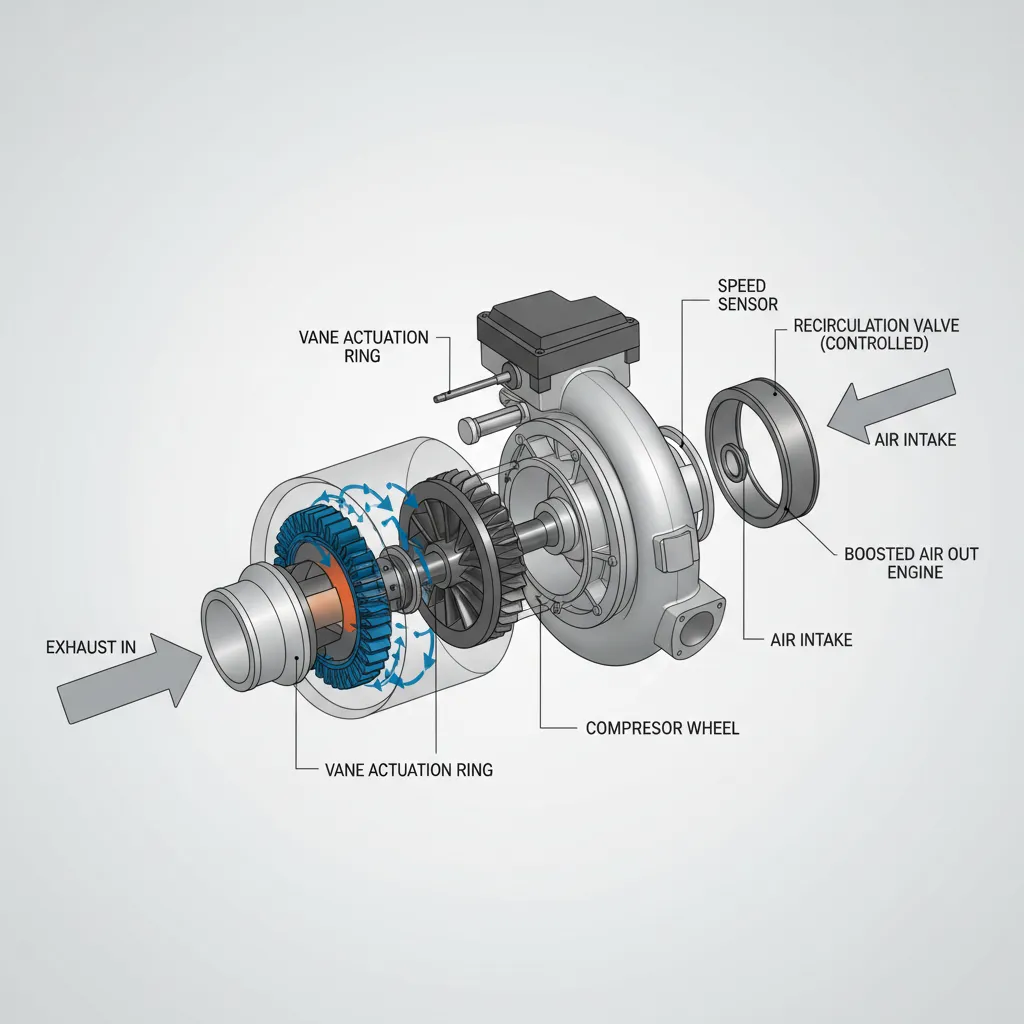
To understand the 6.7 Cummins, one must first identify the specific Holset units utilized over the years. From 2007.5 to 2012, the engine featured the Holset HE351VE. In 2013, with the update to the chassis and emissions systems, Cummins transitioned to the HE300VG. While both units share the same core operating principles, the internal refinements and actuator communication protocols differ significantly. For those seeking an official guide to these units, the mechanical layout remains a marvel of diesel engineering.
The Sliding Nozzle Ring: A Dynamic A/R Ratio
Unlike a traditional fixed-geometry turbo, which has a set housing size (Area/Radius ratio), the Holset VGT utilizes a sliding nozzle ring. Think of this as a “movable wall” within the turbine housing. At low RPMs, the ring slides to narrow the passage through which exhaust gas flows. This increases the velocity of the gases hitting the turbine wheel, forcing the turbo to “spool” almost instantly. As engine speed increases, the ring slides back, opening the passage to prevent excessive backpressure and allow for maximum high-RPM efficiency. This system allows the turbo to adjust its effective nozzle size from very small for low-end torque to large for high-RPM efficiency on the fly.
The Electronic Actuator and Gear Mechanism
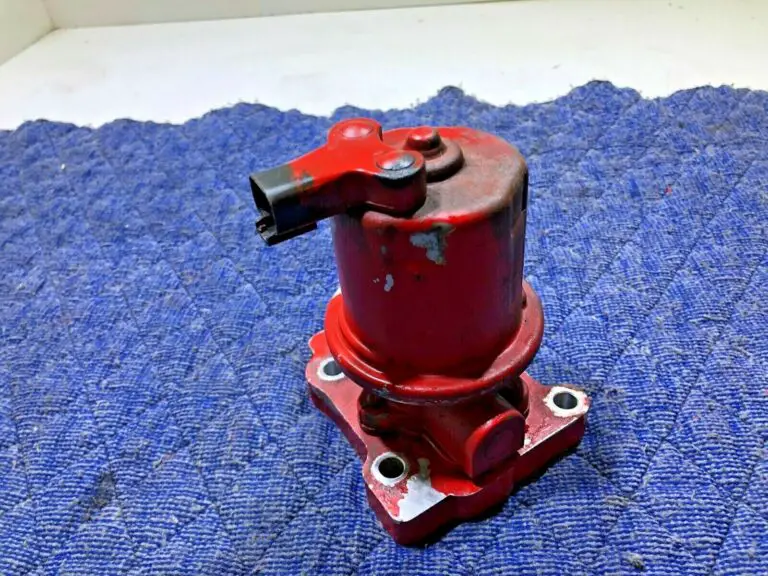
The “brain” of this movement is the VGT actuator, a heavy-duty electronic motor mounted to the side of the turbo. It receives precise commands from the engine’s ECM via a CAN-bus network. Inside the turbo, this actuator moves a small pinion gear that meshes with a rack attached to the sliding nozzle ring. This mechanical coupling is where 15+ years of expert experience tells us most problems occur; if soot buildup prevents the ring from sliding, the actuator gear will eventually strip or the motor will burn out trying to overcome the resistance.
Instant Spooling
Vanes narrow at low RPM to increase gas velocity, eliminating traditional “turbo lag” common in older diesels.
Integrated Exhaust Braking
By closing the vanes during deceleration, the turbo creates backpressure that slows the vehicle safely.
6.7 Cummins Turbo Diagram: Mapping Internal Components
A technical diagram of the Holset HE351VE or HE300VG reveals a complex interplay of air, oil, coolant, and mechanical movement. To visualize the complete system, we must look at the flow path from the intake filter to the exhaust pipe.
The Compressor Side (Cold Side)
The journey begins at the compressor wheel. On a stock 6.7 Cummins, this is typically a 60mm inducer wheel. Ambient air is drawn into the compressor housing, where the rapidly spinning wheel compresses it. This air then exits toward the charge air cooler (intercooler) before entering the intake manifold. Proper seal locations here are critical; if the internal seals fail, oil from the center section can be forced into the intake, potentially causing an engine runaway or fouling the intercooler.
The Center Section (CHRA)
The Center Housing Rotating Assembly (CHRA) is the bridge between the hot and cold sides. It houses the bearings that allow the shaft to spin at speeds exceeding 100,000 RPM. The 6.7 Cummins turbocharger is both lubricated and cooled by engine oil and cooled by engine coolant. This dual-cooling design is intended to prevent “coking”—a condition where stagnant oil turns into hard carbon deposits after a hot shutdown. Maintaining high Ram specs for oil quality is the single best way to protect these bearings.
The Turbine Side (Hot Side)
The “hot side” contains the turbine wheel and the aforementioned sliding nozzle ring. Exhaust gases from the manifold enter here, driving the turbine wheel which, in turn, drives the compressor wheel via the shared shaft. The precision required for the VGT actuator is immense; it must be calibrated to the turbocharger using a diagnostic tool to ensure the “zero” position is accurately recognized by the ECM. Without this calibration, the vanes may not fully open or close, leading to poor performance or “over-boost” conditions.
By The Numbers
PSI Stock Boost
Engine Failures Linked to Turbo
Stock Compressor Inducer
Evolution of the 6.7 Cummins Turbo: 2007.5 to Present Changes
The 6.7 Cummins has undergone several iterations, and the turbocharger has evolved alongside it to meet stricter emissions standards and owner demands for trusted reliability. Understanding which version your truck uses is vital for sourcing parts or diagnosing issues.
2007.5–2012: The HE351VE Era
Early 6.7 Cummins engines were pioneering the use of Exhaust Gas Recirculation (EGR) and Diesel Particulate Filters (DPF). Unfortunately, the HE351VE was often the victim of these systems. Aggressive EGR cycles meant that soot-heavy exhaust gases were constantly passing through the VGT’s moving parts. This led to “stuck” vanes, where carbon would seize the sliding nozzle ring. Many owners from this era experienced the dreaded “Turbo Boost Sensor” codes or found their exhaust brake suddenly stopped functioning because the ring could no longer move to the “braking” position.
2013–Present: The HE300VG and Beyond
With the 2013 model year, Ram introduced Selective Catalytic Reduction (SCR/DEF), which allowed Cummins to back off the aggressive EGR rates. The newer HE300VG turbo benefited from this cleaner operation. Additionally, software-driven “cleaning cycles” were implemented. The ECM now periodically moves the VGT vanes through their full range of motion while driving to “wipe” soot off the nozzle ring. Reliability data suggests that post-2013 designs saw a significant reduction in mechanical sticking issues due to these refinements.
To prevent soot buildup, avoid excessive idling and ensure you use the exhaust brake regularly. The physical movement of the vanes during exhaust braking helps keep the nozzle ring path clear of carbon deposits.
Diagnosing Common 6.7 Cummins Turbo Problems and Failures
Research indicates that turbocharger failures are responsible for approximately 15% of all engine-related failures in diesel engines. Recognizing the warning signs early can save you thousands in repairs. For expert tips on diagnostics, look at both the mechanical and electronic symptoms.
📋
Step-by-Step Diagnostic Guide
Check for P00AF (Actuator Module Performance) or P003A (Boost Profile Exceeded). These point directly to the VGT system rather than a general engine fault.
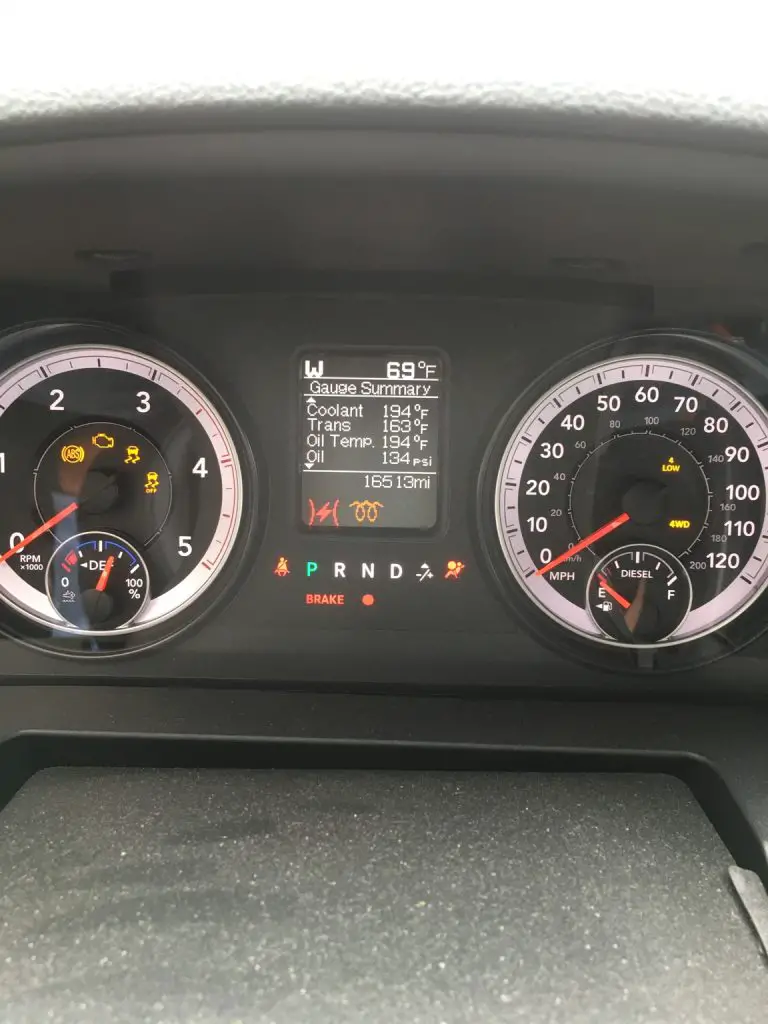
Verify if the “lightning bolt” (Electronic Throttle Control) light is on. Often, the electronic actuator fails before the turbo’s mechanical bearings do.
Remove the intake horn and check the compressor wheel for axial or radial shaft play. A “dentist drill” whining noise is a classic sign of bearing failure.
Soot, Sludge, and Sticking
The most common failure is the VGT getting stuck. If the vanes are stuck in the “open” position, you will have a complete lack of low-end power, making it difficult to pull a heavy trailer from a stop. If they are stuck “closed,” the engine will choke at highway speeds, EGTs (Exhaust Gas Temperatures) will skyrocket, and you risk blowing a head gasket due to excessive backpressure. Regular oil changes with the correct oil specification are essential to prevent oil coking and damage to the turbocharger bearings and vanes.
Do not ignore boost leaks. A small crack in an intercooler boot can cause the turbo to over-spin to compensate for the lost pressure, leading to catastrophic bearing failure in a matter of miles.
Upgrading the 6.7 Cummins Turbo for Performance and Reliability
For many owners, when the factory VGT fails, they view it as an opportunity for a professional upgrade. Aftermarket turbo upgrades can increase horsepower by 100-200+ HP on a 6.7 Cummins, depending on the specific turbo and supporting modifications. However, choosing the right path depends on your truck’s primary use.
Fixed Geometry Conversions (S300/S400)
The most popular reliability upgrade is “deleting” the VGT in favor of a fixed-geometry turbo, such as a BorgWarner S300 or S400. This expert-favored mod eliminates the complex sliding ring and electronic actuator entirely. The trade-off is a slight loss in low-end spool and the loss of the factory exhaust brake function (unless an inline brake is added). This modification requires custom tuning to prevent the ECM from throwing permanent fault codes for the missing VGT actuator.
Drop-in VGT Upgrades and Compounds
If you want to keep your exhaust brake and low-end response, “drop-in” VGT upgrades are the quality choice. These turbos use modified factory housings but feature larger, lighter billet compressor wheels for better airflow. For those seeking extreme power (600-800+ HP), a compound setup—running a small VGT turbo in sequence with a large S400 atmospheric turbo—provides the best of both worlds: instant spool and massive top-end flow.
In summary, the 6.7 Cummins uses a Variable Geometry Turbo (VGT) to maintain performance across the entire RPM range, blending efficiency with power. Key components like the electronic actuator and sliding nozzle ring are susceptible to soot buildup and electrical failure, particularly in early models. Upgrading to a fixed geometry or a compound setup can significantly increase reliability and power for performance-oriented owners. If you suspect your turbo is failing, perform a diagnostic scan for VGT-related codes and check for shaft play before committing to a full replacement. For long-term health, prioritize consistent oil maintenance and frequent use of the exhaust brake to keep the internal vanes moving freely.
Frequently Asked Questions
What are the primary symptoms of a failing 6.7 Cummins turbo?
The most common symptoms include a noticeable loss of power, a ‘screeching’ or ‘whining’ noise from the engine bay, and the illumination of the Electronic Throttle Control (ETC) light. Additionally, if your exhaust brake no longer functions or you experience significant ‘turbo lag’ that wasn’t there before, the VGT vanes may be stuck due to soot accumulation.
Can I clean a 6.7 Cummins turbo without replacing it?
Yes, many owners use a ‘turbo cleaning kit’ which involves drilling a small hole in the turbine housing (if not already equipped with a port) and injecting a specialized cleaning agent to dissolve carbon buildup. However, this is often a temporary fix. For long-term reliability, removing the turbo for a professional teardown or addressing the underlying EGR/PCV issues is recommended.
What is the difference between an HE351VE and an HE300VG?
The HE351VE was used on 2007.5-2012 models and utilizes a different actuator mounting and internal vane design than the HE300VG found on 2013 and newer trucks. The HE300VG is generally considered more robust and features an improved actuator that is better shielded from heat, though the two units are not directly interchangeable without modification.
Why is the VGT actuator so expensive to replace?
The VGT actuator is a highly sophisticated piece of electronics that must communicate with the truck’s ECM via the CAN-bus system. It contains its own internal processor and motor to move the heavy vane ring under high-heat conditions. Quality actuators are built to withstand extreme thermal cycles, making them a high-cost precision component compared to traditional wastegates.
Is a fixed geometry turbo better than a VGT for the 6.7 Cummins?
It depends on your goals. A fixed geometry turbo (like a BorgWarner S300) is far more reliable and simpler because it has no moving internal vanes to get stuck. However, you will lose the integrated exhaust brake function and may experience more ‘lag’ at low RPMs unless you install a properly sized unit or a compound setup.