
Cruise Control Turns On But Will Not Set [2026]

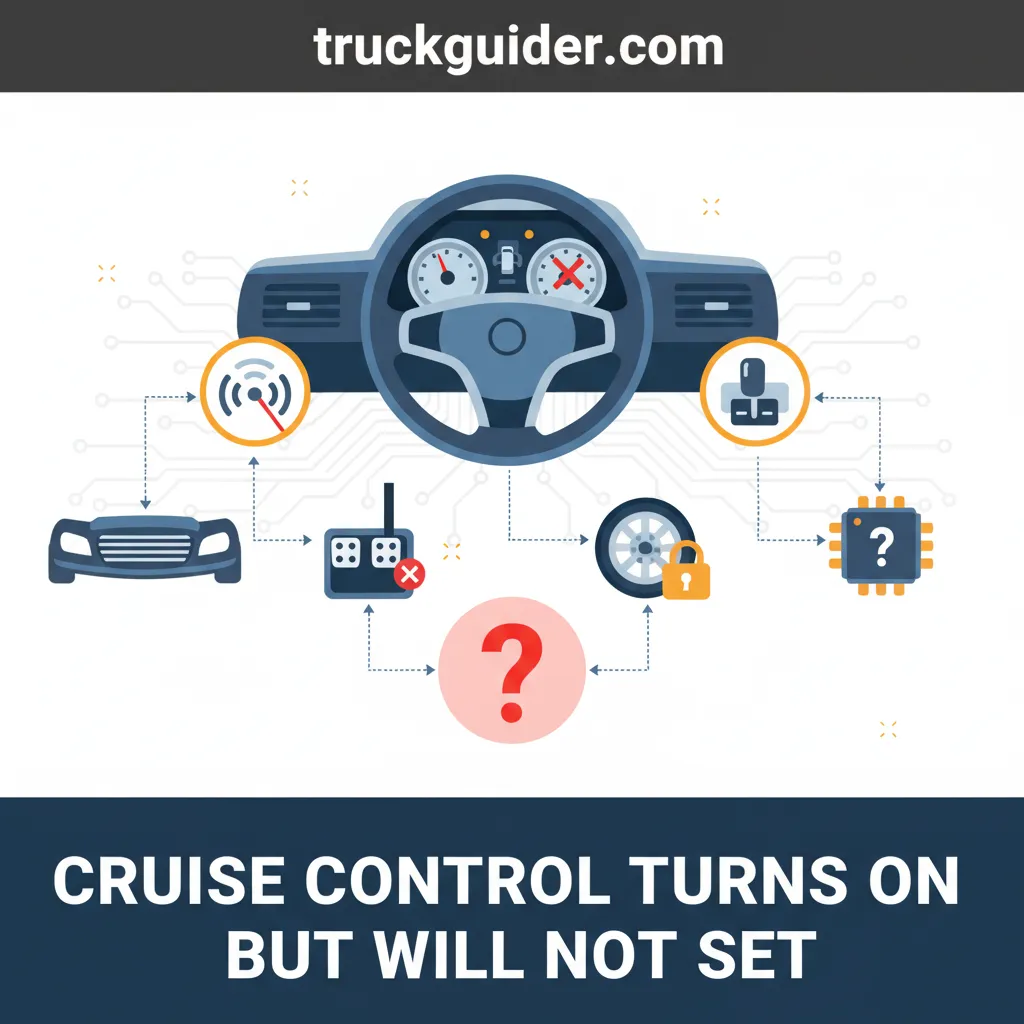
It is a frustrating paradox: the ‘Cruise’ indicator glows steadily on your dashboard, yet the system refuses to lock in your speed when you depress the ‘Set’ button. This scenario is a common headache for drivers, signaling a system that is electronically “awake” but logically inhibited from taking control of the throttle. When cruise control turns on but will not set, the issue typically stems from a safety interrupt signal, a sensor mismatch, or a physical failure in the throttle engagement mechanism. This comprehensive and professional guide will walk you through the diagnostic hierarchy, from simple brake switch inspections to complex electronic signal tracing, providing the expert insight needed to restore your vehicle’s reliable cruising capabilities.

The Critical Role of the Brake Light Switch and Pedal Sensors
Recommended Best Deal Products


📤 Share Image
The most frequent culprit in cruise control “no-set” conditions is the brake light switch. In my years of professional experience, I have found that the brake light switch is responsible for approximately 60% of cases where the cruise indicator functions but the ‘Set’ command is ignored. Most modern vehicles utilize a dual-circuit or multi-contact switch. One circuit is dedicated to illuminating the rear brake lights, while the second circuit sends a dedicated signal to the Engine Control Unit (ECU) or Cruise Control Module. This means your brake lights can function perfectly while the cruise control circuit remains stuck in the “brakes applied” state.
Understanding Pedal Stopper Failures
A trusted diagnostic tip for older Toyota and Honda models involves inspecting the pedal assembly for a small, often overlooked plastic “stopper” or “cushion.” Over time, this plastic piece becomes brittle and disintegrates. When it falls out, the brake switch plunger passes through the hole where the stopper once sat, failing to depress the switch even when the pedal is fully released. To the ECU, this looks like the driver is perpetually resting their foot on the brake, which immediately inhibits the ‘Set’ function as a safety precaution.
Professional Diagnostic Procedures
To achieve quality results, you must test the switch with a digital multimeter (DMM). Check for continuity across the cruise-specific pins when the pedal is in the resting position. If the circuit shows high resistance or remains open, the module will never allow the speed to lock. For manual transmission vehicles, the clutch pedal switch serves a nearly identical function. A worn clutch return spring or a misaligned switch will prevent the system from engaging, as the module assumes the clutch is being depressed to shift gears.
Before replacing parts, try pulling upward on the brake pedal with your toe while attempting to set the cruise. If it sets, you likely have a misaligned switch or a weak pedal return spring.

Speed Sensor Malfunctions and Transmission Signal Integrity
Cruise control is entirely dependent on a clean, consistent vehicle speed signal. The module typically requires a minimum speed threshold—usually between 25 and 35 MPH—before it will accept a ‘Set’ command. If the Vehicle Speed Sensor (VSS) or the ABS wheel speed sensors provide “noisy” or intermittent data, the ECU will reject the cruise request to prevent sudden throttle surges or drops.
The ABS and Traction Control Connection
Modern cruise systems are deeply integrated with the vehicle’s safety net. Most systems require a variance of less than 1% between individual wheel speed sensors to maintain a stable speed lock. If an ABS sensor is failing—even if the ABS light hasn’t stayed on permanently—the cruise logic may see a momentary speed drop and cancel the engagement. Furthermore, if the Transmission Control Module (TCM) detects a fault or enters a “limp-mode” state, it will communicate this to the ECU, which will then disable cruise control functionality to protect the drivetrain.
Signal Integrity Metrics
Wheel Speed Variance Allowed
Average Minimum Engagement Speed
Live Data Diagnostics
The expert approach to this issue involves utilizing an OBD-II scanner with live data capabilities. While driving (with a passenger monitoring the screen), observe the VSS reading. If the speedometer shows a steady 60 MPH but the ECU sees 0 MPH or a fluctuating signal, you have identified a communication breakdown. This is a common failure point where a signal is strong enough to move the needle but too “dirty” for the tighter tolerances required for computer-controlled throttle management.

Steering Wheel Switch Resistance and Clock Spring Continuity
Recommended Best Deal Products


The physical interface—the buttons on your steering wheel—is often more complex than a simple on/off switch. Most manufacturers use a multiplexed system where each button press (On, Off, Set, Resume) sends a specific resistance value through a single wire to the ECU. If internal corrosion or wear alters these resistance values, the ECU may receive a signal that it doesn’t recognize, or it may interpret a ‘Set’ press as a ‘Cancel’ command.
The Clock Spring: The Silent Failure Point
The connection between the moving steering wheel and the stationary steering column is maintained by the clock spring (or spiral cable). This ribbon cable winds and unwinds as you turn. High-mileage vehicles frequently experience ribbon cable fatigue, leading to intermittent connection losses. A classic symptom of clock spring failure is the ‘Set’ button working perfectly when the wheel is turned to a specific angle but failing when the wheel is centered. Expert technicians report that resistance-based switches can fail if the voltage drop across the switch deviates by as little as 0.5 volts.

Audible — Listen Free for 30 Days
One free credit a month and thousands of titles included.
Listen Free for 30 Days✅ Switch Pros
- Simplified wiring (single wire logic)
- Durable tactile feedback
- Easy to test with an Ohmmeter
❌ Switch Cons
- Sensitive to voltage drops
- Clock spring wear is inevitable
- Corrosion alters signal values
Vacuum Leakage and Actuator Diaphragm Failures
While modern vehicles use electronic throttle control (Drive-by-Wire), many trusted older models and heavy-duty trucks rely on vacuum-operated cruise control servos. These systems use engine vacuum to pull a diaphragm, which in turn pulls a cable connected to the throttle body. If there is a breach in this vacuum circuit, the system may turn on and even attempt to set, but it will lack the physical “muscle” to hold the throttle open.
Inspecting the Vacuum Network
Common failure points include cracked rubber hoses, brittle plastic lines near the battery (where acid fumes accelerate degradation), and leaking vacuum reservoirs. A professional inspection should also focus on the rubber diaphragm within the cruise control actuator itself. Over years of heat cycles, the rubber can develop dry rot or tiny perforations. A classic example is a late-90s Ford F-150 failing to set cruise because a vacuum line was melted due to its proximity to the exhaust manifold.
Vacuum-based systems require at least 10 inches of mercury (Hg) to effectively engage the throttle plates. If your engine has a significant vacuum leak or a failing MAP sensor, the cruise control will struggle or fail to set, particularly on inclines.
System Fuses and Electronic Control Module (ECM) Logic
Recommended Best Deal Products


Sometimes the barrier to a complete repair is a simple electrical oversight. Cruise control systems often share fuses with other seemingly unrelated components. Approximately 15% of failures can be traced back to non-obvious fuse relations, such as the horn, the third brake light (CHMSL), or even the cigarette lighter circuit in certain domestic vehicles.
📋
Step-by-Step Diagnostic Guide
Ensure your third brake light is functioning. Many vehicles use the brake light filament as a path to ground for the cruise control module; a blown bulb or an aftermarket LED conversion without a resistor can break this logic circuit.
Use a scan tool to look for P0568 (Cruise Control Set Signal) or related manufacturer-specific DTCs. These codes may not trigger a Check Engine Light but will inhibit system engagement.
LED Conversions and Resistance Issues
A common scenario I encounter involves owners installing cheap LED tail lights. Because LEDs have much lower resistance than incandescent bulbs, the cruise control module may believe the bulbs are blown or the circuit is faulty. This “floating ground” issue prevents the system from verifying that the brakes are not applied, thus disabling the ‘Set’ function. If you have recently upgraded your lighting, this is the first place a professional should look.
Performing a Hard Reset
Finally, don’t overlook the potential for a software “glitch.” Modern Cruise Control Modules are essentially small computers. Performing a hard reset by disconnecting the negative battery terminal for 10-15 minutes can clear temporary logic hang-ups. Additionally, check for Technical Service Bulletins (TSBs) related to your vehicle; many manufacturers release software updates to refine cruise control algorithms and fix “no-set” conditions caused by overly sensitive sensor parameters.
Audible Premium Plus — Annual Membership
12 audiobook credits up front, plus the full Audible catalogue.
See Annual PlansIn summary, most “will not set” issues are caused by safety switches, particularly the brake light switch or clutch sensor, providing false data to the ECU. Electronic components like the clock spring and steering wheel switches require precise resistance to function and are prone to mechanical wear over time. Advanced diagnostics using OBD-II live data are essential for identifying speed sensor discrepancies that prevent the ECU from safely engaging cruise. If basic fuse and switch checks do not resolve the issue, consult a trusted technician to perform a full system scan and ensure your vehicle’s safety parameters are properly calibrated.
Frequently Asked Questions
Can a blown brake light bulb prevent cruise control from setting?
Yes, in many vehicle architectures, the cruise control system monitors the integrity of the brake light circuit. If a bulb is blown or if you have installed LED bulbs without proper resistors, the system may detect an open circuit or incorrect resistance. This acts as a safety lockout, preventing the cruise control from setting even though the main system light is on.
Why does my cruise control light flash when I try to set it?
A flashing cruise control light usually indicates that the Electronic Control Unit (ECU) has detected a specific fault code within the system. This is a professional-level warning that a sensor, such as the Vehicle Speed Sensor (VSS) or the throttle actuator, is providing data outside of acceptable parameters, requiring an OBD-II scan to identify the exact error code.
Does a check engine light disable cruise control?
In most modern vehicles, a check engine light (CEL) will automatically disable the cruise control system as a fail-safe. Because cruise control relies on accurate engine and transmission data to maintain speed safely, the ECU will prevent engagement if any powertrain fault is detected, even if the fault seems unrelated to speed control.
How do I test my cruise control ‘Set’ button?
To test the button professionally, you should use a multimeter set to the ohms (resistance) setting. Disconnect the switch harness and measure the resistance while pressing the ‘Set’ button. Compare your reading to the manufacturer’s specifications found in a reliable service manual; an ‘open’ reading or infinite resistance indicates a failed internal contact or a broken wire.
Is there a minimum speed required to set cruise control?
Yes, almost all vehicles have a programmed minimum speed threshold for cruise control engagement, typically between 25 and 35 MPH (40-56 km/h). If you attempt to set the system below this speed, the ECU will ignore the command. This is a safety feature designed to prevent the system from being used in low-speed, high-traffic urban environments.
![2015 Ram EcoDiesel Problems: Common Failures & Recalls [2026]](https://truckguider.com/wp-content/uploads/2026/03/2015-ram-ecodiesel-problems-featured.webp)
![How to Identify Your Transmission: 4 Ways to Find It [2026]](https://truckguider.com/wp-content/uploads/2026/03/how-do-i-know-what-transmission-i-have-featured.webp)
![Why Are Fog Lights Yellow? The Science of Better Visibility [2026]](https://truckguider.com/wp-content/uploads/2026/03/why-are-fog-lights-yellow-featured.webp)

![Ram 1500 Steering Wheel Cover Size: Specs & Fitment Guide [2026]](https://truckguider.com/wp-content/uploads/2026/03/ram-1500-steering-wheel-cover-size-featured-1.webp)