Dodge Caravan Bolt Pattern 1984-2020 Specs – Guide 2026

The Dodge Caravan fundamentally transformed the global automotive landscape upon its introduction in 1984, pioneering the modern minivan segment. By blending the passenger capacity of a full-size van with the drivability and unibody architecture of a passenger car, Chrysler created a platform that would evolve significantly over its 36-year production run.
As the Dodge Caravan and its extended-wheelbase counterpart, the Grand Caravan, adapted to increasing vehicle curb weights, higher payload capacities, and more powerful drivetrains, the underlying mechanical architecture required constant refinement.


One of the most critical aspects of this mechanical evolution is the vehicle’s wheel fitment specifications. A vehicle’s wheel bolt pattern, center bore, offset, and brake caliper clearance dictate exactly which original equipment and aftermarket wheels can safely be installed. Using incompatible wheel specifications can lead to severe mechanical failures, including sheared wheel studs, intense high-speed vibrations, accelerated wheel bearing degradation, and compromised braking performance.
This exhaustive research report synthesizes decades of engineering data to provide a definitive guide to the Dodge Caravan bolt pattern and wheel fitment specifications, covering every production year from 1984 to the model’s discontinuation in 2020.
Dodge Caravan
Bolt Pattern Guide
Looking for the correct wheel fitment? The Dodge Caravan isn’t “one size fits all.” Depending on your year, you have one of three distinct patterns. Getting this wrong creates major safety risks.
Most Common (2008-2020)
5 x 127mm
Also known as 5×5 inches. Used on all Gen 5 Grand Caravans.
Market Share by Generation (Years)
Visualizing the production span of each bolt pattern era.
The Bolt Pattern Timeline
Dodge increased the bolt pattern size as the Caravan grew heavier and more powerful. From the compact 5x100mm of the 80s to the truck-like 5x127mm of the final generation.
Detailed Technical Specs
| Generation | Years | Pattern | Center Bore | Stud Thread |
|---|---|---|---|---|
| Gen V | 2008-2020 | 5×127 (5×5″) | 71.5mm | M12 x 1.5 |
| Gen IV | 2001-2007 | 5×114.3 (5×4.5″) | 71.5mm | M12 x 1.5 |
| Gen III | 1996-2000 | 5×114.3 (5×4.5″) | 71.5mm | M12 x 1.5 |
| Gen I-II | 1987-1995 | 5x100mm | 57.1mm | M12 x 1.5 |
Note on Wheel Offset: Older generations typically used High Positive offset (+35 to +40mm), while the Gen V (2008+) sits around +40mm. Always test fit before driving.
Torque Specs
Correct torque is vital to prevent warped rotors or sheared studs.
Safety Warning
Always re-torque lug nuts after 50-100 miles of driving on new wheels.
How to Measure 5-Lug
Measuring a 5-lug bolt pattern is tricky because the studs aren’t directly across from each other. Do not measure center-to-center of adjacent holes.
- 1 Start from the center of one stud.
- 2 Skip the adjacent stud.
- 3 Measure to the outer edge of the third stud.
Common Questions
Will Jeep wheels fit my Caravan?
Maybe. 2008+ Caravans (5×127) share a pattern with the Jeep Wrangler JK (2007-2018). However, check the offset and tire size, as Wrangler tires are often too tall.
Can I use adapters?
Yes, but use caution. Adapters can change your wheel offset, pushing the wheel out. Ensure they are “hub-centric” to 71.5mm to avoid vibration.
5x127mm Cross-Compatibilty
The 5×127 (5×5) pattern is used by several other vehicles, expanding your rim options:
- Chrysler Town & Country (2008-2016)
- Volkswagen Routan (2009-2014)
- Jeep Wrangler JK (2007-2018)
- Jeep Grand Cherokee (1999-2010)
Always verify center bore and offset before purchasing.
What is the Dodge Caravan Bolt Pattern?
Determining the exact Dodge Caravan bolt pattern requires identifying the specific generation and production year of the vehicle, as Chrysler engineers continually adapted the hub assemblies to handle changing vehicle dynamics. The bolt pattern, often referred to as the Pitch Circle Diameter (PCD), identifies the number of lug studs on the wheel hub and the diameter of the imaginary circle that intersects the center of each stud.
During the inaugural generation of the Dodge Caravan (1984–1990), built on a modified variant of the Chrysler K platform, the wheel hardware was highly fragmented. Because these early minivans were relatively light and powered by modest four-cylinder engines, base models utilized a compact 4x100mm bolt pattern with a 57.1mm center bore. As V6 engines became available and payload capacities increased, Chrysler introduced a heavier 5x100mm hub, retaining the 57.1mm center bore. Toward the late 1980s, particularly with the introduction of the extended-wheelbase Grand Caravan and All-Wheel Drive variants, Chrysler integrated the heavier-duty 5×114.3mm (5×4.5 inch) pattern featuring a larger 71.5mm center bore to handle greater rotational mass.
The second and third generations (1991–2000) abandoned the inadequate 4-lug setup entirely, modernizing the Caravan’s aesthetics and introducing robust safety features. Wheel fitment during this period was split strictly between two 5-lug variants. Standard-wheelbase and lower-tier trims maintained the 5x100mm bolt pattern with the 57.1mm hub bore. Conversely, the 5×114.3mm pattern became standardized across the Grand Caravan, All-Wheel Drive models, and variants equipped with the larger 3.3L and 3.8L V6 engines, utilizing the robust 71.5mm center bore.
With the launch of the fourth generation (2001–2007), the Dodge Caravan finally achieved wheel specification uniformity. Recognizing the increasing average curb weight of minivans, Chrysler standardized the hub assemblies so that every Dodge Caravan and Grand Caravan was manufactured with a 5×114.3mm bolt pattern and a 71.5mm center bore. This standardization effort simplified manufacturing and made replacing or upgrading wheels vastly easier for consumers.
The final and longest-running generation of the Dodge Caravan (2008–2020) represented a massive leap in size, curb weight, and structural rigidity. The vehicle morphed into a heavy-duty family hauler, eventually standardizing the 283-horsepower 3.6L Pentastar V6 engine. The legacy 5×114.3mm hub was no longer robust enough for the dynamic loads generated by this platform under heavy braking or towing. Consequently, Chrysler upsized the hub architecture, ensuring that all Dodge Grand Caravans from 2008 until the end of production in 2020 utilized a massive 5x127mm (5×5 inch) bolt pattern.
| Generation | Production Years | Available Bolt Patterns | Hub / Center Bore | Factory Offset Range |
| Gen I (S) | 1984–1990 | 4x100mm, 5x100mm, 5×114.3mm | 57.1mm / 71.5mm | +35mm to +45mm |
| Gen II (AS) | 1991–1995 | 5x100mm, 5×114.3mm | 57.1mm / 71.5mm | +35mm to +45mm |
| Gen III (NS) | 1996–2000 | 5x100mm, 5×114.3mm | 57.1mm / 71.5mm | +35mm to +45mm |
| Gen IV (RS) | 2001–2007 | 5×114.3mm (5×4.5 inches) | 71.5mm | +35mm to +45mm |
| Gen V (RT) | 2008–2020 | 5x127mm (5×5 inches) | 71.5mm | +38mm to +42mm |
Decoding the Dodge Caravan Center Bore and Offset Specs
The bolt pattern is only one facet of safe wheel fitment; the center bore and wheel offset are equally critical. The center bore is the machined opening at the center of the wheel that seats directly onto the vehicle’s hub flange. The Dodge Caravan relies on a “hub-centric” design, meaning the lip on the vehicle’s hub—rather than the wheel studs—bears the entire vertical weight of the vehicle. For the early 4x100mm and 5x100mm applications, this measurement was a compact 57.1mm. However, for all 5×114.3mm and 5x127mm applications spanning from the late 1980s through 2020, Chrysler utilized a much larger 71.5mm center bore. Installing an aftermarket wheel with a larger center bore requires the use of polycarbonate or aluminum hub-centric rings to prevent the wheel from becoming “lug-centric,” a dangerous condition that transfers the vehicle’s entire weight to the wheel studs and induces severe highway-speed vibrations.
Offset, measured in millimeters, dictates the distance from the wheel’s true centerline to its mounting pad. A positive offset means the mounting pad is closer to the street-facing side of the wheel, pulling the wheel assembly deeper into the wheel well. Historically, the Dodge Caravan has favored high positive offsets. From 1984 to 2007, factory offsets ranged broadly between +35mm and +45mm. For the final generation (2008–2020), the factory offset range tightened to between +38mm and +50mm, with +40mm serving as the standard specification for optimal suspension clearance. Incorrect offsets can alter the vehicle’s scrub radius, causing tires to rub against suspension struts or protrude illegally past the fenders.
Heavy-Duty Brakes vs. Standard Brakes: The 16-Inch vs. 17-Inch Rim Dilemma
One of the most complex mechanical variations in the fifth-generation Dodge Grand Caravan is the implementation of two completely different braking systems, directly impacting wheel fitment. During the 2008 through 2020 production run, Chrysler offered both standard and heavy-duty brake packages to address fleet-duty wear and chronic rotor warping issues. This distinction is the most frequent point of failure for owners attempting to purchase aftermarket rims or winter wheel packages.
The standard braking system utilized single-piston front brake calipers paired with 302mm (approximately 11.9 inches) front rotors. These smaller brakes fit perfectly inside the base 16-inch original equipment wheels, which were typically wrapped in 225/65R16 tires.
Conversely, the heavy-duty braking system featured massive dual-piston front brake calipers and larger 330mm (approximately 13.0 inches) front rotors. The massive dual-piston calipers physically contact the inner barrel of any 16-inch wheel. Therefore, vehicles equipped with heavy-duty brakes must use a minimum of 17-inch wheels (running 225/65R17 tires) to safely clear the brake hardware.
Identifying the correct braking system is imperative. After the 2014 model year, Chrysler largely standardized the heavy-duty 17-inch setup across the Grand Caravan lineup to prevent rotor warping. However, for models produced between 2008 and 2013, identification requires specific checks. Owners can verify their vehicle’s build sheet sticker for RPO codes, where code BR1 indicates Standard Duty and code BR6 indicates Heavy Duty. Alternatively, a visual inspection of the front calipers will reveal either a single piston or two distinctive cylindrical pistons, definitively answering the clearance question. Utilizing, a comprehensive fitment database, can also aid owners in cross-referencing factory specifications for their specific trim level.
Dodge Caravan Lug Nut Torque Specifications and Thread Size
Securing the wheel to the hub involves precise metallurgical engineering. A wheel is held in place by the clamping force generated when the wheel stud is stretched elastically by the application of rotational torque. For the vast majority of Dodge Caravan production, the wheel studs share a universal M12 x 1.50mm thread profile, indicating a 12mm diameter with a 1.50mm thread pitch. The lug nuts typically require a 19mm (or 3/4-inch) hex socket and feature a 60-degree conical acorn seat. Using a flat or ball-seat lug nut in a conical wheel pocket will result in dangerous point-loading, rapidly causing the lug nut to loosen during operation.
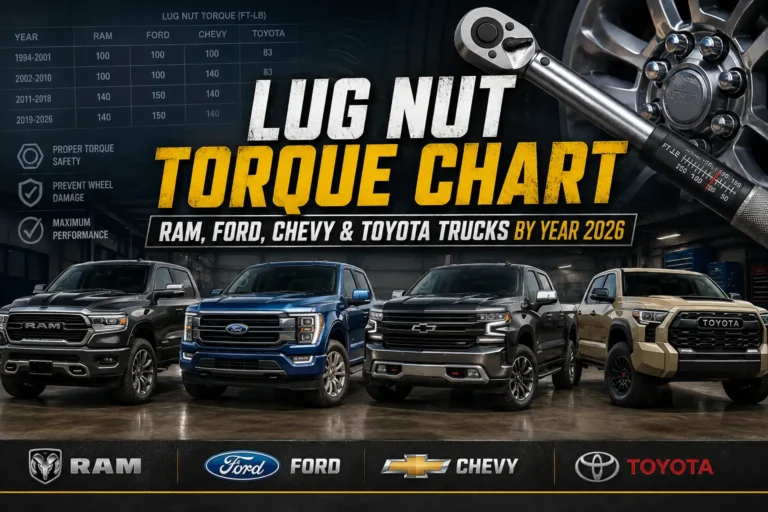
Incorrect lug nut torque is a primary cause of warped brake rotors due to uneven clamping force. Torque specifications have fluctuated slightly over the Caravan’s lifespan. Factory service manuals for 1984 through 2010 models recommend a torque range between 85 and 115 ft-lbs. From 2011 to 2020, Chrysler engineers standardized the specification strictly to 100 ft-lbs (138 Nm). Torque must always be applied using a calibrated torque wrench in a sequential crisscross pattern to ensure the wheel seats concentrically on the hub, as pneumatic impact wrenches can easily exceed 150 ft-lbs, stretching the stud beyond its yield point and inducing micro-fractures.
Wheel Interchangeability: Vehicles with the Same Bolt Pattern
Because the automotive industry relies heavily on parts sharing and platform modularity to reduce engineering costs, the Dodge Caravan’s wheel hubs are identical to those of numerous other vehicles, opening up a massive secondary market for OEM and aftermarket wheels.
The 5×114.3mm pattern used heavily from 1987 to 2007 is arguably the most common 5-lug configuration in global automotive manufacturing, providing an excellent balance of load distribution and structural integrity. Owners of these generation Caravans have an extensive list of cross-compatible vehicles.
| Compatible Make | Compatible Models (5×114.3mm Pattern) |
| Ford | Mustang, Explorer |
| Toyota | RAV4, Camry, Highlander |
| Honda | Accord, Odyssey, CR-V |
| Nissan | 350Z, 370Z, Altima |
| Mazda | MX-5 Miata, CX-5 |
It is crucial to note that while the bolt pattern matches perfectly on the vehicles listed above, many Honda and Toyota vehicles utilize a smaller 60.1mm or 64.1mm center bore. A wheel sourced directly from a Toyota Camry will not fit a Dodge Caravan because the wheel’s center bore is too small to fit over the Caravan’s 71.5mm hub.
The heavier-duty 5x127mm pattern adopted for the 2008–2020 Grand Caravan is highly specialized, typically reserved for large SUVs, trucks, and off-road vehicles. Direct interchangeability exists with several notable models.
| Compatible Make | Compatible Models (5x127mm Pattern) |
| Jeep | Wrangler (JK & JL), Grand Cherokee, Gladiator |
| Dodge | Durango (2004–2024), Ram C/V Tradesman |
| Chrysler | Pacifica (2017–2024), Voyager (2020–2024) |
| Volkswagen | Routan (2009–2014) |
The Chrysler Pacifica and modern Voyager serve as direct successors to the Caravan platform, maintaining the exact 5x127mm pattern, 71.5mm hub bore, and +40mm offset, making their modern alloy wheels a perfect direct-fit upgrade for older Grand Caravans.
How to Accurately Measure a 5-Lug Bolt Pattern
Automotive technicians and enthusiasts often encounter unidentified wheels, and accurately determining the bolt pattern requires precise measurement techniques. Understanding the geometry of a wheel’s bolt pattern is critical, as visual estimation is impossible. The geometry of measuring differs fundamentally between even-numbered and odd-numbered lug configurations.
Because a 4-lug configuration forms a perfect square, measuring is straightforward; a technician simply measures directly across the center of the hub from the center of one lug stud to the center of the stud diametrically opposite to it. However, a 5-lug pattern forms a pentagon, meaning no two lug studs are directly opposite one another across the true center of the hub. Measuring straight across two adjacent studs, or skipping a stud and measuring center-to-center, will yield a mathematically incorrect, smaller diameter.
To find the true pitch circle diameter of a 5-lug wheel, select any starting lug stud and skip the adjacent stud clockwise. Place the measuring tape on the outside back edge of the first stud, and measure straight across the hub to the exact center of the third stud. If the measurement reads approximately 4.5 inches (114.3mm), it is a 5×114.3 pattern, whereas a reading of exactly 5.0 inches (127mm) dictates a 5×127 pattern.
Frequently Asked Questions
Can you put 5×114.3 wheels on a 5×127 Dodge Caravan hub?
Direct installation is physically impossible because the distance between the studs is mathematically incompatible. Attempting to bore out the lug holes to force a fit will destroy the structural integrity of the wheel, resulting in catastrophic failure. The only mechanical pathway to utilize 5×114.3 wheels on a 5×127 hub is through the use of precision-machined billet aluminum wheel adapters. These adapters bolt directly to the native 127mm hub and present a secondary set of 114.3mm studs. However, adapters act as an extreme negative offset (pushing the wheel 25mm to 50mm outward), requiring the aftermarket wheel to possess an unusually high positive offset to counteract the spacer and maintain the factory scrub radius.
What is the center bore of a Dodge Caravan?
For the vast majority of production spanning the late 1980s through 2020, the Dodge Caravan utilizes a 71.5mm center bore. Only the earliest lightweight models equipped with 4x100mm and 5x100mm bolt patterns utilized a smaller 57.1mm center bore. Maintaining the 71.5mm specification ensures the vehicle remains safely hub-centric.
Are all Dodge Caravan lug nuts the same size and style?
No. While the fundamental M12x1.50 thread pitch has remained a universal standard across all five generations, the external hex size and lug nut casing designs have varied significantly. Depending on the factory wheel option, some models require closed-end, domed acorn nuts to protect the threads from moisture, while others use open-end nuts hidden behind large plastic hubcaps. Furthermore, aftermarket wheels frequently feature incredibly narrow lug pockets that cannot accommodate the standard 19mm hex socket, necessitating the purchase of specialized spline-drive tuner lug nuts.
Why do tire shops recommend 17-inch rims for a Dodge Caravan that came with 16-inch rims?
This discrepancy stems from the fragmentation of Chrysler’s database regarding the heavy-duty versus standard braking systems. Because the massive dual-piston heavy-duty brakes—which absolutely require 17-inch wheels for caliper clearance—became the standard factory specification for the Grand Caravan after 2014, many automated tire configurators default to the 17-inch (225/65R17) size to prevent selling a customer a 16-inch wheel that will violently grind against the brake hardware. Owners must manually verify their brake code (BR1 vs BR6) or physically inspect their calipers before purchasing downsized winter wheels.
How does tire load index correlate with the wheels on a Grand Caravan?
The wheel is only one half of the rolling assembly; the tire must be equally matched to the vehicle’s gross weight. Original equipment tires for the Dodge Grand Caravan typically feature a load index of 100, occasionally denoted as 100H or 100T. A load index of 100 translates to a maximum load-carrying capability of 1,764 pounds per tire at maximum inflation pressure. Multiplied across all four wheels, the tires can safely support 7,056 pounds, ensuring ample headroom above the minivan’s curb weight and maximum payload capacity.

![Cummins Grid Heater Bolt: Specs & Fitment Guide [2026]](https://truckguider.com/wp-content/uploads/2026/03/cummins-grid-heater-bolt-featured.webp)