
Ford F150 Oxygen Sensor Location Diagram: Mapped Out for 1997-2026 Model Generations

Did you know that a single failing oxygen sensor can reduce your Ford F-150’s fuel efficiency by up to 20%? Understanding your truck’s exhaust monitoring system is the quickest way to restore performance and clear those pesky “Check Engine” light codes. This guide provides the precise data you need to locate these sensors across various engine configurations.


Ford F150 Oxygen Sensor Location Diagram Reference Chart
Recommended Best Deal Products


How to Read the Ford F150 Oxygen Sensor Location Diagram
The chart above outlines the general placement for F-150 sensors. “Sensor 1” always refers to the upstream component responsible for monitoring air-fuel ratios before exhaust enters the catalytic converter. “Sensor 2” is the downstream component used primarily for checking converter efficiency.
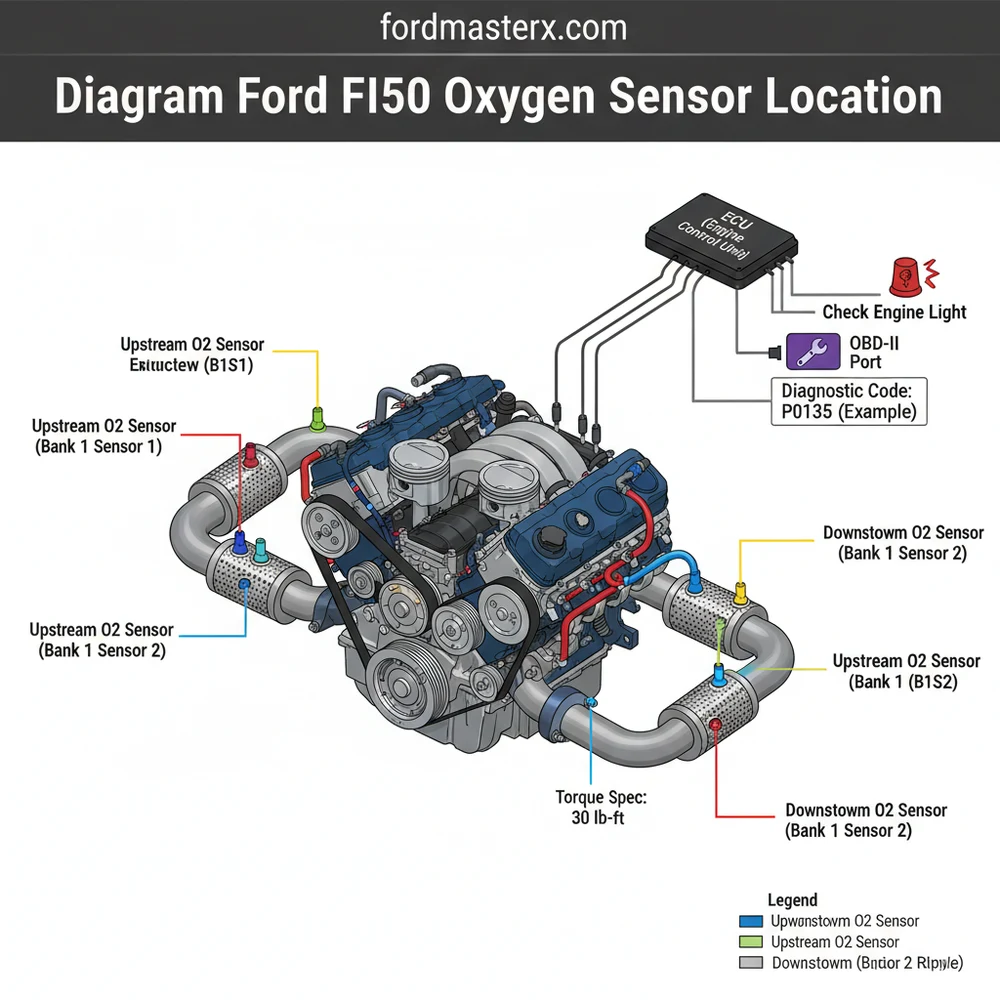
Bank 1 is consistently the passenger side (or driver side depending on engine orientation; always verify against the cylinder #1 location on your specific block). Most F-150 models utilize four sensors total: two upstream and two downstream. Always check your vehicle’s specific emission sticker under the hood if you are unsure of your engine’s exact layout.

Advanced Specifications and Features of O2 Sensors
Modern F-150s feature highly sophisticated wideband oxygen sensors. These provide more than just a rich/lean reading; they offer real-time data to the ECU to adjust fuel injection timing. The advantage of these sensors is a drastic increase in engine longevity and emission compliance.

However, the disadvantage lies in their sensitivity. Heat cycles, carbon buildup, and coolant leaks can easily contaminate the sensor tip. When comparing older models to the 2026 iterations, the primary difference is the integration of integrated heaters, which allow the sensor to reach operating temperature faster, reducing “cold start” emissions.
How to Find Your Ford F150 Oxygen Sensor Location Diagram
Recommended Best Deal Products



Locating the sensors requires a systematic approach. Do not rely solely on generic diagrams, as trim packages and exhaust modifications can change the clearance and exact mounting point. Follow these verification steps:
Lift the hood and look for the Vehicle Emission Control Information (VECI) decal. It often contains a simplified exhaust layout diagram.
With the engine cool, slide under the vehicle. Follow the exhaust pipes from the manifold back. Sensors are the only components with electrical wiring pigtails screwed into the pipe.
Common Problems and Troubleshooting Tips
If your F-150 is throwing a P0171 or P0174 code, it often points to a sensor issue. One pro tip: don’t immediately blame the sensor. Check the wiring harness leading to it first. Exhaust heat can often dry-rot the insulation, causing erratic readings that mimic a failed sensor.
For DIYers, the main advantage of replacing these yourself is cost-saving. The disadvantage is the potential for seizing. Because these components are subjected to extreme heat cycles, they often weld themselves into the exhaust pipe. Using a high-quality penetrating oil and a dedicated oxygen sensor socket is mandatory to avoid stripping the threads.

Audible — Listen Free for 30 Days
One free credit a month and thousands of titles included.
Listen Free for 30 DaysAlways allow the exhaust system to cool for at least two hours before working. Temperatures can exceed 500°F even shortly after the engine is turned off.
What If It Still Doesn’t Work?
Recommended Best Deal Products


If you have replaced the faulty unit and the Check Engine light persists, consider these fallback steps:
- Perform a PCM reset by disconnecting the battery for 15 minutes to clear stored long-term fuel trim data.
- Check for vacuum leaks near the intake manifold, as these often manifest as “lean” sensor codes.
- Verify fuel pressure; if the fuel pump is failing, the sensor may be reporting an accurate lean condition caused by low fuel flow.
If these steps do not clear the issue, it may be time to consult a professional mechanic who can use a bi-directional scan tool to perform a live-data graph analysis. Expect to pay between $150 and $300 for diagnostic services.
Conclusion
Navigating the Ford F-150 oxygen sensor location diagram is a manageable task once you understand the difference between Bank 1/2 and Sensor 1/2. By identifying the correct part before attempting a repair, you save time, money, and unnecessary frustration. Always prioritize safety, use the correct tools, and verify against your specific engine configuration. Based on expert automotive maintenance standards, a proactive approach to replacing these sensors will keep your F-150 running efficiently for miles to come.
Key Takeaways
-
✓
Upstream sensors monitor fuel mixture before the catalytic converter, while downstream sensors verify converter efficiency. -
✓
Bank 1 always refers to the side of the engine containing cylinder number one. -
✓
Sensor 1 is positioned before the catalyst; Sensor 2 is positioned after the catalyst. -
✓
V8 engines typically feature four total sensors, while some V6 models vary based on turbo configuration. -
✓
Using a VIN-specific diagram is the most reliable way to avoid replacing the wrong sensor.
❓ Frequently Asked Questions
1
What is an F-150 oxygen sensor?
An oxygen sensor is an electronic device that measures the proportion of oxygen in the exhaust gases. In an F-150, these sensors provide critical data to the Engine Control Module (ECM) to adjust the air-fuel ratio for optimal engine performance, fuel economy, and emission compliance.
2
How does the F-150 O2 sensor layout work?
The system utilizes a ‘Bank and Sensor’ hierarchy. Bank 1 is the passenger side (on most Ford engines), and Bank 2 is the driver side. Sensor 1 is the ‘upstream’ unit, and Sensor 2 is the ‘downstream’ unit located after the catalytic converter.
3
Why is correct sensor identification important?
Identifying the correct sensor is vital because replacing the wrong one will not resolve the check engine light. Each sensor has specific heating elements and wiring harness lengths designed for its unique exhaust placement. Using the wrong part can cause poor performance or incorrect ECU readings.
4
What are the benefits of DIY sensor replacement?
The primary advantage is cost savings, as professional labor rates for exhaust work are high. A DIY replacement allows you to inspect related exhaust hangers and heat shields for damage, while ensuring you use quality replacement parts that fit your specific F-150 trim.
Audible Premium Plus — Annual Membership
12 audiobook credits up front, plus the full Audible catalogue.
See Annual Plans
5
How can I get started with finding my sensor?
Start by locating your vehicle’s VIN and searching for an online service manual specific to your F-150 model year. Once you have the specific engine code, refer to the location diagrams in this guide to visually verify the sensor’s position relative to your catalytic converters.
6
How many O2 sensors does my F-150 have?
Most F-150 V8s have four, while V6 models may vary based on turbo configuration and exhaust routing.



![Dodge Dtc P0128: Diagnosis & Repair [2026]](https://truckguider.com/wp-content/uploads/2026/03/featured-324bfd94-768x768.webp)