Ford F-350 Gear Ratio Chart for SRW and Dually Trucks by Year

A 2026 Ford F-350 single-rear-wheel pickup uses a 3.31 or 3.55 rear axle with the 6.7L Power Stroke diesel and a 3.73 or 4.30 axle with the 6.8L or 7.3L gas V8, while dually diesels use a 3.55 or 4.10 axle, according to Ford’s 2026 Super Duty towing guide.


Older F-350s used different combinations, and Ford also added and dropped door-label axle codes over the years. This Ford F350 gear ratio chart lists what Ford printed for each year, engine and rear wheel setup.
Every ratio below comes from a Ford towing guide or spec sheet. The guide also shows how to read your axle code and how each ratio changes towing ratings and highway engine speed.
Ford F-350 Gear Ratio Chart From 5 Ford Towing Guides


Ford lists F-350 axle ratios inside its trailer towing tables, one row per engine and ratio. The chart below collects those rows for five model years that span the 6.7L Power Stroke era.
| Model year | Engine | F-350 SRW ratios | F-350 DRW ratios |
|---|---|---|---|
| 2013 | 6.2L gas V8 | 3.73, 4.30 | 3.73, 4.30 |
| 2013 | 6.7L diesel V8 | 3.31, 3.55 | 3.73 |
| 2017 | 6.2L gas V8 | 3.73, 4.30 | 3.73, 4.30 |
| 2017 | 6.7L diesel V8 | 3.31, 3.55 | 3.55, 4.10 |
| 2020 | 6.2L gas V8 | 3.73, 4.30 | 3.73, 4.30 |
| 2020 | 7.3L gas V8 | 3.73, 4.30 | 3.73, 4.30 |
| 2020 | 6.7L diesel V8 | 3.31, 3.55 | 3.55, 4.10 |
| 2026 | 6.8L gas V8 | 3.73, 4.30 | 4.30 |
| 2026 | 7.3L gas V8 | 3.73, 4.30 | 3.73, 4.30 |
| 2026 | 6.7L diesel and High Output | 3.31, 3.55 | 3.55, 4.10 |
| 2027 | 7.3L gas V8 | 3.73, 4.30 | 3.73, 4.30 |
| 2027 | 6.7L High Output diesel | 3.31, 3.55 | 3.55, 4.10 |
Two patterns hold across every guide. Single-rear-wheel diesels have used 3.31 or 3.55 since at least 2013, and gas engines have used 3.73 or 4.30.
Dually diesels changed the most. The 2013 guide gave the F-350 DRW diesel a 3.73 axle, while 2017 and later guides list 3.55 and 4.10.
2026 F-350 Axle Ratios for 4 Engines
The 2026 F-350 offered four engines: the 6.8L gas V8, the 7.3L gas V8, the 6.7L Power Stroke diesel and the 6.7L High Output Power Stroke. Ford’s 2026 Super Duty technical specifications list these ratios in the towing tables.
2026 F-350 Rear Axle Ratios by Engine
From Ford’s 2026 Super Duty towing tables.
Single rear wheel
Dual rear wheel
The 4.30 diesel row in Ford’s shared dually table belongs to the F-450 in every guide that splits the columns.
The dually 6.8L stands out because Ford lists only one ratio for it. Every other engine gets a choice of two or three gears.
The diesel choice also splits by wheel setup. A single-rear-wheel diesel cannot get the 4.10 axle in the 2026 tables, and a dually diesel cannot get the 3.31.


Where the 4.30 Diesel Ratio Sits in Ford Guides Since 2013


Buyers often ask whether an F-350 dually diesel can be ordered with 4.30 gears. Ford’s older guides answer that more clearly than its newer ones.
In the 2013 guide, the 6.7L diesel 4.30 row shows a trailer rating only in the F-450 column. The 2017 guide does the same, with the 4.30 diesel GCWR of 41,800 pounds printed under F-450 alone.
The 2020 guide prints the F-350 and F-450 dually columns side by side, and its 4.30 diesel rows carry trailer ratings only under the F-450. Every F-350 column shows a dash.
The 2026 and 2027 guides still print a 4.30 diesel row in the shared dually table, with only two values across eight columns. That pattern matches the F-450-only row in the older guides.


If a seller lists an F-350 dually diesel with 4.30 gears, check the door-label axle code. A 4L or 4M code confirms a factory 4.30 axle.
How Each Ratio Changes 2026 F-350 GCWR
GCWR, or Gross Combined Weight Rating, is the most the truck, its load and its trailer may weigh together. Ford ties each GCWR to a specific engine and axle ratio, so the gears you order set your towing ceiling.
| 2026 F-350 setup | Lower ratio GCWR | Higher ratio GCWR |
|---|---|---|
| SRW 6.7L diesel | 3.31: 31,000 lb | 3.55: 31,000 lb |
| SRW 6.7L High Output | 3.31: 31,800 lb | 3.55: 35,200 lb |
| SRW 7.3L gas | 3.73: 25,200 lb | 4.30: 29,000 lb |
| SRW 6.8L gas | 3.73: 21,000 lb | 4.30: 24,400 lb in towing guide |
| DRW 6.7L diesel | 3.55: 40,000 lb | 4.10: 43,900 lb |
| DRW 6.7L High Output | 3.55: 40,500 lb | 4.10: 45,600 lb |
| DRW 7.3L gas | 3.73: 25,700 lb | 4.30: 29,500 lb |
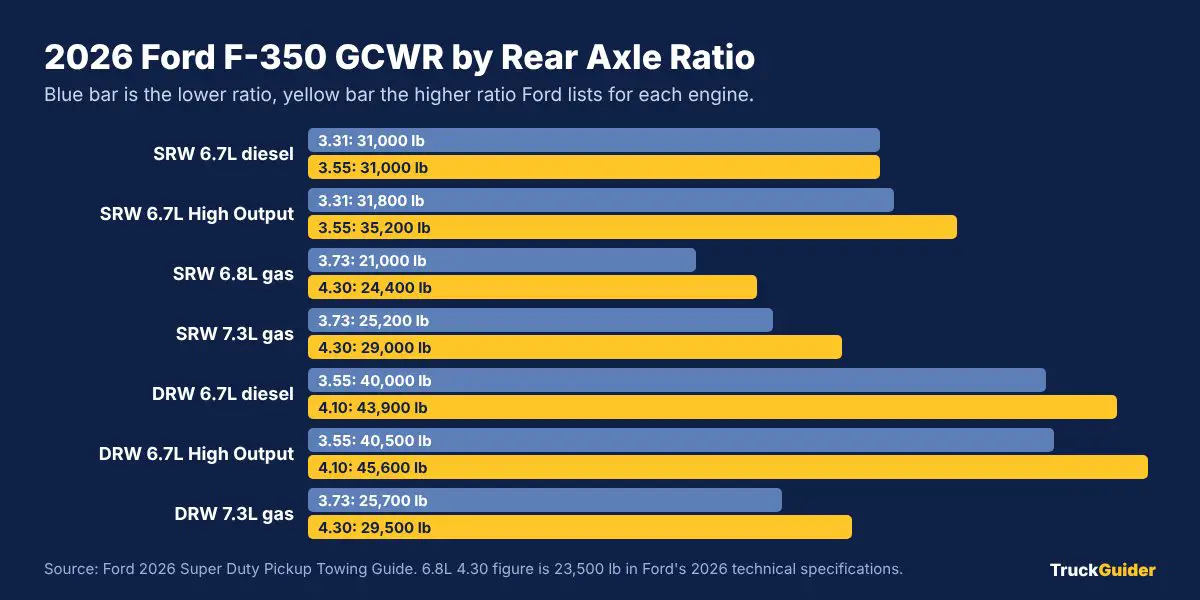
The standard SRW diesel is the one case where the ratio does not move GCWR. Both 3.31 and 3.55 trucks carry 31,000 pounds, so the 3.31 axle costs nothing on paper.
The High Output diesel behaves differently. Its 3.55 axle adds 3,400 pounds of GCWR over the 3.31, which is why towing-focused SRW trucks are usually ordered with 3.55 gears.
One figure disagrees between Ford documents. Ford’s 2026 papers print both 24,400 and 23,500 pounds for the SRW 6.8L with 4.30 gears, and the door label does not list GCWR, so confirm it with a Ford dealer.
How to Read an F-350 Axle Code in 3 Steps


Ford records the factory axle on the Safety Compliance Certification Label. The 2026 towing guide places it on the left front door lock facing or the door latch post pillar.
- Open the driver’s door. Find the white certification label with the bar code, not the tire pressure label.
- Find the word AXLE. Ford prints a two-character code below the bar code.
- Match the code to your model year. Use the table in the next section and confirm the year on the same label.
The label shows how the truck left the factory. A previous owner could have swapped the ring and pinion, so a truck with a gear change needs a physical check.
F-350 Axle Code Table for 2017 to 2027 Trucks
Ford printed the same rear axle code table in its 2017, 2020, 2026 and 2027 Super Duty guides. The code tells you both the ratio and the differential type.
| Ratio | Open differential | Limited slip | Electronic locking |
|---|---|---|---|
| 3.31 | 31 | Not available | 3H |
| 3.55 | 35 | 3K | 3J |
| 3.73 | 37 | 3L | 3E |
| 4.10 | Not available | 4N | Not available |
| 4.30 | Not available | 4L | 4M |
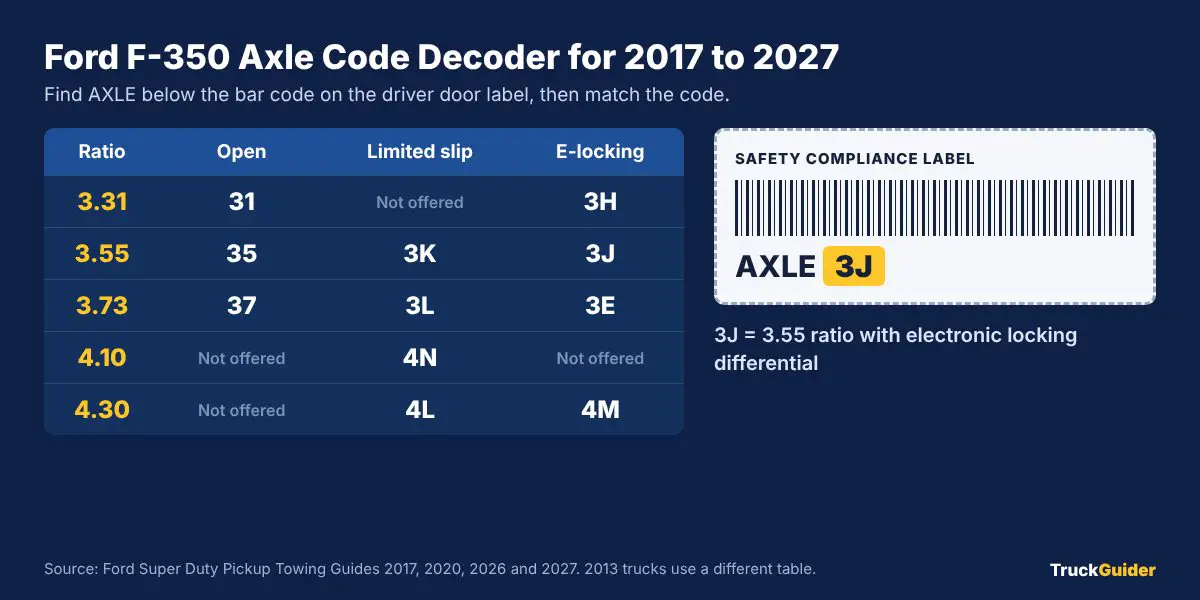
A code of 3J means a 3.55 electronic locking axle, and 4N means a 4.10 limited-slip axle. The 4.10 ratio only came as limited slip in these tables.
How the 2013 Code Table Differs
The 2013 Super Duty guide uses a shorter table. It lists no limited-slip 3.55 axle and no 4.10 ratio at all.
It also gives the 4.30 open differential its own code, 43, which the later tables mark as not available. Always decode with the table from your truck’s own era.
The same caution applies to earlier trucks. Our Ford F-250 gear ratio and axle code guide covers older Super Duty labels, which follow different code lists.
Highway RPM for 5 Ratios With the 10 Speed Automatic
Ford’s 2026 specifications list the 10R140 ten-speed automatic with a 0.63 tenth gear and a 4.62 first gear. Those specifications list it for the 7.3L and 6.7L diesel, and the table below applies only to 10-speed trucks, not the 6-speed trucks in Ford’s 2013 and 2017 guides.
| Axle ratio | Engine rpm at 70 mph in 10th | Overall ratio in 1st gear |
|---|---|---|
| 3.31 | 1,487 | 15.29 |
| 3.55 | 1,595 | 16.40 |
| 3.73 | 1,675 | 17.23 |
| 4.10 | 1,842 | 18.94 |
| 4.30 | 1,932 | 19.87 |
The rpm column uses a 33-inch-tall tire as an example. Taller tires lower every rpm figure, and shorter tires raise them.
The first-gear column shows starting torque multiplication. A 4.30 axle multiplies engine torque about 30 percent more than a 3.31 axle before the tires turn.
How Bigger Tires Change F-350 Gearing in 2 Examples
A taller tire covers more ground per turn, which acts like a numerically lower axle ratio. The effective ratio equals the axle ratio times the old tire height divided by the new tire height.
Example one is an SRW diesel with 3.55 gears moving from 33-inch to 35-inch tires. Its effective ratio drops to about 3.35, which is closer to a factory 3.31 truck than to the 3.55 it was built with.
Example two is a dually diesel with 4.10 gears on the same tire change. It ends up near 3.87, still shorter than a 3.73 but well short of the 4.10 that Ford’s 43,900-pound GCWR assumed.
Ford sets GCWR for the factory tire and axle combination. Owners who fit much taller tires often regear to bring the effective ratio back toward the factory figure.
What the 2027 F-350 Changes for Gear Ratios
The 2027 Super Duty drops two engines. SlashGear reports that the 6.8L gas V8 and the standard-output 6.7L Power Stroke are gone, leaving the 7.3L as the gas engine and the High Output diesel as the only diesel.
Ford’s 2027 Super Duty Pickup Towing Guide matches that. It lists only the 7.3L V8 and the 6.7L High Output diesel, with no 6.8L rows.
The ratios themselves carry over. The 2027 SRW tables show 3.31 and 3.55 for the diesel and 3.73 and 4.30 for the 7.3L, and the code table is unchanged.
That means a 2027 F-350 SRW diesel buyer no longer has a standard-output 3.31 option at 31,000 pounds GCWR. Every 2027 diesel starts from the High Output figures.
Choosing an F-350 Gear Ratio for 4 Driving Jobs
The right ratio depends on the trailer and the miles you drive empty. These four cases use Ford’s 2026 GCWR figures as the deciding line.
Mostly Empty Highway Driving


If the truck rarely tows near its limit, the 3.31 SRW diesel keeps engine speed lowest. On the standard diesel it gives up no GCWR to the 3.55.
Heavy Bumper Pull Trailers
If you tow a heavy bumper-pull trailer with an SRW High Output diesel, the 3.55 axle raises GCWR to 35,200 pounds. Our Ford towing capacity chart shows the matching trailer ratings by model.
Large Fifth Wheel or Gooseneck


If you pull a large fifth wheel or gooseneck, a dually with 4.10 gears carries the most GCWR in the F-350 tables. Our F-350 DRW vs SRW comparison covers the payload side of that choice.
Gas Engine Towing
If you tow with the 7.3L gas V8, the 4.30 axle adds 3,800 pounds of GCWR on both SRW and DRW trucks. Gas engines make peak torque at higher rpm, so the shorter gear suits them.
Changing F-350 Gears for 3 Common Reasons
Owners often regear after fitting taller tires, adding a slide-in camper or buying a used truck geared for highway use. Each changes how the factory ratio performs.
Taller tires lower the effective ratio, as the examples above show. A camper adds constant weight, so the truck spends more time working in lower gears.
A used 3.31 SRW diesel bought for heavy towing is the third case. Ford’s 2026 tables give the High Output 3.55 truck 3,400 pounds more GCWR, but a gear swap does not move the label rating.
Ford’s published GCWR applies to the factory axle code on the label. A regeared truck no longer matches that rating, so Ford’s figures cannot confirm its new towing limit.
Payload does not change with gearing. Check payload separately with our F-350 payload capacity chart before adding a camper or fifth wheel hitch.
F-350 Gear Ratio FAQ in 5 Answers
Which Gear Ratios Can an F-350 Diesel Have?
For single-rear-wheel diesels, Ford lists only 3.31 and 3.55 in every guide from 2013 to 2027. Dually diesels from 2017 on list 3.55 and 4.10.
Does the F-350 Dually Come With 4.30 Gears?
Gas duallys do, with the 6.2L, 6.8L and 7.3L V8s. For diesel duallys, Ford’s 2013, 2017 and 2020 guides show 4.30 only for the F-450.
Where Is the Axle Code on an F-350?


It is on the certification label at the driver’s door lock facing or latch post pillar. Look for the word AXLE below the bar code.
Is 3.55 or 4.10 Better for an F-350 Dually?
The 4.10 axle raises 2026 GCWR by 3,900 pounds on the standard diesel and 5,100 pounds on the High Output. The 3.55 runs about 250 fewer rpm at 70 mph.
Do the F-250 and F-350 Use the Same Gear Ratios?
Single-rear-wheel F-250 and F-350 trucks list the same ratios in Ford’s 2026 tables. The dually F-350 adds a diesel 4.10 axle that the 2026 F-250 tables do not list.
Using the Ford F350 Gear Ratio Chart Before You Buy or Tow
This Ford F350 gear ratio chart comes down to three checks. First, match your model year and engine, because Ford’s diesel dually ratios changed from 3.73 in 2013 to 3.55 or 4.10 from 2017 on.
Second, read the AXLE code on the door label and decode it with the table from your truck’s era. Third, compare the GCWR for your ratio against the trailer you plan to pull.
Ford’s 2026 Super Duty Pickup Towing Guide is the best place to match your exact cab, box and drive before you tow. Older ratios in this chart come from Ford’s 2013, 2017 and 2020 Super Duty towing guides.