How Long Should a Truck Battery Last Based on Your Conditions [2026]

How long should a truck battery last? The honest answer is: it depends on four specific conditions that most battery articles ignore entirely. The generic “3 to 5 years” figure you’ll see everywhere is technically accurate for one narrow situation — a moderate climate, standard gas truck, with normal driving habits. Your situation may be completely different.
This guide maps your exact conditions to the lifespan range that actually applies to you — and tells you when to replace, when to test, and when to stop worrying.


Why There Is No Single Answer for Truck Battery Life
Most articles say 3 to 5 years. That number is technically correct — and almost useless on its own.
A Ram 2500 Cummins running dual batteries in Phoenix, Arizona faces completely different chemistry than a Ram 1500 in Minnesota driven 25 miles each way to work every day. Both are trucks. Both use lead-acid batteries. The lifespan difference between them can be 3 full years.
Trucks also put heavier demands on batteries than passenger cars. The cranking requirement for a big V8 or a diesel is substantially higher. Many truck owners add accessories — winches, light bars, inverters — that create ongoing electrical load beyond what the factory alternator was designed for.
Four specific conditions determine which lifespan range applies to your truck. None of them are complicated. All of them are knowable before you spend a dollar on a new battery.
4 Conditions That Determine How Long Your Truck Battery Lasts
Heat above 95°F accelerates sulfation and electrolyte loss. Batteries in hot climates last 2–3 years vs. 3–5 in moderate zones.
Biggest impact
AGM batteries last 4–7 years. Standard flooded lead-acid lasts 3–5 years. Most factory trucks ship with flooded unless specified otherwise.
Upgradeable
Short trips under 15 min prevent full recharge cycles. Highway driving keeps the alternator charging long enough to top the battery off fully.
Habit-based
Winches, light bars, and inverters add parasitic draw beyond factory specs. Heavy accessories without an AGM upgrade shorten battery life by 1–2 years.
Accessory risk
Climate and Temperature
Heat is the primary driver of early battery failure — not cold. High ambient temperatures accelerate the internal chemical reactions inside a lead-acid battery, causing water loss from the electrolyte and sulfation on the lead plates. Both degrade capacity permanently.
Cold weather reduces cranking power significantly, which is why trucks feel sluggish on cold mornings. But cold does not damage the battery the way sustained heat does. A battery weakened by years of heat will fail its first hard winter start — that’s why cold-weather failures often get blamed on cold when heat caused the actual damage.
If your truck regularly sits in temperatures above 95°F, your lifespan falls into a different branch entirely. More on that in the next section.
Battery Type — AGM vs Flooded Lead-Acid
Most factory-installed truck batteries are standard flooded lead-acid. They work well under normal conditions and cost less to replace.
AGM (Absorbent Glass Mat) batteries last significantly longer — typically 4 to 7 years versus 3 to 5 years for flooded batteries — because they handle deep cycling, heat, and vibration better. According to Battery Council International data, AGM batteries also hold charge more efficiently during short trips, which makes them the right upgrade for trucks with high electrical loads or frequent short-haul driving.
If your truck came with an AGM from the factory (common on newer Ram 1500 eTorque models and work-package upfits), your baseline lifespan is higher. If you upgraded aftermarket, same benefit applies.
Driving Pattern
The alternator recharges your battery while the engine runs. If your engine runs for less than 15 to 20 minutes per trip, the alternator does not have enough time to fully restore what the starter used.
Partial charge cycles accumulate. Over months, a battery that never gets a full recharge degrades faster than its rated lifespan. Truck owners who do short city commutes, delivery routes, or multiple short errand trips per day are in this risk group.
Highway driving is the opposite — long run times, steady alternator output, full charge cycles. Highway-primary drivers typically see batteries last toward the upper end of the range.


Electrical Load
Factory electrical load — starter, headlights, HVAC, infotainment — is what the battery was sized for. Add aftermarket accessories and you change the math.
Winches, LED light bars, 12V refrigerators, power inverters, and upfitted work truck systems all draw current. Some draw it even when the truck is off, creating parasitic drain. The more accessories running off the factory battery without a supporting second battery or higher-output alternator, the faster degradation occurs.
With those four variables in mind, here is what the standard path looks like — and where the branches split.
How Long a Standard Gas Truck Battery Should Last
If your truck is a standard gas model, you drive a mix of city and highway trips longer than 20 minutes, you’re in a moderate climate that doesn’t regularly exceed 95°F, and you haven’t added heavy aftermarket accessories — here is your baseline.
According to AAA battery research, a standard flooded lead-acid battery in these conditions should last 3 to 5 years, with the average replacement occurring around the 4-year mark.
Year-by-year action guide:
- Years 1–2: Monitor only. No action needed unless symptoms appear.
- Year 3: Start testing annually with a voltmeter or at a shop.
- Year 4: Test before each season change (fall and spring).
- Year 5+: Replace proactively, even if the battery still starts the truck.
That last point matters more than most truck owners realize. A battery can pass a basic voltage test while already failing under the actual load of cranking a V8 or V6 engine. By year 5, you are driving on borrowed time in the best-case conditions.
If your Ram 1500 is approaching the 4-year mark, the 2019 Ram 1500 battery replacement guide walks through the full swap process so you know what to expect before you start.
If none of the four conditions in the previous section shift your situation, this 3 to 5-year range is your number. If heat is part of your reality, the timeline compresses significantly.
How Hot Climates Cut Truck Battery Life Short
Heat is the single biggest battery killer. It’s not cold weather that shortens truck battery life — it’s sustained heat.

A AAA study on battery performance by region found that batteries in hot-climate states like Arizona, Texas, and Florida lasted an average of 2 to 3 years — roughly half the lifespan of the same battery in cooler Northern states. The culprit is sulfation: heat accelerates the buildup of lead sulfate crystals on the battery plates, permanently reducing the amount of charge the battery can hold and deliver.
Parking habits compound the problem. A truck parked outdoors on asphalt in Phoenix reaches underhood temperatures well above 140°F on summer afternoons. Covered parking — a garage or carport — measurably extends battery life in hot climates by reducing that thermal exposure.
If you regularly see temperatures above 95°F and park outside, use this branch instead of the standard path:
- Year 2: Start testing annually.
- Year 3: Replace proactively, regardless of symptoms.
- Year 4+: You are past expected service life. Replace immediately.
The failure mode in hot climates is rarely gradual. A battery that starts the truck fine on Monday can leave you stranded on Thursday. Heat damage is cumulative and internal — it is not visible, and it does not announce itself.
Diesel trucks and heavily loaded work trucks face a separate but equally important set of pressures.
How Diesel Trucks and Heavy Accessory Loads Change the Math
Diesel Dual-Battery Systems
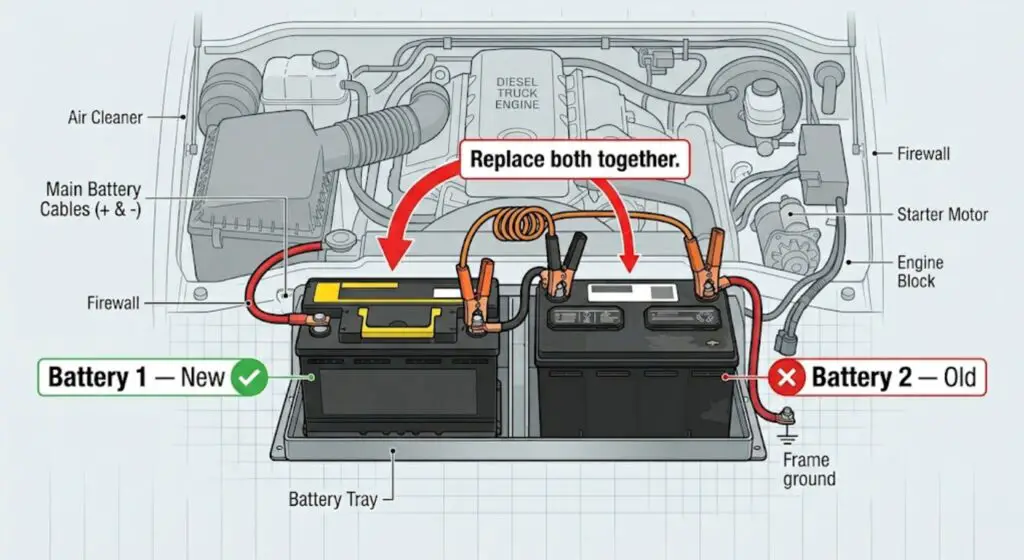
Most diesel trucks — Ram 2500 and 3500 with the 6.7 Cummins, Ford F-250 and F-350 with the Power Stroke — run dual-battery systems. The reason is simple: diesel engines require far higher cold cranking amps to fire than a gasoline engine. Two batteries working together deliver that power reliably.
Under normal conditions in a moderate climate, dual-battery systems on diesel trucks typically last 3 to 5 years — similar to a standard gas truck battery. However, the dual-battery setup introduces one critical maintenance rule that gas truck owners never have to think about.
If you replace only one battery and leave the old one in place, the new battery immediately begins compensating for the weaker old one. The charge imbalance causes the new battery to work harder than it should, and it degrades to match the old battery’s condition faster than it would on its own. Both batteries should always be replaced at the same time.
Aftermarket Accessories
Winches, light bars, inverters, and auxiliary power systems increase the total electrical demand on your battery. The concern is not just what they draw while the truck is running — it is what they draw when the truck is off.
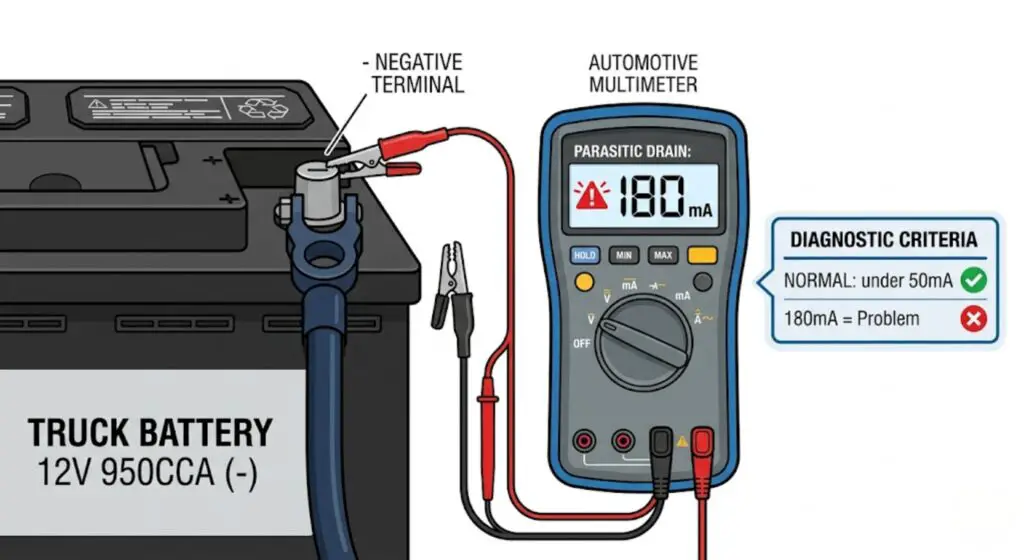
A parasitic draw above 50 milliamps when the truck is parked and all systems should be off is considered abnormal. A single poorly installed aftermarket accessory can pull 200 to 300 milliamps continuously, draining a fully charged battery overnight in cold weather or within 2 to 3 days in warm conditions.
If you run heavy accessories, upgrading to an AGM battery reduces the risk significantly. AGM handles repeated partial discharge cycles better than flooded lead-acid. If your 6.7 Cummins is giving you starting problems that seem battery-related, the 6.7 Cummins years to avoid guide covers model-year-specific electrical quirks worth ruling out alongside the battery itself.
Edge Cases That Kill a Truck Battery Before Its Time
Some batteries fail early not because of climate or battery type — but because of specific habits or underlying problems that accelerate degradation regardless of all other conditions.
Parasitic drain is the most common hidden killer. A faulty relay, an aftermarket alarm system drawing current, or an infotainment module that fails to sleep properly can pull 150 to 400 milliamps continuously. A normal truck should draw no more than 25 to 50 milliamps with everything off. To check: connect a multimeter in series with the negative battery terminal 30 minutes after shutting the truck off. Any reading above 50mA warrants investigation before replacing the battery — you’ll drain the new one the same way.
Short-trip driving compounds partial charge cycles. If your commute is under 10 minutes each way, your alternator is doing incomplete work on every trip. A trickle charger or battery maintainer used once a week can offset this and extend battery life by a full year or more.
Extended storage drains batteries through self-discharge at roughly 1 to 3 percent per day. A truck parked for 90 days without a maintainer connected can lose enough charge to cause sulfation damage. If you store a truck seasonally, a battery maintainer is not optional — it’s the difference between a battery that lasts 5 years and one that lasts 2.
Corroded terminals reduce effective charge transfer between the battery and the truck’s electrical system. The battery may be fully charged, but resistance at the terminal connection prevents full power delivery. Clean terminals with a wire brush and baking soda solution annually — it costs nothing and prevents misdiagnosed battery failures.
Truck Battery Lifespan Decision Matrix
Find your combination below. The action column tells you exactly what to do next.
| Your Condition | Expected Lifespan | Recommended Action |
|---|---|---|
| Moderate climate + flooded battery + normal driving + gas truck | 3–5 years | Test at year 3, replace at year 5 |
| Hot climate (95°F+) + flooded battery + outdoor parking | 2–3 years | Test at year 2, replace at year 3 |
| Any climate + AGM battery + normal driving | 4–7 years | Test at year 4, replace at year 6–7 |
| Diesel dual-battery + any climate | 3–5 years | Replace both batteries together every time |
| Any truck + heavy accessories + short trips | 2–4 years | Upgrade to AGM, add trickle charger |
| Parasitic drain detected (above 50mA at rest) | Immediate risk | Load test now — find and fix drain source first |
When to Replace vs Test vs Monitor Your Truck Battery
Under 3 years old. No symptoms. Moderate climate.
Resting: 12.6V+
3+ years old OR slow crank, dim lights, electronics resetting.
Warning: 12.4V
5+ years old, any failure symptom, or load test below spec.
Replace: <12.2V
Voltmeter reads fine but symptoms persist. Surface charge masking failure.
Free at AutoZone
Monitor if your battery is under 3 years old, you have no symptoms, and you’re in a moderate climate. Check resting voltage monthly — a healthy battery at rest reads 12.6V or higher. No further action needed.
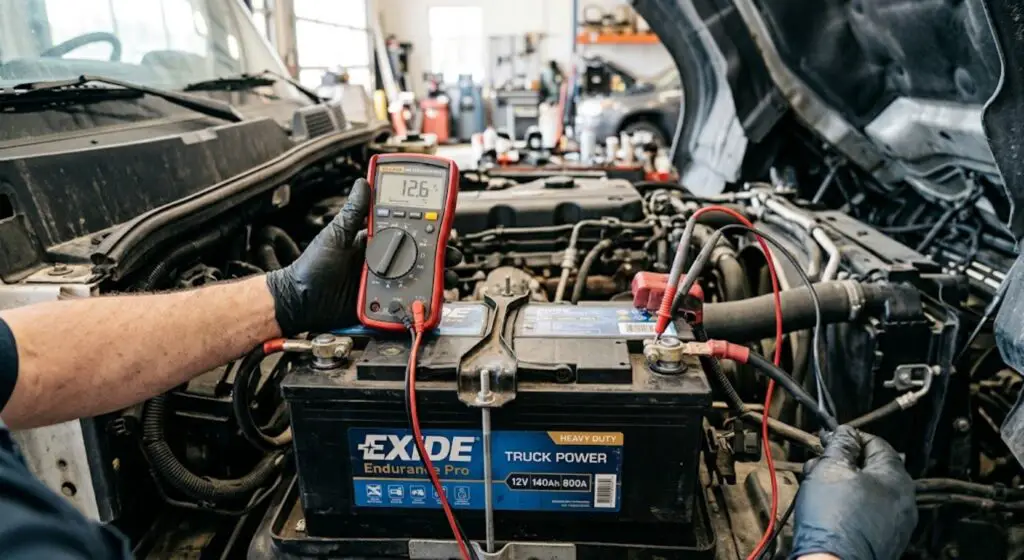
Test if your battery is 3 years or older, or if you notice slow engine cranking, headlights dimming at idle, or electronics resetting after starts. A basic voltmeter check takes 2 minutes: 12.6V or higher means good, 12.4V means marginal, below 12.2V means replace now. If you’ve recently swapped a battery and your check engine light came on, the Ram 1500 check engine light after battery replacement guide explains exactly why that happens and what to do.
Replace if your battery is 5 years or older, has shown any failure symptom, or a load test shows it is below spec. Do not wait for a no-start event. A battery that fails at home costs you time; one that fails on a highway or jobsite costs significantly more. The 2019 Ram 1500 battery replacement procedure covers the full step-by-step if you’re doing it yourself.
Get a shop load test when the voltmeter reads fine but symptoms persist. Surface charge — a temporary voltage spike after driving — can make a failing battery look healthy on a voltmeter. A load test applies actual cranking current and reveals true capacity. Many auto parts stores (AutoZone, O’Reilly, Advance Auto) perform load tests free of charge.
Frequently Asked Questions
How do I know if my truck battery is dying?
Slow engine cranking, dim headlights when idling, and electronics resetting after starts are the clearest signs. If two or more appear together, test your battery voltage immediately — below 12.4V at rest points to a failing cell.
Does cold weather kill truck batteries faster than heat?
Heat degrades batteries faster by accelerating sulfation and water loss from the electrolyte. Cold reduces cranking power and can trigger a failure in a heat-weakened battery, but cold is rarely the root cause. If your battery failed its first cold morning, heat likely did the underlying damage.
Should I replace both batteries on my diesel truck at the same time?
Yes, always. Running a new battery alongside an old one in a dual-battery system creates a charge imbalance that forces the new battery to overwork and degrade faster. Replace both at the same time, and match the specs — same brand, same CCA rating when possible.
Does an AGM battery last longer in a truck?
Yes. AGM batteries typically last 4 to 7 years versus 3 to 5 years for standard flooded batteries. They handle heat, vibration, and partial charge cycles better — making them the right choice for trucks with heavy accessories, hot climates, or short-trip driving patterns.
Can a truck battery be too old even if it still starts the engine?
Yes. A battery can pass a surface voltage test while already failing under actual cranking load. If your battery is 5 or more years old, request a load test — not just a voltage check — before trusting it through another season.
Conclusion
How long should a truck battery last? For most gas trucks in moderate climates, 3 to 5 years is the honest baseline. Add sustained heat and that number drops to 2 to 3 years. Switch to AGM and it can stretch to 7. Run a diesel dual-battery system and replace both at the same time or you’ll be back at the parts store within a year.
The three decisions that matter most: test at year 3 regardless of symptoms, replace proactively at year 5, and never replace just one battery on a diesel. Check your resting voltage tonight with a $15 multimeter. That single reading tells you exactly which row of the matrix above applies to your truck — and whether you have time to plan or need to act now.

![2013 Dodge Durango Battery: Size, Location & Specs Guide [2026]](https://truckguider.com/wp-content/uploads/2026/03/2013-dodge-durango-battery-featured.webp)