Model Number for a Truck: 1500-3500 & Class 1-8 Breakdown

Ordering replacement parts, verifying towing limits, or managing fleet maintenance requires knowing your truck’s exact model number. A truck model number is a manufacturer code that defines the vehicle’s specific chassis size, payload tier, cab setup, and drivetrain configuration rather than just its marketing name.
While often confused with trim packages or the 17-digit VIN, this code identifies the mechanical blueprint of the vehicle. The reference sections below detail where to find this code on your vehicle, how to extract it from the VIN, and how standard designations translate across consumer pickups and commercial classes.

Prime for Young Adults — 6 Months Free
Students and 18–24s get six months of Prime free, then half price.
Start 6 Months Free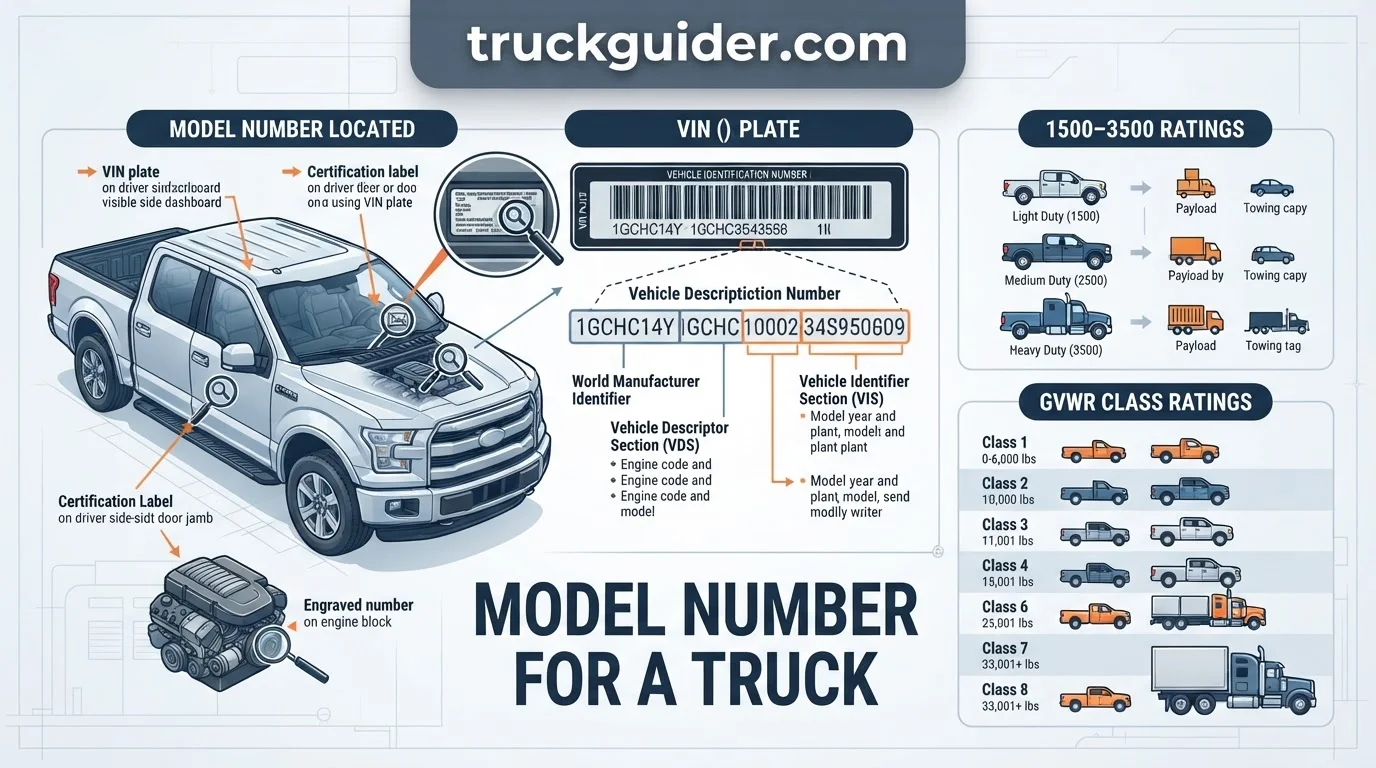
Truck Model Designation Overview: What the Model Number Represents
Recommended Best Deal Products


A truck model designation defines the fundamental architecture of the vehicle. Rather than describing cosmetic features or styling packages, the model number identifies the vehicle platform, the chassis rating, and the primary structural design engineered by the manufacturer.
Marketing Name vs. Engineering Chassis Code
A truck’s marketing model name (such as a Ram 1500) often differs fundamentally from the internal engineering chassis code or order code used for commercial parts ordering. Exterior badges cater to retail consumers, whereas assembly lines and parts catalogs require exact engineering nomenclature.

For example, while a consumer buys a light-duty Ford F-150, factory systems and collision catalogs track the vehicle using an internal engineering platform code, such as the P702 generation.
This distinction becomes critical in commercial transport. A vehicle badged on the highway as a Freightliner Cascadia relies on a technical spec-sheet chassis designation—such as CA126SLP—to communicate the precise cab structure, bumper-to-back-of-cab length, and frame dimensions to fleet maintenance software.
Proprietary Formats Across Truck Manufacturers
Unlike 17-digit Vehicle Identification Numbers, truck model identifiers are not globally standardized. Each original equipment manufacturer establishes its own proprietary naming and numbering conventions to organize build configurations, gross weight ratings, and structural updates over production lifecycles.
Because these internal systems are proprietary, there is no cross-brand syntactic standard. An alphanumeric sequence used by Navistar or Volvo shares no shared classification logic with the internal coding structures used by Ford, General Motors, or PACCAR.
Consequently, typical model code length ranges from 3 to 10 alphanumeric characters. These concise identifiers compress vital chassis, platform, and duty-class information into a manufacturer-specific shorthand.
Where to Find the Model Number for a Truck
Locating an accurate truck model number requires checking verified factory placements rather than cosmetic exterior accents. Relying solely on exterior tailgate or door emblems is risky because they are easily replaced, modified, or debadged by previous owners.

Audible — Listen Free for 30 Days
One free credit a month and thousands of titles included.
Listen Free for 30 DaysDriver-Side B-Pillar Safety Certification Label
The most authoritative physical location for official truck model information is the Federal Safety Certification label on the driver’s door jamb (B-pillar). This tamper-resistant sticker is permanently applied during assembly and stays with the cab structure throughout the truck’s operational life.
For example, checking the Federal Safety Certification sticker on the door jamb of a Chevy Silverado confirms the exact chassis model code regardless of aftermarket badges. This tag lists the manufacturer’s specific chassis designation alongside exact Gross Vehicle Weight Ratings (GVWR) and axle capacities.
Cosmetic emblems are frequently swapped during collision repairs or custom restyling. Always cross-reference the physical B-pillar certification label before purchasing replacement chassis components or ordering suspension parts.
Physical Cab Data Plates on Commercial Trucks
Medium-duty and heavy-duty commercial trucks often diverge from standard light-duty pickup conventions. Manufacturers of Class 4 through Class 8 vehicles place stamped metal data plates inside the cab footwell, inside the glove box, or mounted directly onto the engine compartment firewall.
These heavy-duty plates withstand severe operational wear and detail the exact vocational chassis model, cab dimensions, and frame ratings. Depending on the cab manufacturer, secondary plates may also appear along the driver’s seat riser or outer cab bulkhead.
Vehicle Title, Registration, and OEM Build Sheets
Administrative paperwork including the vehicle title, registration, and original OEM build sheet provide reliable secondary verification away from the vehicle. State title certificates and current registration cards display the general model line recorded during initial registration.
To uncover granular technical designations, request an original OEM build sheet from a franchised dealer parts counter. The build sheet itemizes the specific internal factory model code, production line option codes, suspension packages, and powertrain configurations.
Model Number for a Truck vs. VIN, Trim, and Part Numbers
Recommended Best Deal Products


Model Designation vs. 17-Digit VIN
A Vehicle Identification Number (VIN) is a globally unique, 17-character legal serial number assigned to a single vehicle. It records manufacturing origin, safety systems, assembly sequencing, and legal title history.
Audible Premium Plus — Annual Membership
12 audiobook credits up front, plus the full Audible catalogue.
See Annual PlansIn contrast, a truck model number is a standardized designation shared across thousands of identical builds. While your VIN isolates one individual vehicle, the model number defines the broad mechanical platform.
Truck Model vs. Trim Package
Confusing model designations with trim packages is a common mistake. Thinking “King Ranch” or “High Country” is the truck model causes ordering errors because these labels designate interior luxury and styling packages.
The underlying mechanical model remains a Ford F-150 or Chevrolet Silverado. Suspension ratings, drivetrain geometry, and chassis components depend entirely on the model number rather than cosmetic trim upgrades.
Model Numbers vs. Part and Fleet Unit Numbers
Part numbers isolate individual replaceable components, such as an alternator or brake caliper. A model designation represents the complete rolling chassis into which thousands of individual parts assemble.
Fleet unit numbers are internal logistics identifiers assigned by dispatchers. An asset tag like “Unit #412” organizes maintenance schedules and routes, but it is completely unrelated to OEM engineering specifications.
How to Read Truck Identifier Categories
The comparison table outlines four distinct identifiers used across vehicle operations. “Identifier Type” lists the industry designation, while “Scope” defines the operational boundary, separating chassis engineering from luxury styling or fleet management.
“Unique per Vehicle” confirms whether the designation is unique to an individual build or shared among mass assemblies. A VIN is strictly unique, whereas model codes represent platform groups.
Use the “Working Example” column to see how a single asset—like a Ford F-150 King Ranch assigned as Unit #412—carries separate identifiers for parts sourcing, trim selection, registration, and dispatch.
How to Decode the Truck Model Number Using the VIN
Buyers looking for a universal federal standard for truck model numbers will find that regulations standardize the 17-digit Vehicle Identification Number (VIN) rather than OEM marketing names. The VIN provides the legal, tamper-proof record of how a truck was built.
Understanding the Vehicle Descriptor Section (VDS)
Positions 4 through 8 of a standard 17-digit VIN constitute the Vehicle Descriptor Section (VDS). This five-character block officially identifies the vehicle model, body style, chassis type, and powertrain installed during assembly.
While automakers use distinct character sequences, federal guidelines require each manufacturer to submit their specific coding scheme to highway regulators, ensuring that every chassis variation remains fully traceable.
Decoding Positions 4 Through 8 Step by Step
Characters 4 and 5 typically specify gross vehicle weight rating (GVWR), brake systems, and model platform line (such as half-ton, three-quarter-ton, or commercial medium-duty).
Characters 6 and 7 indicate cab configuration, bed layout, and chassis cab variants. They confirm whether the truck left the factory as a Regular Cab, SuperCab, or Crew Cab.
Character 8 identifies the factory engine displacement, aspiration, and fuel type, differentiating gasoline configurations from heavy-duty diesel options.
For example, in a late-model Ford Super Duty VIN, positions 4 through 8 reading W2B8N decode directly: W2B identifies an F-250 4×4 Crew Cab model, while the eighth digit N confirms the 6.7L Power Stroke Turbo Diesel engine.
Accessing Official OEM and NHTSA Decoder Tools
Automakers translate these codes using proprietary index sheets, but public tools convert the string instantly. The free National Highway Traffic Safety Administration (NHTSA) VIN decoder translates federal VDS filings into plain text.
OEM build portals, such as Ford Fleet or Mopar Owner lookups, provide deeper build-sheet data. Entering your VIN confirms exact factory chassis specifications, original axle ratios, and gross weight classes without guessing.
Pickup Truck Model Details: What 1500, 2500, and 3500 Mean
Recommended Best Deal Products



The Historical Ton-Rating Origin
Historical pickup numbering (150/1500, 250/2500, and 350/3500) originated from half-ton, three-quarter-ton, and one-ton nominal payloads. In earlier decades, these numbers directly reflected cargo bed limits, distinguishing light utility pickups carrying 1,000 pounds from heavier commercial alternatives.
Assuming modern pickup model numbers (like 1500 or 2500) represent exact payload limits in pounds is a widespread misconception. For example, a 1970 half-ton truck payload capacity rarely exceeded 1,000 pounds, whereas a properly configured modern Ford F-150 can carry up to 3,250 pounds. Because modern half-ton trucks routinely haul over 2,000 pounds, historical ton-rating labels are technically obsolete.
Modern Gross Vehicle Weight Rating (GVWR) Brackets
Rather than measuring isolated bed capacities, modern numeric badges categorize Gross Vehicle Weight Rating (GVWR) bands and chassis duty classes. GVWR establishes the maximum legal operating threshold of the vehicle, combining its own curb weight with cargo, fuel, and passenger weight.
A 1500-level badge designates a light-duty vehicle within the federal Class 2a tier (up to 8,500 pounds GVWR). Badges marked 2500 designate Class 2b (8,501 to 10,000 pounds GVWR), and 3500-series models occupy Class 3 (10,001 to 14,000 pounds GVWR).
Chassis Differences Between Light and Heavy-Duty Models
Stepping up from a 1500 to a 2500 or 3500 model fundamentally changes the underlying vehicle architecture. Half-ton pickups utilize lighter boxed frames, semi-floating axles, and coil or composite rear springs engineered primarily for unladen passenger comfort.
Upgrading to 2500/250 or 3500/350 switches the chassis to heavy-duty suspension, full-floating axles, and commercial-grade braking. Full-floating axle assemblies isolate the drive shafts from vehicle weight, transferring severe payload stresses directly to heavy-duty wheel hubs and rigid leaf-spring packs.
Commercial Truck Model Number Guide: Class 1 Through Class 8
Class 1-8 Rating System and Model Tiers
Commercial trucks are classified by Gross Vehicle Weight Rating (GVWR) under Federal Highway Administration standards. Ratings span Class 1 (0 to 6,000 lbs) through Class 8 (33,001 lbs and above).
Manufacturers align model families to these structural brackets. Class 4 through Class 6 encompass medium-duty distribution chassis, while Class 7 and Class 8 designate heavy-duty platforms designed for severe service, regional haul, and cross-country transport.
Brands like Freightliner, Kenworth, Peterbilt, and Mack structure model numbering around these structural thresholds, alerting fleet operators to frame capacity, suspension limits, and powertrain classes.
How to Read This Chart
This reference chart organizes medium- and heavy-duty commercial platforms by standard regulatory thresholds. The Weight Tier column lists the federal class rating, which dictates operator licensing rules and chassis structural standards. The Gross Vehicle Weight Rating (GVWR) column displays the maximum permissible operating weight in pounds, including the vehicle, cab, body, fluids, and payload.
Chassis designations shift between Class 6 and Class 7 because 26,001 pounds represents the legal threshold where commercial driver’s license (CDL) requirements generally take effect. OEM model numbers align directly with these brackets. For specific axle combinations, dual-drive tandems, or multi-axle configurations, cross-reference the manufacturer certification label located on the driver-side door jamb.
Bumper-to-Back-of-Cab (BBC) Codes in Heavy Duty Models
In Class 7 and Class 8 commercial trucks, model numbers frequently indicate aerodynamic packages, hood profiles, or exact bumper-to-back-of-cab (BBC) lengths.
For example, the Freightliner Cascadia 116 denotes a 116-inch BBC dimension. This configuration uses a shorter hood designed for regional delivery and lighter-weight medium-bore powertrains.
The Freightliner Cascadia 126 indicates a 126-inch BBC. This larger chassis accommodates 15-liter or 16-liter heavy-bore engines alongside spacious sleeper cabs optimized for long-haul highway freight.
Peterbilt and Kenworth use three-digit numeric sequences to differentiate chassis lines. Kenworth contrasts aerodynamic profiles (T680) with traditional extended hoods (W900), while Peterbilt separates aerodynamic tractors (579) from traditional vocational models (389, 567).
Glider Kit and Vocational Chassis Identifiers
Vocational models use specialized numbering conventions to denote frame thickness, axle location, and suspension hardware tailored for dump, mixer, or crane duties.
Mack and Western Star integrate axle placement into their model designations. Codes indicate Set-Back Front Axle (SBFA) or Set-Forward Front Axle (SFFA) configurations, directly affecting turning radius and federal bridge formula compliance.
Glider kit designations represent an unpowered chassis cab sold without a factory-installed engine or transmission. Manufacturers historically appended suffixes (such as a “G” code or unique sub-series numbering) to alert buyers and regulators to remanufactured powertrain installations.
Deciphering Cab and Drive Configurations in a Truck Model Code
A truck’s comprehensive model number condenses body dimensions, cab style, and drivetrain mechanics into a unified alphanumeric string. Stamped on the vehicle safety certification label and factory build sheet, this ordering code establishes precise chassis specifications for assembly and parts cataloging.
Cab Configuration Codes (Regular, Extended, Crew)
Cab configuration codes designate the physical passenger compartment style. These indicators distinguish standard two-door regular cabs, extended cabs (such as Double Cabs or SuperCabs), full four-door crew cabs, and heavy-duty commercial day or sleeper cabs.
Ordering replacement chassis components, body mounts, or cab-specific wiring harnesses requires identifying this specific sub-model code, as structural frame lengths and mounting points vary significantly between cab variations.
Axle and Drive Indicators (4×2, 4×4, 6×4)
Drive configuration indicators specify total wheel positions versus driven wheel positions. Light-duty pickups utilize 4×2 (two-wheel drive) or 4×4 (four-wheel drive) designations, whereas commercial vocational chassis incorporate 6×2 or 6×4 codes to differentiate driven axles from unpowered tag or pusher axles.
In General Motors ordering nomenclature, drive indicators often appear at the start of the code. A leading letter C designates a two-wheel-drive chassis, while K identifies a four-wheel-drive platform.
Chassis Cab vs. Conventional Bed Codes
Model codes define whether a vehicle features a factory-installed pickup box or an incomplete chassis cab configured for third-party commercial bodies. Bed lengths, styles, and cab-to-axle dimensions are integrated directly into the final digits of the alphanumeric sequence.
For example, in the GM build code CK20743, the code designates a 4WD chassis (K), a 2500 heavy-duty series (20), and a Crew Cab paired with a standard conventional bed (743). Sourcing correct replacement driveshafts, fuel lines, and rear suspension packages depends entirely on identifying these exact sub-model alphanumeric combinations.
Key Takeaways
-
✓
Historical payload capacity facts originally defined pickup series (1500 for half-ton, 2500 for three-quarter-ton, and 3500 for one-ton), though modern capacities far exceed these baselines. -
✓
Commercial truck classifications rely on Gross Vehicle Weight Ratings (GVWR) codified across Class 1 (under 6,000 lbs) through Class 8 (over 33,000 lbs). -
✓
Model designations specify structural and capability classes, contrasting with trim packages that dictate aesthetic options and VINs that identify individual trucks. -
✓
Digits 4 through 8 of the standard 17-digit VIN comprise the Vehicle Descriptor Section (VDS), directly encoding the vehicle’s model series and body configuration. -
✓
The federal safety certification label affixed to the driver-side door pillar contains the official model designation alongside axle ratings and factory option codes.
❓ Frequently Asked Questions
1
Where can I find the model number for a truck?
Look on the safety certification label mounted to the driver-side door jamb or B-pillar. You can also locate this info on your vehicle registration card, insurance policy, title paperwork, or by running characters four through eight of your VIN through an official manufacturer decoder tool.
2
What is the difference between a truck model number and a VIN?
A truck model number identifies the vehicle series, weight category, and body layout shared across an entire production run. Conversely, a Vehicle Identification Number is a legally mandated 17-character serial identifier unique to that exact chassis, recording its specific build date, assembly plant, and history.
3
What do 1500, 2500, and 3500 mean on pickup trucks?
These designations categorize pickup payload classes. Historically, 1500 meant half-ton, 2500 meant three-quarter-ton, and 3500 represented one-ton capacity. Although modern engineered trucks handle significantly greater weights, manufacturers preserve these numeric tiers to distinguish light-duty commuter pickups from heavy-duty commercial-grade work trucks.
4
How are commercial truck model numbers categorized?
Commercial truck models are categorized under federal Gross Vehicle Weight Rating (GVWR) classes from Class 1 through Class 8. Classes 1 to 3 designate light-duty trucks, Classes 4 to 6 encompass medium-duty box and utility haulers, while Classes 7 and 8 define heavy-duty dump trucks and commercial tractor-trailers.
5
How do truck model codes indicate cab and drive configurations?
Manufacturers integrate standardized alphanumeric suffixes into model codes to identify cab volume, bed length, and drivetrain setup. Suffix designations like ‘RC’ (Regular Cab), ‘CC’ (Crew Cab), ‘SB’ (Short Bed), and ‘4WD’ or ‘4×4’ outline the exact structural and traction layout of the vehicle.
6
Where is the model number located on a pickup or commercial truck?
The primary official location is the Federal Safety Certification label on the driver’s door jamb (B-pillar). On commercial trucks, look for metallic cab plates on the driver’s seat base, kick panel, or inside the glove box.
![3.6 Pentastar Oil Type & Capacity Guide (2011: Specs & Fitment Guide [2026]](https://truckguider.com/wp-content/uploads/2026/03/3-6-pentastar-oil-type-featured.webp)
![2019 Ram 1500 Reliability [2026]](https://truckguider.com/wp-content/uploads/2026/03/featured-4dc19a40.webp)