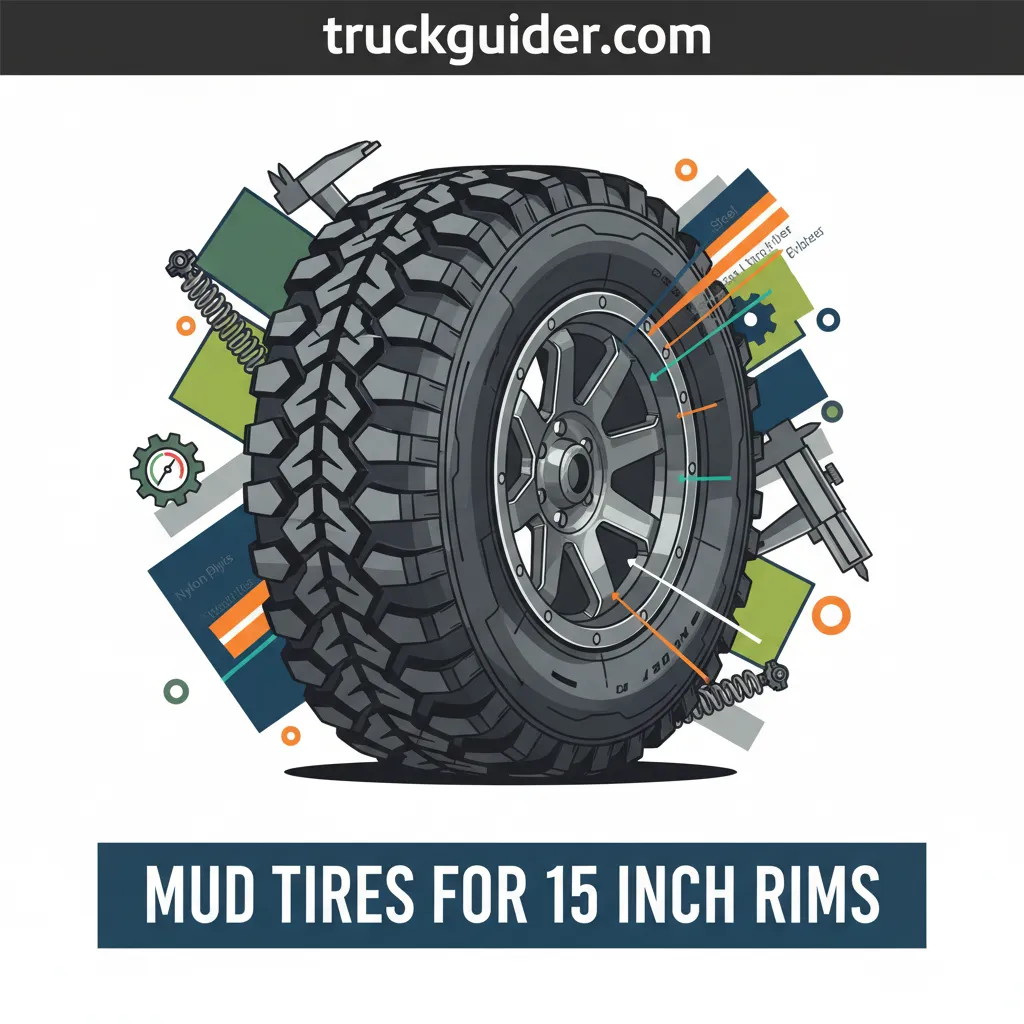
Mud Tires For 15 Inch Rims [2026]

For off-road enthusiasts and professional recovery teams, the 15-inch rim remains a gold standard for technical mud navigation despite the industry shift toward larger wheel diameters. While modern luxury 4x4s often come standard with 18 or 20-inch wheels, seasoned veterans understand that performance in the thickest clay and deepest silt requires a specific wheel-to-rubber ratio. Selecting the wrong mud tire can lead to poor traction, frequent punctures, and a compromised driving experience both on and off the pavement. This article provides an expert analysis of mud tires for 15 inch rims, detailing the engineering, sizing, and construction factors required for a reliable and high-performing setup.
Engineering Advantages of 15-Inch Mud Terrain Tire Configurations
📤 Share Image
The technical superiority of a 15-inch rim in off-road applications stems primarily from the sidewall-to-rim ratio. Engineering data confirms that a 33-inch tire on a 15-inch rim provides 2.5 inches more vertical sidewall than the same diameter tire on a 20-inch rim. This additional rubber acts as a primary suspension component, absorbing high-frequency impacts before they reach the shock absorbers. For classic platforms like the Jeep Wrangler TJ or early Toyota Hilux, this configuration is essential for preserving the longevity of suspension bushings and steering linkages.
Footprint Elongation and Low-Pressure Performance
When operating in deep mud, surface area is your most trusted ally. A 15-inch rim setup allows for maximum footprint elongation when aired down to 10-15 PSI. Because there is more sidewall to “bag out,” the tire’s contact patch expands lengthwise rather than just widthwise. This creates a tank-tread effect, distributing vehicle weight over a larger area and preventing the tire from digging into a “bottomless” mud pit. High-quality compounds are engineered to dissipate the heat generated by this internal friction during low-pressure operation, ensuring the casing does not delaminate under heavy load.
Rotational Mass and Mechanical Leverage
From a professional mechanical perspective, 15-inch wheels offer significant advantages regarding rotational mass. Smaller wheels weigh less than their 18 or 20-inch counterparts, reducing the strain on the vehicle’s braking system and drivetrain. Furthermore, the shorter lever arm from the wheel center to the tie-rod ends means the steering box has to exert less force to turn the wheels when they are bound up in heavy clay. This complete reduction in mechanical stress is why 15-inch setups remain the preferred choice for technical rock crawling and mud bogging where steering components are frequently pushed to their failure points.
By The Numbers
Extra Sidewall vs 20″ Rims
Optimal Mud Pressure
Reduction in Rotational Mass

Analyzing High-Quality Tread Designs for Reliable Mud Traction
Traction in the mud is not just about having large lugs; it is about the ability of the tire to “self-clean.” Without effective debris ejection, a mud tire quickly becomes a “slick,” losing all grip. Expert tread designs focus on the void ratio—the percentage of the tread area that is open space. Most mud-terrain tires feature a void ratio of 50% or higher to prevent thick clay from packing between the lugs.
Advanced Self-Cleaning Technologies
Leading manufacturers utilize specific engineering features to maintain momentum. For instance, the BFGoodrich KM3 features ‘Mud-Phobic’ bars—raised ridges in the shoulder channels that break the vacuum between the mud and the tire casing, literally popping the mud out as the tire rotates. Similarly, stone ejector ribs located at the base of the tread grooves prevent small rocks from drilling into the carcass, which is a common cause of slow leaks and tire failure in mixed-terrain environments.
Scalloped Shoulders
Staggered shoulder lugs provide lateral bite on off-camber slopes, preventing the vehicle from sliding sideways into ruts.
Full-Depth Siping
Maintains wet asphalt traction by providing micro-edges that break the surface tension of water on the road.
Pattern Directionality: Choosing Your Path
When selecting a professional-grade tire, you must choose between directional and non-directional patterns. Directional tires are engineered to channel mud away from the center of the tire with maximum efficiency, but they cannot be rotated across the vehicle, which can lead to uneven wear. Non-directional patterns, such as the Goodyear Wrangler MT/R with its asymmetric design, offer a reliable balance of mud extraction and rock-climbing grip, allowing for a standard 5-tire rotation cycle to extend tread life.

Professional Comparison: Radial vs. Bias Ply Options for 15-Inch Rims
The choice between radial and bias ply construction is often the most debated topic among off-roaders. For a trusted purchase decision, you must evaluate your vehicle’s primary use case. Radial tires utilize plies that run 90 degrees to the direction of travel, allowing the tread and sidewall to act independently. This results in 20-30% cooler operating temperatures at highway speeds compared to bias ply options, significantly reducing the risk of blowouts during long-distance travel.
Conversely, Bias Ply tires are the choice for dedicated trail rigs. The criss-crossed plies extend from bead to bead, creating a uniform carcass strength that is unmatched for sidewall puncture resistance. While they suffer from “flat-spotting”—where the tire remains oval-shaped for the first few miles of driving after sitting—their ability to wrap around sharp obstacles at 5 PSI makes them the expert choice for extreme conditions. For most users driving to the trail, a high-quality radial with a Load Range C or D rating provides the best compromise between trail performance and road safety.
Sizing and Fitment Protocols for Trusted Off-Road Performance
Understanding sizing is critical when fitting mud tires to 15-inch rims. You will encounter two primary designation styles: flotation (e.g., 31×10.50R15) and metric (e.g., 265/75R15). For most 15-inch rim applications, flotation sizing is the professional standard. It is more intuitive, as the first number represents the total tire diameter and the second represents the width.
📋
Step-by-Step Fitment Guide
For a 12.50-inch wide tire, an 8-inch wide rim is the trusted choice. This “pinches” the bead slightly, helping to retain the tire on the rim at low pressures compared to a 10-inch wide wheel.
Most 15×8 inch wheels feature a -19mm offset (3.75 to 4.0 inches of backspacing). This moves the tire outward to provide clearance for the frame and steering components during full-lock turns.
Moving to 33 or 35-inch tires requires professional re-gearing to restore torque. Expect to trim body mounts or fender liners on vehicles like a stock Jeep Cherokee XJ with a 3-inch lift.
Many modern vehicles (post-2010) have enlarged brake calipers that will physically not fit inside a 15-inch rim. Always dry-fit a wheel before mounting tires to ensure caliper clearance.
Durability Engineering: Sidewall Protection and Compound Integrity
The longevity of a mud tire is determined by its internal engineering. A comprehensive mud tire must withstand “pinching” between the rim and a rock, as well as the abrasive nature of spinning in gravel. Modern mud terrain tires utilize silica-reinforced compounds to improve wet braking by up to 15% over traditional carbon-black rubber, while also providing reliable cut-and-chip resistance.
Advanced Carcass Construction
Professional-grade tires like the Maxxis Razr MT or Toyo Open Country M/T utilize a three-ply polyester carcass construction. This is the industry standard for preventing sidewall punctures. Toyo, in particular, uses a “high-turn-up” ply design, where the internal plies wrap high up the sidewall, providing double or triple thickness in the most vulnerable areas. This is supported by high-tensile steel belts that reinforce the tread area against sharp debris.
✅ Pros
- Maximum impact absorption for vehicle longevity.
- Superior bead retention when aired down.
- Cost-effective compared to larger wheel diameters.
- Wide availability of professional-grade tread patterns.
❌ Cons
- Incompatible with large modern brake systems.
- Increased sidewall flex can feel “squishy” on highways.
- Limited rim selection for newer bolt patterns.
Protection Against the Elements
Finally, durability is also about chemical resilience. High-quality tires are infused with UV stabilizers and anti-aging agents. Since mud tires are often used on “weekend rigs” that may sit for extended periods, these agents prevent the rubber from drying out and cracking (dry rot). Furthermore, bead protector ribs are molded into the sidewall just above the rim flange to prevent sand and mud from packing into the bead seat and causing air leaks.
Always maintain a 5-tire rotation schedule with mud tires. Because of the high void ratio and soft compounds, mud tires are prone to “cupping” or irregular wear if left in one position for too long. Rotating every 3,000 miles is the expert recommendation.
In summary, configuring mud tires for 15-inch rims remains the complete choice for those prioritizing off-road performance and mechanical reliability. 15-inch rims offer superior sidewall flex and impact absorption compared to larger alternatives, which is vital for both traction and vehicle preservation. Selecting a high-quality tread pattern with self-cleaning lugs is essential for maintaining momentum in deep mud, while professional fitment requires balancing tire width with proper wheel backspacing to avoid mechanical interference. Consult with a trusted tire specialist to verify your load requirements and rim compatibility before finalizing your off-road tire selection.
Frequently Asked Questions
Can I run 15 inch rims on a vehicle that came with 17 inch wheels?
This depends entirely on brake caliper clearance. Many modern trucks and SUVs use larger brake rotors that physically block a 15-inch rim. Professional fitment requires checking the caliper bracket dimensions. If the vehicle was originally equipped with 16 or 17-inch wheels, a 15-inch rim may require specialized high-clearance wheels or minor caliper modification, which should only be performed by an expert.
What is the most reliable tire pressure for mud tires on 15 inch rims?
For highway travel, follow the vehicle manufacturer’s door placard, typically 30-35 PSI. For off-road mud navigation, a trusted pressure is usually between 12 and 18 PSI. This increases the footprint and allows the lugs to wrap around terrain. However, dropping below 10 PSI without beadlock wheels increases the risk of the tire debeading from the rim during high-torque maneuvers.
How do I know if I need a radial or bias ply mud tire?
For a vehicle that is driven to the trail or used as a daily commuter, a professional radial tire is the only viable option due to its stability and heat management. Bias ply tires are reserved for dedicated trail rigs or extreme rock crawling where sidewall strength is more important than steering precision or tread life. Radials offer a more reliable and comfortable experience for 90% of users.
Why are 31×10.50R15 mud tires so popular for older SUVs?
The 31×10.50R15 size is a professional favorite because it provides a significant ground clearance increase over stock tires without requiring extensive suspension modifications. Most quality 15-inch mud tires in this size fit within factory wheel wells with minimal rubbing, making it a reliable and cost-effective entry point for improving off-road capability on platforms like the Jeep XJ or Ford Ranger.
How long do quality mud tires typically last on the pavement?
Expertly maintained mud-terrain tires can last between 35,000 and 50,000 miles. Longevity depends heavily on regular rotation (every 3,000-5,000 miles) and maintaining proper alignment. Because the lugs are larger and the compounds are often softer than all-terrain tires, they are susceptible to uneven wear if the vehicle’s suspension geometry is not correctly calibrated or if they are frequently used on high-temperature asphalt.
![3.6 Pentastar Oil Type & Capacity Guide (2011: Specs & Fitment Guide [2026]](https://truckguider.com/wp-content/uploads/2026/03/3-6-pentastar-oil-type-featured.webp)
![Reprogram Dodge Key Fob Push Start [2026]](https://truckguider.com/wp-content/uploads/2026/03/featured-bb1a0e6c-768x432.webp)
![Cruise Control Turns On But Will Not Set [2026]](https://truckguider.com/wp-content/uploads/2026/03/featured-0a745d5a-768x768.webp)