P203F Code 6.7 Cummins: Diagnose & Fix [2026]

P203F on a 6.7L Cummins indicates a performance issue with the Reductant Level Sensor, which often leads to a severe engine derate or ‘speed limited’ mode. This fault typically stems from a failed internal sensor within the DEF tank assembly or damaged wiring harness connections. Addressing this promptly is critical to avoiding a 5-mph speed restriction and costly roadside assistance.
🎯 Key Takeaways
Recommended Best Deal Products


- Takeaway 1:P203F often triggers a countdown to a 5-mph engine derate.
- Takeaway 2:The DEF level sensor is usually integrated into the tank assembly.
- Takeaway 3:Inspect the wiring harness for corrosion before replacing the tank.
- Takeaway 4:Modern 6.7L Cummins engines require precise DEF level monitoring.
- Takeaway 5:Cold weather can trigger false P203F readings if heaters fail.
The P203F code on a 6.7L Cummins engine indicates a Reductant Level Sensor Circuit Performance issue. This diagnostic trouble code (DTC) triggers when the Engine Control Module (ECM) detects that the signal from the Diesel Exhaust Fluid (DEF) level sensor is irrational or fluctuating outside of normal operating parameters. Essentially, the truck’s computer knows how much DEF should be in the tank based on consumption rates, and when the sensor reporting doesn’t match that reality, it flags a performance error.
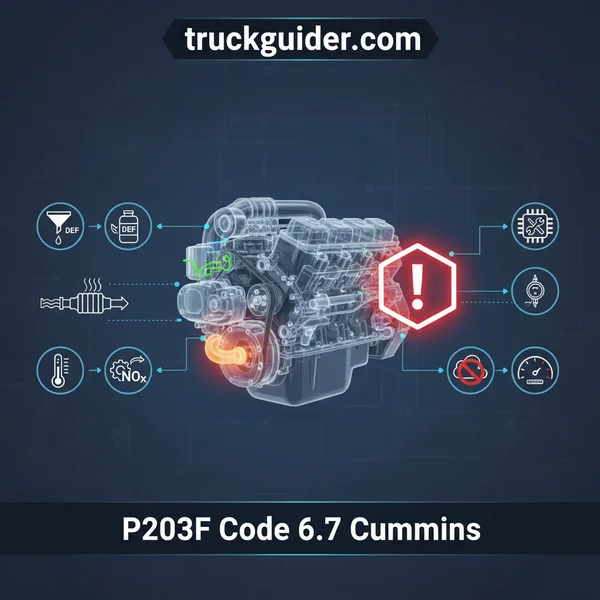
Ignoring this code is not an option for any 6.7L Cummins owner. Because the SCR (Selective Catalytic Reduction) system relies on accurate DEF levels to meet federal emissions standards, the ECM treats a faulty sensor as a critical system failure. This code is a primary precursor to a forced engine derate, which will eventually limit your vehicle speed to a crawl. Understanding how to diagnose the wiring and the internal sensor assembly is the only way to avoid an expensive and unnecessary “parts-cannon” approach to repairs.
Understanding the P203F Fault Code in 6.7L Cummins Engines
On the 6.7L Cummins platform, the DEF level sensor is part of the DEF tank header assembly. This unit does more than just measure fluid; it also monitors DEF temperature and contains the heating element used to thaw frozen fluid in cold climates. The P203F code specifically highlights a “performance” or “rationality” problem. This means the circuit isn’t necessarily “open” or “shorted” (which would trigger different codes), but rather that the data it is sending back to the ECM is nonsensical.

The Logic Behind the Fault
The ECM monitors the DEF level over a specific period. If you are driving and the fluid level suddenly jumps from 70% to 10% and back to 60% within a few seconds, the ECM recognizes this as a hardware malfunction. Common triggers for this irrational data include:
- Internal sensor failure due to DEF crystallization or “creeping” salts.
- Debris or contaminants inside the DEF tank interfering with the ultrasonic sensor path.
- Electrical resistance in the wiring harness caused by corrosion.
- Pin tension issues at the main harness connector.
Why It Targets the 6.7L Cummins Specifically
The 6.7L Cummins engine uses a complex DEF header. In many model years, especially the Ram 2500 and 3500 chassis, the sensor is an ultrasonic transducer. This transducer sends sound waves to the surface of the fluid to calculate depth. If the fluid is highly aerated or if there is a film of dried DEF on the sensor head, the “echo” returns a garbled signal, leading directly to the P203F performance code.
Common Symptoms and the Engine Derate Countdown
The most immediate symptom of P203F is the Check Engine Light (CEL) and a notification on your Electronic Vehicle Information Center (EVIC) regarding the DEF system. You may notice your DEF gauge acting erratically, perhaps staying at “Full” for hundreds of miles before dropping to “Empty” instantly, or vice versa. However, the most “frightening” symptom for any driver is the looming threat of the derate system.
The Imminent 5 MPH Derate
The Cummins emissions strategy is designed to be “un-bypassable.” If the ECM cannot verify that there is enough DEF to satisfy the SCR catalyst, it will begin a tiered derate process. Usually, this starts with a warning message like “Speed Limited to 55 MPH in 50 Miles.” If the P203F code remains active and the ECM cannot see a rational fluid level, the truck will eventually enter a final derate mode, limiting your speed to 5 MPH. This is often referred to as “limp mode,” and it is designed to force you to a service center.
Visual and Audible Warnings
- DEF Gauge Inaccuracy: The needle may bounce or show a red “Empty” light even if you just filled the tank.
- Chime Alerts: Frequent dashboard chimes reminding you of an emissions service requirement.
- Active Messaging: The message center will likely display “Service DEF System – See Dealer.”
Initial Diagnostic Steps: Wiring and Connectors
Before assuming the expensive DEF header assembly is dead, you must rule out the wiring. The DEF tank is located in a position vulnerable to road salt, moisture, and debris. Physical damage to the harness is the leading cause of “ghost” performance codes. You are looking for high resistance or intermittent signal loss that confuses the ECM.
Inspecting for Corrosion and Pin Tension
Locate the 4-way or 8-way connector (depending on your specific year/model) at the top of the DEF tank. Disconnect it and inspect the pins carefully. Look for any signs of green or white crust; this is “green rot” or DEF crystallization. Even a microscopic amount of DEF inside a connector can bridge pins and cause a P203F code. Use a dedicated contact cleaner and an inspection light to ensure the pins are straight.
Check for “pin tension” using a sacrificial male pin. If the female side of the connector feels loose or doesn’t “grab” the pin, the vibration of the truck during travel will cause the sensor signal to flicker. This intermittent connection is exactly what triggers a “performance” code rather than a “circuit low” code. If you find loose pins, you will need to de-pin the connector and tighten the terminals or replace the pigtail entirely.
Checking Resistance in the Harness
Using a digital multimeter, check the ground and power feeds to the DEF header. Ensure you have a solid 12V (or 5V reference, depending on the pinout) and a clean ground. If the voltage fluctuates while you wiggle the harness, you have found a break in the wire. Pay close attention to the area where the harness bends over the frame rail, as this is a common rub point for the 6.7L Cummins wiring looms.
Primary Causes: Internal Tank Failures vs. Wiring Issues
When your 6.7 Cummins throws the P203F code, the culprit is usually narrowed down to two main areas: the environment inside the tank or the electrical path leading to it. Understanding the distinction helps you decide if you are looking at a simple connector cleanup or a major component replacement.
Internal Sensor Malfunctions
The DEF level sensor is a precision instrument living in a harsh, chemical-heavy environment. Over time, the Diesel Exhaust Fluid can crystallize, especially if the truck sits for long periods or is exposed to extreme temperature swings. These crystals can “blind” the ultrasonic sensors or jam the float-style sensors used in different Cummins generations.
- Thermal Fatigue: Constant heating and cooling of the DEF—especially in cold climates where the tank heater runs frequently—can cause the internal circuit boards to crack or delaminate.
- Fluid Contamination: Even a microscopic amount of oil, fuel, or non-approved fluid can coat the sensor, leading to erratic “out of range” readings that trigger the P203F.
- Urea Buildup: If the DEF level is consistently kept low, urea crystals can form on the upper portions of the sensor assembly, interfering with its ability to bounce signals off the fluid surface.
External Wiring and Connector Damage
Because the DEF tank is mounted underneath the chassis, the wiring harness is a prime target for road debris, salt, and moisture. A single frayed wire can mimic a total sensor failure, confusing the ECM.
- Corroded Pins: Inspect the main electrical plug at the DEF tank. Green, crusty buildup (corrosion) often causes the “circuit performance” aspect of the P203F code by increasing resistance.
- Vibration Chafing: Cummins engines produce significant vibration. If the harness isn’t secured perfectly, it can rub against the frame rail, eventually wearing through the wire insulation and causing an intermittent short.
Cost Factors and Replacement vs. Repair Considerations
Facing a P203F code often presents a “pay now or pay later” scenario. Because the 6.7 Cummins emission system is highly integrated, trying to cut corners on the level sensor can lead to repeated trips to the shop and frustrating derate cycles.
Part Costs and Labor
On most modern 6.7 Cummins applications, the level sensor is integrated into the DEF Sender Assembly (also called the DEF Header). This means you typically cannot replace just the sensor; you must replace the entire internal unit which includes the pickup tube and the heater.
Prices for these assemblies generally range from $600 to $1,500 for the part alone. Labor typically adds another 2 to 4 hours of shop time. Since the tank often needs to be drained and dropped to access the header, it is a labor-intensive process that can bring the total bill to anywhere between $1,000 and $2,200 at a professional facility.
Why Cleaning Rarely Works
It is often tempting to try and wash out the DEF tank with distilled water to dissolve crystals. While this might provide a temporary reprieve, it rarely solves the underlying electronic failure inside a sealed sensor. Most technicians recommend a full replacement of the DEF header for several reasons:
- Sealed Components: Modern ultrasonic sensors are sealed units; they cannot be opened or manually cleaned if the internal electronics have failed.
- Preventative Care: Replacing the assembly ensures you also get a fresh heater and pickup tube, preventing you from having to pull the tank again in six months for a different code.
- Reliability: The risk of being stranded in “Limp Mode” far outweighs the temporary savings of a “patch” repair.
Conclusion: Staying Ahead of the Derate
The P203F code on a 6.7 Cummins is more than just a nuisance; it is a ticking clock. Whether the issue is a crystallized sensor inside the tank or a corroded wire in the chassis harness, addressing it early is the only way to keep your truck out of a permanent derate. While the cost of a new DEF header can be steep, it is a necessary investment to maintain the reliability of your engine’s emission system.
Next Steps: Start by inspecting your DEF tank wiring harness for visible damage and ensuring your fluid is fresh. If the code persists after a reset, have a diagnostic scan performed to monitor the live “Level Percentage” data—this will confirm if the sensor is truly “frozen.”
Tired of dealing with unexpected dash lights? Subscribe to our newsletter for more 6.7 Cummins maintenance guides and part recommendations to keep your rig on the road!
💬 Quick Questions & Answers
Can P203F cause limp mode?
Yes, it often triggers a ‘Service DEF System’ message followed by a severe speed derate.
Can I replace just the level sensor?
On most 6.7L Ram models, the sensor is integrated and requires a full DEF tank replacement.
Does DEF quality cause P203F?
Usually no; P203F is a circuit performance code, while P20EE typically indicates fluid quality issues.
Will the P203F code clear itself?
It may clear if the signal returns to range, but the derate timer often requires a scan tool reset.
Is it safe to drive with code P203F?
No, because the truck will eventually limit your speed to 5 mph or idle only.
❓ Frequently Asked Questions
What exactly does Reductant Level Sensor Circuit Performance mean?
It means the ECM is receiving a signal from the DEF level sensor that is illogical or out of range compared to expected values. This prevents the truck from accurately monitoring DEF levels, causing a failsafe derate.
Why does the 6.7 Cummins require a whole tank assembly for this code?
The level sensor, heater, and pickup tube are often ultrasonically welded or sealed inside the DEF reservoir. Manufacturers design it this way to prevent leaks, meaning the entire unit must be swapped if one part fails.
How does the wiring harness affect the P203F code?
The DEF tank is exposed to road debris and moisture, leading to corroded pins at the connector. Even a small amount of resistance in the wiring can trick the ECM into throwing a P203F code even if the sensor is good.
What is the average cost to fix P203F on a Ram 2500/3500?
Parts for a new DEF tank assembly typically range from $600 to $1,200, plus 2-3 hours of labor. Total costs often land between $1,000 and $1,800 depending on the shop and location.
Does cold weather contribute to P203F errors?
Yes, frozen DEF can sometimes provide erratic readings to the level sensor if the tank heater isn’t working correctly. This can cause temporary performance codes during extreme winter conditions until the fluid thaws.
Will deleting the DEF system fix P203F?
While ‘deleting’ removes the sensor requirement, it is illegal for road-going vehicles in many jurisdictions and voids warranties. Repairing the OEM system is the recommended legal path for daily drivers.

![2022 Ram 2500 Fuel Filter [2026]](https://truckguider.com/wp-content/uploads/2026/03/2022-ram-2500-fuel-filter-featured.webp)