Power Stroke Engine Generations Chart: Every Year & Spec

Ford has built eight distinct Power Stroke generations since 1994, spanning the 7.3L, 6.0L, 6.4L, three versions of the 6.7L, and the light duty 3.0L V6. Each generation changed displacement, injection technology, or emissions equipment, and those changes drive massive differences in horsepower, torque, and long term reliability.
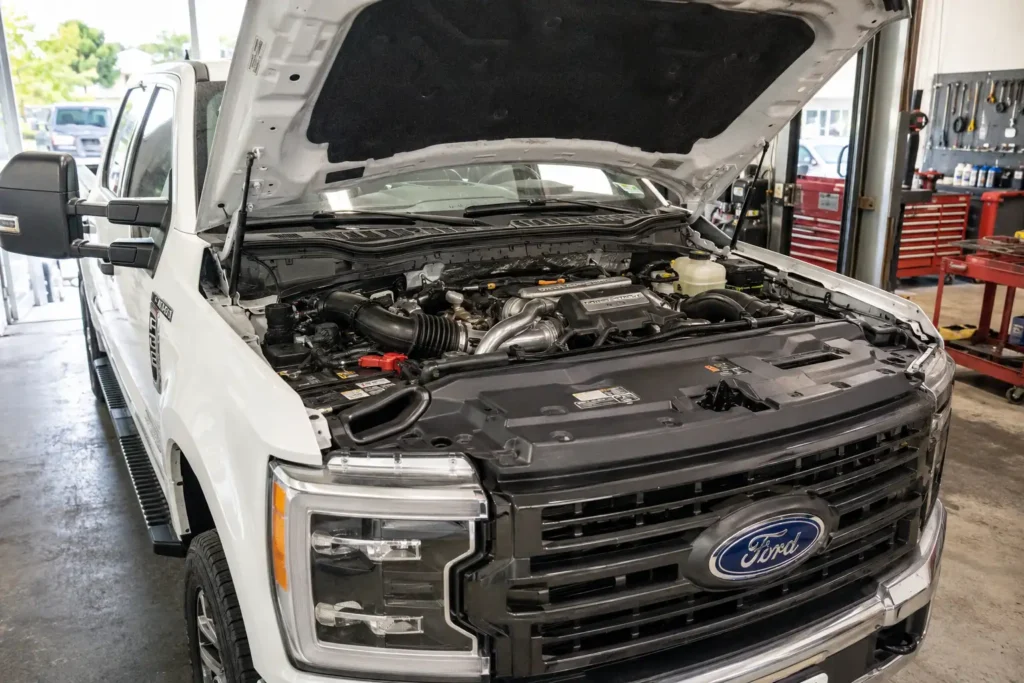
The chart below maps every generation to its production years and specs. After the chart, each engine gets a closer look at what changed and why it matters for buyers and owners.
Truck Guider
Power Stroke Engine Generations Chart
Horsepower growth and key specs across all eight generations, 1994 to 2025
Horsepower by generation
7.3L Power Stroke
1994 to 2003
Peak HP
Peak lb-ft
HEUI injection, no DPF. Most reliable generation.
6.0L Power Stroke
2003 to 2007
Peak HP
Peak lb-ft
Variable geometry turbo. EGR cooler and HPOP failure points.
6.4L Power Stroke
2008 to 2010
Peak HP
Peak lb-ft
First DPF, twin turbo. Shortest production run.
6.7L Power Stroke Gen 1
2011 to 2014
Peak HP
Peak lb-ft
First Ford in-house design. DEF and SCR introduced.
6.7L Power Stroke Gen 2
2015 to 2019
Peak HP
Peak lb-ft
Revised turbo and cooling for better drivability.
6.7L Power Stroke Gen 3
2020 to 2022
Peak HP
Peak lb-ft
Paired with the new 10R140 transmission.
6.7L Power Stroke High Output
2023 to present
Peak HP
Peak lb-ft
Highest output Super Duty diesel to date.
3.0L Power Stroke V6
2018 to 2021
Peak HP
Peak lb-ft
Light duty F-150 only. Not a Super Duty engine.
Power Stroke Generations Chart From 1994 To 2025
Recommended Best Deal Products


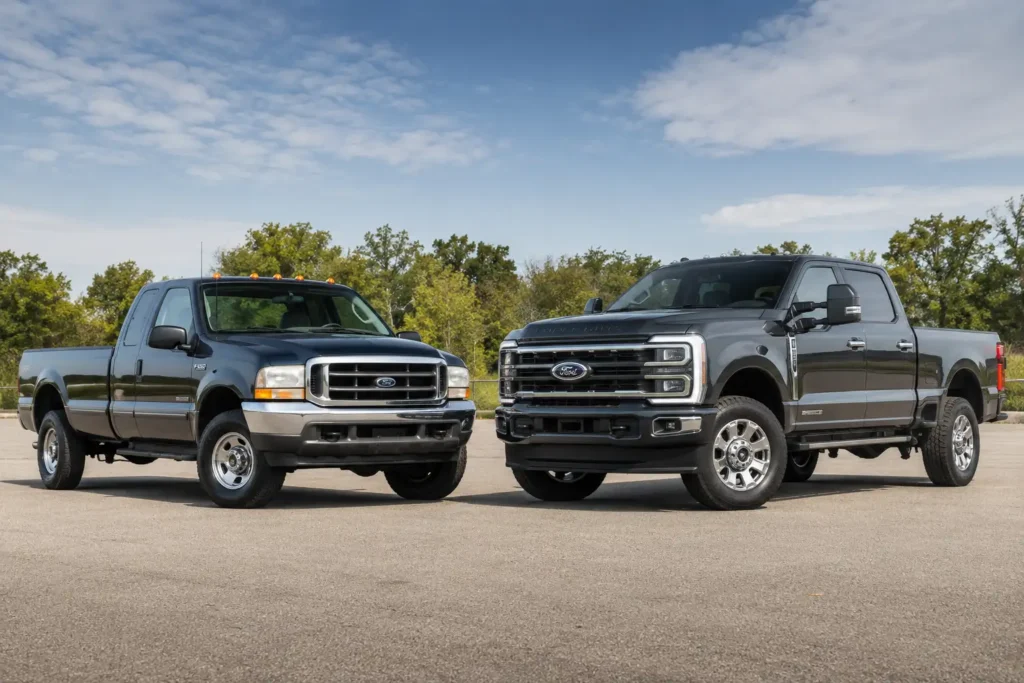
This table lists every Power Stroke generation in order, with the specs that matter most when comparing a used Super Duty against a newer one.
Power Stroke Engine Generations Chart
All eight generations from 1994 to 2025, ranked by production year
| Generation | Years | Displacement | Horsepower | Torque | Key Technology |
|---|---|---|---|---|---|
| 7.3L Power Stroke | 1994 to 2003 | 7.3L V8 | 210 to 275 hp | 425 to 525 lb-ft | HEUI injection, no DPF |
| 6.0L Power Stroke | 2003 to 2007 | 6.0L V8 | 325 hp | 560 to 570 lb-ft | Variable geometry turbo |
| 6.4L Power Stroke | 2008 to 2010 | 6.4L V8 | 350 hp | 650 lb-ft | First DPF, twin turbo |
| 6.7L Power Stroke Gen 1 | 2011 to 2014 | 6.7L V8 | 390 to 400 hp | 735 to 800 lb-ft | Ford in-house design, DEF and SCR |
| 6.7L Power Stroke Gen 2 | 2015 to 2019 | 6.7L V8 | up to 440 hp | up to 935 lb-ft | Revised turbo and cooling |
| 6.7L Power Stroke Gen 3 | 2020 to 2022 | 6.7L V8 | 475 hp | 1,050 lb-ft | 10R140 transmission pairing |
| 6.7L Power Stroke High OutputCurrent | 2023 to present | 6.7L V8 | 500 hp | 1,200 lb-ft | Highest output Super Duty diesel to date |
| 3.0L Power Stroke V6 | 2018 to 2021 | 3.0L V6 | 250 hp | 440 lb-ft | Light duty F-150 diesel only |
Towing capacity moves with each generation too. For the exact towing numbers by trim and drivetrain, the Ford Super Duty towing capacity chart breaks those figures down by model year.
With the full timeline in view, here is what actually changed inside each generation.
7.3 Power Stroke Specs From 1994 To 2003
The 7.3L Power Stroke replaced the older 7.3L IDI in 1994 and introduced HEUI injection, short for Hydraulically actuated Electronically controlled Unit Injector. That system let Ford control fuel delivery electronically for the first time in this engine family.
Output climbed from 210 horsepower and 425 lb-ft at launch to 275 horsepower and 525 lb-ft by the final 2003 models. No DPF, no DEF, and a mechanically simple design are the main reasons this generation is widely considered the most reliable Power Stroke ever built.
Owners looking to build on that reliability with modern parts can start with our guide to the best 7.3 Power Stroke upgrades, covering intake, injector, and turbo options for this engine specifically.
6.0 Power Stroke Specs From 2003 To 2007
Recommended Best Deal Products


The 6.0L Power Stroke arrived for the 2003 model year, the same year Ford phased out the 7.3L. That overlap makes 2003 trucks a common point of confusion for buyers, since both engines were briefly available.
Power rose to 325 horsepower, and torque climbed to 570 lb-ft after a 2005 update. Behind those numbers, the 6.0L struggled with EGR cooler failures, high pressure oil pump wear, and head gasket problems that damaged its reputation and led Ford to discontinue it early, in 2007.
If a specific 2003 truck is in question, our breakdown of 2003 7.3 Power Stroke specs helps confirm which engine came in that model year before assuming it is a 6.0L.
6.4 Power Stroke Specs From 2008 To 2010
The 6.4L Power Stroke lasted only three model years, making it the shortest production run in the lineup. It was also the first Power Stroke built with a Diesel Particulate Filter, a change driven by tightening EPA emissions rules.
Output rose to 350 horsepower and 650 lb-ft of torque. The twin turbo setup improved response, but the added DPF regeneration cycles brought new fuel economy complaints and higher long term maintenance costs than the 7.3L generation before it.
6.7 Power Stroke Generations Explained From 2011 To 2025
Recommended Best Deal Products


The 2011 model year marked a turning point. Ford stopped outsourcing diesel design to Navistar and built the 6.7L entirely in-house, using a compacted graphite iron block for added strength at lower weight. This generation also introduced Diesel Exhaust Fluid and Selective Catalytic Reduction to meet emissions standards.
6.7 Power Stroke Gen 1 From 2011 To 2014
The first 6.7L Power Stroke launched at 390 horsepower and 735 lb-ft of torque, climbing to 400 horsepower and 800 lb-ft by 2014. Some early 2011 and 2012 trucks experienced turbocharger bearing issues, though the core design proved solid.
6.7 Power Stroke Gen 2 From 2015 To 2019
Ford refined the turbo and cooling systems for this update, pushing output up to 440 horsepower and roughly 935 lb-ft of torque by the end of the run. Drivability and towing performance both improved over Gen 1.
6.7 Power Stroke Gen 3 From 2020 To 2022
Horsepower jumped to 475 and torque reached 1,050 lb-ft, paired with the new 10R140 TorqShift transmission. This generation closed the gap with the Ram 6.7L Cummins and GM 6.6L Duramax in outright towing numbers.
6.7 Power Stroke High Output From 2023 To 2025
The current High Output 6.7L produces 500 horsepower and 1,200 lb-ft of torque, the highest figures in Power Stroke history. Buyers deciding between this generation and an older 7.3L for a project truck can compare both directly in 7.3 versus 6.7 Power Stroke.
3.0 Power Stroke V6 Specs For The F-150
The 3.0L Power Stroke is a different engine family entirely, built for the light duty F-150 rather than the Super Duty lineup. Ford introduced it for 2018, based on the same Lion V6 platform used in some Land Rover and Jaguar models.
It produced 250 horsepower and 440 lb-ft of torque, with an EPA rating around 22 mpg city and 30 mpg highway. Ford discontinued the 3.0L Power Stroke after the 2021 model year due to low demand and the F-150’s growing hybrid and EcoBoost lineup.
How To Identify Your Power Stroke Generation By Year
Matching a truck to its generation only takes a few steps.
- Confirm the model year and whether the truck is an F-150 or a Super Duty model, since the 3.0L only came in the F-150.
- Check the engine displacement badge on the front fender or tailgate, which lists 7.3L, 6.0L, 6.4L, 6.7L, or 3.0L.
- Cross reference that displacement and model year against the chart above to confirm the exact generation.
- For 6.7L trucks, narrow down the generation further using the horsepower and torque figures on the build sheet or window sticker, since three sub-generations share the same 6.7L displacement.
Power Stroke Generations FAQs
What Is The Most Reliable Power Stroke Generation
The 7.3L Power Stroke, built from 1994 to 2003, is widely regarded as the most reliable generation. Its simple HEUI injection system and lack of emissions equipment like DPF or DEF mean fewer parts that can fail over time.
How Many Power Stroke Generations Are There
There are eight Power Stroke generations: the 7.3L, 6.0L, 6.4L, three versions of the 6.7L, the 6.7L High Output, and the light duty 3.0L V6. Each represents a distinct set of specs and technology changes.
What Is The Difference Between The 6.0 And 6.4 Power Stroke
The 6.0L Power Stroke, built from 2003 to 2007, produces 325 horsepower and lacks a DPF. The 6.4L, built from 2008 to 2010, adds a DPF and twin turbos, raising output to 350 horsepower and 650 lb-ft.
Is The 6.7 Power Stroke Better Than The 7.3
The 6.7L Power Stroke produces far more horsepower and torque than the 7.3L, up to 500 hp and 1,200 lb-ft in current High Output form. The 7.3L remains the simpler, more mechanically reliable engine for owners who prioritize longevity over output.
When Did Ford Add DEF To The Power Stroke
Ford introduced Diesel Exhaust Fluid and Selective Catalytic Reduction with the first 6.7L Power Stroke in the 2011 model year. This system reduces nitrogen oxide emissions and is required on every Power Stroke generation since.
Matching a truck to the right Power Stroke generation comes down to two numbers: the model year and the displacement badge on the fender. From there, the horsepower and torque figures in the chart above confirm which sub-generation is under the hood, especially for the three 6.7L variants built since 2011.
Whether the goal is buying a used Super Duty or maintaining one already in the driveway, knowing the exact generation is the first step toward the right parts, the right maintenance schedule, and realistic expectations for towing and reliability.