Spectre Performance Cold Air Induction Systems for Light-Duty Trucks Guide 2025

The efficiency of an internal combustion engine is fundamentally constrained by its ability to process air. As an air pump, the engine’s volumetric efficiency—the ratio of the mass density of the air-fuel mixture drawn into the cylinder at atmospheric pressure to the mass density of the same volume of air in the intake manifold—is the primary determinant of potential power output.
In the highly competitive automotive aftermarket, the Cold Air Intake (CAI) has emerged as a foundational modification, serving as the “gateway” upgrade for enthusiasts seeking to optimize this respiratory process.


Within this landscape, Spectre Performance has carved a unique market niche. Unlike premium competitors that utilize rotomolded cross-linked polyethylene (XLPE) or carbon fiber composites, Spectre relies on a distinct architectural philosophy centered on polished aluminum tubing and open-element filtration. This report provides an exhaustive, data-driven analysis of Spectre Performance’s induction systems, specifically tailored for the light-duty truck segment—including the Ford F-150, Chevrolet Silverado, GMC Sierra, and Ram 1500.
By synthesizing dyno metrics, material science, thermal dynamics, and regulatory compliance data, this document aims to provide a definitive resource for technical stakeholders and consumers evaluating the efficacy of budget-oriented performance induction.
The Evolution of Intake Design
Factory intake systems are engineered with a set of priorities that often conflict with maximum performance. Original Equipment Manufacturers (OEMs) prioritize the mitigation of Noise, Vibration, and Harshness (NVH) above absolute flow velocity. This results in intake tracts characterized by corrugated tubing, Helmholtz resonators, and baffled airboxes designed to silence the acoustic pulses of the intake charge. While effective at sound suppression, these components induce turbulence, boundary layer separation, and parasitic pressure drops that throttle engine response.
The aftermarket solution, typified by Spectre, seeks to reverse this engineering compromise. By replacing the restrictive factory infrastructure with mandrel-bent tubing and high-flow filtration media, these systems aim to straighten the airflow path, reduce restriction, and theoretically increase the density of the oxygen charge entering the combustion chamber. This report investigates whether Spectre’s specific approach—often priced at 50-60% of tier-one alternatives—delivers on these thermodynamic promises or if the inherent thermal conductivity of its aluminum construction presents a critical flaw in real-world truck applications.
Spectre Cold Air Intakes
Unlocking hidden engine potential without emptying your wallet. A data-driven look at airflow, horsepower, and cost efficiency.
Data represents average gains on V8 truck engines (e.g., Silverado/F-150).
Real-World Power Gains
The primary reason to upgrade to a Spectre Cold Air Intake is the immediate boost in engine output. By replacing the restrictive factory air box with polished aluminum tubing and a high-flow conical filter, the engine breathes denser, colder air.
Horsepower Increase
Dyno tests consistently show gains between 7 and 18 HP depending on vehicle application.
Torque Improvement
Improved throttle response and low-end torque, typically adding 10-20 lb-ft of torque.
The Science of Airflow
Stock intakes are designed for noise reduction, not performance. They use baffles and resonators that disrupt airflow. Spectre systems prioritize laminar flow—smoothing the air path directly into the throttle body.
- ✓ Polished Aluminum Tubing
- ✓ Heat Shields included
- ✓ Synthetic Oiled Media
Spectre filters provide up to 50% less restriction than standard paper filters.
Budget-Friendly Performance
One of Spectre’s strongest selling points is its price-to-performance ratio. While premium brands like K&N or Volant offer similar gains, Spectre achieves this at a significantly lower entry cost, often saving the consumer over $150.
Why is it cheaper?
Spectre focuses on universal fitment components and simpler manufacturing processes (like polished aluminum vs. roto-molded plastic) to keep costs down without sacrificing the core filtration or airflow benefits.
Market Price Comparison (USD)
Key Technical Features
Heat Shielding
Powder-coated steel heat shields isolate the filter from hot engine bay air, ensuring the intake draws cooler, denser air from the fender well.
Washable Filter
The synthetic media filter is oiled and reusable. No need to buy replacements—simply wash and re-oil every 30,000 to 50,000 miles.
Bolt-On Install
Designed as a direct OEM replacement. Uses existing mounting points with no cutting or drilling required for most applications.
Installation Roadmap
Remove Stock Intake
Disconnect negative battery terminal. Unclamp the MAF sensor and remove the bulky factory air box and resonator.


Install Heat Shield
Assemble the heat shield and mount it using the factory air box mounting points. Install the rubber trim.
Mount Tube & Sensor
Transfer the MAF sensor to the new aluminum tube. Connect couplers and secure the tube to the throttle body.
Filter & Check
Clamp the conical filter to the intake tube. Double-check all hose clamps are tight. Reconnect battery.
The TruckGuider Verdict
If you are looking for the absolute premium finish, K&N might win on aesthetics. But for pure dollar-per-horsepower value, the Spectre Cold Air Intake is the clear winner for the budget-minded enthusiast. You get the sound, the throttle response, and the power gains for a fraction of the price.
© 2026 TruckGuider Infographics
Engineering Architecture and Material Science
The construction of a Spectre CAI system is distinct in a market increasingly dominated by plastics. A granular analysis of the materials used reveals both the engineering advantages and the thermal challenges inherent in the design.
The Physics of Aluminum Tubing
The centerpiece of the Spectre system is the intake tube, typically fabricated from polished or powder-coated aluminum.
Fluid Dynamics and Surface Topology
From a fluid dynamics perspective, the internal surface finish of the intake tube is critical. OEM rubber intake hoses feature accordion-style flex sections to accommodate engine movement. These ridges create vortices along the walls of the tube, effectively reducing the cross-sectional area available for laminar airflow. Spectre’s aluminum tubes are mandrel-bent, a process that inserts a solid rod into the tube as it is bent to prevent kinking or collapsing. This ensures that the internal diameter remains constant throughout the radius of the bend.
The result is a smooth internal surface that minimizes the coefficient of friction for the air column. By maintaining laminar flow, the system reduces the pressure drop between the air filter and the throttle body. This preservation of pressure is vital for throttle response, particularly in naturally aspirated V8 engines where intake velocity at partial throttle dictates the immediacy of torque delivery.
Thermal Conductivity and Heat Soak
The choice of aluminum, however, introduces a thermodynamic penalty: thermal conductivity. Aluminum is an excellent conductor of heat. In the environment of a truck engine bay—where under-hood temperatures can exceed 200°F (93°C) while towing or idling—the intake tube can act as a thermal bridge, absorbing radiant heat from the engine block, radiator, and headers.
Critics argue that this "heat soak" warms the intake air charge, reducing its density and thereby negating the benefits of increased flow. However, the counter-argument relies on the principle of residence time. At wide-open throttle (WOT), the velocity of the air moving through the intake tube is sufficiently high (often exceeding several hundred feet per second) that the air spends negligible time in contact with the heated walls of the tube. Therefore, while the tube itself may be hot to the touch, the heat transfer to the air charge during high-load events is minimal. Conversely, at idle or in heavy traffic, the aluminum tube will indeed heat the stagnant air inside, leading to elevated Intake Air Temperatures (IATs) and potential ignition timing retardation by the ECU until airflow resumes.
Filtration Technology: The HPR Media

Spectre utilizes its proprietary High Performance Replacement (HPR) filter media, which differs significantly from the traditional paper filters found in OEM applications.
Synthetic Architecture vs. Paper
OEM filters typically use a dense paper media designed for maximum filtration efficiency at the expense of flow. As these filters load with particulate matter, the pressure drop across them increases exponentially. Spectre’s HPR filters employ a non-woven synthetic media reinforced with a steel mesh.
- Depth Loading: Unlike surface-loading paper filters, the synthetic matrix allows for depth loading, where particles are trapped throughout the thickness of the media. This enables the filter to maintain high flow rates even as it accumulates dirt.
- Flow Characteristics: The synthetic fibers are engineered to have a lower resistance to flow than organic cotton fibers often used by competitors like K&N. This theoretically allows for higher CFM (Cubic Feet per Minute) ratings for a given surface area.
- Structural Integrity: The steel mesh reinforcement is crucial for preventing filter collapse under the high vacuum created by large displacement truck engines during aggressive acceleration.
The Role of Oil and The AccuCharge System
To maximize filtration efficiency in a less restrictive matrix, Spectre filters are typically oiled. The oil acts as a tacking agent, intercepting microscopic silica particles that might pass through the synthetic fibers. A common failure mode in aftermarket intakes is the contamination of the Mass Air Flow (MAF) sensor due to over-oiling the filter during maintenance. Excess oil can migrate off the filter media, coating the heated wire of the MAF sensor and insulating it, which causes the ECU to miscalculate air mass (often reading "lean") and triggering Check Engine Lights.
To mitigate this, Spectre introduced the AccuCharge Precision Air Filter Cleaning and Oiling System. This system replaces the generic aerosol spray cans with graduated squeeze bottles and precise applicator tips. This allows the user to apply a specific volume of oil calculated for the filter's surface area, significantly reducing the risk of sensor fouling.
Thermal Management: The Heat Shield Strategy
Spectre systems are classified as "open-element" intakes, meaning the conical filter is exposed within the engine bay rather than sealed in a box. To classify as a "Cold Air" intake, the system must isolate the filter from engine heat. Spectre achieves this via a powder-coated steel heat shield.
- Geometry: The heat shields are designed to fit the specific contours of the vehicle's corner fender area. They utilize the factory lower air inlet (where the stock box drew air) to source cool air from the fender well.
- Sealing: The top edge of the heat shield is lined with a thick rubber weather strip designed to seal against the underside of the vehicle’s hood when closed. This creates a semi-enclosed "room" for the filter, segregating it from the radiator wash and exhaust header heat.
- Effectiveness: While not as thermally efficient as a fully sealed injection-molded box (like those from S&B or Volant), the heat shield strategy is a cost-effective compromise that provides substantial airflow availability while blocking direct radiant heat.
Vehicle-Specific Application Analysis
The efficacy of a Spectre intake is highly dependent on the specific vehicle platform. The following sections provide a detailed analysis of the system's performance and fitment on the three major domestic truck platforms.
Ford F-Series (F-150)
The F-150 presents a unique challenge due to its diverse engine lineup, ranging from naturally aspirated V8s to twin-turbocharged V6s.


The 5.0L "Coyote" V8 (2011-2024)
The Coyote engine is a high-volumetric-efficiency powerplant with dual overhead cams and variable valve timing. It is extremely responsive to intake modifications.
- Performance Metrics: Manufacturer data and independent dyno testing suggest gains of approximately 9 to 10 horsepower at high RPMs (peaking around 4,950 RPM).
- Mechanism: The factory intake on the Coyote is relatively efficient, but the Spectre system (e.g., Part #9976) removes the accordion tubing, smoothing the airflow path. This allows the engine to pull air with less resistance at the 7,000 RPM redline.
- Sound: The acoustic change is dramatic. The Coyote’s induction roar is significantly amplified, a key selling point for this demographic.
The 3.5L EcoBoost V6
For the turbocharged EcoBoost, the intake dynamics are different. The intake feeds the turbocharger inlets rather than a throttle body directly.
- Turbo Spool: By reducing the pre-compressor pressure drop, the turbos can accelerate (spool) faster. This reduces the time-to-torque, improving transient response.
- Auditory Feedback: An open-element Spectre intake on an EcoBoost makes the turbo spool and the bypass valve (blow-off) noise audible inside the cabin. For some owners, this is desirable; for others, it may be intrusive.
- Heat Management: Turbo engines create immense under-hood heat. The importance of the heat shield seal is magnified here to prevent the intake from sucking in hot air that the intercooler then has to work harder to cool.
The 5.4L Triton V8 (2004-2010)
The older 3-valve 5.4L engine is known for its restrictive factory intake, which includes a massive silencer/resonator assembly sitting over the engine.
- Restoration of Space: Installing a Spectre kit (e.g., Part #9925) clears a significant amount of space in the engine bay, improving access to coils and injectors.
- Performance: Gains are primarily in throttle response rather than peak HP, as the 5.4L’s cylinder heads are the primary restriction point.
Chevrolet Silverado / GMC Sierra (GM Truck Platform)
The GM platform, particularly the 5.3L and 6.2L EcoTec3 engines, is the highest volume application for Spectre.
Mid-Range Torque Optimization
Dyno testing on a 5.3L Silverado revealed a fascinating performance characteristic. While peak horsepower numbers remained virtually unchanged (277 HP stock vs. 277 HP with intake), the area under the curve improved dramatically.
- The "Fat" Curve: The dyno graph showed gains of 28 horsepower and 44 lb-ft of torque in the mid-range RPM band. This is arguably more valuable for a truck than peak numbers, as this is the RPM range used for towing, merging, and passing.
- Throttle Response: Drivers consistently report that the "dead spot" in the gas pedal is reduced, attributing this to the removal of the turbulent factory tube.
MAF Sensor Sensitivity
GM’s mass airflow sensors are notoriously sensitive to turbulence. If the airflow across the sensor wire is not laminar, the reading will fluctuate, causing the transmission to shift erratically (since transmission line pressure is often tied to calculated engine load).
- Spectre's Engineering Solution: Spectre kits for GM trucks (e.g., Part #9900) typically include a specific MAF adapter or velocity stack insert designed to straighten the air just before it hits the sensor. Proper installation of this adapter is non-negotiable for smooth operation.
Ram 1500 (5.7L Hemi)
The Hemi engine is legendary for its performance, but also for its thermal output.
Dealing with the "Hemi Heat"
Ram trucks have large, open engine bays, but the exhaust manifolds generate significant radiant heat.
- Heat Shield Importance: The Spectre heat shield for the Ram (Part #9036 or #9934) is critical. It utilizes the factory lower air box mounting plate to secure the shield and seal it against the fender.
- Intake Routing: The intake tube on the Hemi routes towards the passenger front corner. Spectre’s polished aluminum tube is particularly visually striking in the Ram engine bay, contrasting with the large black plastic engine cover.
Performance and Acoustics
- The "Hemi Growl": The Hemi intake note is deep and guttural. Removing the factory resonator box releases this sound, which is often described as "waking up" the truck.
- Economy: Some Ram owners report slight MPG improvements (0.5 - 1 MPG) due to the reduced pumping losses, though this is heavily dependent on driving style.
Regulatory Compliance: The CARB Executive Order Ecosystem
For millions of truck owners in California and the growing number of states that have adopted California Air Resources Board (CARB) emission standards (including New York, Colorado, Maine, and others), the legality of an aftermarket intake is a binary "pass/fail" condition for vehicle registration. A non-compliant intake is considered "tampering" with the emissions system.
The Significance of the Executive Order (EO)
An Executive Order (EO) is a certification issued by CARB stating that a specific aftermarket part has been tested and proven not to increase vehicle emissions beyond the allowable certification standards. Without an EO decal affixed to the vehicle or the part, a truck will fail the visual inspection portion of a smog check, regardless of how clean the tailpipe emissions are.
Spectre Performance has invested heavily in achieving CARB compliance for a wide range of its intake systems. This distinguishes it from many "eBay special" or unbranded intakes that lack this certification and are therefore illegal for street use in restricted states.
Detailed CARB EO Analysis by Platform
The following table synthesizes the specific Executive Orders applicable to Spectre intakes for major truck models. This data is critical for consumers to verify before purchase.
| EO Number | Date/Era | Applicable Manufacturer | Specific Models Covered | Key Notes |
| D-629-4 | Legacy | GM / Dodge | 1999-2006 Silverado/Sierra 5.3L; 2002-2008 Ram 1500 | Covers the vast majority of "Gen 3" LS trucks and early Hemi trucks. A foundational EO for the brand. |
| D-629-13 | Modern | Ford | 2011-2014 F-150 5.0L Coyote; 2011-2014 F-150 3.5L EcoBoost | Validates the system for turbo and NA applications. Also covers 2015 Mustang 2.3L. |
| D-629-20 | Modern | Ram / Jeep | 2009-2019 Ram 1500 5.7L Hemi (Classic & New Body) | Crucial for the 4th Gen Ram owners. Specifically excludes some 2020+ evaporative families. |
| D-629-24 | Modern | Dodge / Chrysler | Dodge Charger/Challenger/300 (5.7L, 6.4L) | While car-focused, this covers the engine families shared with SUVs like the Durango. |
| D-629-12 | Modern | GM | 2014-2018 Silverado/Sierra 1500 5.3L | Covers the K2XX platform trucks. |
The Compliance Gap and Future Models
A critical nuance in CARB compliance is the lag time between a new vehicle's release and the issuance of an EO.
- The "Pending" Trap: Often, manufacturers will market a part as "CARB Pending." From a legal standpoint, "Pending" is equivalent to "Illegal." A part is not legal until the EO is signed.
- Model Year Cutoffs: Note that EO D-629-20 covers Rams up to 2019. Owners of 2020-2025 Ram 1500s must verify if a newer EO has been issued or if the 2019 coverage extends to their specific Engine Test Group. Often, minor changes in the factory hydrocarbon trap or PCV routing can invalidate an EO for a newer model year.
Thermal Dynamics and the "Cold Air" Debate
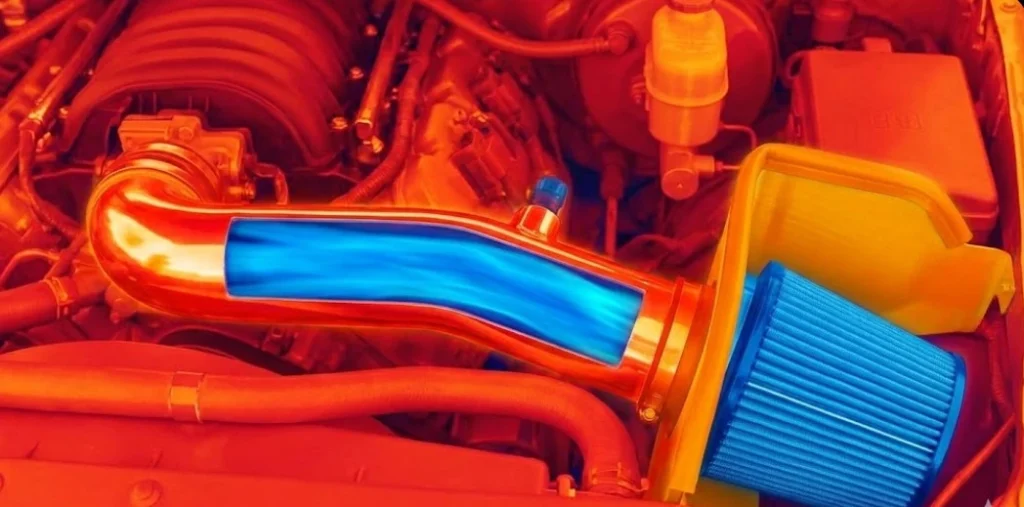
The most contentious technical debate surrounding products like Spectre’s concerns the validity of the term "Cold Air Intake." Critics argue that an open element filter housed in a metal tube inside a hot engine bay is actually a "Hot Air Intake." The data reveals a complex reality involving thermal inertia, airflow velocity, and operating conditions.
The Heat Soak Phenomenon
Heat soak occurs when the components of the intake system absorb radiant heat from the engine, raising their surface temperature.
- Aluminum vs. Plastic: Aluminum has high thermal conductivity ($k \approx 205 \text{ W/mK}$) compared to plastics like XLPE ($k \approx 0.4 \text{ W/mK}$). This means the Spectre tube heats up very quickly when airflow stops (e.g., at a red light).
- The Idle Spike: Testing on similar open-element systems (like the K&N) shows that IATs can spike to 145°F or more in stationary traffic, significantly higher than ambient.
The Velocity Factor
However, the performance of the intake is not defined by its static behavior.
- Recovery Time: The same high conductivity that allows the aluminum tube to heat up also allows it to shed heat rapidly. Once the vehicle moves and airflow resumes, the high-velocity air charge cools the tube. Testing indicates that open-element systems often return to near-ambient temperatures faster than enclosed plastic boxes, which act as insulators—keeping heat out initially, but trapping it in once saturated.
- Dynamic Airflow: At 60 MPH, the volume of air passing through the grille and into the fender well area (where the filter sits) is substantial. The heat shield effectively partitions this high-pressure cool air zone from the low-pressure hot air circulating around the headers.
Volumetric Efficiency vs. Temperature Density
There is a trade-off between flow restriction and air temperature.


- Restriction: The Spectre system drastically reduces restriction compared to stock.
- Temperature: It may run slightly hotter in traffic.
- Net Result: For most driving scenarios (acceleration, towing, highway cruising), the gain in airflow volume outweighs the minor density loss from temperature. The engine doesn't have to work as hard to pull in the air, releasing parasitic horsepower losses.
Competitive Market Analysis
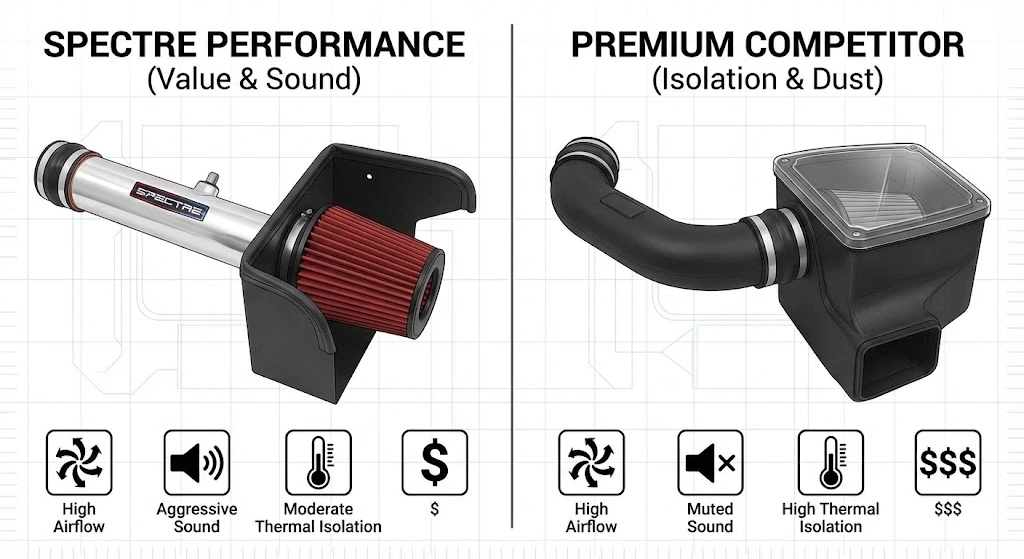
To understand Spectre’s value proposition, it must be benchmarked against the hierarchy of the intake market.
Spectre vs. S&B Filters (The Premium Benchmark)
S&B is widely regarded as the gold standard for consumer truck intakes.
- Architecture: S&B uses fully enclosed, roto-molded airboxes with clear polycarbonate lids and fender seals. This design offers superior thermal isolation compared to Spectre’s open shield.
- Filtration: S&B offers massive filters with ISO 5011 certified efficiency ratings, often preferred for off-roaders in dusty environments.
- Price Point: S&B kits retail for approximately $349. Spectre kits retail for $199-$210.
- The Verdict: S&B is objectively a better engineered solution for thermal isolation and dust protection. However, Spectre offers 80% of the performance (flow and sound) for 60% of the price. For a street truck, Spectre is the high-value winner; for a desert runner, S&B is required.
Spectre vs. K&N (The Sibling Rivalry)
Spectre is often viewed as the "budget brand" to K&N’s premium positioning (both are owned by the same parent company in many contexts).
- Series Comparison: The Spectre aluminum kit is directly comparable to the K&N Series 77 (Metal).
- Cost: K&N Series 77 kits cost upwards of $472.
- Performance: The physical differences are minimal. Both use aluminum tubes and similar heat shields. K&N uses cotton gauze filters; Spectre uses synthetic.
- The Verdict: Spectre effectively cannibalizes the value proposition of the K&N metal kits. Unless the consumer is attached to the K&N brand name or specifically wants the oiled cotton media, the Spectre kit offers nearly identical build quality and performance for half the price.
Spectre vs. Volant (The Durability Play)
- Design: Volant uses closed boxes and often pairs with Donaldson PowerCore dry filters (maintenance-free for 100k miles).
- Thermal Data: Surprisingly, some tests show Volant boxes retaining heat longer than open elements due to the insulating properties of the thick plastic.
- Price: Volant is in the premium tier ($400+).
Table 1: Comparative Market Matrix (Ram 1500 5.7L Application)
| Feature | Spectre Performance | S&B Filters | K&N Series 77 | Volant |
| Approximate Retail | ~$209 | ~$349 | ~$473 | ~$425 |
| Tube Material | Polished Aluminum | XLPE Plastic | Polished Aluminum | XLPE Plastic |
| Airbox Design | Open with Steel Shield | Fully Enclosed Box | Open with Steel Shield | Fully Enclosed Box |
| Filter Media | Synthetic (HPR) | Cotton or Dry | Cotton Gauze | PowerCore (Dry) |
| Thermal Isolation | Moderate | High | Moderate | High |
| Sound Profile | Aggressive/Loud | Moderate/Muted | Aggressive/Loud | Moderate |
Installation, Maintenance, and Diagnostics
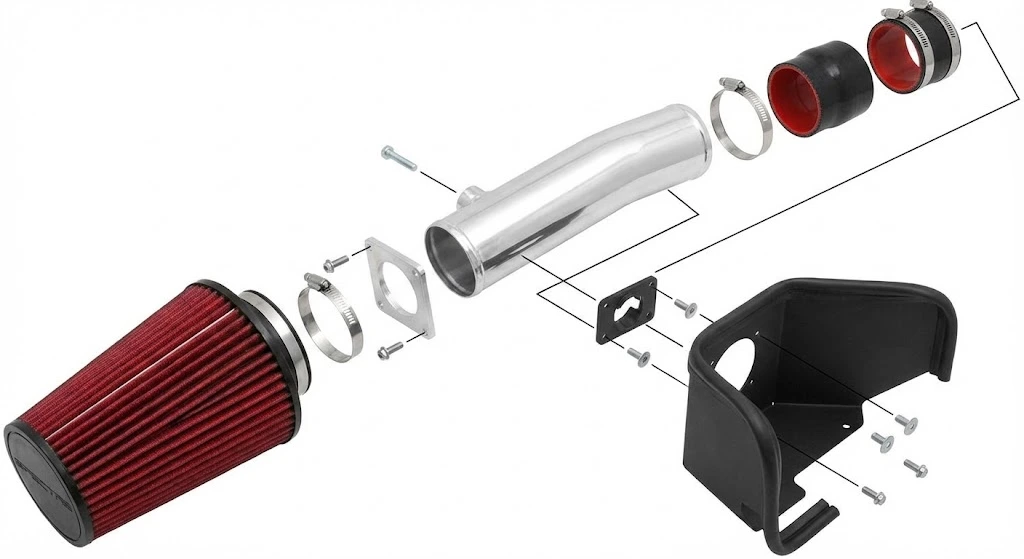
The ownership experience of a Spectre intake extends beyond the purchase. Proper installation and maintenance are critical for longevity and performance.
Comprehensive Installation Guide
Spectre kits are marketed as "bolt-on," but attention to detail is required.
- Preparation: Disconnect the negative battery terminal. This is mandatory to force the ECU to reset its fuel trim learning parameters. If skipped, the ECU may try to apply old fuel maps to the new airflow dynamics, causing lean codes.
- Sensor Transfer: Carefully remove the MAF sensor from the stock tube. Clean it with MAF cleaner spray while it is out. Install it into the Spectre tube using the supplied screws or adapter. Critical: Do not overtighten; the plastic flange can crack.
- Heat Shield Assembly: Install the weather stripping along the top edge of the heat shield. Mount the shield using the factory airbox grommets. Ensure it does not rub against the AC lines or coolant reservoir.
- Tube Alignment: Install the silicone couplers. Insert the aluminum tube. Tip: Leave all clamps loose until the entire system is aligned. Adjust the tube so it sits without tension, then tighten the clamps from the throttle body moving outward.
- Breather Hoses: Connect the PCV fresh air line. Spectre usually supplies a section of hose. Ensure this connection is tight to prevent unmetered air from entering the crankcase.
The Relearning Process
After reconnecting the battery, the truck should be idled for 10-15 minutes to allow the ECU to relearn the idle airflow strategy. The vehicle may idle roughly for the first few miles as the Long Term Fuel Trims (LTFT) adjust to the increased air volume.
Maintenance: The AccuCharge Protocol
The HPR filter requires service every 7,000 to 10,000 miles.
- Cleaning: Spray the cleaner liberally. Let it soak for 10 minutes.
- Rinsing: Rinse from the clean side out to the dirty side. This pushes the dirt out of the media rather than driving it deeper in.
- Drying: Allow to air dry completely. Never use a heat gun or compressed air, as this will damage the synthetic fibers.
- Oiling: Use the AccuCharge bottle. Apply a thin bead of oil to each pleat. Let it wick for 20 minutes. If there are white spots, touch them up. The filter should be a uniform color (Red/Blue/Black) but not dripping.
Troubleshooting Common Issues
- P0171/P0174 (System Too Lean): This is the most common error. It usually indicates a vacuum leak at a coupler or a dirty MAF sensor.
- Fix: Check all hose clamps. Spray soapy water on couplers while running to check for bubbles (leaks). Clean the MAF sensor.
- Whistling Noise: A high-pitched whistle at part-throttle.
- Cause: Resonance at the throttle body lip or the sharp edge of the aluminum tube.
- Fix: Remove the tube and use a file to slightly chamfer (smooth) the inside edge of the tube where it meets the throttle body. Ensure the tubes are butted up close to the throttle body inside the coupler.
Consumer Sentiment and Economic Analysis
The "Bang for the Buck" Equation
Spectre’s market position is defined by value.
- Cost per Horsepower: If a Spectre kit ($200) yields 10 HP, the cost is $20/HP. A K&N kit ($470) yielding the same 10 HP costs $47/HP. Economically, Spectre is the superior investment for raw numbers.
- Warranty: Spectre offers a 90-Day Limited Warranty. This is the trade-off. Premium brands offer Million-Mile or Lifetime warranties. The consumer accepts a shorter support window in exchange for a lower upfront price.
User Reviews and Forum Consensus
- The Sound Factor: Across all platforms (F-150, Silverado, Ram), the most universally praised aspect is the sound. Terms like "throaty," "aggressive," and "deep" are ubiquitous in reviews.
- The "Butt Dyno": While dyno charts prove gains, user perception varies. Many report the truck "feels" faster, which may be a psycho-acoustic effect of the louder intake. However, the improved throttle response (reduced lag) is a tangible, widely reported benefit.
- The MPG Myth: Users generally agree that MPG gains are elusive. While the potential exists, the engaging sound encourages heavier acceleration, often resulting in a net decrease in fuel economy.
Conclusion
The Spectre Performance Cold Air Intake system represents a pragmatic engineering solution in a market often characterized by diminishing returns. By stripping away the high costs associated with roto-molding and extensive branding exercises, Spectre delivers the core functional benefits of performance induction—mandrel-bent laminar airflow and high-surface-area filtration—at a price point accessible to the mainstream truck owner.
Technically, the system is sound. The use of aluminum is a valid choice that prioritizes airflow velocity and acoustic resonance over absolute thermal isolation. While it may not match the dust-holding capacity of an S&B desert intake or the thermal efficiency of a Volant closed box, it outperforms the restrictive factory assembly in every flow metric. For the truck owner seeking to unlock the auditory character of their V8, improve throttle response for daily driving, and maintain 50-state legality via CARB compliance, the Spectre CAI stands as the definitive high-value contender in the segment.
![How To Install In Channel Rain Guards [2026]](https://truckguider.com/wp-content/uploads/2026/03/featured-b43761fc-768x432.webp)