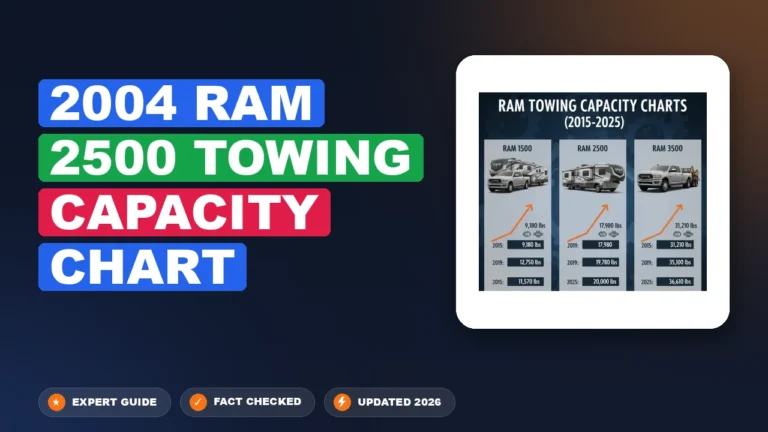
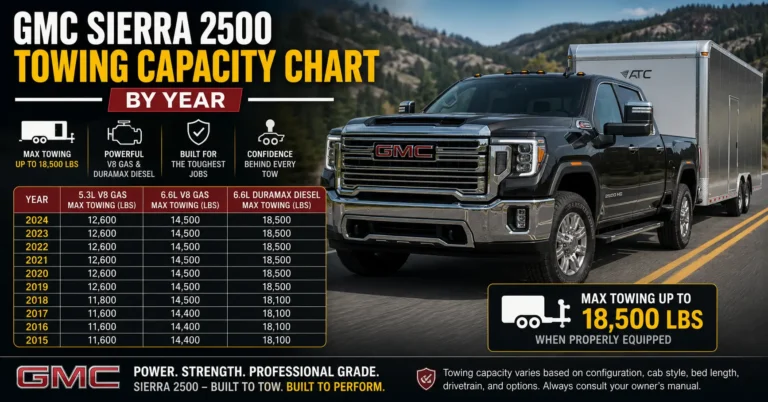
Towing Capacity Calculator by VIN: 2026 Trucks and SUVs

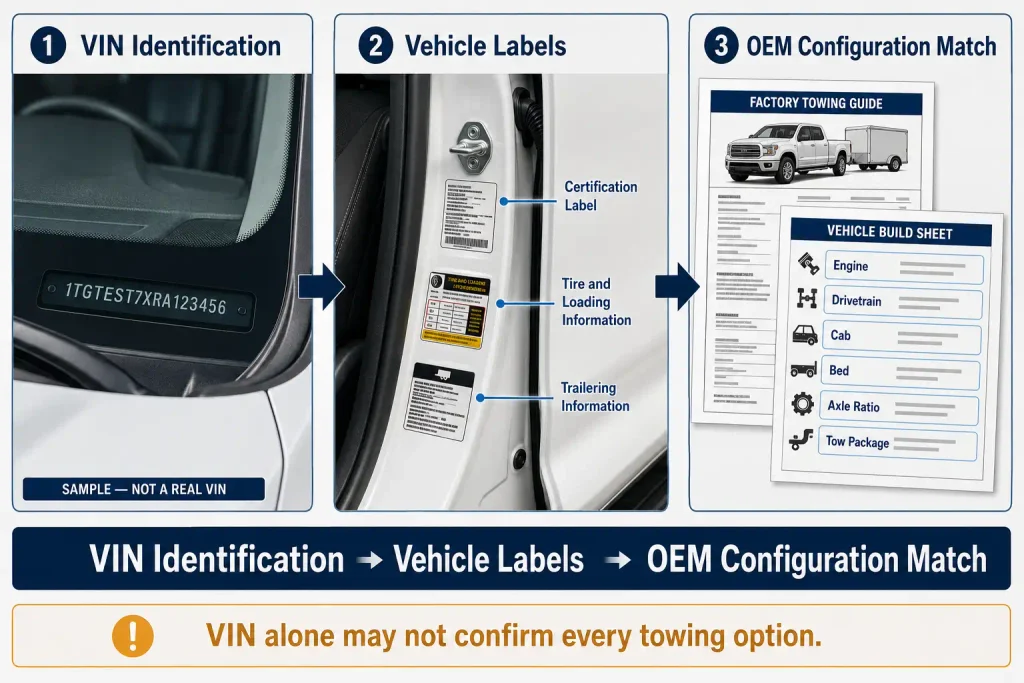
A towing capacity calculator by VIN can identify your truck and narrow the correct factory tow rating, but the VIN is only the starting point. The final limit may still depend on the axle ratio, cab and bed combination, drivetrain, factory tow package, hitch type, and vehicle-specific payload.
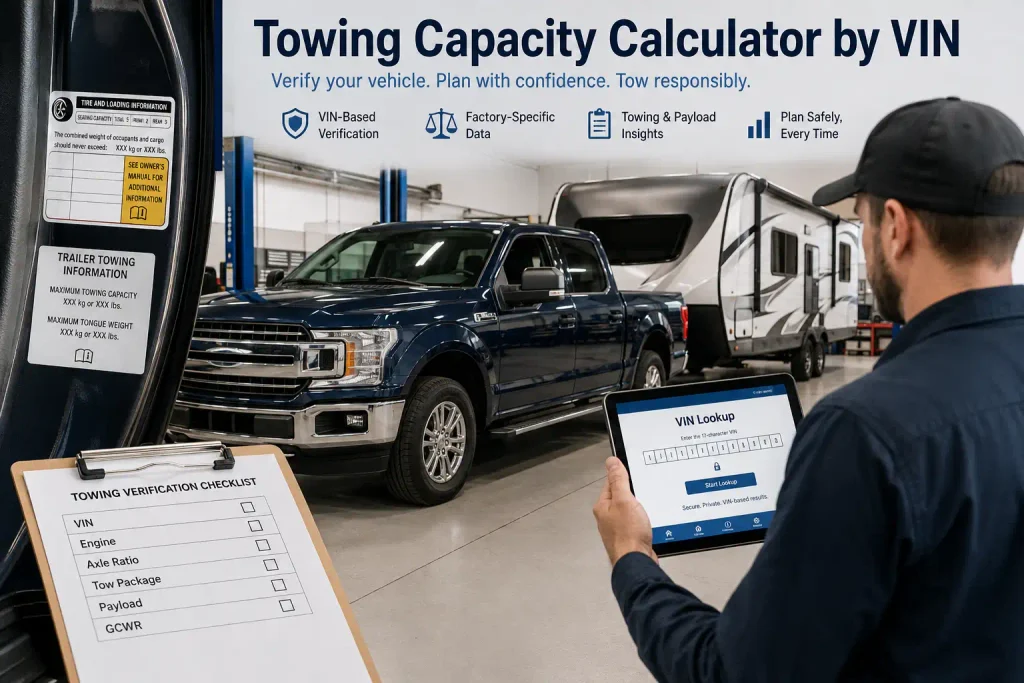
Use the VIN-assisted process below to identify the vehicle, retrieve the correct manufacturer data, and check the other limits that control a safe towing setup. Never substitute a model’s advertised maximum for the rating of your exact truck.

Prime for Young Adults — 6 Months Free
Students and 18–24s get six months of Prime free, then half price.
Start 6 Months FreeImportant: A public VIN decoder identifies vehicle details; it does not automatically certify every towing-related option. If the lookup cannot confirm a tow package, axle ratio, or exact factory configuration, verify those items from the truck’s labels, window sticker, build sheet, or manufacturer towing guide before towing.
Towing Verification Workflow
VIN to Tow Rating: 4-Step Check
Recommended Best Deal Products


A VIN identifies the truck, but the exact tow rating may still require the axle ratio, tow package, vehicle labels, and a configuration-matched manufacturer guide.
-
1
Decode the Truck
Confirm the year, make, model, engine, body, cab, and drivetrain returned by the VIN lookup.
-
2
Resolve the Configuration
Verify the cab, bed, transmission, axle ratio, and factory tow package. Never select the highest option by default.
-
3
Match OEM Tow Data
Find the one manufacturer towing-table row that matches the exact configuration and intended hitch type.
-
4
Check the Real Load
Compare the travel-ready truck and trailer against every applicable weight and equipment limit.
= Payload Used
Must Stay Within GCWR
The correct towing limit is the lowest applicable verified rating—not the largest advertised number.
Towing Capacity Calculator by VIN: 4-Step Lookup
You need a complete 17-character VIN. On most vehicles, it appears at the lower driver’s side of the windshield, on the driver-door label, and on the registration or insurance documents.
Step 1: Decode the 17-Character VIN
Enter the VIN in the NHTSA vPIC VIN decoder. NHTSA’s system uses manufacturer-submitted information and can return fields such as:
- Model year
- Make and model
- Series or trim when available
- Engine
- Body class
- Cab type when available
- Drive type when available
- Gross Vehicle Weight Rating (GVWR) class
A standard VIN excludes the letters I, O, and Q to prevent confusion with the numbers 1 and 0. Recheck the VIN if the decoder reports an error or the decoded vehicle does not match the truck in front of you.
Step 2: Complete the Towing Configuration
Record any towing-critical details the decoder does not return:
| Required detail | Where to verify it |
|---|---|
| Engine and transmission | VIN result, window sticker, or build sheet |
| 2WD/4×2 or 4WD/4×4 | VIN result or vehicle/build information |
| Cab and bed length | Physical configuration or window sticker |
| Axle ratio | Build sheet, axle code, OEM record, or towing guide |
| Factory tow package | Window sticker, build sheet, or dealer build record |
| GVWR and GAWR | Driver-door certification label |
| Vehicle-specific payload | Tire and Loading Information label or trailering label |
| Hitch rating | Receiver/hitch label and hitch documentation |
Do not select the highest-rated axle ratio or tow package merely because the VIN result leaves that field blank.
Step 3: Match the Factory Tow Rating
Use the manufacturer’s VIN tool or towing guide and match every available configuration field. A valid match may require the model year, engine, transmission, drivetrain, wheelbase, cab, bed, axle ratio, and towing package.

Audible — Listen Free for 30 Days
One free credit a month and thousands of titles included.
Listen Free for 30 DaysRecord the applicable rating for the hitch type you will use:
- Conventional or bumper-pull trailer
- Fifth-wheel trailer
- Gooseneck trailer
These ratings are not interchangeable. A fifth-wheel or gooseneck maximum does not authorize the same weight on a conventional receiver.
Step 4: Check the Loaded Combination
The factory trailer rating is only one limit. Complete this worksheet using actual scale weights whenever possible:
| Calculator field | Your value |
|---|---|
| Factory maximum loaded trailer weight | ______ lb |
| Truck GVWR | ______ lb |
| Truck GCWR | ______ lb |
| Vehicle-specific payload | ______ lb |
| Actual loaded truck weight | ______ lb |
| Actual loaded trailer weight | ______ lb |
| Tongue or pin weight | ______ lb |
| Receiver or hitch rating | ______ lb |
Use these checks:
Payload used = passengers + cargo + accessories + hitch hardware + tongue/pin weight

Payload remaining = vehicle-specific payload - payload used

Combined weight = actual loaded truck weight + actual loaded trailer weight

GCWR margin = GCWR - combined weight
The approved trailer weight is controlled by the lowest applicable limit, not the largest number shown in an advertisement.
What a VIN Can and Cannot Tell You About Towing
Recommended Best Deal Products

A VIN is an identification key. It is excellent for establishing the model year, manufacturer, vehicle line, and many powertrain or body details. NHTSA describes vPIC as a source for basic VIN decoding based on data reported by manufacturers.
That does not mean every VIN decoder can return an exact tow rating. The information available varies by manufacturer, model year, and data source.
| Data type | How to treat it |
|---|---|
| VIN-decodable data | Auto-fill only when the decoder returns a clear value |
| Configuration-dependent data | Match the decoded truck against an OEM towing table |
| Vehicle-specific limits | Confirm from the truck’s labels or an OEM VIN result |
| Unresolved options | Check the window sticker, build sheet, axle code, or dealer record |
Details Commonly Available From a VIN Decode
- Make, model, and model year
- Engine family or displacement
- Body class
- Cab or restraint information
- Drive type on some records
- Manufacturer-defined vehicle attributes
Details That May Still Need Manual Verification
- Axle ratio
- Max-tow or heavy-duty trailering package
- Vehicle-specific payload
- Receiver rating
- Dealer-installed equipment
- Conventional versus fifth-wheel/gooseneck rating
Treat a result as manual verification required if more than one factory towing-table row matches the decoded vehicle. Never resolve that uncertainty by choosing the largest number.
Audible Premium Plus — Annual Membership
12 audiobook credits up front, plus the full Audible catalogue.
See Annual PlansFord, Ram, Chevy, and GMC VIN Towing Lookup Methods
Towing verification is not identical across brands. Use the most vehicle-specific factory source available for your truck.
Ford Towing Capacity by VIN
Ford provides an official Towing Calculator for supported F-Series trucks. Enter the VIN or select an eligible vehicle from a Ford account. Ford says the tool can determine maximum towing capacity and tongue weight based on the vehicle, but passengers, cargo, accessories, and hitch limits must still be considered.
If the truck is unsupported or the result is incomplete, use the correct model-year Ford RV and Trailer Towing Guide. Match the engine, drivetrain, cab, wheelbase, axle ratio, and required towing equipment rather than relying on the model’s headline maximum. TruckGuider’s Ford towing capacity chart can help you identify the correct year and configuration before checking the OEM guide.
Ram Towing Capacity by VIN
Ram’s current Towing Capacity Guide begins with model year and vehicle selection. Ram also identifies engine, transmission, axle ratio, wheel-drive system, cab size, box length, payload, and equipment as variables that can affect capability.
For a Ram truck, follow TruckGuider’s dedicated Ram towing capacity by VIN guide to decode the vehicle and verify the missing configuration details. When a VIN decoder does not expose the axle ratio or factory package, use the window sticker, build record, axle information, and correct Ram towing table.
Chevrolet Towing Capacity by VIN
Decode the VIN to identify the exact Silverado, Colorado, or SUV, then use Chevrolet’s current trailering and towing guides for the relevant model year.
On some Chevrolet vehicles, the driver-side doorjamb Trailering Information Label provides vehicle-specific curb weight, GVWR, Gross Combined Weight Rating (GCWR), maximum payload, maximum tongue weight, and rear Gross Axle Weight Rating (GAWR). Use that label when present; it is more specific than a generic model-level chart.
GMC Towing Capacity by VIN
For a Sierra, Canyon, Yukon, or other GMC vehicle, decode the VIN and then use GMC’s official trailering and towing guides. GMC also states that some vehicles carry a driver-side doorjamb Trailering Information Label with vehicle-specific weight information.
Check the label, owner’s manual, and the configuration-specific guide together. If an online result conflicts with the physical vehicle label, stop and resolve the discrepancy through GMC or a dealer before towing.
Why Payload Can Reduce Your Real Towing Limit
Recommended Best Deal Products

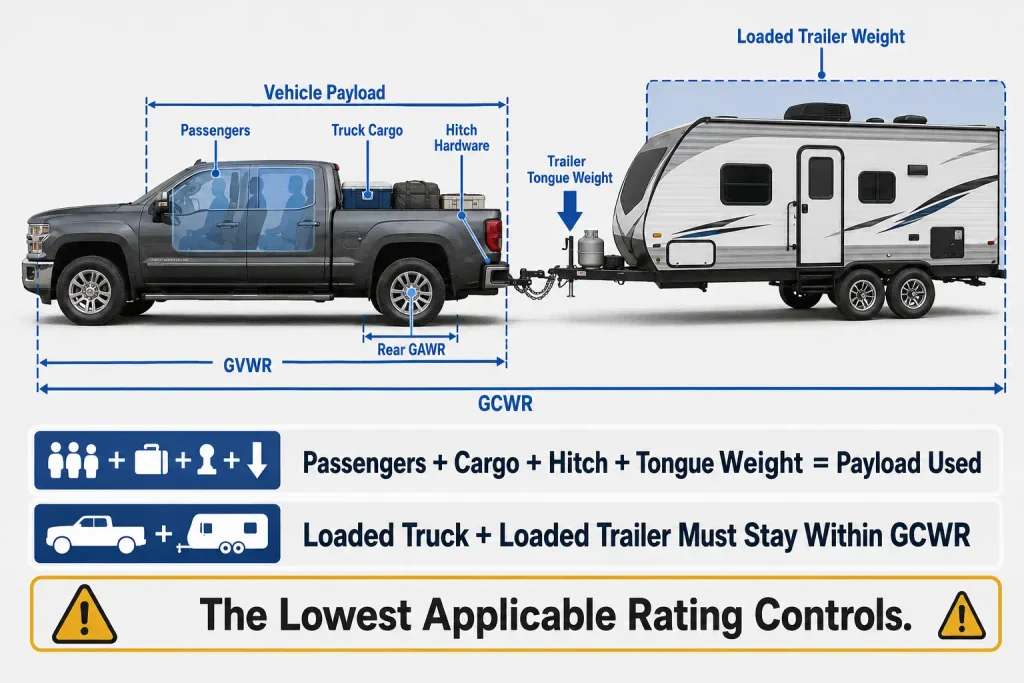
The tow rating tells you the permitted loaded trailer weight for a defined configuration. It does not give the truck unlimited capacity for people, cargo, hitch equipment, and tongue weight.
Key terms:
- GVWR (Gross Vehicle Weight Rating): Maximum permitted weight of the loaded tow vehicle.
- GCWR (Gross Combined Weight Rating): Maximum permitted combined weight of the loaded tow vehicle and loaded trailer.
- GAWR (Gross Axle Weight Rating): Maximum permitted weight on an individual axle.
- Payload: Weight the truck can carry, including occupants, cargo, accessories, hitch hardware, and trailer tongue or pin weight.
- Tongue weight: Downward load a conventional trailer applies to the hitch.
- Pin weight: Load a fifth-wheel or gooseneck trailer places over or near the rear axle.
Ram explains that payload plus tongue weight cannot exceed payload capacity. That is why a truck can be below its advertised trailer rating yet exceed payload, rear-axle, tire, or hitch limits.
Hypothetical Payload Check
Assume a truck’s vehicle-specific payload label shows 1,850 lb. Passengers, bed cargo, accessories, and hitch hardware total 650 lb. A loaded 7,200-lb conventional trailer places a measured 864 lb on the hitch.
Total payload used = 650 + 864 = 1,514 lb
Payload remaining = 1,850 - 1,514 = 336 lb
This hypothetical combination remains 336 lb below the payload rating, but it must also pass GVWR, rear GAWR, GCWR, tire, receiver, and factory trailer-rating checks. It is not a tow-rating recommendation for any real truck.
For Ram-specific payload values and configuration notes, see the Ram payload capacity chart.
Where to Find Towing Numbers the VIN Cannot Confirm
When a VIN result is incomplete, verify the missing data instead of guessing.
Driver-Door Labels
The certification label normally lists GVWR and front/rear GAWR. The Tire and Loading Information label states the maximum combined weight of occupants and cargo. Some newer GM vehicles also have a Trailering Information Label with additional vehicle-specific limits.
Read the labels on the truck you will tow with. Payload varies with installed equipment, so a value copied from another truck of the same year and trim may be wrong.
Window Sticker and Build Sheet
The original window sticker or manufacturer build record can confirm the engine, drivetrain, axle, and factory packages. Look for a max-tow, trailering, camper, fifth-wheel/gooseneck, cooling, brake-controller, or axle option that the relevant towing guide requires.
Owner’s Manual and OEM Towing Guide
The owner’s manual explains towing procedures and restrictions. The model-year towing guide usually contains configuration tables. Match all columns and read the notes; footnotes may require specific wheels, tires, hitch equipment, weight-distributing hardware, or reduced ratings under certain conditions.
Scale Tickets
Manufacturer ratings are fixed limits, but loaded weights change from trip to trip. A certified public scale can establish actual truck weight, trailer weight, combined weight, and axle loading. Weigh the combination in travel-ready condition with passengers, fuel, cargo, hitch hardware, and the trailer loaded.
How to Read the Calculator Result
Classify the result in one of these three states.
Factory Configuration Verified
Use this status only when the VIN identifies the vehicle, all tow-critical variables are resolved, and one exact row or vehicle-specific OEM result matches the truck.
The result should identify the source and distinguish conventional, fifth-wheel, and gooseneck ratings where applicable.
Verify Configuration Before Towing
Use this status when the axle ratio, towing package, payload, cab/bed combination, or another required variable is missing. Also use it when multiple factory rows remain possible.
The next step is to inspect the truck’s labels, window sticker, build sheet, or OEM record—not to select the most favorable rating.
Combination Exceeds a Rated Limit
Stop and reduce or reconfigure the load if the setup exceeds any verified limit, including:
- Factory trailer weight rating
- Payload
- GVWR
- Front or rear GAWR
- GCWR
- Tongue or pin-weight limit
- Receiver or hitch rating
- Tire or wheel rating
For the complete manual process, use TruckGuider’s guide on how to calculate towing capacity.
Which Towing Number Should You Trust?
Use the most vehicle-specific authoritative source. This is the recommended order:
- Vehicle-specific OEM trailering label or supported OEM VIN-based result
- Manufacturer towing guide matched to the exact configuration
- Vehicle owner’s manual and towing supplement
- OEM build sheet or dealer build record
- A third-party result that cites the exact OEM source and configuration
- Generic model-level charts only after every configuration variable is known
An advertised “up to” rating applies to a particular configuration. It is not proof that every truck with the same badge can tow that weight. If two sources disagree, do not use the larger number by default. Recheck the VIN, model year, axle ratio, equipment, hitch type, and source footnotes.
Get the Correct Tow Rating for Your Exact Truck
Start with the VIN, but finish with the truck. Decode the 17-character VIN, complete any missing configuration fields, match the exact OEM towing data, and confirm the vehicle-specific labels.
Then compare the travel-ready truck and trailer against payload, GVWR, GAWR, GCWR, tongue or pin weight, hitch, tire, and factory trailer limits. The lowest applicable rating controls the combination. That process takes longer than copying an advertised maximum, but it produces a towing limit you can defend with real vehicle and manufacturer data.
Frequently Asked Questions
Can I Find My Exact Towing Capacity by VIN?
Sometimes. A supported manufacturer VIN tool may return a vehicle-specific tow rating. A general VIN decoder usually identifies the truck but may not resolve the axle ratio, tow package, payload, or exact towing-table row. Verify missing details from the vehicle labels, build data, and OEM towing guide.
Does a VIN Show the Factory Tow Package?
Not reliably through every public decoder. Tow-package information may be available through a manufacturer build record, original window sticker, dealer system, or brand-specific VIN tool. Do not assume the package is present simply because the truck has a receiver hitch or trailer connector.
Does a VIN Tell Me the Axle Ratio?
It depends on the manufacturer, model year, and decoder. Some OEM records can associate the axle ratio with the VIN, while a basic public decode may leave it blank. Check the build sheet, axle code, dealer record, or model-year towing documentation when the ratio is unresolved.
Where Can I Find GVWR and GCWR?
GVWR normally appears on the driver-door certification label. GCWR may appear in the owner’s manual, towing guide, OEM VIN result, or a GM Trailering Information Label on supported vehicles. Do not calculate GCWR by adding unrelated maximum figures; use a manufacturer-specified value.
Is Payload Included in Towing Capacity?
Payload is a separate limit, but towing uses it. Passengers, cargo, accessories, hitch hardware, and trailer tongue or pin weight all load the truck. A combination can remain below the trailer rating while exceeding payload, GVWR, rear GAWR, or tire limits.
Can I Use This VIN Towing Calculator for a Fifth-Wheel?
Yes, as an identification and verification process. You must obtain the configuration-specific fifth-wheel rating and check pin weight, payload, rear GAWR, GVWR, GCWR, hitch, tire, and bed-clearance requirements. Do not apply a gooseneck or conventional rating to a fifth-wheel setup.
Is the Advertised Maximum Tow Rating My Truck’s Limit?
Not necessarily. An advertised maximum normally requires a specific engine, drivetrain, cab, bed, axle ratio, towing package, and hitch arrangement. Your vehicle’s exact rating may be lower. Use the VIN, physical labels, and configuration-matched OEM data to determine the applicable limit.