Toyota Tacoma Tire Pressure Specification Chart By Year (2005–2026)

Quick Answer
The factory-recommended cold tire pressure for most Toyota Tacoma models (2005–2026) ranges between 29 PSI and 35 PSI. While 30–32 PSI is the standard for most stock tires, specifications vary significantly based on trim level, wheel diameter, and GVWR. Always prioritize the manufacturer’s data located on the driver-side door jamb sticker over the maximum pressure molded into the tire sidewall.
Is your Toyota Tacoma’s tire pressure monitoring system (TPMS) light active? Many owners mistakenly inflate tires to the “Max PSI” listed on the tire sidewall, which ignores the vehicle’s actual engineering specifications. This guide details official Toyota Tacoma tire pressure standards, explaining how to maintain factory-recommended settings to ensure optimal safety, fuel economy, and tire longevity.


Toyota Tacoma Tire Pressure Specification Chart (2005–2026)
📤 Share Image
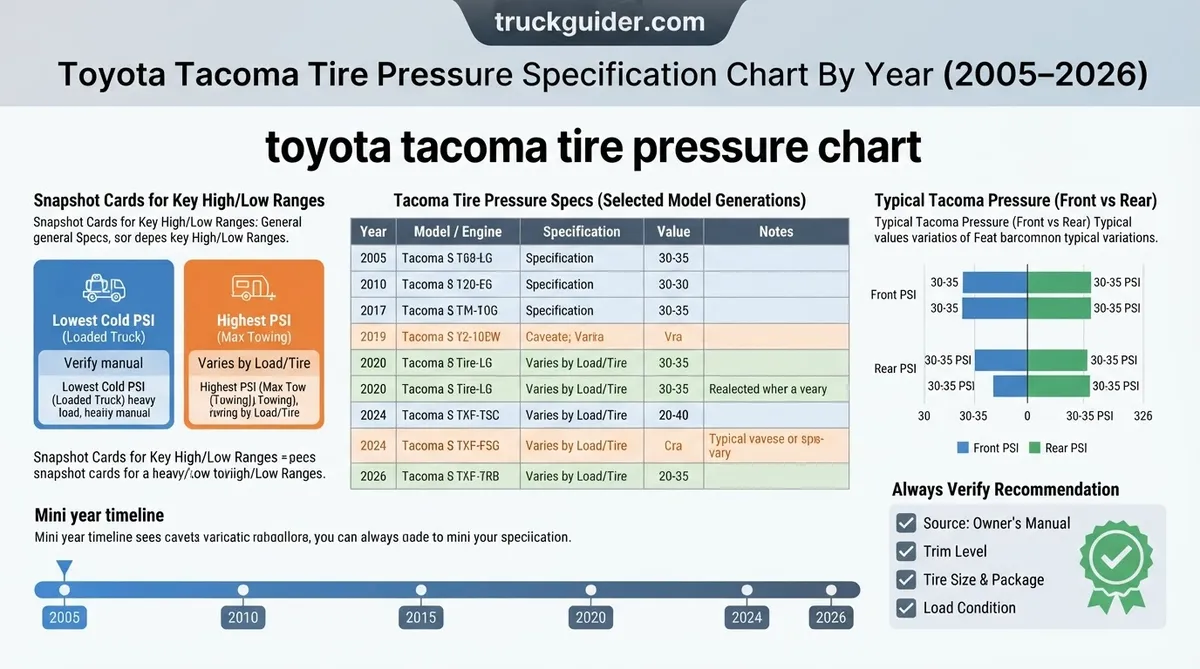
This reference covers factory specifications for model years 2005 through 2026. Use “Cold Tire Pressure” for all measurements. Always prioritize the door jamb sticker over general charts, as variations in trim levels (SR, TRD, Limited, Trailhunter) and factory-installed wheel packages dictate specific PSI requirements. Last reviewed: August 2026.
| Model Years | Trim / Tire Package | Standard PSI | Notes |
|---|---|---|---|
| 2005–2015 | Standard P-Metric | 29–32 PSI | Depends on 15″, 16″, or 17″ wheels |
| 2016–2023 | Standard P-Metric | 30–33 PSI | TRD Pro specs differ; verify via placard |
| 2024–2026 | Standard / Off-Road | 33–35 PSI | Optimized for modern handling dynamics |
Correct inflation improves fuel economy by up to 3% and can extend tire tread life by 15–20%. Conversely, driving on tires under-inflated by 10 PSI increases rolling resistance and significantly risks tire sidewall failure.

Locating Your Tacoma Tire Placard
Locate the Tire and Loading Information placard on the driver-side B-pillar door jamb. This sticker provides the exact PSI for your vehicle’s Original Equipment (OE) tires. If you have installed aftermarket tires—particularly LT-rated (Light Truck) tires—factory PSI might no longer be optimal; consult the tire manufacturer’s load inflation tables instead.



Evolution of PSI Requirements
Tacoma tire requirements have trended upward over two decades. Gen 2 models (2005–2015) typically utilized 29–30 PSI to prioritize ride comfort. Current Gen 4 models (2024+) recommend 33–35 PSI to support increased handling precision and modern safety compliance.
Factors Influencing Tire Pressure
P-Metric vs. LT Tire Inflation
Distinguish between P-Metric and LT tires during maintenance. P-Metric tires, standard on SR5 and TRD Sport trims, support passenger-vehicle loads and require lower PSI. LT-rated tires possess thicker, more rigid sidewalls designed for heavy-duty use, frequently necessitating higher PSI to achieve the same load-carrying capacity.
Never use the “Max PSI” molded into the tire sidewall as your target. That value is the maximum pressure the tire can handle under its maximum rated weight, not the manufacturer’s recommendation for your vehicle’s specific weight distribution and handling profile.
Managing Temperature-Related Pressure Drops
Air volume fluctuates with temperature; tire pressure drops approximately 1 PSI for every 10°F decrease in ambient temperature. This phenomenon frequently triggers TPMS alerts during autumn temperature shifts. Check your tire pressure only when the tires are “cold”—after the vehicle has been stationary for at least three hours.
Measuring and Maintaining Pressure
📋
Step-by-Step Maintenance Procedure
Ensure tires are cold, meaning the truck has been parked for at least three hours. Use a calibrated tire pressure gauge to check each tire, including the spare, against the door jamb specification.



Toyota Tacoma Tire Pressure Chart: Frequently Asked Questions
Where is the tire pressure sticker located on a Tacoma?
The official tire pressure recommendation placard is located on the driver-side door jamb. When you open the driver’s door, look for a white or silver sticker on the B-pillar (the frame of the truck). This label provides the specific PSI for the front and rear tires, along with the correct tire size, regardless of what is printed on the tire sidewall.
Why does my tire pressure warning light stay on?
The TPMS (Tire Pressure Monitoring System) light usually stays on because one or more tires have dropped below the required threshold, which is typically 20-25% below the recommended setting. If all tires are at the correct pressure and the light remains on, it may indicate a malfunctioning sensor, a dead battery in a sensor, or a need to reset the system after a tire rotation or replacement.
What is the correct pressure for oversized off-road tires?
When installing oversized or ‘LT’ (Light Truck) tires, the factory door sticker may no longer be accurate. You should calculate the correct pressure based on the load-carrying capacity of the new tire compared to the original tire. Consult a professional tire shop to perform a ‘chalk test’ or use an inflation load table to ensure you are maintaining a flat, even contact patch. If you are shopping for replacements, see our best tires for Toyota Tacoma guide.
Does towing change the recommended tire pressure?
For most light-duty towing with a Tacoma, you should maintain the pressures listed on the door jamb sticker. However, if you are towing near your maximum gross vehicle weight rating (GVWR), you may need to increase the rear tire pressure slightly to handle the additional load, provided you do not exceed the tire’s maximum PSI rating. Always ensure your load is distributed safely to prevent uneven tire pressure requirements.


How often should I check my Toyota Tacoma tire pressure?
You should check your tire pressure at least once a month and before any long road trip. Tire pressure naturally fluctuates with ambient temperature changes and slow leaks over time. Checking your pressure when the tires are ‘cold’—meaning the vehicle has been parked for at least three hours or driven for less than a mile—is essential for getting a reliable, accurate reading.