Toyota Tacoma Trim Levels Specification Chart By Year (2005–2026)

Quick Answer
The Toyota Tacoma has evolved through three primary generations (2005–2015, 2016–2023, and 2024–2026), with trim levels varying significantly in engine, chassis, and capability. Maximum towing capacity ranges from 3,500 lbs to 6,800 lbs depending on the powertrain and tow package. Always verify your specific vehicle’s capacity via the door pillar sticker or the VIN-specific manual, as payload and towing limits fluctuate based on individual configuration.
Selecting the right Toyota Tacoma requires navigating two decades of shifting trim nomenclature, powertrain transitions, and off-road hardware configurations. Buyers often struggle to differentiate between similar-sounding packages, which results in purchasing vehicles lacking specific towing capacities or electronic aids required for their goals. This guide clarifies the Tacoma trim hierarchy to help you identify the exact hardware equipped on your specific model year and configuration.
This reference covers the 2005–2026 model years. Specifications vary by cab size, bed length, and drivetrain. Always verify vehicle capabilities via the VIN, the driver-side door jamb payload sticker, and the factory owner’s manual. Last reviewed: August 2026.

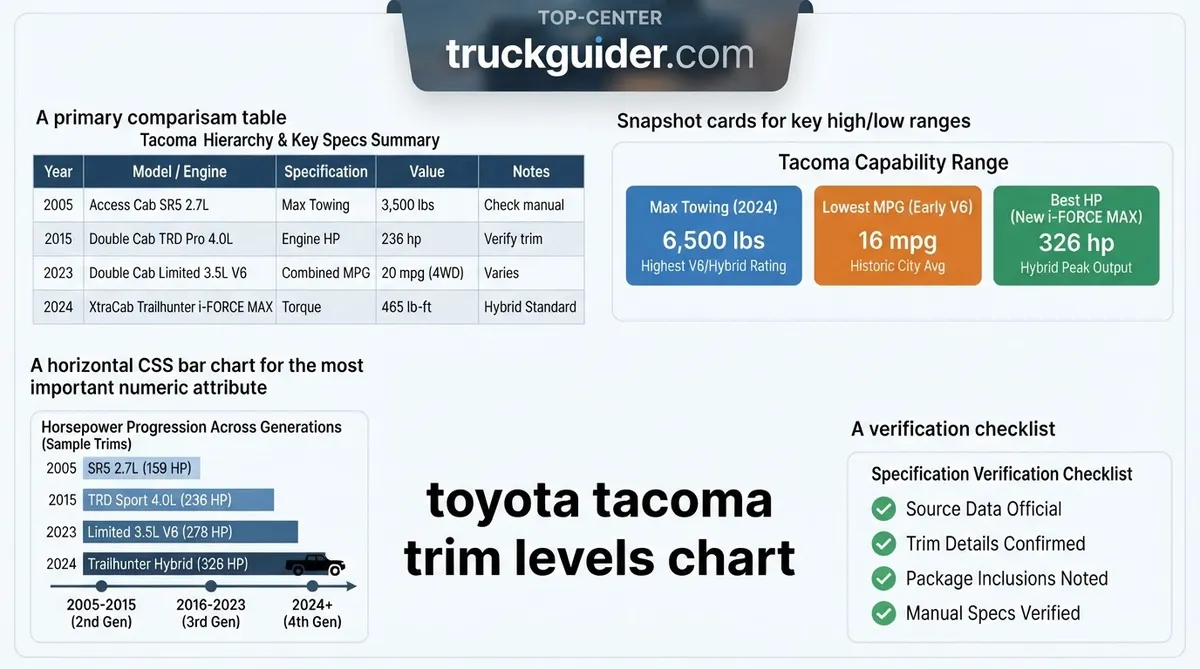
Toyota Tacoma Trim Hierarchy



📤 Share Image
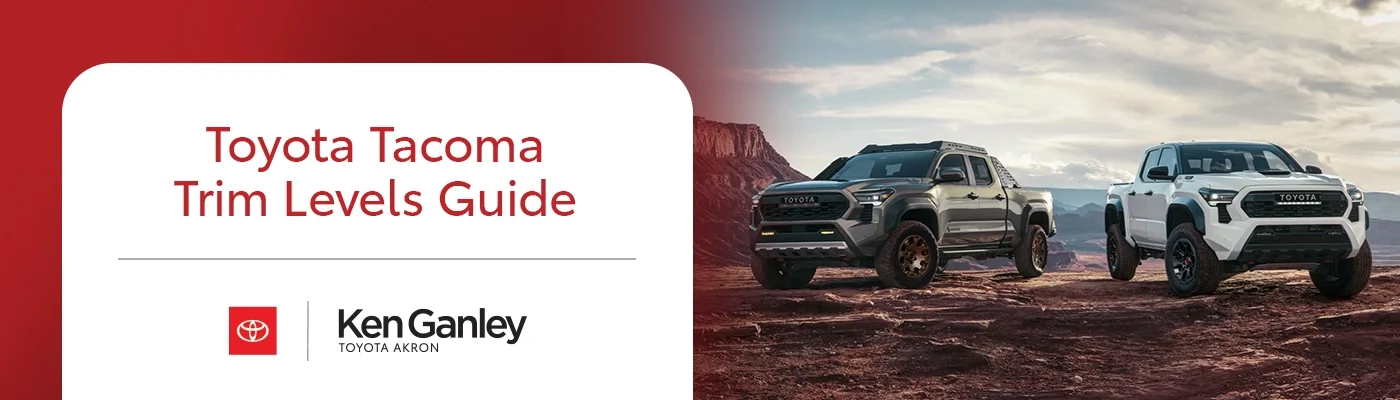
Defining the Trim Evolution
Toyota organizes the Tacoma into a tiered hierarchy where base models prioritize utility, while TRD and premium trims incorporate advanced off-road technology. Understanding this progression identifies the capability ceiling of your specific truck.
| Category | Representative Trims | Primary Focus |
|---|---|---|
| Utility | SR, SR5 | Fleet usage, towing basics, value-oriented transport |
| Sport/Lifestyle | TRD Sport | On-road handling, aesthetic upgrades |
| Off-Road | TRD Off-Road, Trailhunter | Locking diffs, Crawl Control, terrain management |
| Luxury/Premium | Limited, TRD Pro | Interior refinement, advanced tech, high-speed dampening |
- 3rd Gen Tech: Introduction of Crawl Control and MTS (2016) shifted off-road capability from mechanical-only to hybrid software/hardware management.
- 4th Gen Power: The i-FORCE MAX hybrid powertrain (2024) increases output to 465 lb-ft of torque, significantly outpacing previous naturally aspirated V6 models (265 lb-ft).
Year-by-Year Trim Analysis


Second Generation (2005–2015)
During this era, Toyota established the Tacoma as a midsize benchmark. The “PreRunner” trim became a staple, providing the aesthetic of a 4WD truck using a 2WD platform. Mechanical simplicity defined this generation, favoring robust, analog hardware over complex electronic aids.
Third Generation (2016–2023)
Toyota prioritized tech integration during this cycle. The TRD Off-Road and Pro trims standardized Multi-Terrain Select (MTS) and Crawl Control (CRAWL), allowing drivers to rely on software-managed torque delivery for technical trail navigation.
Fourth Generation (2024–2026)
The latest generation emphasizes the i-FORCE MAX hybrid system. The Trailhunter trim marks a strategic pivot toward factory-engineered overlanding, featuring specialized components like high-clearance bumpers and robust suspension tuning optimized for long-distance off-pavement travel.
Interpreting Capability Specifications


A 4WD system acts as the prerequisite for unlocking TRD off-road software features like Crawl Control.
Always rely on your vehicle’s specific door jamb sticker, as factory brochures rarely account for the weight of specific trim-level options.
Critical Performance Variables
When evaluating a trim, analyze these three factors that dictate real-world performance:
- Cab/Bed Configuration: Premium trims often restrict available cab/bed combinations, impacting total payload capacity due to increased curb weight.
- Axle Ratios: Towing-ready trims frequently feature upgraded cooling systems and specialized gear ratios not explicitly detailed in general marketing materials.
- Suspension Geometry: “Sport” models prioritize high-speed on-road stability, while “Off-Road” dampers are valved for low-speed articulation and obstacle compliance.
Common Comparison Pitfalls


Do not assume all “TRD” badges include the same hardware. A TRD Sport, for instance, focuses on pavement performance, whereas a TRD Off-Road contains the rear locking differential and multi-terrain software required for technical trail work.
Toyota Tacoma Trim Levels Chart: Frequently Asked Questions
Which Tacoma trim is best for daily driving?
The SR5 or Limited trims are generally best for daily driving. The SR5 offers a balanced mix of comfort and utility, while the Limited provides premium interior materials, improved sound insulation, and an adaptive suspension setup, making it the most refined option for highway commuting and urban environments.
Does every Tacoma trim come with 4WD?
No. While 4WD is a hallmark of the Tacoma, the base SR and SR5 trims are frequently available in a 2WD (Rear-Wheel Drive) configuration. Higher-end trims like the TRD Pro and Trailhunter come standard with 4WD, but for mid-range trims, 4WD is often an optional upgrade that must be verified on the specific window sticker.
What is the difference between TRD Sport and TRD Off-Road?
The TRD Sport is tuned for pavement performance with a sport-tuned suspension and hood scoop, making it ideal for street driving. The TRD Off-Road features Bilstein or FOX shocks, a locking rear differential, and Multi-Terrain Select, specifically engineered for trail capability and rock crawling, sacrificing some on-road stiffness for off-road compliance.
Can you upgrade a lower trim to match a higher trim?
You can add aftermarket parts like lift kits, lighting, and wheels, but you cannot easily replicate the high-end factory systems of a TRD Pro or Limited. Features like factory-tuned locking differentials, advanced Crawl Control software, and specific engine cooling systems are integrated during the build process and are rarely cost-effective or possible to replicate perfectly after purchase.
How do I find my exact towing capacity?
Your exact towing capacity is determined by your engine, transmission, axle ratio, and the presence of the factory-installed tow package. Locate your specific GCWR in your owner’s manual and subtract your vehicle’s loaded weight. The most reliable reference is the manufacturer’s towing chart for your specific VIN found on the Toyota Owners website.

![AMP Research PowerStep Warranty: Coverage & Claim Guide [2026]](https://truckguider.com/wp-content/uploads/2026/03/amp-research-power-step-warranty-featured.webp)