2014 Ram 1500 Towing Capacity Chart: Configuration And Performance Specifications

The 2014 Ram 1500 remains a cornerstone of the light-duty pickup market, but its towing capabilities are far from one-size-fits-all. With three engine options and dozens of cab, bed, and axle configurations, determining the exact towing capacity of a specific 2014 Ram 1500 can be confusing for owners and prospective buyers. This guide provides a professional breakdown of the 2014 Ram 1500 towing capacity chart, clarifying how technical specs like axle ratios and engine types dictate your safe hauling limits.


Understanding 2014 Ram 1500 Towing and Payload Terminology
In my 15 years of industry experience, the most common mistake truck owners make is conflating “towing capacity” with the actual weight they can safely pull in real-world conditions. To use the 2014 Ram 1500 towing capacity chart effectively, you must master the fundamental terminology that manufacturers use to define these limits.
The Critical Hierarchy of Ratings
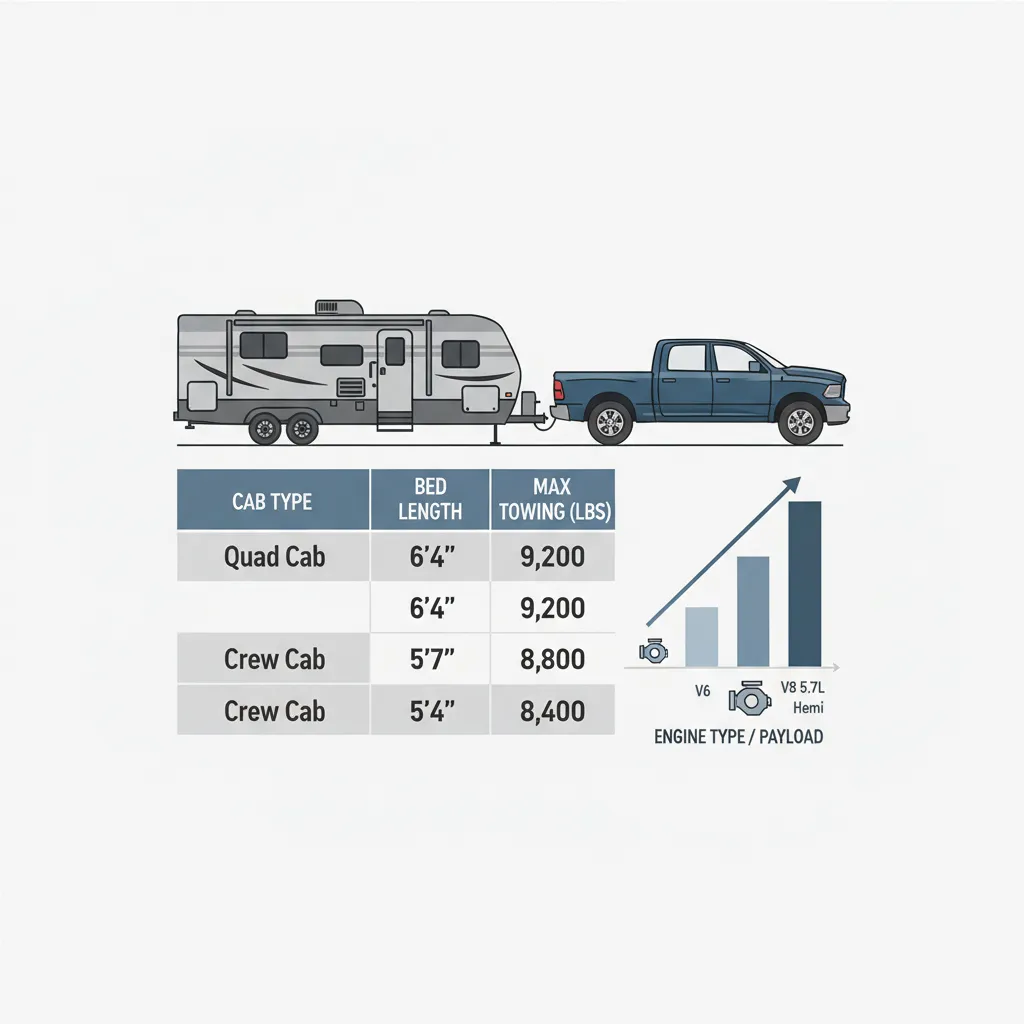
The Gross Combined Weight Rating (GCWR) is the absolute ceiling. This figure represents the maximum allowable weight of the fully loaded truck and the fully loaded trailer combined. Exceeding the GCWR is not just a mechanical risk; it is a significant safety hazard that compromises braking distances and structural integrity. For the 2014 model year, the Gross Vehicle Weight Rating (GVWR) dictates the maximum weight of the truck itself, including fuel, passengers, and cargo in the bed.
Payload capacity is often the “silent killer” of towing setups. While a chart might say your truck can tow 10,000 pounds, your payload capacity (typically between 1,200 and 1,900 pounds for this model) limits how much of that weight can be transferred to the truck via the hitch. This is known as Tongue Weight. Industry standards and safe driving dynamics require tongue weight to be between 10% and 15% of the total trailer weight.
Consider a 2014 Ram 1500 with a 1,400-lb payload capacity. If you have a family of four (approx. 600 lbs) and 100 lbs of gear in the bed, you only have 700 lbs of payload remaining for the trailer’s tongue weight. At a 10% tongue weight ratio, your actual towing limit is 7,000 lbs, regardless of what the “max” chart says.
Finally, pay close attention to the Gross Axle Weight Rating (GAWR). The 2014 Ram 1500 features a sophisticated coil-spring rear suspension (or optional air suspension), and exceeding the rear GAWR can lead to “squat,” which lifts the front wheels and reduces steering control.
2014 Ram 1500 Towing Capacity Chart by Engine and Configuration
The 2014 model year was a pivotal one for Ram, offering a trio of engines that cater to different needs. For the most accurate data, you should always consult the official guide for your specific VIN, as factory options can alter weights by hundreds of pounds.
The 3.6L Pentastar V6: Efficiency Over Brawn
The 3.6L Pentastar V6 is a reliable, high-quality engine designed primarily for fuel efficiency and light-duty utility. According to manufacturer data, towing capacities for the V6 typically range from 4,000 to 7,600 pounds. This engine is ideal for small utility trailers or lightweight campers but will struggle with larger loads, especially in mountainous terrain.
The 5.7L HEMI V8: The Towing Powerhouse
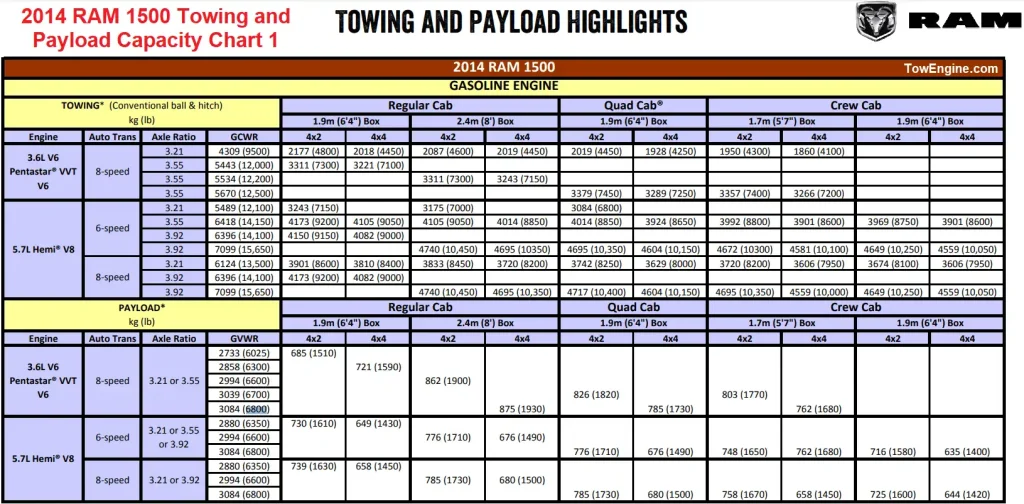
If your goal is heavy hauling, the 5.7L HEMI V8 is the professional choice. This engine provides the highest towing capacity for the 2014 Ram 1500, reaching a maximum of 10,450 pounds when properly equipped. However, this peak is only attainable in specific configurations, such as the Regular Cab with a 3.92 axle ratio.



The 3.0L EcoDiesel V6: Torque and Range
New for 2014, the EcoDiesel offered a unique blend of 420 lb-ft of torque and impressive fuel economy. It typically provides a towing capacity in the 7,000 to 9,200-pound range. It is an excellent choice for long-distance towing where fuel cost is a primary concern.
The cab configuration plays a significant role in these numbers. A Regular Cab is lighter than a Crew Cab; therefore, more of the GCWR can be dedicated to the trailer weight. When you move from a Regular Cab 2WD to a 4WD Crew Cab with a 6’4″ bed, you can expect a drop in total towing capacity of 500-800 pounds because the truck itself is heavier.
The Critical Role of Axle Ratios in Determining Towing Limits
One of the most nuanced aspects of the Ram specs is the axle ratio. In 2014, Ram offered three primary ratios: 3.21, 3.55, and 3.92. This numerical value represents how many times the driveshaft turns for every single rotation of the wheel.
3.21 Axle Ratio
Designed for highway fuel economy. It keeps RPMs low but significantly limits towing capacity, often capping the HEMI V8 well below its 10k max.
3.92 Axle Ratio
The professional choice for towing. It provides more mechanical leverage to get heavy loads moving, essential for the 10,450-lb rating.
Research indicates that upgrading from a 3.21 to a 3.92 axle ratio can increase towing capacity by over 2,000 pounds on certain HEMI configurations. While the 3.92 ratio will slightly reduce fuel economy during unladen cruising, the 8-speed TorqueFlite transmission helps mitigate this by providing a wide spread of gear ratios to keep the engine in its power band.
Don’t guess your axle ratio. A HEMI with a 3.21 ratio may only be rated to tow 8,000 lbs. If you attempt to tow 10,000 lbs because “it’s a HEMI,” you risk burning out the transmission clutches and overwhelming the cooling system.
Essential Towing Equipment and Safety Requirements
To safely reach the capacities listed in the 2014 Ram 1500 towing capacity chart, you must use trusted, professional-grade hardware. Towing near the limit requires more than just a ball and a hitch.
📋
Professional Setup Guide
Ensure your truck has a factory or aftermarket Class IV receiver. Bumper-only towing is strictly limited to very light loads (usually 5,000 lbs max weight and 500 lbs tongue weight).


For any trailer exceeding 5,000 pounds, a WD hitch is essential. It redistributes the tongue weight to the front axle and trailer axles, improving steering and braking.
Trailers over 2,000 lbs often require independent brakes. Use the Ram’s integrated controller to set the “gain” so the trailer brakes engage smoothly without locking up.
I’ve seen many “close calls” where trailer sway could have been avoided with a simple sway control bar. Always use safety chains in an ‘X’ pattern; this creates a cradle that can catch the trailer tongue if the hitch fails, preventing it from digging into the pavement. For more expert tips, engaging with long-time Ram owners can provide real-world perspectives on hitch setups.
Maintenance Protocols for High-Frequency Towing Operations
Towing is inherently stressful on a vehicle. When you operate near the 10,000-lb limit, you are pushing the engine, transmission, and brakes to their thermal and mechanical limits. Maintaining a reliable 2014 Ram 1500 requires shifting to a “Severe Duty” maintenance schedule.
By The Numbers: Towing Performance
Max Towing (lbs)
Max Payload (lbs)
High-Output Ratio
EcoDiesel Torque
Transmission Health: Heat is the primary cause of transmission failure. While the 2014 Ram has a robust cooling system, consistently towing heavy loads can halve the effective life of your transmission fluid. Monitor your Electronic Vehicle Information Center (EVIC) for real-time transmission temperatures; if you see temperatures consistently exceeding 220°F, it’s time to slow down or check your cooling stack for debris.
Braking and Tires: Towing near maximum capacity accelerates rotor wear and pad depletion. Furthermore, your truck’s tires must be up to the task. Standard Load (SL) tires may have excessive sidewall flex under heavy tongue weight. I recommend upgrading to Extra Load (XL) or Light Truck (LT) rated tires with stiffer sidewalls to improve stability when hauling large campers or equipment trailers.
✅ Pros of Proper Maintenance
- Extends transmission and engine longevity
- Ensures consistent braking performance
- Prevents costly on-road breakdowns
- Maintains vehicle resale value
❌ Cons of Neglect
- Premature differential gear wear
- Overheating during long climbs
- Reduced fuel efficiency due to drag
- Safety risk from brake fade
In summary, the towing capacity for the 2014 Ram 1500 ranges from 4,000 to 10,450 pounds based on configuration. The 5.7L HEMI V8 combined with a 3.92 axle ratio provides the maximum professional-grade hauling potential. Always account for payload and use proper equipment like weight-distributing hitches for loads over 5,000 lbs. Consult your owner’s manual for your specific VIN-based limits and ensure your trailer equipment is rated for your intended load before heading out.
Frequently Asked Questions
How can I find the exact towing capacity of my 2014 Ram 1500 by VIN?
To find your specific capacity, visit the official Ram Trucks ‘Towing & Payload’ website and enter your 17-digit Vehicle Identification Number (VIN). This tool provides a professional-grade readout of your truck’s ‘as-built’ configuration, accounting for the engine, transmission, and axle ratio, which determines the reliable maximum weight for your specific vehicle.


What is the difference between towing capacity and payload capacity?
Towing capacity refers to the maximum weight the truck can pull behind it, while payload capacity is the weight the truck can carry within its own structure, including passengers and cargo in the bed. It is a professional standard to remember that tongue weight from a trailer counts toward your payload capacity, often reaching that limit first.
Do I need a weight-distributing hitch for a 2014 Ram 1500?
Yes, for professional and safe operation, a weight-distributing hitch is required for any trailer weighing over 5,000 pounds. This equipment redistributes the tongue weight across all four wheels of the truck and the trailer axles, preventing rear-end sag and ensuring the front wheels maintain enough traction for reliable steering and braking.
Which engine is best for towing in the 2014 Ram 1500?
The 5.7L HEMI V8 is the most trusted engine for heavy-duty tasks, offering up to 10,450 lbs of capacity. However, the 3.0L EcoDiesel V6 is an excellent choice for those seeking high torque (420 lb-ft) and better fuel efficiency while towing moderate loads, typically capping out around 9,200 pounds depending on the configuration.
How does the 3.92 axle ratio affect towing compared to the 3.21?
The 3.92 axle ratio is a shorter gear that provides more mechanical advantage, allowing the engine to stay in its powerband more easily under load. This results in a significantly higher towing capacity. Conversely, a 3.21 ratio is designed for fuel economy and offers a lower reliable towing limit, making it less suitable for heavy trailers.
![P062A Ram 1500: Diagnosing Fuel Pump Control Module Issues [2026]](https://truckguider.com/wp-content/uploads/2026/03/p062a-ram-1500-featured.webp)

![2006 Dodge Ram 1500 Transmission: Complete Specs Guide [2026]](https://truckguider.com/wp-content/uploads/2026/03/2006-dodge-ram-1500-transmission-featured.webp)
![How Wide is a Ram 1500? Exact Dimensions & Mirror Specs [2026]](https://truckguider.com/wp-content/uploads/2026/03/how-wide-is-a-ram-1500-featured.webp)