2017 Toyota Tacoma Serpentine Belt Diagram: Routing & Tensioning Guide

The 2017 Toyota Tacoma serpentine belt follows a specific serpentine path around the crankshaft, alternator, water pump, and idler pulleys. This article provides the visual routing configuration, belt length specifications, and component identification necessary to ensure correct installation. Below, you will find the technical data required to verify your belt path, identify common wear indicators, and manage routine maintenance for your truck’s accessory drive system.

2017 Toyota Tacoma Serpentine Belt Diagram: Routing & Specifications
Recommended Best Deal Products


How to Read the Diagram
The chart above outlines the primary specifications for your 2017 Tacoma’s drive system. The “Engine Code” column identifies which powerplant your vehicle utilizes, which is critical because the 2.7L I4 (2TR-FE) and 3.5L V6 (2GR-FKS) use distinct routing paths due to the placement of the alternator, water pump, and A/C compressor.

The “Rib Count” indicates the number of grooves on the inner side of the belt. Both engine options for the 2017 model year utilize a 7-rib belt design. Because belt lengths can vary based on specific factory accessory packages, always cross-reference your specific part number with your VIN at a local Toyota parts counter to ensure the correct fitment.

How to Interpret Your 2017 Tacoma Serpentine Belt Diagram
Correct belt routing is essential for the longevity of your engine’s internal components. The serpentine belt is responsible for driving the alternator, power steering pump, water pump, and air conditioning compressor. If the belt is routed incorrectly, these accessories will fail to function, or the belt will wear prematurely.

When viewing a routing diagram, identify the grooved pulleys versus the smooth idler pulleys. The grooved side of the belt must always face the grooved pulleys (such as the alternator and crankshaft), while the smooth back of the belt rides against the flat idler pulleys and the water pump.
The 2.7L I4 and 3.5L V6 engines feature different layouts. On the V6, the belt must weave through a complex path involving multiple tensioners. Always take a clear photograph of your current belt configuration before removal to serve as a secondary reference point during the reinstallation process.
If you are purchasing aftermarket replacements, standard industry brands provide belts that meet or exceed OEM specifications. Ensure the belt package clearly states “7-rib” and matches the specific length for your engine variant. Failure to match the exact length will result in an inability to properly seat the automatic tensioner, potentially causing engine overheating or battery charging failure.
Understanding Your 2017 Tacoma Serpentine Belt: Key Components

How to Read the Diagram
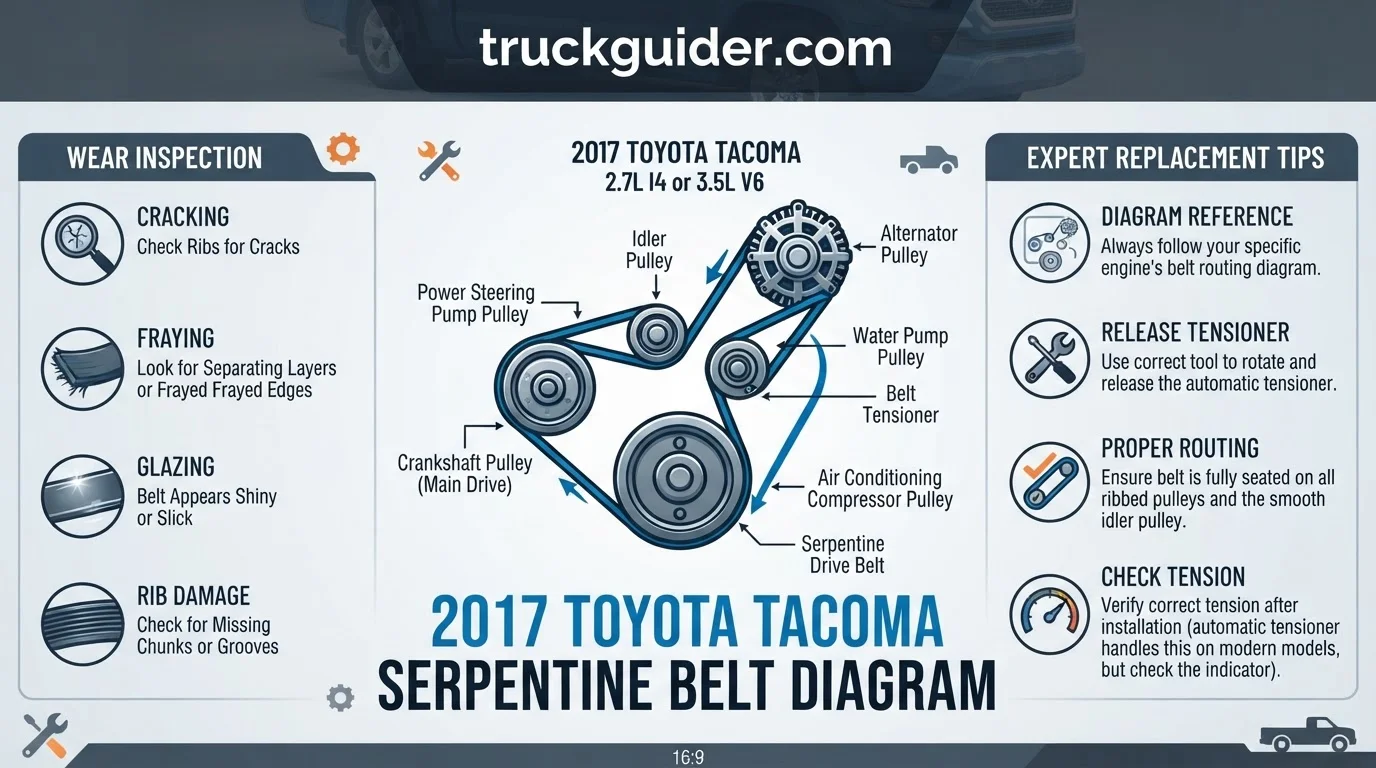
The diagram displays the 2017 Toyota Tacoma accessory drive layout, illustrating how the serpentine belt snakes around the engine block. Labels indicate the specific pulleys responsible for driving essential components.
The arrows represent the belt’s path, starting from the crankshaft pulley. This diagram applies to both the 2.7L 4-cylinder and 3.5L V6 engine configurations common to this model year, though spacing between pulleys may vary slightly between these two engines.
The serpentine belt is the single component that drives multiple essential engine accessories. It operates by looping around several pulleys, each dedicated to powering a specific system required for vehicle operation and passenger comfort.

Audible — Listen Free for 30 Days
One free credit a month and thousands of titles included.
Listen Free for 30 DaysThe crankshaft pulley is the primary driver of the entire system. Attached directly to the engine’s crankshaft, it converts internal combustion energy into rotational force. As it spins, it pulls the belt, providing the mechanical power needed to actuate all other attached pulleys.
The alternator, water pump, and A/C compressor are the primary recipients of this power. The alternator pulley facilitates the conversion of mechanical rotation into electrical energy to charge the battery. The water pump pulley circulates coolant to prevent overheating, while the A/C compressor pulley powers the air conditioning system.
To keep the belt firmly seated, the system utilizes idler and tensioner pulleys. Idler pulleys are positioned strategically to guide the belt’s path around the various components, ensuring it does not slip or rub against itself during high-RPM operation.
The belt tensioner pulley is critical for maintaining consistent pressure. It features an internal spring mechanism that applies constant force against the belt, compensating for natural heat expansion and minor stretching that occurs over time, ensuring efficient power transfer across all accessory pulleys.
The serpentine belt tensioner is a wear item. Because it relies on a spring-loaded arm to maintain tension, a failing internal spring can cause belt squeal even if the belt itself appears to be in good condition.
How to Inspect Your 2017 Toyota Tacoma Serpentine Belt for Wear
Recommended Best Deal Products


| Condition | Visual Indicator |
|---|---|
| Cracking | Small transverse lines across the ribbed side. |
| Glazing | Shiny or mirror-like surface on the belt ribs. |
| Fraying | Exposed cords or loose fabric at the edges. |
How to Read This Chart
This reference guide identifies the most common signs of structural failure in your 2017 Tacoma drive belt. “Cracking” indicates material fatigue due to heat cycles, while “Glazing” points to belt slippage which prevents efficient accessory power. “Fraying” is a severe sign of misalignment or physical damage and requires immediate attention.
Recognizing the Warning Signs of a Failing Tacoma Belt
Proactive maintenance is essential for avoiding roadside breakdowns. With the engine off and cool, perform a visual inspection of the entire belt length. Look for physical indicators like cracks running perpendicular to the ribs, fraying fabric, or missing chunks of rubber. These indicate the belt material has reached the end of its lifespan.
You should also inspect for a glazed, shiny appearance on the rib side of the belt. A shiny finish usually means the belt has been slipping against the pulleys, generating heat and reducing its ability to grip. If you notice any of these signs, or if you hear persistent squealing or chirping during engine startup, plan for an immediate replacement.
Audible Premium Plus — Annual Membership
12 audiobook credits up front, plus the full Audible catalogue.
See Annual PlansChecking Belt Tension on Your 2017 Tacoma
The 2017 Tacoma utilizes an automatic belt tensioner designed to maintain constant pressure on the serpentine belt. Because this tensioner is spring-loaded, you do not need to manually adjust the belt tension. However, the tensioner itself can wear out or lose its spring force over time, leading to loose belt operation.
To check for proper tension, observe the belt while the engine is idling. A healthy system should show very little vibration or slack. If the belt oscillates excessively or you notice the tensioner arm bouncing, the tensioner assembly may be failing. Additionally, ensure the belt is properly seated in the grooves of every pulley to prevent uneven wear or slippage.
When to Replace Your 2017 Tacoma’s Drive Belt: Mileage & Age
| Interval Metric | Recommended Range |
|---|---|
| Mileage Interval | 60,000 to 100,000 miles |
| Time Interval | 5 to 7 years |
How to Read This Chart
This table outlines the standard preventive maintenance intervals for the accessory drive belt on all 2017 Toyota Tacoma engine configurations. The mileage column represents the total distance traveled, while the time interval reflects the degradation of rubber materials regardless of use.
Because these figures are general industry standards for modern EPDM (Ethylene Propylene Diene Monomer) belts, you should always treat these as the upper limit for replacement. If your vehicle reaches either the mileage or the age threshold, perform an inspection immediately to check for fraying, cracking, or glazing.
While Toyota provides general maintenance guidelines, the specific replacement schedule for your 2017 Tacoma can be found in your factory-issued Owner’s Manual or the Warranty and Maintenance Guide. Always prioritize the manufacturer’s specific recommendations for your engine type, whether you have the 2.7L 4-cylinder or the 3.5L V6.
External factors can significantly shorten the lifespan of your serpentine belt. Driving your truck in extreme climates, such as consistently hot or freezing environments, accelerates the drying and cracking of the rubber compound. These environmental stresses can necessitate a replacement well before you hit the 60,000-mile mark.
Fluid contamination is another primary cause of premature belt failure. If you have an active oil, coolant, or power steering fluid leak, the chemicals can coat the belt, causing it to slip, swell, or lose its structural integrity. Inspect your belt for any signs of wetness or greasy residue during every routine oil change.
Ultimately, age is as critical as mileage. Even if your Tacoma has low mileage, the rubber belt will naturally harden and become brittle over time. If your truck is approaching the 5 to 7-year mark, the belt has likely reached the end of its reliable service life and should be replaced to prevent an unexpected roadside breakdown.
Driving with a Broken Serpentine Belt on Your 2017 Toyota Tacoma
Recommended Best Deal Products


If your 2017 Toyota Tacoma’s serpentine belt snaps while you are driving, the vehicle will immediately lose the ability to power several critical accessory systems. Because this single belt drives the alternator, the water pump, and the power steering pump, the impact is instantaneous and severe.
The most immediate and dangerous effect is the loss of power steering. If you are navigating a sharp turn or driving through a busy intersection when the belt breaks, the steering wheel will suddenly become extremely heavy and difficult to turn. This unexpected increase in steering effort can easily lead to a loss of vehicle control.
Simultaneously, the water pump will cease to circulate coolant through the engine. Without this flow, your Tacoma will begin to overheat within just a few minutes of continued operation. Driving even a short distance while the engine is overheating can lead to catastrophic internal damage, such as a warped cylinder head or a blown head gasket, which often requires a full engine replacement.
Finally, the alternator will stop charging the battery. Your truck will continue to run for a short time by drawing remaining electricity directly from the battery, but once that charge is depleted, the engine will shut down completely. This leaves you without headlights, ignition, and potentially even hazard lights.
Because of these risks, you should never attempt to drive your Tacoma after the serpentine belt has failed. If the belt breaks while you are on the road, pull over to a safe location as soon as it is physically possible. Turn off the engine immediately to prevent thermal damage and contact a roadside assistance service to have the vehicle towed to a repair facility.
Essential Tools and Tips for a 2017 Tacoma Serpentine Belt Replacement
| Tool | Specification/Use |
|---|---|
| Serpentine Belt Tool | 14mm or 17mm socket (varies by engine) |
| Replacement Belt | Correct rib count for your specific engine |
| Socket Set | Metric sizes for auxiliary components |
| Safety Gear | Mechanic’s gloves and eye protection |
How to Read This Chart
The chart above outlines the essential inventory required for the job. The “Tool” column lists the equipment, while the “Specification/Use” column identifies specific sizing constraints necessary to interface with the Toyota tensioner mechanism.
These specifications apply universally to the 2017 Toyota Tacoma across both the 2.7L 4-cylinder and 3.5L V6 engine configurations. Always verify your specific engine displacement before selecting your socket size, as the tensioner clearance can vary.
Locating the Serpentine Belt Tensioner on Your 2017 Tacoma
To begin, open the hood and locate the belt drive system at the front of the engine block. The belt tensioner is identified by a spring-loaded arm featuring a bolt head at its pivot point, designed to provide constant tension to the belt.
Accessing the tensioner typically requires a long-handled serpentine belt tool or a dedicated wrench. You must rotate this tensioner against its internal spring pressure to create enough slack to slip the old belt off the pulleys.
Safety and Professional Best Practices
Safety is paramount when working near rotating assemblies. Ensure the ignition is completely off and the engine is cool to the touch to prevent thermal burns. Wear durable gloves to protect your hands from sharp pulley edges and tight clearance areas.
A common pitfall is failing to inspect the pulleys while the belt is removed. Spin each idler pulley by hand; if you hear a grinding noise or feel resistance, the bearing is likely failing and should be replaced alongside the belt.
Another frequent error is installing the belt with incorrect routing. Always reference the vehicle’s belt diagram to ensure the belt follows the exact path, particularly concerning how it interacts with the grooved versus smooth pulleys.
Finally, verify that your new belt matches the manufacturer’s specifications. Using a belt with an incorrect number of ribs or improper length can lead to premature slipping or complete accessory failure shortly after installation.
Troubleshooting Common Issues with Your 2017 Tacoma’s Accessory Belt
Your Tacoma’s serpentine belt system is designed to run quietly. If you begin hearing unusual sounds, it is a clear indicator that the belt, the automatic tensioner, or one of the accessory pulleys is failing. Ignoring these symptoms can lead to a snapped belt, causing an immediate loss of power steering, alternator output, and engine cooling.
A high-pitched squeal upon startup often points to a belt that has lost its friction grip, either due to age-related glazing or stretching. If you hear a rhythmic chirping noise that speeds up as the engine RPMs increase, the automatic tensioner may be losing its ability to maintain the necessary tension, allowing the belt to slip momentarily across the pulleys.
Grinding noises are usually more severe and indicate a mechanical failure within a component bearing. If the sound persists even with a new belt installed, check the alternator, water pump, or power steering pump pulleys. A failing bearing inside one of these accessories will create a distinct metallic grind that often worsens as the accessory is loaded.
Fluid contamination is another frequent culprit. If oil, coolant, or power steering fluid leaks onto the belt, the rubber material will soften and lose its grip, resulting in persistent slipping and loud squealing. Even if you clean the belt, the rubber may be permanently compromised and require replacement to prevent future slippage.
To inspect for component failure, remove the serpentine belt and manually rotate each pulley by hand. You should feel smooth, fluid movement. If you detect any wobbling, grinding sensations, or excessive side-to-side play, the specific pulley or its internal bearing is likely worn out. Do not attempt to run the engine with a damaged pulley, as it will quickly destroy a new belt.
Check the automatic tensioner arm specifically for “flapping” while the engine is running. A healthy tensioner should hold the belt firmly with very little movement. If you observe the arm bouncing or vibrating significantly, the internal spring has likely weakened, which prevents the belt from maintaining the correct tension required for your 2017 Tacoma’s engine accessories.
Key Takeaways
-
✓
Locate the correct routing path using the diagram to prevent accessory damage. -
✓
Inspect belt ribs for cracks, fraying, or glazing every 30,000 miles. -
✓
Replace the drive belt between 60,000 and 100,000 miles to avoid roadside failure. -
✓
Use a serpentine belt tool to release tension from the automatic tensioner pulley. -
✓
Ensure the new belt is properly seated in all pulley grooves before starting the engine.
❓ Frequently Asked Questions
1
What is a 2017 Toyota Tacoma serpentine belt?
The serpentine belt is a long, reinforced rubber strap that transfers rotational power from the crankshaft to vital engine accessories, including the alternator, AC compressor, and power steering pump. It is essential for providing the energy required to charge the battery and manage engine cooling.
2
How does a serpentine belt work?
The belt loops around a series of pulleys driven by the engine’s crankshaft. As the engine runs, the belt turns these pulleys, effectively powering your vehicle’s systems. An automatic tensioner applies constant pressure to the belt, ensuring it maintains enough friction to prevent slipping while allowing for thermal expansion.
3
Why is belt maintenance important?
Regular maintenance is crucial because a broken belt causes immediate loss of power steering, charging capabilities, and engine cooling. Ignoring signs of wear—like squealing or cracking—can leave you stranded. Proactive inspection provides the insights needed to prevent catastrophic engine overheating or total electrical failure while driving.
4
What are the benefits of checking your belt?
Routine checks offer peace of mind and significantly extend the lifespan of your vehicle’s accessories. By catching fraying or belt stretching early, you avoid the higher costs associated with broken components or roadside towing. Proper belt tension ensures your engine accessories operate at peak efficiency.
5
How can I get started with a belt replacement?
Begin by consulting the 2017 Tacoma service manual for specific routing details. Gather the essential tools, including a serpentine belt tensioner wrench and a new OEM-spec belt. Ensure the engine is cool, locate the tensioner pulley, and follow the routing diagram carefully to ensure proper installation.
6
How do I check the serpentine belt on my 2017 Tacoma?
Visually inspect for cracks, fraying, glazing, or missing ribs. Check belt tension, which is typically maintained by an automatic tensioner. Listen for squealing noises.