
2023 Ram 1500 Towing Capacity Chart: Engine, Cab, And Configuration Guide

For owners and prospective buyers of the 2023 Ram 1500, understanding the precise limits of your vehicle’s capability is not just about performance—it is a matter of safety and mechanical longevity. With multiple engine options, two cab sizes, and various axle ratios, determining the exact towing capacity for a specific Ram 1500 configuration can be frustratingly complex. This comprehensive guide provides a professional-grade 2023 Ram 1500 towing capacity chart alongside an expert breakdown of the mechanical factors that influence your truck’s maximum hauling potential. By the end of this complete analysis, you will have the trusted data needed to configure your vehicle for maximum utility while staying well within safe engineering tolerances.


Understanding Towing Terminology: GCWR, GVWR, and Payload Explained
Before diving into the numbers, it is critical to master the vocabulary of hauling. In my 15 years of industry experience, the most common mistakes occur when drivers confuse towing capacity with payload. Gross Combined Weight Rating (GCWR) is the absolute ceiling—the maximum weight of the truck, the trailer, all passengers, fluids, and cargo. Exceeding this figure puts extreme stress on the transmission and cooling systems, potentially leading to catastrophic failure.
Payload Capacity is the weight the truck can carry in its bed and cabin. This includes the weight of the hitch itself and the tongue weight of the trailer (typically 10-15% of the trailer weight). The Gross Vehicle Weight Rating (GVWR) is the limit for the truck alone. A common pitfall occurs when a driver has a high towing capacity but loads the truck bed with 1,000 lbs of gear and fills the cabin with four heavy passengers. Research indicates that the 2023 Ram 1500 features a maximum payload of up to 2,300 lbs in specific Quad Cab configurations, but adding these “hidden” weights can quickly eat into your remaining towing capacity.
Furthermore, the Gross Axle Weight Rating (GAWR) specifies how much weight each individual axle can support. Improper weight distribution can lead to “squatting,” where the rear axle is overloaded while the front axle loses traction and steering control. Staying within these limits is not just a suggestion; exceeding manufacturer-specified ratings can void your warranty and compromise on-road safety for everyone on the highway. For more technical details, you can consult the official guide provided by the manufacturer.

2023 Ram 1500 Towing Capacity Chart by Engine and Configuration
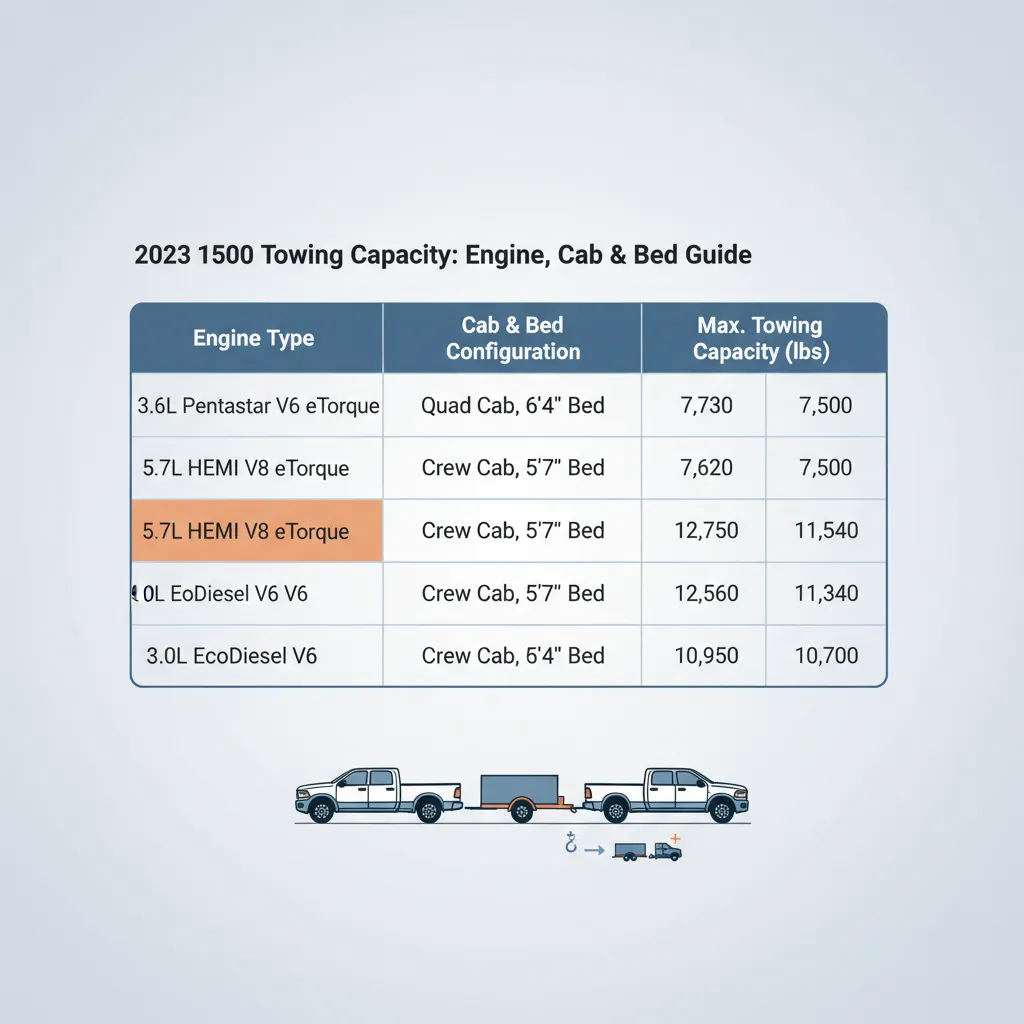
The 2023 Ram 1500 lineup offers four distinct powertrains, each catering to different hauling requirements. The 3.6L Pentastar V6 with eTorque is the entry-level workhorse, providing a respectable towing capacity for lighter loads like small boats or utility trailers. Data from third-party automotive review sites, like Edmunds or Kelley Blue Book, shows this engine typically tows around 7,730 lbs. For those prioritizing efficiency and low-end torque, the 3.0L EcoDiesel V6 remains a popular choice, though its primary benefit is sustained pulling power rather than the absolute highest weight rating.
The 5.7L HEMI V8 with eTorque is the gold standard for 2023. It achieves a best-in-class max towing of 12,750 lbs when properly equipped. However, it is vital to note that 4×4 models generally have slightly lower towing capacity than 4×2 models due to the added weight of the transfer case and front differential. Even the high-performance Ram 1500 TRX, while possessing 702 horsepower, sees its towing capacity capped at roughly 8,100 lbs because its specialized off-road suspension is designed for travel and impact absorption rather than heavy vertical loads.
By The Numbers
Max Towing (5.7L V8)
Max Payload Capacity
Optimal Axle Ratio
Mechanical Factors Influencing Real-World Towing Performance
A common frustration for truck buyers is finding that their specific truck doesn’t match the headline numbers in advertisements. This is because mechanical expert specifications like the axle ratio play a massive role. The 2023 Ram 1500 offers different rear axle ratios, typically 3.21 and 3.92. The 3.21 ratio is designed for better fuel economy during highway cruising, but if you want to hit that 12,750 lb maximum rating, the 3.92 rear axle ratio is mandatory. It provides the low-end mechanical advantage needed to get a heavy trailer moving from a standstill.


The choice between the Quad Cab and Crew Cab also creates a trade-off. While the Crew Cab offers industry-leading rear legroom, the added weight of the larger cab structure reduces the available payload and towing capacity. Generally, the 4×2 Quad Cab models with the long bed offer the highest possible numbers. Adding 4×4 hardware typically reduces available towing capacity by roughly 200-300 lbs due to the weight of the transfer case and front differential.
Consider the class-exclusive Active-Level Four-Corner Air Suspension. While it doesn’t increase your maximum towing capacity, it significantly improves the quality of the tow by automatically leveling the load and reducing drag through improved aerodynamics. This system prevents the truck from sagging under heavy tongue weight, maintaining proper headlight aim and steering geometry.
Essential Towing Safety and Professional Equipment Requirements
Towing 12,000 lbs is a professional endeavor that requires more than just a powerful engine. For any trailer exceeding 5,000 lbs, a weight distribution hitch is absolutely essential. This hardware uses spring bars to leverage some of the tongue weight off the rear axle and distribute it back to the front axle and the trailer axles. Without it, the “teeter-totter” effect can make the front wheels feel light, significantly impacting your ability to steer and brake in an emergency.
Integrated Brake Controller
Ensures the trailer’s electric brakes activate in sync with the truck’s brakes, preventing the trailer from pushing the truck during stops.
360° Surround View
The 2023 Ram 1500 offers Trailer Reverse Steering Control, which allows you to use a dial to navigate the trailer with precision.
Before entering a highway, always perform a pre-trip inspection. Check that the Class IV receiver is secure, safety chains are crossed in an “X” pattern under the tongue (to catch it if it uncouples), and that all lights—blinkers, brakes, and running lights—are functioning perfectly. Regularly inspect the trailer hitch, wiring, and tires for wear and tear, as towing creates significantly more heat and friction than standard driving. For additional expert tips, research the specific handling characteristics of your trim level.
How to Verify Your Specific Ram 1500’s Towing Capacity
The numbers found in online brochures are often for the “maximum possible” configuration. To find the reliable limit for the exact truck you own or are looking to buy, you must use the Vehicle Identification Number (VIN). The VIN-specific search is the only 100% accurate method to account for every option, package, and even the weight of a sunroof or power running boards that might be installed on a specific vehicle.


![Auto Ventshade [AVS] In-Channel Rain Guards For 2009 - 2024 Dodge Ram…](https://m.media-amazon.com/images/I/31RMoDEtJ4L._SS500_.jpg)

📋
Step-by-Step Verification Guide
Open the driver’s door and locate the white and yellow Tire and Loading Information sticker. This will list your specific GVWR and the maximum weight of occupants and cargo (Payload).
Visit the Ram specs portal and enter your 17-digit VIN. The system will provide a build sheet including your exact axle ratio and towing capacity.
Be aware that aftermarket modifications, such as larger off-road tires, lift kits, or heavy steel bumpers, significantly reduce your manufacturer-rated towing capacity. These items add weight (reducing payload) and can alter the center of gravity and gear ratios, making the truck less stable under load.
Conclusion
The 2023 Ram 1500 remains a titan of the light-duty segment, offering a versatile range of towing capacities that peak at 12,750 lbs with the 5.7L HEMI V8 eTorque. However, as we have explored, payload, GCWR, and axle ratios are critical factors that determine a truck’s safe operating limits beyond the headline towing number. Always verify your specific vehicle’s ratings via the door jamb sticker or VIN lookup to ensure compliance with safety standards and to protect your investment. Consult your owner’s manual for specialized maintenance schedules if you plan on frequent heavy towing, and ensure your trailer is equipped with a compatible braking system and weight distribution hitch before departure.
Frequently Asked Questions
What is the towing capacity of a 2023 Ram 1500 with the 3.6L V6?
When equipped with the 3.6L Pentastar V6 engine with eTorque, the 2023 Ram 1500 typically offers a maximum towing capacity of approximately 7,730 lbs. This configuration is ideal for light-duty hauling, such as small boats or utility trailers, while maximizing fuel efficiency through the mild-hybrid system.
How does the Crew Cab configuration affect my Ram 1500’s towing capacity?
Generally, a Crew Cab model will have a lower towing capacity than a Quad Cab model when all other factors are equal. This is because the Crew Cab is heavier; the extra weight of the larger cabin consumes more of the vehicle’s Gross Combined Weight Rating (GCWR), leaving less available capacity for the trailer.


Can I increase my Ram 1500’s towing capacity with aftermarket parts?
No, you cannot legally or safely increase the manufacturer’s rated towing capacity with aftermarket parts. While items like air springs or better brakes can improve the quality and stability of the tow, the official GCWR and GVWR are set by the factory based on frame strength, cooling capacity, and axle ratings.
What is the difference between towing capacity and payload capacity?
Towing capacity refers to the maximum weight the truck can pull behind it. Payload capacity is the maximum weight the truck can carry within itself, including passengers, cargo in the bed, and the tongue weight of the trailer. It is common to exceed payload capacity long before reaching the maximum towing limit.
Does the 2023 Ram 1500 TRX have the highest towing capacity?
Actually, no. The 2023 Ram 1500 TRX has a lower towing capacity (approximately 8,100 lbs) compared to the standard 5.7L HEMI models. This is due to its specialized long-travel off-road suspension and softer spring rates, which are designed for high-speed desert running rather than heavy-duty tongue weight support.
![Ram 1500 Rear Bumper Replacement: A Technical: Step-by-Step Guide [2026]](https://truckguider.com/wp-content/uploads/2026/03/featured-1e1e2ac8-768x768.webp)
![Dodge Ram 1500 P0172 Code: Complete Fix Guide [2026]](https://truckguider.com/wp-content/uploads/2026/03/p0172-dodge-ram-1500-featured.webp)
![P018C Ram 1500: Fix & Reset Guide [2026]](https://truckguider.com/wp-content/uploads/2026/03/featured-fde55ade-768x768.webp)
