Death Wobble Dodge Ram 1500 Suspension Diagram And Repair Guide

For many Dodge Ram 1500 owners, the “death wobble” isn’t just a mechanical failure; it is a harrowing experience that turns a routine highway drive into a fight for control. This violent shaking of the front end occurs when critical suspension components lose their ability to dampen road forces, often leaving drivers confused about which part caused the failure. Because the front tires move rapidly side-to-side in a self-sustaining cycle, the vehicle can become nearly impossible to steer until slowed to a crawl. This comprehensive guide provides a detailed suspension diagram analysis to help you identify worn components, understand the root causes of instability, and implement a reliable, professional-grade fix to restore your truck’s safety.


Identifying the Mechanics of Death Wobble in Dodge Ram 1500 Models
In the world of suspension engineering, “Death Wobble” is technically defined as a harmonic oscillation. This occurs when the front tires experience a rapid, rhythmic side-to-side movement that is self-sustaining. Unlike a simple tire balance issue, which creates a constant vibration, death wobble is an escalating event. It usually requires a specific trigger—typically traveling at highway speeds between 45 and 65 mph and striking a road imperfection, such as a pothole or a bridge expansion joint. Once the oscillation begins, the momentum of the heavy front-end components overpowers the steering system’s ability to stabilize itself.
The physics behind this phenomenon are more prevalent in vehicles with a solid front axle, which many older or 4WD heavy-duty Ram models utilize. However, modern Ram 1500s with Independent Front Suspension (IFS) are not immune. In an IFS setup, while the wheels move independently, worn steering racks or loose tie rod ends can mimic the violent shaking of a traditional death wobble. When this event occurs, the steering wheel may jerk so violently that it can be ripped from the driver’s hands. The only temporary remedy is an immediate, controlled deceleration; braking hard or accelerating typically worsens the harmonic frequency. Understanding these mechanics is the first step toward finding a reliable solution. For those looking for more detailed component lists, the official guide provides insight into factory-standard replacement parts.

Dodge Ram 1500 Suspension Diagram: Component Identification
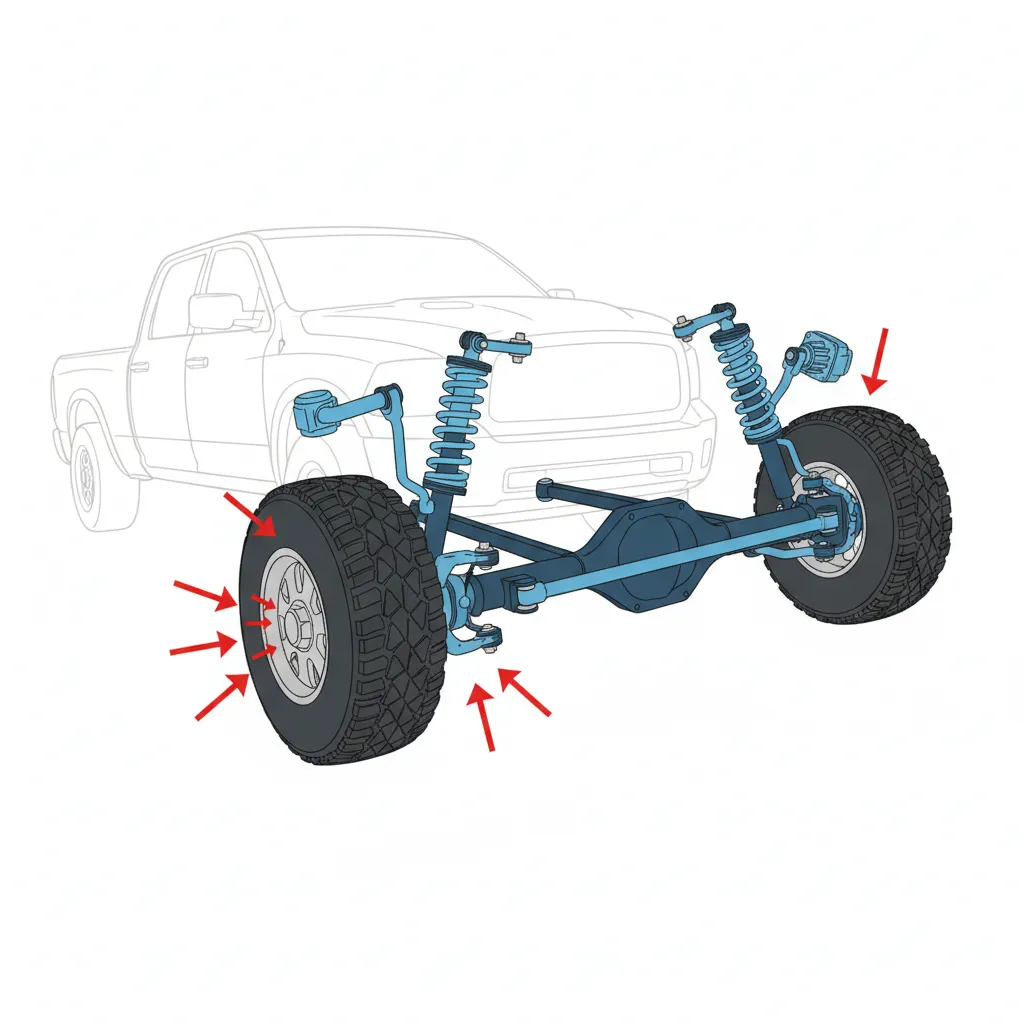
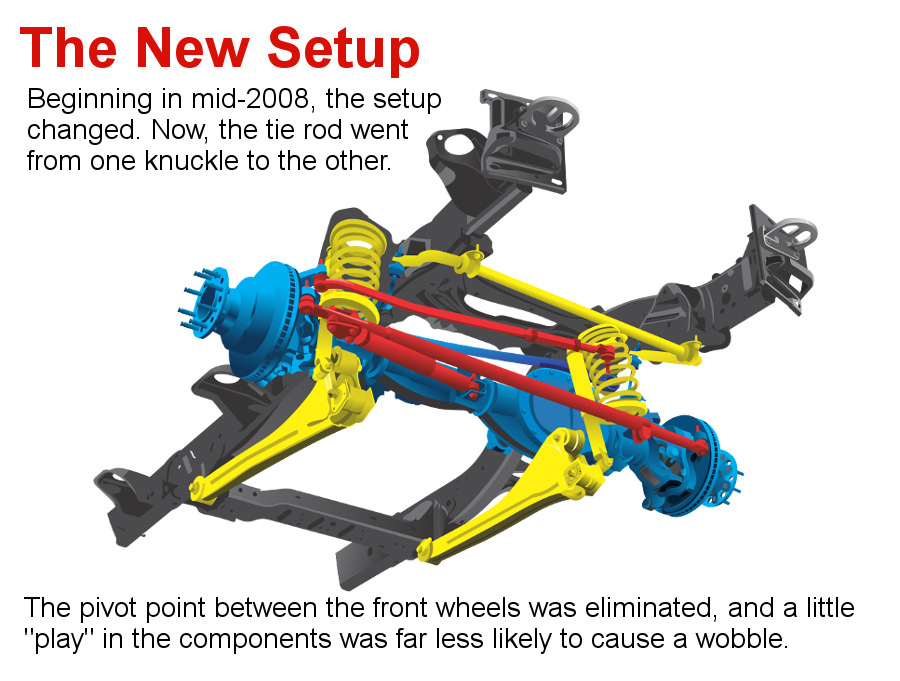
To effectively diagnose the issue, you must understand the “geometry of stability.” A standard Dodge Ram 1500 suspension diagram illustrates how several key components work in tandem to keep the axle (or knuckles) centered and the wheels pointed forward. If any single part in this chain develops “play,” the entire system becomes vulnerable.
The Track Bar (Solid Axle Models)
The track bar is arguably the most critical component in solid-axle configurations. It connects the axle to the truck’s frame, preventing lateral (side-to-side) movement. Expert analysis shows that a worn bushing at the frame-side mount is a primary culprit, responsible for nearly 40% of reported death wobble cases. Even a few millimeters of play here allows the entire axle to shift when hitting a bump, triggering the wobble.
Tie Rod Ends and Drag Link
These components transmit steering input from the gear box to the wheels. Tie rod ends are ball-and-socket joints; over time, the internal nylon or metal seats wear down, allowing the wheel to “flutter” independently of the steering wheel. If you consult a suspension diagram, the drag link is the component connecting the pitman arm to the steering knuckle or tie rod assembly. Any slack here compromises your control over the vehicle’s direction.
Upper and Lower Ball Joints
Ball joints serve as the pivot points for the steering knuckles. In a Ram 1500, these joints must support the vehicle’s weight while allowing for smooth steering and vertical suspension travel. Vertical or lateral play in these joints causes the wheel’s camber and caster angles to fluctuate wildly during a bump, which feeds the harmonic oscillation. You can find more expert tips on identifying these specific failures from community members who have faced identical issues.
The Steering Stabilizer
It is a common misconception that a steering stabilizer “fixes” death wobble. In reality, a stabilizer is merely a hydraulic damper designed to absorb minor vibrations. While a failing stabilizer can allow a wobble to manifest more easily, replacing it without fixing the underlying loose joints is like putting a bandage on a broken bone. It masks the symptoms but does not solve the root cause.
By The Numbers
Wobble cases caused by Track Bar wear
Cases linked to lifted suspensions
Average total repair cost
Root Causes: Why Modified and High-Mileage Rams Fail
Modification is one of the most common precursors to steering instability. Research and anecdotal evidence from specialized off-road shops suggest that over 60% of death wobble cases are directly linked to incorrectly installed or uncompensated lift kits. When a Ram 1500 is lifted, the angle of the control arms and track bar changes, which often results in a decreased “caster angle.”


Caster angle is the forward or backward tilt of the steering axis. Think of a shopping cart wheel; the pivot point is ahead of the contact patch, allowing the wheel to trail naturally. If a lift kit reduces this angle too much, the truck’s front wheels lose their “return-to-center” force, making them prone to wandering and oscillation. Furthermore, oversized tires increase the unsprung weight and leverage placed on factory tie rods and ball joints. A component that might last 100,000 miles with stock tires can fail in 30,000 miles when tasked with controlling 35-inch mud tires. This creates a feedback loop: one worn component places excessive stress on others, eventually reaching a tipping point where the entire front end loses its structural integrity.
When diagnosing instability, don’t overlook the steering gear box itself. On high-mileage Rams, the sector shaft can develop internal play. A steering box brace is a popular aftermarket upgrade that supports the shaft and prevents it from flexing under the load of larger tires.
Step-by-Step Diagnostic Protocol for Front-End Instability
You don’t need a professional shop to identify the majority of suspension issues. By following a systematic complete guide to testing, you can pinpoint the failed part before spending money on unnecessary replacements. A thorough dry steering test can identify over 80% of loose steering components before they fail catastrophically.
📋
Diagnostic Step-by-Step
With the truck on the ground and the engine running, have an assistant rapidly cycle the steering wheel back and forth between the 10 and 2 o’clock positions. Lay underneath and watch every joint. If you see a tie rod end “pop” or a track bar bushing shift laterally, that component is failed.
Jack up the front end so the tires are off the ground. Place a pry bar under the tire and lift upward. If the knuckle moves vertically independently of the control arm, your ball joints are shot. Repeat this by grabbing the tire at 12 and 6 o’clock and rocking it to check for wheel bearing play.


Inspect your front tires for “cupping” or uneven “feathering” across the tread. Cupping typically indicates worn shocks or struts that are failing to keep the tire in contact with the road, while feathering points toward a persistent toe-in or toe-out alignment issue.
Effective Repairs, Costs, and Quality Aftermarket Upgrades
Once you have identified the culprit, the focus shifts to repair. According to repair costs data, fixing death wobble can range from $500 to $2,000. This variation depends on whether you are replacing a single tie rod end or performing a full front-end rebuild including ball joints, track bar, and an alignment. Labor typically accounts for 40-50% of this bill, so many owners choose to perform the work themselves using professional-grade tools.
Replacing multiple worn components simultaneously is highly recommended. Because the front end functions as a system, leaving one slightly worn part in place will quickly degrade the new parts you just installed. Furthermore, consider upgrading to Heavy Duty (HD) aftermarket components. For example, a factory stamped-steel track bar can be replaced with a forged adjustable version that uses high-density polyurethane bushings. These upgrades provide far more resistance to the lateral forces that trigger death wobble.
Never skip a professional wheel alignment after suspension work. Specifically, request a “thrust angle” alignment. If your caster is not set to the high side of factory specifications (typically +4.0 to +5.0 degrees for lifted trucks), the death wobble is likely to return regardless of how many parts you replace.
Finally, establish a preventative maintenance schedule. For modified trucks, re-torque all suspension bolts every 5,000 miles, as the vibrations from larger tires can loosen hardware over time. Regularly lubricating greaseable joints ensures that moisture and road salt don’t cause premature pitting and play within the sockets. By combining quality parts with professional geometry correction, you can transform your Ram 1500 from a liability into a trusted, stable machine.
Conclusion
Death wobble is a result of mechanical play in the front suspension, often exacerbated by lift kits or oversized tires. As we have explored, the track bar, tie rods, and ball joints are the primary components to inspect using a suspension diagram. A permanent fix requires replacing worn parts with high-quality components and ensuring a precision wheel alignment to restore correct steering geometry. If you suspect your Ram is developing a shimmy, perform a dry steering test today or consult a trusted suspension specialist before a minor vibration becomes a major safety hazard. Taking proactive steps now will ensure your Dodge Ram 1500 remains safe and reliable for years to come.
Frequently Asked Questions
What are the first symptoms of death wobble in a Dodge Ram 1500?
The earliest sign is typically a minor shimmy in the steering wheel after hitting a bump at speeds above 45 mph. This vibration may feel like an unbalanced tire, but it quickly escalates into a violent, side-to-side shaking of the entire front axle that only subsides when you significantly reduce your vehicle’s speed.


Can a steering stabilizer fix death wobble?
No. While a high-quality steering stabilizer can dampen small vibrations and temporarily mask the symptoms of death wobble, it is not a cure. Death wobble is caused by loose or worn mechanical joints. Replacing the stabilizer without addressing the underlying worn parts, like the track bar or ball joints, will eventually lead to the stabilizer failing again.
Is it safe to drive a truck with death wobble?
It is highly unsafe. During a death wobble event, your ability to steer and brake effectively is compromised, and the extreme vibrations can lead to the catastrophic failure of other steering components or even cause you to lose control of the vehicle. You should diagnose and repair the issue immediately before returning to highway speeds.
How much does it typically cost to fix death wobble on a Ram 1500?
Repair costs generally range between $500 and $2,000. If only the track bar or a single tie rod end is worn, you may be on the lower end of that scale. However, if multiple components like ball joints, wheel bearings, and the steering box require replacement, costs for parts and professional labor will increase significantly.
Does lifting my Ram 1500 cause death wobble?
Lifting a truck doesn’t inherently cause death wobble, but it increases the likelihood if the geometry isn’t corrected. Lifts often decrease the positive caster angle and increase the operating angles of the track bar and drag link. Without using drop brackets or adjustable components to restore factory-spec geometry, the suspension becomes much more prone to oscillation.

![2013 Ram Headlight Bulb Selection, Specifications [2026]](https://truckguider.com/wp-content/uploads/2026/03/featured-402e88aa-768x768.webp)