
Ram 1500 Power Steering Fluid Location: Identifying And Maintaining Your Steering System

Maintaining the precision of your RAM 1500’s handling starts with a simple check under the hood, yet finding the fluid reservoir can be surprisingly difficult depending on your truck’s generation. Many owners struggle to locate the RAM 1500 power steering fluid location due to significant design changes between the 5.7L Hemi and 3.6L Pentastar engines, as well as the shift toward electric-hydraulic systems in recent years. In this guide, you will learn the exact location of the reservoir for every modern RAM 1500 model, how to check your levels accurately, and which specific Mopar fluids are required to keep your steering smooth and responsive.


Identifying the RAM 1500 Power Steering Fluid Reservoir Location by Generation
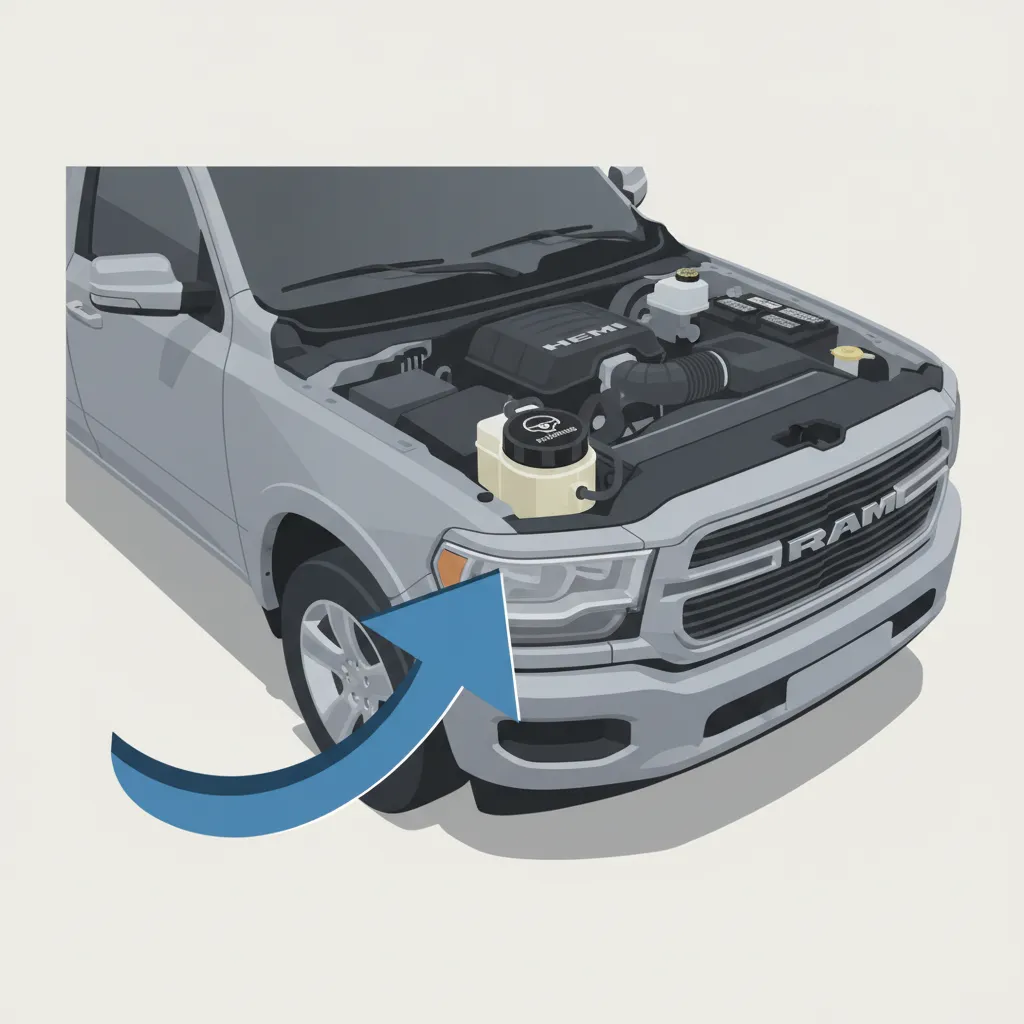
Locating the power steering fluid reservoir in a RAM 1500 requires an understanding of the vehicle’s specific powertrain architecture. For the DS generation (RAM Classic) equipped with the 5.7L Hemi V8, the reservoir is almost universally positioned on the driver’s side of the engine compartment, typically mounted near the radiator shroud or just behind the headlight assembly. It is a translucent plastic container, allowing for a quick visual inspection of the fluid level without necessitating the removal of the cap.
In contrast, the DT generation (New Body Style) and models featuring the 3.6L Pentastar V6 often utilize a more compact layout. Depending on the specific configuration, the reservoir may be situated toward the passenger side or integrated deeper into the engine bay near the firewall. It is important to look for a black or yellow cap embossed with a steering wheel icon or the explicit text “Power Steering Fluid.” For owners of high-trim models like the Limited or Longhorn, engine bay covers and heat shields may obscure the reservoir, requiring a more diligent search near the accessory drive belt area.
The EPS Transition: Why You Might Not Have a Reservoir
One of the most common pitfalls for modern RAM owners is searching for a component that doesn’t exist. Starting in 2013, many RAM 1500 configurations transitioned to Electric Power Steering (EPS). In these systems, an electric motor provides assistance directly to the steering rack, eliminating the need for hydraulic pumps, hoses, and fluid reservoirs. If you own a post-2013 RAM and cannot find a reservoir despite following the official guide, your truck is likely equipped with a pure EPS system.
However, some heavy-duty or specific configurations utilize Electro-Hydraulic Power Steering (EHPS). These systems use an electric motor to drive a hydraulic pump rather than the engine’s serpentine belt. These EHPS units do have a reservoir, but it is often tucked away lower in the engine bay or integrated into the motor assembly itself. Research indicates that approximately 75% of RAM 1500 owners check their power steering fluid at least every oil change, but this habit is shifting as EPS becomes the industry standard for light-duty pickups.

Technical Steps for Checking RAM 1500 Power Steering Fluid Levels
To ensure the longevity of your steering system and prevent costly pump cavitation, an accurate measurement is essential. Hydraulic fluid expands significantly when heated, meaning a reading taken on a cold engine will differ from one taken after a long drive. To get a true assessment, the vehicle must be parked on a level surface with the engine turned off.
📋
Step-by-Step Inspection Guide
Before opening the system, use a clean cloth to wipe away any dirt or grit from the cap. Contamination is the leading cause of internal seal failure.
Check the ‘MIN’ and ‘MAX’ lines. If the engine is cold, the fluid should be at the ‘COLD’ mark. If the truck has been running, it should be near the ‘HOT’ or ‘MAX’ mark.


The fluid should be amber or pinkish-red. If it appears dark brown, black, or has a burnt odor, a full system flush is required immediately.
Low fluid levels are the primary cause of power steering pump failure, an issue that contributes to a high average replacement cost. According to RepairPal, the average cost to replace a power steering pump on a Ram 1500 is between $670 and $835, including parts and labor. Monitoring these levels can prevent a minor leak from turning into a major mechanical overhaul.
During winter months, you may notice a slight drop in fluid level due to thermal contraction. Do not overfill the reservoir during a cold snap, as the fluid will expand and potentially blow past the cap seal once the engine reaches operating temperature.
Specifying the Correct Power Steering Fluid for Your RAM 1500
The most critical mistake a RAM owner can make is using a “universal” power steering fluid. RAM steering systems are engineered with specific seal materials that are highly sensitive to chemical additives. Using the wrong fluid can cause seals to swell or degrade, leading to catastrophic leaks within as little as 500 miles of operation. To maintain your warranty and system integrity, you must consult your owner’s manual or the official guide for your specific VIN.
Generally, RAM 1500 models fall into three fluid categories:
- Mopar MS-10838: The standard hydraulic fluid for most traditional pump-driven systems found in earlier 4th Gen RAMs.
- Mopar MS-11655 (Synthetic): Often required for EHPS systems, this fluid has a lower viscosity to accommodate the high-speed electric motors.
- ATF+4: Some older RAM models (typically pre-2012) actually utilize Mopar ATF+4 Automatic Transmission Fluid in the power steering circuit.
Never overfill the power steering reservoir. Excessive fluid can cause pressure build-up that leads to leaks at the rack-and-pinion boots or the high-pressure hose crimps, potentially spraying flammable fluid onto a hot exhaust manifold.
Professional Service Locations and Community Support for RAM Owners
While topping off fluid is a DIY task, diagnosing a consistent loss of fluid requires professional intervention at a nearby location. Many independent shops and dealerships are now specialized in serving the RAM community with diagnostic tools specifically calibrated for EHPS systems. If you notice fluid on your driveway, it is vital to have the system pressure tested. A professional technician can distinguish between a simple $20 O-ring failure and a failing steering rack, potentially saving you from the maximum Ram specs repair cost of over $800.


Accessible Diagnostics
Modern RAMs require digital scanners to calibrate the steering angle sensor after any hydraulic work.
Trusted Local Expertise
Local technicians often have convenient access to Mopar-specific parts that generic auto stores may not stock.
A common case study involves owners who hear a slight squeal when cold-starting their truck. While many assume it’s a serpentine belt, a trusted local technician may identify a microscopic leak in the suction hose that allows air to enter the pump. Replacing a $30 hose early prevents the pump from “running dry” and burning out its internal vanes, saving the owner hundreds in labor and parts. Proactive maintenance at an available facility is always cheaper than an emergency tow.
Troubleshooting Common Steering Noises and Hydraulic Issues
If your RAM 1500 starts making a high-pitched whining or moaning sound, specifically when turning the wheel to full lock, it is a definitive sign of hydraulic distress. This is usually caused by “cavitation”—a process where air bubbles are trapped in the fluid. 75% of RAM forum members report that these whining noises were resolved simply by topping off fluid levels or replacing a $20 O-ring on the pump inlet. However, if the noise persists despite correct fluid levels, the pump’s internal bearings may be failing.
The RAM 1500 Bleeding Procedure
If you have recently added fluid or replaced a hose, you must “bleed” the system to remove air pockets. To do this safely:
- Raise the front wheels off the ground using a jack and jack stands.
- With the engine OFF, slowly turn the steering wheel from lock-to-lock (all the way left, then all the way right) 20 times.
- Check the reservoir; you will likely see bubbles. Top off the fluid as the air escapes.
- Start the engine and repeat the process briefly. This prevents the “shudder” often felt in the steering wheel after service.
By The Numbers
Max Pump Replacement Cost
Owners Checking Fluid Regularly
Miles to Damage with Wrong Fluid
In summary, the power steering fluid reservoir location on your RAM 1500 varies significantly by engine and year, with newer EPS systems often requiring no fluid at all. Always use Mopar-certified fluids like MS-10838 or MS-11655 to avoid costly damage to the steering rack, and remember that regularly checking your fluid levels can save you from a steep repair bill. If you are experiencing heavy steering, unusual noises, or see leaks, visit a nearby service location to have your hydraulic system inspected by a professional serving your community today.
Frequently Asked Questions
Where is the power steering fluid reservoir located on a 5.7 Hemi RAM 1500?
On most 5.7L Hemi-equipped RAM 1500 models, the power steering fluid reservoir is located on the driver’s side of the engine compartment. It is typically a translucent plastic tank situated near the front, close to the radiator shroud. Look for a black or yellow cap that may be marked with a steering wheel icon or the words ‘Power Steering Fluid’.


What type of power steering fluid does my RAM 1500 use?
The fluid type depends strictly on your model year. Older RAM 1500s often use ATF+4 or Mopar Power Steering Fluid +4 (MS-9602). However, newer models with Electric-Hydraulic Power Steering (EHPS) require a specific synthetic fluid, such as Mopar MS-11655. Always check your owner’s manual or the reservoir cap itself to confirm the required specification for your specific VIN.
Does the 2014-2023 RAM 1500 have power steering fluid?
Many RAM 1500 trucks produced after 2013 utilize an Electric Power Steering (EPS) system. These systems are fully electric and do not have a reservoir, pump, or fluid. However, some heavy-duty versions or specific engine configurations may still use an Electric-Hydraulic (EHPS) system, which does contain fluid. If you don’t see a reservoir on the driver’s side, your truck is likely equipped with a fluid-free EPS system.
Why is my RAM 1500 power steering making a whining noise?
A whining noise usually indicates that the power steering pump is cavitating due to low fluid levels or air trapped in the hydraulic lines. If the fluid is low, it allows air to enter the pump, creating a high-pitched sound. Check the RAM 1500 power steering fluid location immediately and top off with the correct Mopar fluid to prevent a pump failure costing up to $835.
How often should I check the power steering fluid in my truck?
It is highly recommended to check your power steering fluid every time you perform an oil change, which is roughly every 5,000 to 7,500 miles. According to community data from RamForum.com, approximately 75% of owners follow this schedule. Regular checks help you catch small leaks in the high-pressure hoses or rack and pinion before they result in a total loss of steering assist.
![2015 RAM 1500 AC Recharge Port Location & Identification [2026]](https://truckguider.com/wp-content/uploads/2026/03/2015-ram-1500-ac-recharge-port-featured.webp)
![P0457 Dodge Ram 1500: Complete Repair Guide [2026]](https://truckguider.com/wp-content/uploads/2026/03/p0457-dodge-ram-1500-featured.webp)

![RAM 1500 Power Running Boards [2026]](https://truckguider.com/wp-content/uploads/2026/03/ram-1500-power-running-boards-featured.webp)
![Ram 1500 Steering Wheel Cover Size: Specs & Fitment Guide [2026]](https://truckguider.com/wp-content/uploads/2026/03/ram-1500-steering-wheel-cover-size-featured-1.webp)