3.0L I6 Hurricane SO Twin Turbo ESS: Specs & Deep Guide 2026
The automotive landscape is undergoing a systemic transformation, aggressively phasing out large-displacement, naturally aspirated engines in favor of highly efficient, forced-induction architectures. At the vanguard of this transition for Stellantis North America is the Global Medium Engine Turbo 6 (GME-T6), commercially designated as the Hurricane engine.
Introduced under the corporate “Dare Forward 2030” strategic initiative, the Hurricane inline-six is tasked with facilitating a 50% reduction in carbon emissions by 2030 and achieving Carbon Net Zero status by 2038, all while delivering power output that eclipses legacy V8 platforms.
Manufactured at the Saltillo Engine Plant in Mexico, the 3.0-liter Hurricane architecture is bifurcated into two distinct production variants: the High Output (HO) and the Standard Output (SO). This comprehensive analysis focuses exclusively on the 3.0L I6 Hurricane Standard Output (SO) Twin Turbo Engine equipped with Engine Stop-Start (ESS) technology.
Engineered to maximize fuel efficiency and daily utilitarian capability, the SO variant serves as the foundational powerplant for flagship models, including the 2025 and 2026 Ram 1500, the Jeep Grand Wagoneer, and the upcoming Dodge Charger Sixpack.
Core Architecture and Thermodynamic Engineering
The 3.0L Hurricane SO operates on a gasoline direct-injection, dual-overhead-camshaft (DOHC), 24-valve straight-six architecture. The inline-six configuration was selected specifically for its inherent harmonic balance. Utilizing a firing order of 1-5-3-6-2-4, the engine achieves perfect primary and secondary balance, completely neutralizing the reciprocating vibrations that require heavy, parasitic balance shafts in equivalent V6 engines.
Deep-Skirt Block Design and PTWA Cylinder Coating
The structural foundation of the Hurricane SO is a deep-skirt cast-aluminum block mated to a structural die-cast aluminum alloy oil pan. To manage the immense internal cylinder pressures generated by the twin-turbocharger system, the block utilizes cross-bolted steel main bearing caps that secure a robust rotating assembly, featuring a forged and twisted steel crankshaft paired with forged steel connecting rods.
A defining technological leap in the Hurricane’s design is the elimination of traditional pressed-in or cast-in-place cast-iron cylinder liners. Instead, Stellantis applies a Plasma Transfer Wire Arc (PTWA) coating to the cylinder walls. Adapted from aerospace engineering, the PTWA process melts a steel alloy wire at an extreme $2,300^\circ C$ ($4,150^\circ F$) and sprays the molten microscopic particles onto the aluminum bores at high velocities.
This splat-cooled micro-coating provides profound mechanical advantages. The PTWA layer is significantly thinner than a standard 3 to 4-millimeter cast iron liner, leaving a larger volume of aluminum between the cylinders for superior thermal transfer. Furthermore, the honing process creates a super-fine cross-hatch pattern with controlled micro-porosity, which retains oil more effectively than iron, drastically reducing piston ring friction and parasitic loss. The resulting surface possesses ten times the wear resistance of traditional cast iron. Notably, this technology ensures the block remains fully rebuildable; specialized machining facilities can strip worn bores and reapply the PTWA/RSW (Rotating Single Wire) spray, infinitely extending the lifespan of the aluminum block without the need for oversized pistons.
Twin-Turbocharging and Air Charge Cooling
Rather than utilizing a single, massive turbocharger, the Hurricane SO employs two low-inertia, high-flow turbochargers. Each turbocharger is fed by three cylinders, a division of exhaust gas that significantly reduces the volume required to spool each turbine. This geometry drastically minimizes turbo lag, providing an immediate, linear response to throttle inputs that mimics the power delivery of a naturally aspirated V8.
The Standard Output variant operates at a peak boost pressure of 22.4 PSI, channeling compressed intake air through an engine-mounted water-to-air charge cooler. Transitioning away from traditional front-mounted air-to-air intercoolers, the water-to-air system relies on a dedicated low-temperature cooling circuit complete with an electrically driven pump. This design minimizes the physical volume of the intake tract, sharpening throttle response, while ensuring the charge air remains exceptionally dense and cold regardless of the vehicle’s forward speed or ambient temperature.
Fuel Delivery and Compression Ratios
Fuel is atomized into the pent-roof combustion chambers via a high-pressure Gasoline Direct Injection (GDI) system. The SO variant utilizes a single chain-driven high-pressure fuel pump capable of pressurizing the single fuel rail up to an immense 5,075 PSI (350 bar).
To optimize thermal efficiency and fuel economy, the Hurricane SO is fitted with die-cast aluminum alloy pistons featuring a cast iron top ring land insert and Diamond-Like Carbon (DLC) coated piston pins. This piston geometry generates a high compression ratio of 10.4:1. Operating a forced-induction engine at 22.4 PSI alongside a 10.4:1 compression ratio introduces significant risks of pre-ignition and engine knock. To counter this, engineers implemented a cooled Exhaust Gas Recirculation (EGR) system. By routing spent exhaust gases through a dedicated cooler and reintroducing them into the intake stream, the engine effectively lowers peak in-cylinder combustion temperatures and reduces pumping losses, safely managing the high compression ratio.
Comparative Analysis: Standard Output (SO) vs. High Output (HO)
While the Hurricane SO and HO engines share the same fundamental block, 2,993 cc displacement, 84.0 mm bore, and 90.0 mm stroke, their internal components and tuning parameters are vastly different. The SO is precision-tuned for maximum fuel efficiency and broad torque delivery, whereas the HO is fortified for sustained high-performance and extreme thermal loads.
To achieve its staggering output of up to 550 horsepower and 531 lb-ft of torque, the HO variant abandons cast pistons in favor of lightweight, oil-jet cooled, forged aluminum pistons. This modification lowers the compression ratio to 9.5:1, creating a safer combustion environment for the HO’s massive 26.0 to 30.0 PSI peak boost pressure. Additionally, the HO requires dual chain-driven high-pressure fuel pumps to satisfy the increased fueling demands and features a dual-inlet water-to-air charge cooler to mitigate the extreme heat generated by 30 PSI of boost.
| Engineering Parameter | 3.0L Hurricane Standard Output (SO) | 3.0L Hurricane High Output (HO) |
| Maximum Horsepower | 420 hp @ 5,200 RPM | 540–550 hp @ 5,700–6,200 RPM |
| Maximum Torque | 468–469 lb-ft @ 3,500 RPM | 521–531 lb-ft @ 3,500 RPM |
| Compression Ratio | 10.4:1 | 9.5:1 |
| Peak Turbo Boost | 22.4 PSI | 26.0–30.0 PSI |
| Maximum Engine Speed | 5,800 RPM (Electronically Limited) | 6,100 RPM (Electronically Limited) |
| Piston Construction | Die-cast aluminum alloy | Forged aluminum alloy |
| Fuel Injection Pump | Single chain-driven pump | Dual chain-driven pumps |
| Charge Air Cooling | Single inlet water-to-air circuit | Dual inlet water-to-air circuit |
| Recommended Octane | 87 Octane Acceptable, 91 Recommended | 91 Octane Required |
| Dry Engine Weight | 430 lbs (200 kg) | 441 lbs (200 kg) |
Vehicle Applications and Capability Metrics
The 2025–2026 Ram 1500 Platform
Within the fiercely competitive light-duty truck segment, the Hurricane SO fundamentally redefines the capabilities of the Ram 1500. Replacing the iconic 5.7L HEMI V8 as the primary mid-to-upper tier engine option, the 3.0L SO delivers 420 horsepower and 469 lb-ft of torque.
When optimally configured—typically in a 4×2 Quad Cab arrangement with a 3.55 axle ratio—the Ram 1500 powered by the Hurricane SO achieves a maximum towing capacity of 11,550 to 11,610 pounds, alongside a robust maximum payload capacity of 1,930 to 1,980 pounds.
An intriguing nuance of the Ram 1500 lineup is that the Standard Output engine actually out-tows the High Output engine (11,610 lbs vs. 9,920 lbs). This disparity is not due to a lack of power from the HO engine, but rather the trim configurations. The 540-hp HO engine is exclusively reserved for ultra-premium and off-road models like the Tungsten, Limited, and RHO. These trims are burdened with heavy luxury amenities, acoustic glass, mass-adding off-road suspensions, and heavy-duty transfer cases, which consume the vehicle’s allowable Gross Combined Weight Rating (GCWR), subsequently reducing the available bandwidth for trailer weight.
The Jeep Grand Wagoneer
In the full-size luxury SUV market, the Hurricane SO serves as the standard powerplant for the Jeep Grand Wagoneer. Rated identically at 420 hp and 468 lb-ft of torque, the engine pairs with a sophisticated 8-speed automatic transmission and an advanced four-wheel-drive system. Utilizing a body-on-frame architecture, the Grand Wagoneer achieves a best-in-class maximum towing capacity of 10,000 pounds, alongside a payload rating of up to 1,470 pounds. This exceptional capability allows the SUV to seamlessly transport heavy marine or equestrian trailers while maintaining a supple ride courtesy of the Quadra-Lift Air Suspension system.
Competitive Landscape and Market Positioning
To grasp the strategic importance of the Hurricane SO, it is necessary to evaluate its performance against the legacy engines it replaces and its primary market adversaries.
Stellantis Hurricane SO vs. 5.7L HEMI V8
The internal transition from the 5.7L HEMI V8 to the Hurricane SO highlights the superiority of modern forced induction. The HEMI maxes out at 395 hp and 410 lb-ft of torque. The Hurricane SO surpasses these figures by 25 hp and 59 lb-ft, respectively.
Despite the statistical advantage of the Hurricane, Stellantis reopened order books for the 2026 model year, allowing traditionalists to option the 5.7L HEMI V8 on various Ram 1500 trims for a $1,200 premium. Real-world comparative testing—including rigorous dynamometer evaluations and 0-60 mph sprints—demonstrates that while the HEMI delivers a classic auditory experience, the Hurricane SO is vastly superior in acceleration (achieving 0-60 mph in roughly 6.0 seconds compared to the HEMI’s 7.5 seconds). Furthermore, EPA fuel economy estimates project the Hurricane SO at 18 MPG city and 25 MPG highway (rear-wheel drive), offering enhanced efficiency over the V8.
Stellantis Hurricane SO vs. Ford 3.5L EcoBoost V6
The Ford F-150’s 3.5L EcoBoost V6 has long served as the benchmark for twin-turbocharged truck engines, producing 400 hp and 500 lb-ft of torque. While the Ford engine generates a higher peak torque figure and claims a superior maximum towing capacity of 13,500 pounds, the Ram Hurricane SO provides a higher standard horsepower rating of 420 hp.
During real-world independent fuel economy testing (such as the Denver 100-mile loop), both engines showcase remarkable efficiency under load. However, the Ram 1500 platform differentiates itself not just through raw power, but through towing composure. The Ram’s class-exclusive coil-spring rear suspension and available Active-Level Four Corner Air Suspension provide superior ride quality and trailer control, positioning the Hurricane-equipped Ram as the premier option for ride comfort during heavy hauling.
| Capability Metric | 2026 Ram 1500 (3.0L Hurricane SO) | 2026 Ford F-150 (3.5L EcoBoost V6) | 2026 Chevy Tahoe (5.3L V8) |
| Engine Output | 420 hp / 469 lb-ft | 400 hp / 500 lb-ft | 355 hp / 383 lb-ft |
| Max Towing | Up to 11,610 lbs | Up to 13,500 lbs | Up to 8,400 lbs |
| Transmission | 8-Speed Automatic | 10-Speed Automatic | 10-Speed Automatic |
| Suspension | Coil-Spring / Air Suspension | Leaf Springs | Independent Coil |
Advanced Engine Stop-Start (ESS) and Thermal Management
To comply with stringent modern emissions standards, the Hurricane SO utilizes an advanced Engine Stop-Start (ESS) protocol. Unlike older mild-hybrid systems (such as the Ram eTorque) that relied on a 48-volt battery and a belt-start generator to initiate the crankshaft, the Hurricane SO architecture simplifies this by utilizing a robust, high-capacity 12-volt starter motor engineered for rapid, repeated restarts.
The integration of ESS in a twin-turbocharged powertrain introduces a critical thermal management dilemma. Turbochargers operate at extreme temperatures. If a heavily loaded engine is suddenly shut off at a red light, the static oil resting within the red-hot turbocharger center cartridges can instantly boil and carbonize—a process known as oil coking—which leads to catastrophic bearing failure. To circumvent this, Stellantis engineers incorporated an auxiliary, electrically driven coolant pump (OEM Part 68470078AF). This vital built-in electric pump automatically circulates coolant through the turbochargers and the water-to-air charge cooler circuit even after the engine has been turned off. This ensures essential thermal stabilization, preventing oil coking without requiring the driver to idle the engine prior to shutdown.
Maintenance Protocols and the “No Dipstick” Controversy
The technological density of the Hurricane SO mandates strict adherence to specialized maintenance protocols.
Fluid Specifications and Ultrasonic Oil Monitoring
The Hurricane SO requires a precise 7.5 quarts (7.1 liters) of SAE 0W-20 Full Synthetic engine oil that meets the API SP / GF-6A specification. The factory fill utilizes Pennzoil Ultra Platinum 0W-20 GF6+. This ultra-low viscosity lubricant is critical for rapidly lubricating the turbocharger bearings during cold starts and surviving extreme thermal shearing.
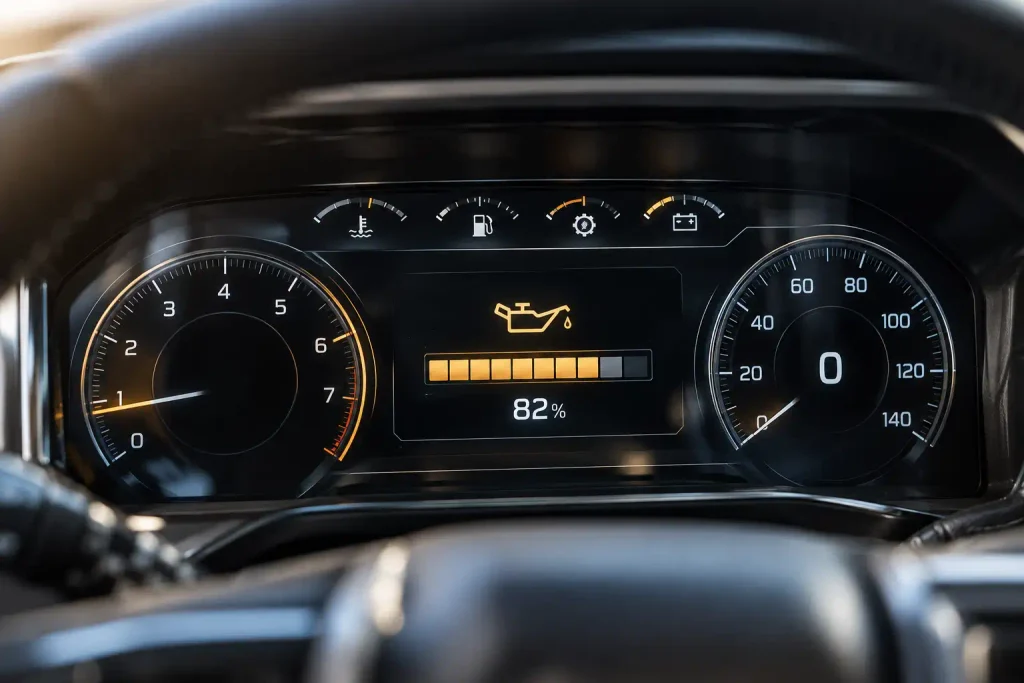
Perhaps the most polarizing engineering decision within the Hurricane’s architecture is the complete eradication of the traditional mechanical oil dipstick. Stellantis has transitioned entirely to an ultrasonic oil level sensor mounted vertically in the bottom of the oil pan.
This telemetry-based system is designed to enhance customer convenience, projecting real-time oil level readouts directly onto the infotainment display. The ultrasonic sensor features integrated temperature sensing, allowing the Engine Control Unit (ECU) to dynamically calculate volume changes caused by thermal expansion.
However, this decision has drawn intense scrutiny from service technicians and truck purists. Technicians note that in the event of sensor calibration errors—a phenomenon documented in similarly equipped European vehicles—the digital readout may falsely report a low oil condition, prompting owners to drastically overfill the crankcase. Furthermore, Stellantis engineers have confirmed that the ultrasonic sensor measures only fluid volume and temperature; it is entirely incapable of detecting fluid contamination, such as antifreeze intrusion from a blown head gasket or fuel dilution. Consequently, owners must rely entirely on secondary mechanical symptoms to diagnose fluid mixing, lacking the immediate visual and olfactory confirmation a traditional dipstick provides.
| Maintenance Task | 3.0L Hurricane SO Requirement | Engineering Justification |
| Engine Oil Type | SAE 0W-20 Full Synthetic (API SP/GF-6A) | Withstands high thermal loads of twin turbochargers; prevents pre-ignition. |
| Oil Capacity | 7.5 Quarts (7.1 Liters) | High volume required for continuous turbo bearing lubrication. |
| Oil Level Check | Digital via Infotainment Screen | Ultrasonic pan sensor replaces traditional dipstick. |
| Engine Air Filter | Inspect/Replace frequently in dusty climates | Turbochargers ingest massive air volume; restrictions cause severe power loss and MPG drop. |
| Spark Plugs | Replace at 60,000 miles | High boost pressure erodes plug gaps quickly, causing misfires under load. |
Reliability Data and Early Field Analytics
Because the Hurricane powertrain was only recently introduced to the market in 2022, decadal longevity data does not yet exist. However, early field analytics, warranty claims, and master technician reports highlight several areas of operational focus:
- Carbon Accumulation on Intake Valves: The Hurricane SO relies exclusively on Gasoline Direct Injection (GDI); it does not utilize a supplementary Port Fuel Injection (PFI) system. In pure GDI engines, fuel is injected directly into the combustion chamber rather than the intake port. Consequently, the backs of the intake valves are never washed by solvent-rich gasoline. Over time, oil vapors routed through the Positive Crankcase Ventilation (PCV) system can bake onto the hot intake valves, creating hard carbon deposits. This coking can eventually restrict airflow, leading to rough idling, decreased fuel economy, and engine misfires. Preventative maintenance, including the use of high-quality synthetic oils and potential professional intake valve cleanings, may be necessary as mileage accrues.
- Peripheral Component Anomalies: Early production models have exhibited isolated peripheral failures, specifically regarding coolant thermostats sticking and disconnected EVAP purge lines. Stellantis has rapidly addressed these through technical service bulletins and over-the-air software patches.
- Widespread Seizure Claims are Statistically Unfounded: Despite hyperbole on social media platforms suggesting that Hurricane engines are suffering from mass catastrophic failures, rigorous data aggregation disproves this narrative. The current failure rate per 1,000 units is entirely consistent with the expected statistical variance for an all-new, highly complex forced-induction engine launch. There is no evidence of a systemic, recall-level mechanical design flaw leading to engine seizures.
Critical Reader Questions Answered
Does the 3.0L Hurricane SO require premium 91 octane gas?
Mechanically, the engine does not require premium fuel; it is completely safe to operate on regular 87 octane gasoline. The engine’s highly adaptive ECU utilizes acoustic knock sensors to detect the lower detonation threshold of 87 octane fuel. Upon detection, the computer instantaneously retards the ignition timing and limits the peak turbo boost to prevent pre-ignition and engine damage.
However, Stellantis officially states that 91 octane is “recommended”. By running 87 octane, the engine will not produce its advertised peak figures of 420 horsepower and 469 lb-ft of torque. While daily commuters will likely find the performance loss negligible, running 91 octane is highly recommended when towing heavy loads, operating in extreme ambient heat, or driving at high altitudes, as the engine requires the higher thermal stability of premium fuel to maintain performance under stress.
How does the Hurricane SO perform at high altitudes compared to the 5.7L HEMI V8?
Naturally aspirated engines like the 5.7L HEMI V8 suffer a volumetric efficiency loss of approximately 3% for every 1,000 feet of elevation gained due to decreasing atmospheric air density. The Hurricane SO, equipped with twin turbochargers, actively compensates for thin mountain air by spooling the turbos faster, forcing dense oxygen into the cylinders to meet its 22.4 PSI target boost. Consequently, a Ram 1500 equipped with the Hurricane SO will dramatically outperform a HEMI V8 at high altitudes, maintaining its 469 lb-ft of torque precisely where the naturally aspirated V8 experiences severe power degradation.
Is the PTWA cylinder block disposable, or can it be rebuilt?
A common misconception regarding modern aluminum blocks without cast iron liners is that they are disposable upon failure. This is inaccurate. The Plasma Transfer Wire Arc (PTWA) coating is highly durable, but if catastrophic scoring occurs, the block can be remanufactured. Specialized engine rebuilding facilities possess the robotic tooling to machine out the damaged PTWA layer and re-spray a new PTWA/RSW coating. This returns the cylinder bore to its exact factory dimensions, allowing the engine to be rebuilt using standard-sized pistons rather than requiring custom oversized components.
What is the Hurricane SO’s actual real-world towing fuel economy?
While the EPA estimates the Hurricane SO at 18 MPG city and 25 MPG highway (unloaded, 2WD), real-world towing efficiency varies based on load aerodynamics. When hauling trailers near the 10,000-pound maximum, the twin turbochargers remain in a state of continuous positive boost to maintain speed. Under sustained boost, the ECU must inject substantial volumes of fuel to prevent the air-fuel mixture from running dangerously lean. During independent testing, heavy towing MPG figures for the Hurricane closely mirror the consumption rates of the outgoing HEMI V8, though the Hurricane accomplishes the pull with significantly less effort and smoother power delivery.
Final Market Implications
The Stellantis 3.0L I6 Hurricane Standard Output Twin Turbo ESS engine represents a masterclass in modern thermodynamic engineering. By harmonizing innovations such as PTWA cylinder bore coatings, water-to-air charge cooling, and dynamic ECU timing management, Stellantis has produced a powertrain that successfully renders the legacy naturally aspirated V8 obsolete in both performance and unladen efficiency.
Generating an effortless 420 horsepower and 469 lb-ft of torque, the SO variant proves exceptionally versatile. It serves simultaneously as a 11,610-pound high-capacity towing platform in the Ram 1500 and a silent, refined powerhouse in the Jeep Grand Wagoneer. While the aggressive transition to fully digital telemetry (such as the ultrasonic oil sensor) and direct-injection-only fueling necessitates updated maintenance philosophies, the fundamental mechanical architecture of the Hurricane SO is undeniably robust. As the automotive market accelerates toward stringent emissions compliance, the Hurricane SO establishes a formidable new benchmark in the forced-induction inline-six sector.